
Author

admin

Browsing

Here’s a quick recap of the crypto landscape for Friday (November 21) as of 9:00 p.m. UTC.

Get the latest insights on Bitcoin, Ether and altcoins, along with a round-up of key cryptocurrency market news.

Bitcoin and Ether price update

Bitcoin (BTC) was priced at US$84,479.56, down by 2.4 percent over 24 hours. Its lowest price of the day was US$82,623.93, and its highest was US$85,341.10.

Bitcoin price performance, November 21, 2025.

Chart via TradingView.

Ether (ETH) was at US$2,736.67, down 3.8 percent over 24 hours. Its lowest price on Friday was US$2,685.25 and its highest was US$2,799.63.

Altcoin price update

  • XRP (XRP) was priced at US$1.94, down by 3.3 percent over 24 hours. Its lowest price of the period was US$1.89 and its highest was US$1.99.
  • Solana (SOL) was trading at US$127.23, down by 4.8 percent over 24 hours. Its lowest price of the day was US$124.20 and its highest was US$129.79.

Fear and Greed Index snapshot

CMC’s Crypto Fear & Greed Index plunged to 11, firmly in “extreme fear” and its lowest level since late 2022. Reports of large-scale whale liquidations have added to the uncertainty, amplifying pressure across an already fragile market.

CMC Crypto Fear and Greed Index, Bitcoin price and Bitcoin volume.

Chart via CoinMarketCap.

Crypto derivatives and market indicators

Open interest in Bitcoin futures declined slightly by 0.98 percent, settling at approximately US$58.67 billion, while Ether futures saw a larger drop of 2.50 percent, closing at US$32.39 billion. This contraction in open interest suggests some unwinding of speculative positions or reduced leverage in the derivatives markets for both leading cryptocurrencies.

Bitcoin experienced US$30.48 million in contracts being liquidated, predominantly short positions, whereas Ether had a slightly higher US$32.43 million liquidated, also mostly shorts. This contrasts with recent days, where the vast majority of liquidations were long positions, indicating a shift in market dynamics and trader positioning.

Bitcoin’s relative strength index was low at 31.32, signaling that it is nearing oversold territory, which can often precede a price rebound or a period of consolidation. Its funding rate was recorded at a modestly positive 0.003 percent, indicating a nearly balanced market where long traders pay a small premium to shorts, reflecting moderate bullish sentiment or mild cost for holding long perpetual contracts.

Ether’s funding rate was higher at 0.01 percent, suggesting stronger bullish positioning and higher demand for long exposure in Ether perpetual futures. Generally, positive funding rates imply that longs are paying shorts, signaling optimism about price appreciation. However, considering liquidations skewed toward shorts recently, this could reflect traders attempting to position for a reversal or hedging against potential volatility.

Today’s crypto news to know

Anchorage expands institutional custody and staking support

Anchorage Digital now supports full custody and staking for HYPE tokens across the Hyperliquid ecosystem. Institutions can custody HYPE on HyperEVM and stake on HyperCORE through Anchorage Digital Bank, the only federally chartered crypto bank in the US, as well as through Anchorage Digital Singapore and the self-custody wallet Porto.

Partnering with staking provider Figment, Anchorage now offers a regulated pathway for institutional participation in the Hyperliquid DeFi ecosystem. This expansion also includes custody for additional ERC-20 tokens like Kinetiq, enhancing institutional access to Hyperliquid’s fast-growing blockchain infrastructure.

Crypto lawyer seeks New York attorney general seat

Khurram Dara, a 36-year-old cryptocurrency lawyer with experience at Coinbase Global (NASDAQ:COIN) and Bain Capital Crypto, has announced his candidacy for attorney general in the state of New York.

Dara is seeking the Republican nomination to challenge the incumbent Democrat, Letitia James, in the 2026 election. Dara’s campaign focuses on ending what he calls ‘lawfare,’ the use of legal tactics for political gain, reducing regulatory overreach, especially in the crypto sector and fostering a more business-friendly environment in New York.

Dara holds a JD from Columbia Law and is affiliated with the Council on Foreign Relations and crypto advocacy groups. He resides in Brooklyn and will face Republican primary competition from Michael Henry.

BitMine reports strong earnings, plans Ether staking launch

BitMine Immersion Technologies (NYSEAMERICAN:BMNR) announced net income of US$328.2 million for its 2025 fiscal year, with fully diluted earnings per share of US$13.39.

The company also declared an annual dividend of US$0.01 per share, becoming the first large-cap crypto firm to pay a dividend. Notably, BitMine announced plans to launch its ‘Made-in-America Validator Network,’ an Ethereum staking infrastructure, in early 2026 with initial pilot partners selected for testing.

Coinbase rolls out Ether-backed loans

Coinbase has launched a new lending feature for eligible US users.

They will be able borrow up to US$1 million in USDC by using Ether as collateral. The product is integrated with the Morpho protocol on Base, though users interact with it entirely through Coinbase’s interface. Borrowers keep exposure to Ether’s price movements while accessing liquidity without having to sell their holdings.

The service is available across most US states, with the exception of New York due to regulatory requirements.

Securities Disclosure: I, Giann Liguid, hold no direct investment interest in any company mentioned in this article.

Securities Disclosure: I, Meagen Seatter, hold no direct investment interest in any company mentioned in this article.
This post appeared first on investingnews.com

Perth, Australia (ABN Newswire) – Locksley Resources Ltd (ASX:LKY,OTC:LKYRF) (FRA:X5L) (OTCMKTS:LKYRF) announced the appointment of Ms. Stacy Newstead to its Advisory Board as Strategic Advisor – Materials Strategy.

Stacy Newstead brings U.S. defense materials expertise to advance Locksley’s critical mineral and commercialisation initiatives.

HIGHLIGHTS

– Stacy Newstead appointed as a Strategic Advisor to the Locksley Advisory Board

– Ms Newstead currently serves as Materials Strategy and Risk Manager at Lockheed Martin, overseeing U.S. supply chain risk mitigation for critical materials used in advanced defence systems

– Over two decades of experience across defence, critical minerals, and advanced materials sectors, including leadership roles at Huntington Ingalls Industries, Textron Systems, and Evolution Energy Solutions –

– Expertise spanning U.S. Department of Defence acquisition, system manufacturing and production, materials engineering, supply chain risk mitigation, critical component supply chains, and state and federal engagement for manufacturing facilities

– Appointment strengthens Locksley’s U.S. Government initiatives and supports commercialisation of American-sourced antimony and rare earth supply chains

– Locksley has submitted U.S. Govt White Paper funding request under Defence Production Act Title III DPA to advance project financing position and accelerate first mover status in re-establishing domestic Antimony industry and U.S supply chain strength

Ms. Newstead currently serves as Materials Strategy and Risk Manager at Lockheed Martin, where she leads initiatives to secure domestic and allied sources of key materials vital to U.S. defense manufacturing and national security. Her work focuses on assessing and mitigating material, pricing, and geopolitical risk across complex supply chains that underpin critical technologies including munitions, batteries, and aerospace systems.

A highly accomplished executive, Ms. Newstead brings more than 20 years of experience across U.S. Government, defense, and industrial sectors. Her prior roles include senior program leadership at Huntington Ingalls Industries and Textron Systems, as well as Chief Executive Officer of the U.S. subsidiary of Evolution Energy Minerals (ASX:EV1), where she led onshoring initiatives for graphite and advanced battery materials.

Her appointment reinforces Locksley’s position at the intersection of critical minerals, defense, and national security strategy, providing invaluable insight into U.S. policy, funding and industrial collaboration opportunities. This strengthens the Company’s ability to engage with U.S. partners and access Federal programs supporting domestic critical mineral supply chains, advancing Locksley’s mine-to-market strategy for U.S.-sourced antimony and rare earths.

Kerrie Matthews, Locksley CEO commented:

‘Stacy’s appointment represents another significant step in strengthening our U.S. advisory capability. Her deep understanding of defense material supply chains, coupled with her leadership at Lockheed Martin, brings exceptional strategic value to Locksley as we advance our mine-to-market development of American sourced antimony and rare earths.’

‘Her perspective on material security and risk will help guide our engagement with U.S. industry and government stakeholders as we scale from pilot to commercial operations.’

Ms Newstead commented:

‘The restoration of secure, transparent and domestic critical mineral supply chains is essential to both U.S. defense readiness and the broader energy transition. Locksley’s integrated mine-to-market model and U.S. operational footprint, position it as a key contributor to these national objectives. I’m honored to support the team’s strategy and growth trajectory.’

About Locksley Resources Limited:

Locksley Resources Limited (ASX:LKY,OTC:LKYRF) (FRA:X5L) (OTCMKTS:LKYRF) is an ASX listed explorer focused on critical minerals in the United States of America. The Company is actively advancing exploration across two key assets: the Mojave Project in California, targeting rare earth elements (REEs) and antimony. Locksley Resources aims to generate shareholder value through strategic exploration, discovery and development in this highly prospective mineral region.

Mojave Project

Located in the Mojave Desert, California, the Mojave Project comprises over 250 claims across two contiguous prospect areas, namely, the North Block/Northeast Block and the El Campo Prospect. The North Block directly abuts claims held by MP Materials, while El Campo lies along strike of the Mountain Pass Mine and is enveloped by MP Materials’ claims, highlighting the strong geological continuity and exploration potential of the project area.

In addition to rare earths, the Mojave Project hosts the historic ‘Desert Antimony Mine’, which last operated in 1937. Despite the United States currently having no domestic antimony production, demand for the metal remains high due to its essential role in defense systems, semiconductors, and metal alloys. With significant surface sample results, the Desert Mine prospect represents one of the highest-grade known antimony occurrences in the U.S.

Locksley’s North American position is further strengthened by rising geopolitical urgency to diversify supply chains away from China, the global leader in both REE & antimony production. With its maiden drilling program planned, the Mojave Project is uniquely positioned to align with U.S. strategic objectives around critical mineral independence and economic security.

Tottenham Project

Locksley’s Australian portfolio comprises the advanced Tottenham Copper-Gold Project in New South Wales, focused on VMS-style mineralisation

Source:
Locksley Resources Limited

Contact:
Kerrie Matthews
Chief Executive Officer
Locksley Resources Limited
T: +61 8 9481 0389
Kerrie@locksleyresources.com.au

News Provided by ABN Newswire via QuoteMedia

This post appeared first on investingnews.com

Perth, Australia (ABN Newswire) – Altech Batteries Limited (ASX:ATC,OTC:ALTHF) (FRA:A3Y) (OTCMKTS:ALTHF) announced a significant and strategically important development in its Silumina Anodes(TM) project, following formal engagement initiated from a leading global battery manufacturer and one of the world’s largest electric-vehicle battery manufacturer (‘Battery Group’). The Battery Group approached Altech expressing strong interest in the Company’s proprietary high-performance silicon-enhanced anode technology. This unsolicited approach represents a major validation of the technical progress achieved by Altech and underscores the growing global recognition of the breakthrough potential of its alumina-coated silicon innovations.

Following initial discussions, a mutual Non-Disclosure Agreement (NDA) was executed to enable the confidential technical exchange and evaluation of materials. As part of this collaboration, Altech has prepared and supplied Silumina AnodesTM samples to the Battery Group. These samples, developed under the leadership of Altech’s Chief Technical Officer Dr Jingyuan Lui, have now been shipped to the Battery Group for formal testing in their advanced battery-evaluation laboratories in China.

The Battery Group’s team, during preliminary discussions, indicated that across the industry they have not yet seen silicon additions deliver such meaningful performance improvements at low percentages.

Traditionally, attempts to integrate silicon into commercial lithium-ion anodes have been challenged by expansion-related degradation, unstable solid-electrolyte interphase (SEI) formation and rapid cycle-life fade. The strong performance of Altech’s coated silicon, achieved with only modest silicon loading, was highlighted as particularly noteworthy. The Battery Group acknowledged that very few material suppliers globally are producing silicon additives with this level of stability, consistency, and real-world applicability.

This early feedback reinforces the technical advantage and disruptive potential of Altech’s process.

The Battery Group has also requested that Altech undertake coating trials on their supplied graphite material to assess the performance impact of integrating Altech’s proprietary alumina technology directly onto their own anode substrate. Under the NDA, the Battery Group has dispatched several kilograms of representative graphite samples to Altech’s Perth laboratory, where Dr Lui’s team will apply the Company’s coating process and prepare evaluation batches. These coated graphite samples will then be returned to the Battery Group for benchmarking against their internal standards, providing a direct comparison of how Altech’s technology enhances their preferred graphite formulations.

UPDATE OF LONG CYCLE SILUMINA TESTING

Altech announced on 9 October 2025 a major advancement in its Silumina Anodes(TM) project, achieving the strongest battery-cycling performance recorded to date for its proprietary alumina-coated spherical silicon anode material. Since that announcement, the latest test results now demonstrate an impressive 83% capacity retention after 1,000 charge-discharge cycles with a 5% Silumina Anodes(TM) addition to a standard graphite anode. This represents a significant milestone for the Silumina Anodes(TM) technology, confirming both its durability and real-world commercial potential. Importantly, such cycle-life performance places Altech’s material at the forefront of next-generation silicon-enhanced anode technologies, strengthening its position in the rapidly evolving global battery materials market.

HOW SILUMINA ANODES(TM) IS MADE

Altech’s spherisation process transforms irregular silicon particles into perfectly rounded, alumina-coated spheres that integrate seamlessly within graphite anodes. The process begins with submicron silicon powders that are uniformly coated with a nanolayer of high-purity alumina, buffering against volume expansion during lithiation. These coated particles are then spherified through a precision-controlled thermal and mechanical process that rounds their geometry (refer Figure 1*). When blended into the graphite matrix, the spherical Silumina AnodesTM particles naturally occupy microscopic voids, where they can expand and contract freely during cycling without damaging the surrounding structure (refer Figure 2*). This optimised configuration mitigates mechanical stress, maintains electrode integrity, and enhances electrical connectivity. With only a 5% addition, the design achieves >40% capacity boost while preserving exceptional cycle stability over extended use.

Altech’s Managing Director Iggy Tan stated ‘This engagement from the world’s largest battery manufacturer is a powerful validation of our Silumina Anodes(TM) technology. Their early feedback, particularly noting they have not seen silicon additions perform this effectively at such low levels, reinforces the significance of our breakthrough. We are excited to advance this collaboration under the NDA and look forward to demonstrating how Altech’s coating technology can further enhance their graphite and anode performance.’

*To view tables and figures, please visit:
https://abnnewswire.net/lnk/444MKKI0

About Altech Batteries Ltd:

Altech Batteries Limited (ASX:ATC,OTC:ALTHF) (FRA:A3Y) is a specialty battery technology company that has a joint venture agreement with world leading German battery institute Fraunhofer IKTS (‘Fraunhofer’) to commercialise the revolutionary CERENERGY(R) Sodium Alumina Solid State (SAS) Battery. CERENERGY(R) batteries are the game-changing alternative to lithium-ion batteries. CERENERGY(R) batteries are fire and explosion-proof; have a life span of more than 15 years and operate in extreme cold and desert climates. The battery technology uses table salt and is lithium-free; cobalt-free; graphite-free; and copper-free, eliminating exposure to critical metal price rises and supply chain concerns.

The joint venture is commercialising its CERENERGY(R) battery, with plans to construct a 100MWh production facility on Altech’s land in Saxony, Germany. The facility intends to produce CERENERGY(R) battery modules to provide grid storage solutions to the market.

Source:
Altech Batteries Ltd

Contact:
Corporate
Iggy Tan
Managing Director
Altech Batteries Limited
Tel: +61-8-6168-1555
Email: info@altechgroup.com

Martin Stein
Chief Financial Officer
Altech Batteries Limited
Tel: +61-8-6168-1555
Email: info@altechgroup.com

News Provided by ABN Newswire via QuoteMedia

This post appeared first on investingnews.com

Bitcoin and ether slumped to multi-month lows on Friday, with cryptocurrencies swept up in a broader flight from riskier assets as investors worried about lofty tech valuations and bets on near-term U.S. interest rate cuts faded.

Bitcoin, the world’s largest cryptocurrency, fell 5.5% to a seven-month low of $81,668. Ether slid more than 6% to $2,661.37, its lowest in four months.

Both tokens are down roughly 12% so far this week.

Cryptocurrencies are often viewed as a barometer of risk appetite and their slide highlights how fragile the mood in markets has turned in recent days, with high-flying artificial intelligence stocks tumbling and volatility spiking VIX.

“If it’s telling a story about risk sentiment as a whole, then things could start to get really, really ugly, and that’s the concern now,” Tony Sycamore, a market analyst at IG, said of the fall in bitcoin.

About $1.2 trillion has been wiped off the market value of all cryptocurrencies in the past six weeks, according to market tracker CoinGecko.

Bitcoin’s slide follows a stellar run this year that propelled it to a record high above $120,000 in October, buoyed by favourable regulatory changes towards crypto assets globally.

But analysts say the market remains scarred by a record single-day slump last month that saw more than $19 billion of positions liquidated.

“The market feels a little bit dislocated, a bit fractured, a bit broken, really, since we had that selloff,” said Sycamore.

Bitcoin has since erased all its year-to-date gains and is now down 12% for the year, while ether has lost close to 19%.

Citi analyst Alex Saunders said $80,000 would be an important level as it is around the average level of bitcoin holdings in ETFs.

The selloff has also hurt share prices of crypto stockpilers, following a boom in public digital asset treasury companies this year as corporates took advantage of rising prices to buy and hold cryptocurrencies on their balance sheets.

Shares of Strategy, once the poster child for corporate bitcoin accumulation, have fallen 11% this week and were down nearly 4% in premarket trade, languishing at one-year lows.

JP Morgan said in a note this week that the company could be excluded from some MSCI equity indexes, which could spark forced selling by funds that track them.

Its Japanese peer Metaplanet has tumbled about 80% from a June peak.

Crypto exchange Coinbase was down 1.9% in premarket trade and is on course for its longest losing streak in more than a month.

Crypto miners MARA Holdings and CleanSpark were down 2.4% and 3.6%, respectively, while the Winklevoss twins’ newly-listed Gemini has plunged 62% from its listing price.

“Bitcoin market conditions are the most bearish they have been since the current bull cycle started in January 2023,” said digital asset research firm CryptoQuant in its weekly crypto report on Wednesday.

“We are highly likely to have seen most of this cycle’s demand wave pass.”

This post appeared first on NBC NEWS

What began as a banner day for stocks turned into a major rout, as investors signaled ongoing skepticism about the longevity of the artificial intelligence boom and trimmed hopes of support from the Federal Reserve.

The tech-heavy Nasdaq fell 2%, and the broad S&P 500 index dropped by more than 1.5%. The Dow Jones Industrial Average, which tracks 30 top-tier stocks, declined by nearly 390 points. It had been up 700 points earlier in the day. Cryptocurrencies also shed billions in value: Bitcoin had fallen below $87,000 as of late Thursday afternoon, weeks after having set highs above $120,000.

The stunning turnaround added further unease to an already shaky economy that has forced households to trim budgets amid stubborn inflation and signs of a wavering job market. With an ever-increasing part of the economy’s principal driver — consumer spending — now reliant on affluent households, an extended market pullback could inflict wider damage.

‘You don’t have to have the biggest bubble in history for an expensive stock market’ and end up seeing declines, said Matt Maley, chief market strategist at Miller Tabak asset management group.

Traders’ hopes were boosted early Thursday by a better-than-expected jobs report that appeared to show the economy remained resilient. Even before the day began, stocks looked poised to rise after Nvidia, the chipmaker at the heart of the AI boom, reported strong quarterly earnings and revenue.

Yet by midday, markets had turned red. The solid September jobs report diminished the odds that the Federal Reserve will cut interest rates next month to lower the cost of borrowing money to spur economic activity. When investors don’t have to pay as much in interest, they often put those savings into stocks.

“The broad rebound in payrolls suggests diminished risks of a higher unemployment rate,” analysts with Morgan Stanley said in a note published shortly before noon. “We no longer expect a Fed cut in December.”

Losses were further compounded by ongoing concerns about AI — specifically, how much more profitable the companies buying chips like Nvidia’s will be. The fears were articulated Wednesday evening on X by Michael Burry, made famous by the movie ‘The Big Short.’

‘Just because something is used does not mean it is profitable,’ he wrote.

Finally, the ongoing sell-off of bitcoin indicated to some traders that a key source of support for stocks — retail or day traders — were beginning to waver on their trademark ‘buy the dip’ mentality.

‘I wouldn’t say we’ve flipped from bull to bear,’ said Steve Sosnick, chief strategist at Interactive Brokers financial group. ‘I would say we’ve flipped from bull to balanced market in the short term. A lot depends on whether sentiment continues to weaken.’

Stocks had already been showing signs of flagging in recent weeks. With Thursday’s losses, the S&P 500 fell to its lowest point since September.

The long-delayed September jobs report, which showed that the United States added a sturdy 119,000 jobs, appeared to show some glimmers of hope for the economy.

Although the unemployment rate ticked up from 4.3% in August to 4.4%, about 450,000 workers entered the labor force. Economists view that as evidence that job opportunities are still plentiful, despite a wave of corporate layoffs.

Just before the Bureau of Labor Statistics released the jobs report, Verizon told employees it planned to lay off 13,000 employees, or about 13% of its workforce.

The company joined a suite of other blue-chip employers that say they plan to eliminate tens of thousands of jobs, including Amazon, General Motors, IBM, Microsoft, Paramount, Target and UPS.

The details of the jobs report, which captured conditions before the government shutdown, as well more recent jobs data, suggested a more mixed picture for the U.S. economy.

Manufacturing shed 6,000 jobs, continuing a trend in a sector the Trump administration has touted as a key target of its economic policies. Transportation and warehousing also lost 25,300 jobs. Wage growth slowed, and job totals for July and August were revised downward.

The employment gains in September were concentrated in the health care, hospitality and social assistance sectors.

Another snapshot of the economy came courtesy of Walmart, which on Thursday reported strong sales and raised its outlook for the year. That strength points to cracks in the economy, though. Executives said the chain is luring more high-income shoppers who are looking for bargains, and noted that lower-income families are feeling more pressure.

‘As pocketbooks have been stretched, you’re seeing more consumer dollars go to necessities versus discretionary items,’ Chief Financial Officer John David Rainey said on an earnings call Thursday morning.

Walmart’s stock closed 6.5% higher.

This post appeared first on NBC NEWS

They could’ve avoided all this drama. Could’ve hired Lane Kiffin last year, and been a year ahead of the rebuild. 

Maybe even where Ole Miss is right now. 

If what should have been done last year at Florida was done immediately — Billy Napier fired, Kiffin hired — none of the crazy suffocating college football is playing out day after day.

The beauty of the College Football Playoff demolition derby is in full bloom, and the Heisman Trophy race — can you remember one with less juice? — would be at front of mind. 

Instead of where Kiffin, who has never won a Power conference championship, will coach in 2026 and be paid at the top of his profession.

Instead of Florida and LSU throwing around Monopoly money, desperately trying to recapture the magic of lost glory.

Instead of Florida, for the second time in four years, kicking a field goal in the second half of a blowout loss to extend its NCAA-record streak of avoiding a shutout. It was Tennessee last night, and Oregon State in Napier’s first season, and the record is now at 472 and counting.

But that Florida had to do it twice within the four-year Napier framework tells you all you need to know about the spectacular fail of a hire. 

Yet Florida athletic director Scott Stricklin doubled down last season after the Gators got hot and beat, ironically, LSU and Ole Miss. He ignored the obvious signs of ineptitude — too many to even explain now after the fact — and threw more good money after bad. 

If Stricklin makes the tough decision last fall, 2024 would’ve been the second-half collapse with an interim coach, and 2025 would’ve been Year 1 under Kiffin.

Think about the talented Florida roster with a coaching staff that includes Kiffin, offensive coordinator and quarterbacks coach Charlie Weis Jr. (who Napier tried to hire after the 2023 season), and former Florida coach Will Muschamp as defensive coordinator (he was interested in the DC job this season). 

It’s not a stretch to think Florida could be the team in the CFP hunt, not Ole Miss. Florida could be the team, organically built through high school recruiting and supplementing from the portal (the one thing Napier crushed), as the team no one wants to play in December.

Instead Florida sustained its first home loss to Tennessee since 2003, and worst loss to Tennessee since Steve Spurrier’s first season at Florida in 1990. And we’ll go through the next seven days — Rivalry Week, no less — debating what Kiffin will do and how it will impact three programs.

Ohio State vs. Michigan. Texas vs. Texas A&M. Georgia vs. Georgia Tech. Alabama vs. Auburn. Tennessee vs. Vanderbilt.

Significant games, with significant CFP impact. All overshadowed by the Kiffin decision.

If only what should’ve been done eventually was done immediately.

Matt Hayes is the senior national college football writer for USA TODAY Sports Network. Follow him on X at @MattHayesCFB.

This post appeared first on USA TODAY

  • Despite a previous blowout loss, the Texas Longhorns’ playoff hopes are not entirely extinguished.
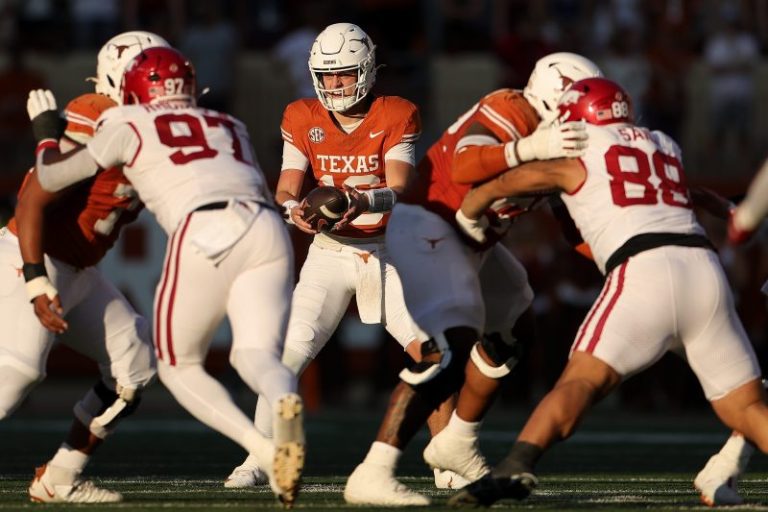
  • A decisive 52-37 victory over Arkansas, led by Arch Manning’s four touchdowns, keeps Texas in the conversation.
  • The team’s chances rely on a potential upset of undefeated Texas A&M and chaos among higher-ranked teams.

If you thought Texas’ blowout loss at Georgia served as a playoff extinction-level event, you’re confusing this 12-team bracket with a beauty contest.

It’s not.

At the tail end of the bracket, it could be much more of a they’d-do-in-a-pinch type of affair.

If the selection committee finds itself in a pinch in a couple of weeks, facing a dearth of beauties, well, Texas still lurks.

And if the Longhorns don’t look like a grand prize, just knock back a six-pack and flip on game film of this 52-37 rout of Arkansas. This didn’t look half bad.

Let’s not turn this result into more than it is. This win serves as a blowout of a bad team, an opponent with an interim coach, a rival that lost to playoff-bound Notre Dame by 43 points.

But, the Razorbacks have had a way about hanging close against SEC opponents, before ultimately losing, and Texas changed the script by burying the Hogs.

“The season’s not done,’ Texas coach Steve Sarkisian said afterward on ABC. ‘You never know what can happen.”

Don’t take this as me stumping for Texas’ playoff bona fides. I had an eyewitness view of the Longhorns’ fourth-quarter meltdown in Athens, Georgia. Sarkisian did my job for me when he called his team’s disintegration against Georgia ‘a disaster.’ Couldn’t have said it any better.

The Longhorns did not resemble a playoff team that night, much as it did not in a loss at Florida or in white-knuckle victories at Kentucky and Mississippi State.

Texas languishes on the road. It’s pretty good at home, and it boasts wins against Oklahoma and Vanderbilt, a pair of top-15 teams.

The committee suffers from an affliction known as recency bias. If Texas’ final trip down the catwalk before Selection Sunday is an upset of undefeated Texas A&M in primetime on Black Friday, well, let’s just say hold off on shoveling the dirt on this season.

‘All eyes will be on us,’ Sarkisian said. ‘We’ve got to go compete.”

Need I remind you the first-team-out last season was three-loss Alabama? If Texas reaches 9-3, it’ll tout a resume superior to that of the 2024 Tide.

Texas checked in at No. 17 in the latest CFP rankings. Its playoff hopes would benefit from a dash of chaos inflected upon teams ranked ahead of it. Southern California losing this weekend helps. Look for Texas to be ranked no worse than No. 15 in next week’s pecking order. Add in a victory against Texas A&M, and you never know. If the committee finds itself in a pinch, the Longhorns might look fine.

Blake Toppmeyer is the USA TODAY Network’s senior national college football columnist. Email him at BToppmeyer@gannett.com and follow him on X @btoppmeyer.

This post appeared first on USA TODAY

For much of the 2025 college football season, the Big 12 has been wildly unpredictable.

Though Texas Tech — with a 10-1 record and a 22-point win over its fellow first-place team BYU to its name — has established itself as the class of the conference, there was a packed cluster of teams behind the Red Raiders and Cougars entering Week 13 of the season, with four teams with two losses in league play.

This weekend offered some much-needed clarity.

While Texas Tech was enjoying its bye week, several other teams near the top of the conference standings either greatly enhanced their Big 12 championship game outlook or saw it get severely diminished.

No. 11 BYU went on the road and knocked off Cincinnati 26-14, improving the Cougars to 7-1 in conference play while knocking the Bearcats down to 5-3 and eliminating them from title game contention. No. 14 Utah kept its championship game and College Football Playoff dreams alive with a thrilling, come-from-behind 51-47 victory against Kansas State.

Arizona State stayed among the group of two-loss teams in Big 12 play by thumping Colorado 42-17 while No. 24 Houston missed what would have been a game-tying kick in the final minute in a 17-14 loss to TCU, knocking the Cougars out of the Big 12 championship race.

Barring massive upsets next week, with Texas Tech playing 4-7 West Virginia and BYU taking on 5-6 UCF, it will be a rematch between the Red Raiders and Cougars with a conference championship on the line.

So where do things stand now?

Here’s a look at the Big 12 standings after Week 13:

Big 12 football standings after Week 13

Here’s a full look at the Big 12 football standings after Week 13:

  • T-1. Texas Tech (10-1, 7-1 Big 12)
  • T-1. BYU (10-1, 7-1)
  • T-3. Utah (9-2, 6-2)
  • T-3. Arizona State (8-3, 6-2)
  • T-5. Houston (8-3, 5-3)
  • T-5. Arizona (8-3, 5-3)
  • T-5. Cincinnati (7-4, 5-3)
  • T-8. Iowa State (7-4, 4-4)
  • T-8. TCU (7-4, 4-4)
  • T-8. Kansas State (5-6, 4-4)
  • T-11. Baylor (5-6, 3-5)
  • T-11. Kansas (5-6, 3-5)
  • T-13. UCF (5-6, 2-6)
  • T-13. West Virginia (4-7, 2-6)
  • 15. Colorado (3-8, 1-7)
  • 16. Oklahoma State (1-10, 0-8)
This post appeared first on USA TODAY

Instead of providing answers, Week 13 of the college football season brought more confusion for the Atlantic Coast Conference standings.

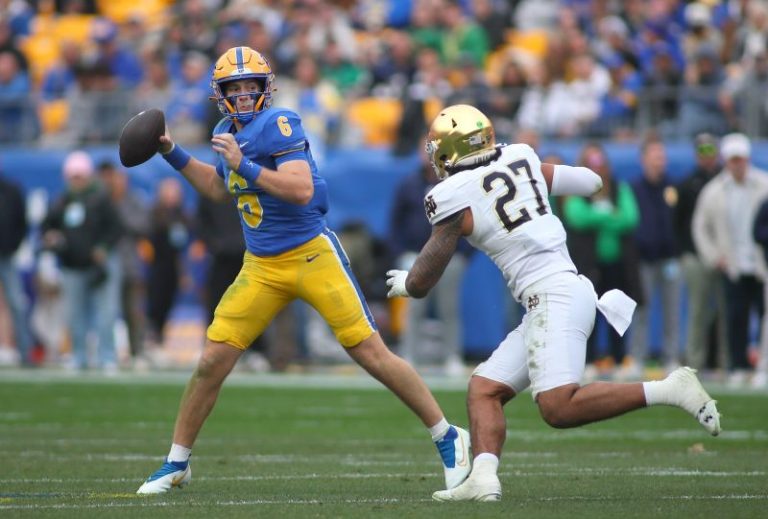
With Pittsburgh pulling off the 42-28 upset win over No. 12 Georgia Tech, the final week of the regular season will determine who is headed to the ACC championship game on Saturday, Dec. 6, in Charlotte, North Carolina.

If the Yellow Jackets had beaten the Panthers on Saturday, Nov. 22, they would have clinched a spot in the championship game. Instead, Pitt now needs to beat Miami — and needs one of SMU or Virginia to lose in Week 14 — to get into the conference title game. All three teams enter the final week with one ACC loss.

Meanwhile, two-loss teams Georgia Tech, Miami and Duke all remain alive, but will need serious help to have a chance to get to the championship game.

Here’s a look at the ACC standings after Week 13:

ACC football standings after Week 13

Here’s a full look at the ACC standings after Week 13 of the college football season.

  • T-1. Southern Methodist (8-3, 6-1 ACC)
  • T-1. Pittsburgh (8-2, 6-1 ACC)
  • T-1. Virginia (9-2, 6-1 ACC)
  • T-4. Georgia Tech (8-2, 5-2 ACC)
  • T-4. Duke (6-5, 5-2 ACC)
  • T-4. Miami (9-2, 5-2 ACC)
  • 7. Wake Forest (8-3, 4-3 ACC)
  • 8. Clemson (6-4, 4-4 ACC)
  • 9. Louisville (7-4, 4-4 ACC)
  • T-10. California (6-5, 3-4 ACC)
  • T-10. North Carolina State (6-5, 3-4 ACC)
  • 11. Stanford (4-7, 3-5 ACC)
  • T-12. Virginia Tech (3-8, 2-5 ACC)
  • T-12. North Carolina (4-7, 2-5 ACC)
  • 15. Florida State (5-6, 2-6 ACC)
  • 16. Syracuse (3-8, 1-6 ACC)
  • 17. Boston College (1-10, 0-7 ACC)
This post appeared first on USA TODAY