
Author

admin

Browsing

Coinbase Global (NASDAQ:COIN) said on Tuesday (September 16) that it is rolling out rewards on USD Coin (USDC) balances for Canadian users, offering returns of up to 4.5 percent

This marks the first time Canadians can automatically earn interest-like payouts simply by holding USDC on the platform. Coinbase customers in Canada will receive 4.1 percent annualized rewards on their USDC, paid weekly.

Members of Coinbase One, the company’s subscription service, can boost the rate to 4.5 percent on up to US$30,000 in holdings, while any amount above that earns the base 4.1 percent.

There are no lockups or opt-ins required, and users retain full access to withdraw or spend their USDC at any time.

USDC is a stablecoin that is pegged 1:1 to the US dollar and backed by reserves of cash and short-term US treasuries held with regulated institutions. Unlike volatile cryptocurrencies such as Bitcoin, stablecoins are designed to maintain price stability, making them more suitable for payments, savings and yield-generating products.

Angus Reid research conducted for Coinbase in August 2024 shows 83 percent of Canadians believe the global financial system needs an overhaul, while 91 percent think domestic banks prioritize profits over customers’ financial wellbeing.

Coinbase’s Canadian rollout builds on the company’s November 2024 introduction of USDC rewards through Coinbase Wallet, with a 4.7 percent annual yield offered to global users.

At the time, the company highlighted USDC’s utility in combining “the stability of the U.S. dollar with the power and speed of the internet,” enabling instant, borderless transactions.

“Along with earning rewards, you can send USDC on Base instantly and with zero fees,” Coinbase said when it launched the wallet-based program last year, noting that payouts would be deposited monthly into user accounts.

That feature was made available across most regions, including the US.

The wallet program also builds on another strategic advantage of stablecoins: cross-border efficiency. Transactions conducted on blockchain networks like Base, Coinbase’s Ethereum Layer 2 chain, are settled in real time, which means the fees and delays associated with traditional payment rails are sidestepped.

The Canadian launch arrives as stablecoins gain momentum in mainstream finance. Companies including Visa (NYSE:V), PayPal Holdings (NASDAQ:PYPL) and a growing number of fintech platforms have announced integrations in the past year, allowing users to pay, settle or transfer value using tokens like USDC and Tether’s USDT.

Coinbase is betting that frustration with legacy systems, combined with the appeal of higher yields and fast payments, will be enough to tip more users toward digital assets.

Securities Disclosure: I, Giann Liguid, hold no direct investment interest in any company mentioned in this article.

This post appeared first on investingnews.com

Laramide Resources (TSX:LAM,ASX:LAM,OTCQX:LMRXF) announced that it has identified multiple target areas for a 15,000 meter drill program at its Chu-Sarysu project in Kazakhstan.

Uranium remains the company’s primary focus, but the asset is also prospective for rare earths and copper.

“This inaugural exploration program for Laramide in Kazakhstan is targeting high-grade, large-scale uranium deposits, amenable to cost-efficient and environmentally responsible in-situ recovery mining, and within a district that already hosts infrastructure and producing operations, which provides clear cost advantages,” said President and CEO Marc Henderson in a press release shared on Monday (September 15).

Situated in the Suzak District of the South Kazakhstan Oblast, Chu-Sarysu is located in one of Kazakhstan’s main uranium-producing basins. The country accounted for almost 40 percent of global U3O8 production in 2024, with the Chu-Sarsyu and neighboring Syr Darya basins contributing over 75 percent of the nation’s output.

Chu-Sasryu is Laramide’s only asset outside the US and Australia, and forms part of Laramide’s three year option agreement to acquire shares of Kazakh company Aral Resources. The agreement closed in December 2024, and Laramide has the option to acquire all of Aral’s shares and gain full ownership of the project.

As part of its efforts, Laramide has compiled a large dataset from Kazakhstan’s state National Geological Services with assistance from local geological contractors over the past year.

“We have found the Kazakhstan Government to be supportive of mineral exploration with policies that encourage foreign investment and streamline permitting,” Henderson added. “This creates a favourable environment for advancing new discoveries that can ultimately contribute to the growing global demand for nuclear fuel.”

Laramide submitted the required exploration work plans to Kazakhstan’s Ministry of Industry and Construction this year, and the remaining permits for drilling are currently being finalized.

Phase 1 of drilling is expected to begin toward the end of 2025.

Securities Disclosure: I, Gabrielle de la Cruz, hold no direct investment interest in any company mentioned in this article.

This post appeared first on investingnews.com

Investor Insight

Green Technology Metals aims to build Ontario’s first integrated lithium business, developing two mining hubs and a downstream conversion facility to supply North America’s fast-growing EV and battery industry. The company’s approach is straightforward: bring Seymour into production, secure the downstream footprint at Thunder Bay with EcoPro, and then layer in Root as a long-life second feed. The plan is underpinned by offtake agreements, government funding and a management team with direct experience building lithium mines.

Overview

Green Technology Metals (ASX:GT1) is building Ontario, Canada’s first integrated lithium business, anchored by three upstream assets and a planned downstream conversion facility. The portfolio consists of the flagship Seymour project, the large-scale Root lithium project, and the Junior exploration project, which together provide a clear pipeline of feed into a proposed lithium hydroxide facility in Thunder Bay, Ontario.

The company is actively leveraging Canadian policy support for critical minerals development and supporting a growing number of EV and battery manufacturers in Ontario. The province’s Building More Mines Act, alongside several federal programs, is creating a supportive funding environment for new projects. GT1 has already received conditional approval for C$5.5 million from the Critical Minerals Innovation Fund (CMIF) to support road and infrastructure upgrades at Seymour. In addition, the company has received a letter of intent for a C$100-million project financing support from Export Development Canada, and has pending applications with SIF/NRCan and CMIF Round 2, including a C$5-million submission tied to the Root project. These mechanisms substantially de-risk the financing path and provide tangible momentum toward development.

The strategy is being executed in three phases. First, Seymour will be brought into production with a concentrator based on a dense media separation flowsheet, taking advantage of coarse spodumene mineralogy and proven metallurgical performance. Second, GT1 will construct the Thunder Bay lithium conversion facility in partnership with EcoPro Innovation, replicating proven hydrometallurgical technology to produce battery-grade lithium hydroxide. Finally, Root will be developed as the company’s second, larger mining hub, designed to provide long-life scale and additional feed into the Thunder Bay facility.

Pilot processing of 600 kg of Seymour concentrate produced exceptional overall recoveries averaging >94 percent.

Strategic partnerships reinforce this integrated model. LG Energy Solution has secured a binding offtake for a portion of Seymour’s concentrate production and has invested directly into GT1, providing early validation of the project’s place in the EV supply chain. EcoPro Innovation, as the company’s technical partner on the Thunder Bay facility, has already piloted Seymour concentrate into high-purity lithium hydroxide.

Company Highlights

  • Integrated strategy in Ontario: The Seymour and Root projects form the foundation for a vertically integrated lithium business, supported by a proposed lithium hydroxide plant in Thunder Bay, Ontario, with rail, port, power, gas and water access.
  • Marketing and offtake secured: LG Energy Solution has a binding offtake for 25 percent of Seymour concentrate and has invested directly into the company, demonstrating strong downstream demand.
  • Strategic process partner: EcoPro Innovation is co-developing the conversion facility. Pilot work has already produced battery-grade lithium hydroxide with high recoveries.
  • Government backing: GT1 has secured conditional approval for significant funding programs, including C$5.5 million for road upgrades, a C$100 million project financing support LOI from EDC, and additional CMIF and SIF applications.
  • Resource base: A combined inventory of over 30 Mt @ ~1.2 percent lithium oxide across Seymour and Root, providing both near-term production and long-life scale.
  • By-product upside: Seymour hosts a significant rubidium resource in mica streams that could be recovered alongside lithium, creating an additional revenue line.

Key Projects

Seymour Lithium Project

The Seymour lithium project, near Armstrong, Ontario, contains a total resource of 10.3 million tonnes (Mt) @ 1.03 percent lithium oxide, including 6.1 Mt indicated @ 1.25 percent lithium oxide. Mineralization is hosted in the North and South Aubry pegmatites, which remain open along strike and at depth. An optimized preliminary economic assessment (PEA) demonstrated strong project economics based on a DMS-only concentrator producing 130 ktpa. Key numbers include a C1 cash cost of US$680/t, an after-tax NPV of US$251 million, an IRR of 33 percent, and a three-and-a-half-year payback.

The project benefits from existing road and rail access, low strip ratios, and simple metallurgy with coarse spodumene that responds well to dense medium separation (DMS). Mining leases were granted in August 2025, the environmental assessment submission has been lodged, and the closure plan is nearing completion.

An offtake agreement with LG Energy Solution secures sales for 25 percent of initial concentrate production. Seymour also includes a maiden rubidium resource (8.3 Mt @ 0.27 percent rubidium oxide, with a 3.4 Mt high-grade core at 0.40 percent), which can be recovered from mica streams already separated in the flow sheet, creating potential for a by-product circuit.

Thunder Bay Lithium Conversion Facility

GT1 and EcoPro Innovation are developing a lithium hydroxide monohydrate facility in Thunder Bay. The selected site is fully serviced with rail access, 44 kV power, municipal water and gas, and port facilities. The plant will replicate EcoPro’s operating hydromet trains, with two parallel ~13 ktpa back-end lines designed to scale with Seymour and Root concentrate supply.

Pilot-scale processing of 600 kg of Seymour concentrate at EcoPro’s Pohang facility achieved battery-grade lithium hydroxide, meeting downstream specifications with >94 percent overall recovery. This demonstration significantly de-risks the conversion step and supports ongoing financing discussions with Invest Ontario, SIF and EDC. The project is being advanced through PFS-level engineering, with permitting and JV structuring underway.

Root Lithium Project

Located in Northwestern Ontario, Root is GT1’s scale project, hosting 14.6 Mt @ 1.21 percent lithium oxide (10.0 Mt Indicated @ 1.32 percent). The April 2025 optimized PEA outlined a combined open-pit and underground mining scenario producing ~213 ktpa. The project carries a C1 cost of ~US$677/t, an after-tax NPV of US$668 million, an IRR of 53.5 percent, and a three-year payback.

Root enjoys outstanding infrastructure advantages: road and rail access, proximity to port, and most critically, grid hydro power delivered by the Watay transmission line, reducing both operating costs and upfront capex for power infrastructure. Drilling has confirmed stacked pegmatite bodies that remain open along strike and down dip, leaving scope for significant resource expansion. A bulk sample has been completed, with further testwork and pilot runs at EcoPro planned. Permitting is in its early stages, with a PFS targeted for 2026 and potential construction by late 2027.

Junior Lithium Project

The Junior project is located near Seymour and contains three drill-ready targets. Its proximity to the planned Seymour concentrator makes it a strategic satellite project, with the potential to extend Seymour’s mine life and provide incremental feed. Drilling is expected to test these targets in upcoming campaigns, potentially increasing the overall feed available for the Seymour hub.

Management Team

John Young – Non-executive Chairman

John Young co-founded Pilbara Minerals and played a key role in transforming it into a multi-billion-dollar lithium producer. His background as a geologist spans more than three decades, with significant contributions across discovery, development and financing of lithium and gold projects. At GT1, Young provides strategic oversight and proven operational expertise to scale a lithium developer into a fully integrated producer.

Cameron Henry – Managing Director

Cameron Henry was appointed managing director in June 2024, stepping up from his earlier role as executive director. A founder and substantial shareholder of GT1, Henry has over 20 years’ experience in minerals processing and project delivery. Prior to GT1, he built Primero Group into a respected global leader in lithium infrastructure EPC, successfully executing major projects in Australia and globally. His role is to drive Seymour into production and to lead the execution of the Thunder Bay downstream strategy.

Patrick Murphy – Non-executive Director

Patrick Murphy brings nearly two decades of experience in resource sector investment and deal-making. He has held senior positions at Macquarie and AMCI Group, with expertise in capital deployment, project financing and strategic partnerships. His presence on GT1’s board ensures strong connectivity to the financial community and a disciplined approach to structuring project funding.

Robin Longley – Non-executive Director

With more than 30 years of experience in exploration and project evaluation, Robin Longley is a seasoned geologist who has led successful exploration and development programs across lithium, gold and other critical minerals in Australia, Canada and Africa. His practical technical knowledge and management experience strengthen GT1’s ability to evaluate and expand its Ontario portfolio.

Han Seung Cho – Non-executive Director

Representing EcoPro Innovation, Han Seung Cho serves as a direct link between GT1 and its strategic partner on the Thunder Bay conversion facility. As general manager of EcoPro’s strategic business team, he brings decades of experience in lithium procurement, downstream offtake structuring, and project development for LHM plants. His position ensures that GT1’s downstream ambitions remain closely aligned with end-user requirements in the battery sector.

This post appeared first on investingnews.com

LimeWire, the filesharing service that set the internet ablaze in the 2000s before being shut down for copyright infringement, said Tuesday that is acquiring the rights to Fyre Festival.

And it appreciates the irony.

‘LimeWire Acquires Fyre Festival Brand — What Could Possibly Go Wrong?’ the company titled its news release.

LimeWire said it would “unveil a reimagined vision for Fyre — one that expands beyond the digital realm and taps into real-world experiences, community, and surprise.” The company offered no additional details about how the Fyre brand will be relaunched.

For years, LimeWire operated as a competitor to fellow file-sharing platform Napster before being effectively shut down by a court ruling in 2010 after a judge ruled it had facilitated large-scale copyright violations. In 2022, Austrian brothers Julian and Paul Zehetmayr bought LimeWire’s intellectual property and turned it into an NFT service.

Fyre Festival was a 2017 music festival that saw ticket buyers spend thousands of dollars for a weekend in the Bahamas only to be met with a logistics debacle that included portable bathrooms taking the place of regular toilets, and low-budget food options that betrayed promises of celebrity chef fare. Organizer Billy McFarland was later convicted of fraud and sentenced to six years in prison.

“Fyre became a symbol of hype gone wrong, but it also made history,” LimeWire CEO Julian Zehetmayr said. “We’re not bringing the festival back — we’re bringing the brand and the meme back to life. This time with real experiences, and without the cheese sandwiches.”

LimeWire said its bid was backed by Maximum Effort, the creative agency co-founded by the actor and entrepreneur Ryan Reynolds.

“Congrats to LimeWire for their winning bid for Fyre Fest,” Reynolds said in the release. “I look forward to attending their first event but will be bringing my own palette of water.”

This post appeared first on NBC NEWS

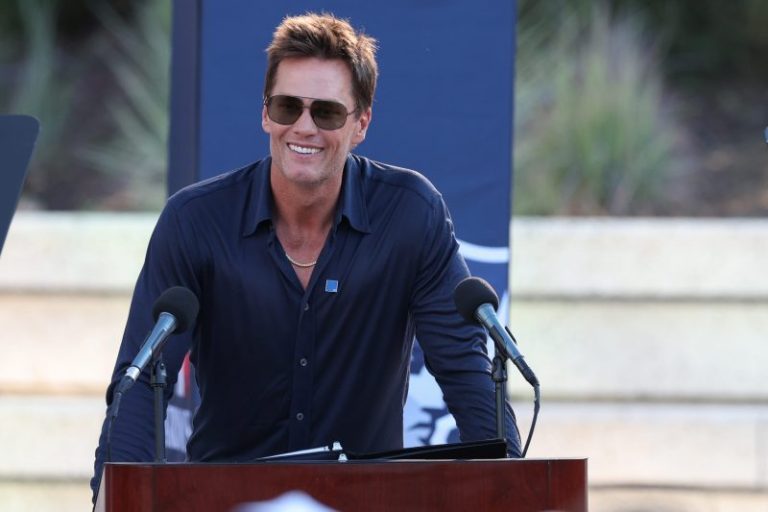
You couldn’t keep Tom Brady off the football field forever.

The seven-time Super Bowl champion quarterback’s post-playing days have treated him nicely. Brady quickly found a spot in the broadcast booth with FOX, serving on the network’s top team as an analyst. He continued to increase his influence by acquiring an ownership stake in the Las Vegas Raiders.

Now Brady is dusting off the cleats to play in the Fanatics Flag Football Classic, according to a statement obtained by USA TODAY Sports on Monday.

“I couldn’t be more excited to return to the field, get the competitive juices flowing alongside some of the game’s brightest stars and iconic legends, and bring a truly unique global sports event to fans everywhere during Riyadh Season,’ Brady said about his return to football.

Flag football is set to debut as a new event at the 2028 Summer Olympics in Los Angeles and continues to increase in popularity. Brady, who retired in 2023, will play a key role in the upcoming tournament.

‘I have always admired the power of flag football and how it connects fans of all ages, and it’s awesome to be able to showcase the sport on such a global stage while joining together so many incredibly skilled athletes,’ Brady added. ‘I’m looking forward to partnering with Turki Alalshikh, Fanatics, OBB Media, my team at Shadow Lion and my friends at FOX Sports to showcase some fierce competition. And I will be bringing home the trophy.’

The competitive flag football tournament is set to take place on March 21, 2026 in Riyadh, Saudi Arabia at the Kingdom Arena. It features a star-studded list of NFL players who will participate.

Saquon Barkley, CeeDee Lamb, Christian McCaffrey, Sauce Gardner, Myles Garrett, Brock Bowers, Maxx Crosby, Tyreek Hill, Odell Beckham Jr. and Rob Gronkowski are among the participants for the three teams of eight players. The format is a round-robin tournament, with the top two teams competing for a championship.

Additional players will be announced in the coming months. According to the statement, those players will be from across the sports and entertainment industries.

Sean Payton, Kyle Shanahan and Pete Carroll are set to serve as the coaches for the teams.

While the focus remains squarely on Brady’s return to football, he isn’t ready to commit to playing the Olympics just yet.

‘We’ll see,’ Brady told reporters when asked if he would play in the 2028 games. ‘Let’s see how this game goes.’

Brady also pointed out that he thinks there will be plenty of interest in the event going forward.

‘I think there’s a lot of people gonna want to be involved in the Olympics, especially because football players have never had an opportunity to do that,’ Brady said. ‘It’s quite a ways away. I think for me it’s just exciting, I still love throwing the football.’

This tournament follows Olympic-style flag football rules, the statement indicates. Games will be played on a 50-yard field with two 10-yard end zones, a 5-on-5 format and two 20-minute halves.

All the action is set to be broadcast on FOX Sports and Tubi, Fox’s free streaming service, with more details being revealed in the coming months.

This post appeared first on USA TODAY

  • Joe Burrow has won the NFL Comeback Player of the Year award twice due to multiple significant injuries in his career.
  • Burrow’s latest toe injury is expected to sideline him for a minimum of three months, impacting the Bengals’ season.
  • The Bengals have allocated a large portion of their salary cap to Burrow and his top wide receivers.

“I wouldn’t say this is necessarily an award you want to be nominated for two times,” Burrow said while holding the trophy at the NFL Honors in New Orleans. “But I’m proud of the work that I put in to come back from these injuries that I seem to face every year.”

It was somewhat of a sobering reminder of the string of injuries Burrow’s endured during his career.

Burrow suffered a season-ending knee injury that limited him to 10 games his rookie year. He won his first comeback player of the year award and led the Bengals to a Super Bowl 56 appearance the following season. In 2023, he sustained a season-ending wrist injury in Week 11. The very next year Burrow led the league is passing yards and touchdown passes.

Joe Burrow injury timeline dates back to before his rookie season

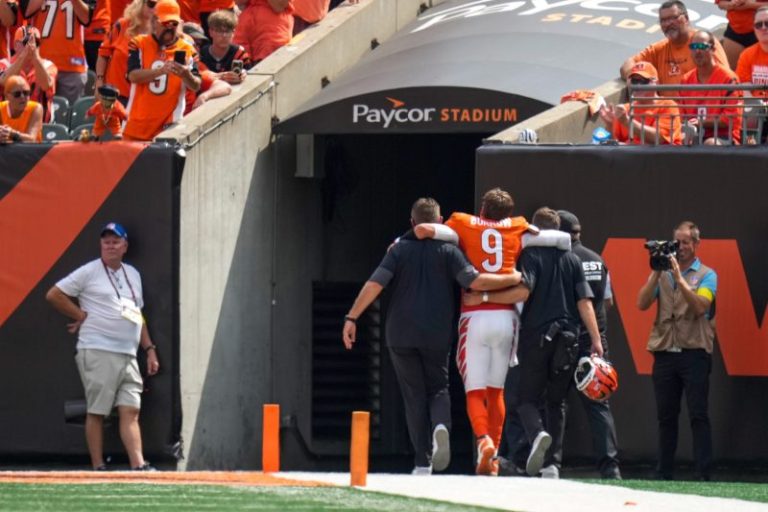
Season six for Burrow. It’s a toe injury that’s expected to require surgery. He’ll miss a minimum of three months.

It’s not quite a season-ending injury, but it might be. The best-case scenario has Burrow returning around mid-December.

Burrow’s injury is a brutal blow for a 2-0 Bengals team with Super Bowl aspirations. But the Bengals and Burrow both share some culpability with the predicament they are in.

The Bengals acquiesced to Burrow’s public plea to re-sign wide receivers Ja’Marr Chase and Tee Higgins to lucrative deals. They are the highest-paid receiver duo in the NFL. Combine Burrow’s five-year, $275 million deal that he signed in 2023, the Bengals are allocating approximately $124 million a year for three players. Bengals brass even agreed to give defensive end Trey Hendrickson a revised one-year contract after some nudging from Burrow.

The Bengals’ choice to pay Burrow, Chase, Higgins and Hendrickson at the top of the market for their respective positions has handicapped the team’s ability to build around them.

Safety Jessie Bates and running back Joe Mixon were on Cincinnati’s squad that advanced to Super Bowl 56. They are no longer in town.

The Bengals have also not been able to effectively protect Burrow throughout his career. According to ESPN research, the Bengals pass block win rate has ranked 27th in the NFL or worst since Burrow entered the league in 2020.

Burrow was sacked a league-high 51 times in 2021. He’s been sacked at least 41 times in every season he’s played at least 16 games. Some of the sacks are on Burrow. He does have a tendency at times to hold onto the football in an attempt to extend plays, though, the O-line has routinely been among the league’s worst units.

After the Bengals made Burrow their top pick in the 2020 draft, the team selected Higgins the very next round (33 overall) instead of building upfront with a player like guard Robert Hunt who went No. 39 overall. Hunt was elected to the Pro Bowl last year.

The Bengals used their first-round pick on Chase instead of tackle Penei Sewell in the 2021 draft. Chase and Sewell are both All-Pros.

Granted, the Bengals did select tackle Amarius Mims in the first round of the 2024 draft and recently signed veteran guard Dalton Risner. The jury is still out on Mims.

But the Bengals invested heavily on quarterback and wide receiver. The rest of the roster has holes. The holes are glaring on defense and along the offensive line. Burrow’s injury is a cumulative effect of that.

Follow USA TODAY Sports’ Tyler Dragon on X @TheTylerDragon.

This post appeared first on USA TODAY

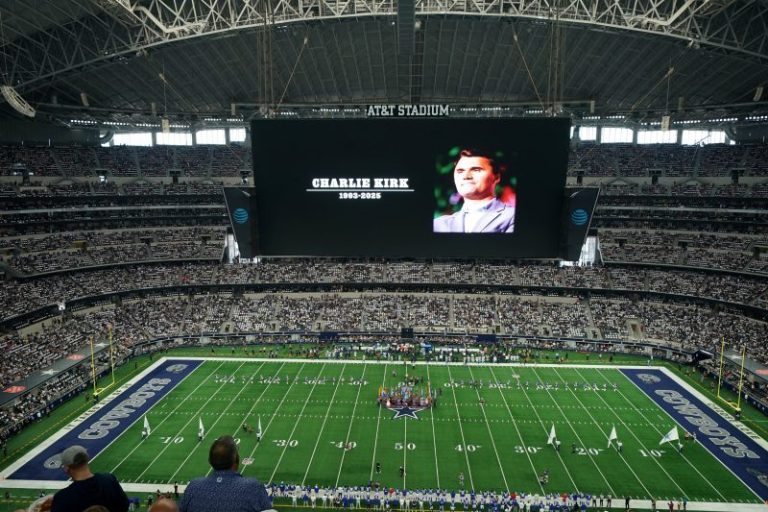
  • Several major sports leagues and teams held moments of silence for conservative commentator Charlie Kirk following his death.
  • Sports are often seen as a unifying force in society, but these memorials widened national divisions, Armour writes.
  • The White House commended the sports organizations for honoring Kirk, stating the tributes reflected admiration for his work.

In our most troubled, turbulent times, sports have been our healer. They’ve been a source of comfort and unity, one of the few places we know we’ll find common ground with our fellow Americans.

Not this past weekend, however.

With their moments of silence for Charlie Kirk, the NFL, NASCAR, New York Yankees, Chicago Cubs and some college football teams chose to glorify someone whose career was built on driving this country apart.

One of the beauties of sports is the idea that they are the great equalizer. Your color, gender, sexual orientation, how much money you have — it all becomes irrelevant when you step on the field. It’s your physical skill, determination and ability to play well with others that matters.

It’s why parents put their kids in sports at an early age, to help teach them the life lessons of commitment, cooperation and resilience. It’s why many of us continue to play as adults, a means of connecting with people we might otherwise not.

And it’s why we’re drawn to sports in the worst of times. They are our communal bond, a reminder that we’re stronger together than apart. They offer us a way to move forward — if we want it.

“The U.S. could learn a lot from our locker room. I think the people in this world could learn a lot from our locker room. You walk into our locker room, and you’ve got guys of different races, guys of different backgrounds, different religions. And you’ve got a team that loves each other,” Oregon coach Dan Lanning said when he was asked about Kirk’s killing after Saturday’s game.

“Tons of differences, tons of differences. Where they come from, what they deal with. And, ultimately, you’ve got a team that loves each other,” Lanning said. “I think we’re missing some of that in our country.”

It cannot be one-sided, however, and that’s why the memorials to Kirk were so problematic.

Kirk did not simply disagree with people who looked, loved and believed differently than he did. He demonized and ridiculed them and did what he could to make their lives hell.

He denied the intelligence of former First Lady Michelle Obama and Supreme Court justice Ketanji Brown Jackson, among other rivals, saying that the Black women lacked the “brain processing power to otherwise be taken really seriously. You had to go steal a White person’s slot.”

He said the Civil Rights Act was a “huge mistake.”

Kirk pushed for women to return to the stereotypical, stifling roles of the 1950s, telling Taylor Swift after she got engaged that she should “submit” to her husband. He also told the billionaire pop star, recognized as both one of the best songwriters of her generation and the savviest businesswoman, that “you’re not in charge.”

Kirk mocked Islam, promoted the racist Great Replacement theory, opposed same-sex marriage and said some gun deaths were “worth it” to preserve the Second Amendment. He said then-President Joe Biden should be “put in prison and/or given the death penalty for his crimes against America.”

(It’s telling that none of the tributes to Kirk included things he actually said.)

And though Kirk styled himself as a champion of free speech, he created an enemies list of college professors he disagreed with. The harassment some of these educators were then subjected to was so bad they feared for their safety. He proclaimed to be a Christian, yet too many of his words and deeds were the exact opposite of what Christ preached.

This brand of ugliness is tearing our country apart, and everyone — Democrat or Republican, red state or blue state — should be condemning it at full throat. Instead, Kirk was treated like a venerable statesman before several sporting events over the weekend.

‘These tributes reflect the widespread admiration for Kirk’s dedication to inspiring the next generation of American Patriots,’ the White House said in a statement Monday. ‘We commend these organizations for honoring a figure who championed the values that unite us all, and we join the nation in celebrating his legacy.’

The White House, and Kirk’s followers, see him in a way so many others do not. In a way that does not reflect what he actually stood for. The tributes and public memorials might have comforted his followers, but the same cannot be said for the rest of the country.

Sports has the power to bridge our country’s divides. These memorials to Kirk at sporting events only served to widen them.

Follow USA TODAY Sports columnist Nancy Armour on social media @nrarmour.

(This column has been updated with additional information.)

This post appeared first on USA TODAY

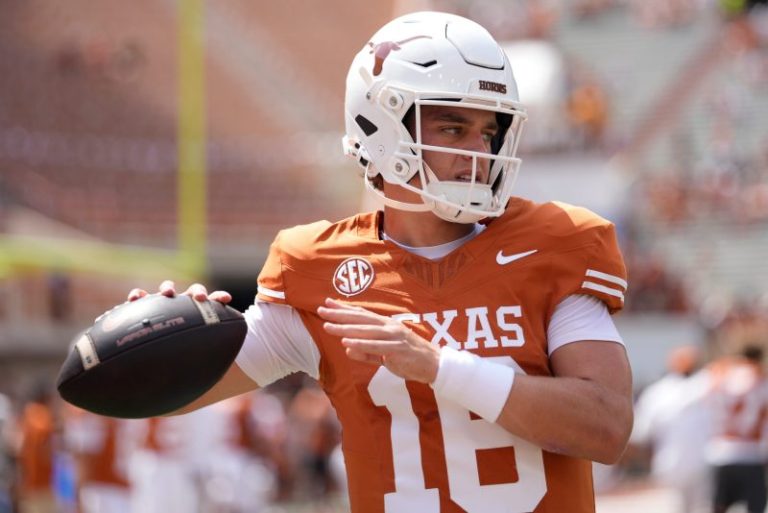
The Arch Manning era at Texas has gotten off to a rocky start, but the quarterback vows he and the Longhorns will improve.

‘I know the type of player that I am,’ Manning said on Monday, Sept. 15. ‘I know I’m going to play better and we’re going to be better as an offense.’

All of the buzz and excitement surrounding Manning has turned into frustration and concern in Austin as the preseason Heisman Trophy candidate hasn’t met the lofty expectations set on him. He struggled in the season opener against Ohio State and was able to shake off a shaky start against San Jose State in Week 2, although coach Steve Sarkisian had to downplay rumors his quarterback was injured.

The narrative didn’t get better in Week 3 against UTEP. Manning and Texas struggled against the Miners; he was 5-for-16 with 69 yards and an interception in the first 30 minutes, including 10 consecutive incompletions as he was unable to hit his receivers. Boos rained down in DKR-Texas Memorial Stadium as the team went into halftime with a 14-3 lead.

Manning finished 11-for-25 passing for 114 yards − a career low in games he has started − with one touchdown and an interception. 

It has caused worry as the No. 7 Longhorns wrap up non-conference play and prepare for an SEC schedule that includes Florida, Oklahoma, Vanderbilt, Georgia and Texas A&M. Texas will play 0-3 Sam Houston at home on Saturday, Sept. 20.

‘It’s frustrating because I know I’m better than that,’ Manning said. ‘But you know, we’re going to be better this week and get clicking on offense. I’m excited to get going.’

Sarkisian had a similar belief in Manning. After he said his quarterback played ‘athlete football’ against UTEP, Sarkisian said he expects Manning is ‘going to right this ship quickly.’

‘I think you learn a lot about yourself through adversity and overcoming adversity,’ Sarkisian said. ‘To have some of this adversity that he has right now, and when he gets on the other side of it, I think all of this is going to serve not only well for him but well for us as a team. Love the challenge for him.’

The 2-1 Longhorns host the Bearkats at DKR-Texas Memorial Stadium at 8 p.m. ET.

This post appeared first on USA TODAY

Here’s a quick recap of the crypto landscape for Monday (September 15) as of 9:00 p.m. UTC.

Get the latest insights on Bitcoin, Ethereum and altcoins, along with a round-up of key cryptocurrency market news.

Bitcoin and Ethereum price update

Bitcoin (BTC) was priced at US$115,303, a 0.3 percent decrease in 24 hours. Its lowest valuation of the day was US$114,509, and its highest was US$115,549.

Bitcoin price performance, September 15, 2025.

Chart via TradingView.

CrypNuevo projects that Bitcoin may dip to US$112,000 to US$113,000 this week before presenting new swing long opportunities in altcoins like Chainlink and Ripple. Profit taking on Bitcoin longs is planned to start around US$119,200, anticipating market volatility and liquidity shifts around the US Federal Reserve’s meeting.

Ether (ETH) was priced at US$4,494.71, a decrease of 2.6 percent over the past 24 hours. Its lowest valuation on Monday was US$4,476.73, and its highest was US$4,538.16.

Altcoin price update

  • Solana (SOL) was priced at US$232.85, a decrease of 4 percent over the last 24 hours. Its lowest valuation on Monday was US$230.63, and its highest level was US$236.56.
  • XRP was trading for US$2.99, down by 1.4 percent in the past 24 hours, and at its lowest valuation of the day. Its highest value for Monday was US$3.03.
  • SUI (Sui) was valued at US$3.49, down by 5.6 percent in the past 24 hours. Its lowest price point of the day was US$3.47, and its highest price was US$3.53.
  • Cardano (ADA) was priced at US$0.8594, down by 3.3 percent over 24 hours. Its lowest valuation on Monday was US$0.8548, and its highest was US$0.8679.

Today’s crypto news to know

Bitcoin ETF inflows fuel bets on Q4 rally

Spot Bitcoin exchange-traded funds (ETFs) in the US have seen a staggering US$2.3 billion in inflows over the past week, a sign that institutional demand is surging just ahead of a critical Fed interest rate decision.

Traders widely expect the central bank to cut rates on Wednesday (September 17), a move that could boost risk assets across the board. Analysts say that Bitcoin, which has slipped nearly 8 percent since peaking at US$124,128 in August, may be poised for another leg higher if liquidity conditions ease.

“We’re only halfway through what could be a very powerful Q4 rally,” said Sean Dawson, head of research at Derive, who projects Bitcoin could reach US$140,000 by year end. Options data shows heavy positioning at US$140,000 to US$200,000 December calls, with some putting cycle tops as high as US$250,000 if flows persist.

PayPal plans crypto integration

PayPal (NASDAQ:PYPL) has introduced PayPal links, personalized one-time links generated within the PayPal app that can be shared via text, email or chat. According to the company, the move will make it more convenient for users to send digital currencies like Bitcoin, Ether and PYUSD to PayPal and its sister service, Venmo.

PayPal links will initially launch in the US, with plans to expand to the UK, Italy and other markets later this year.

Robinhood to launch venture fund for retail investors

Robinhood Markets (NASDAQ:HOOD) has filed with the US Securities and Exchange Commission to launch a venture fund accessible to retail investors, according to a Monday company announcement. The fund would offer exposure to startup and private company investments, opportunities typically restricted to institutions.

“For decades, wealthy people and institutions have invested in private companies while retail investors have been unfairly locked out. With Robinhood Ventures, everyday people will be able to invest in opportunities once reserved for the elite,” said Robinhood Chairman and CEO Vlad Tenev.

The announcement highlights the disparity in investment opportunities for retail and institutional investors, explaining that the fund, Robinhood Ventures Fund I (RVI), would address this by expanding access to the private market.

This initiative builds on Robinhood’s previous launch of private tokenized stocks in the EU, which allows US retail investors to participate in private markets and gain exposure to companies before they go public. RVI plans to invest long term in a focused portfolio of private companies across various sectors.

Base teases native token launch and Solana bridge

Coinbase Global’s (NASDAQ:COIN) Layer 2 blockchain, Base, teased the potential launch of a native token at its BaseCamp event, a major event for the network. While details have not been confirmed, the news hints at a possible governance or utility token to expand Base’s ecosystem and incentivize user participation.

“As we begin this exploration, we’re sharing this shift in philosophy early as part of our commitment to building in the open, but we have no definitive plans to share at this time,” the company said following the event.

During the announcement, Base also shared that an open-source bridge to connect Base and Solana is in progress; it would enable cross-chain interoperability between the two ecosystems. Base also discussed new tools to support developers and users, including Base Batches 002 to help transform projects from concept to launch, and a Base Build dashboard designed to help builders scale and monetize their work.

France threatens to block EU crypto license “passporting”

France’s financial regulator is raising the stakes in Europe’s battle over crypto oversight, warning it could block firms licensed in other EU countries from operating domestically. According to a Reuters exclusive, the Autorité des Marchés Financiers (AMF) says some companies are “shopping around” for jurisdictions with looser standards under the bloc’s new MiCA framework, then using those approvals to “passport” their services across the EU.

Alongside Italy and Austria, France is pressing for the European Securities and Markets Authority to take charge of supervising major crypto players. AMF Chief Marie-Anne Barbat-Layani described the potential rejection of EU licenses as an “atomic weapon” that Paris could wield if it sees regulatory gaps.

Analysts worry fragmented national approaches could undermine investor protection and financial stability.

Notably, exchanges like Coinbase and Gemini have already secured MiCA licenses in Luxembourg and Malta, raising questions about uneven enforcement across the bloc.

Ethereum Foundation pivots to privacy-first roadmap

The Ethereum Foundation, a non-profit organization that supports Ethereum and related technologies, has unveiled a new initiative to make privacy a default feature across the blockchain’s ecosystem.

Rebranding its Privacy & Scaling Explorations team as the “Privacy Stewards of Ethereum,” the foundation has laid out plans for private transfers, confidential DeFi and protected governance mechanisms within the next six months.

“Our vision is to make privacy on Ethereum the norm rather than the exception,” the group said in a statement, arguing that users and institutions will otherwise drift to centralized alternatives. The roadmap also extends beyond transactions, with proposals to embed privacy in wallets, identity tools, and data portability.

Co-founder Vitalik Buterin has long championed stronger safeguards. His recent comments about risks from artificial intelligence-driven data leakage have reinforced the urgency of integrating privacy at the protocol level.

Securities Disclosure: I, Giann Liguid, hold no direct investment interest in any company mentioned in this article.

Securities Disclosure: I, Meagen Seatter, hold no direct investment interest in any company mentioned in this article.
This post appeared first on investingnews.com

  • ESPN announcer Chris Fowler sounded unwell during the beginning of the ‘Monday Night Football’ broadcast.
  • Fowler’s voice appeared to improve as the first quarter of the Raiders-Chiefs game progressed.
  • The announcer has had a busy schedule between his college football and US Open responsibilities.

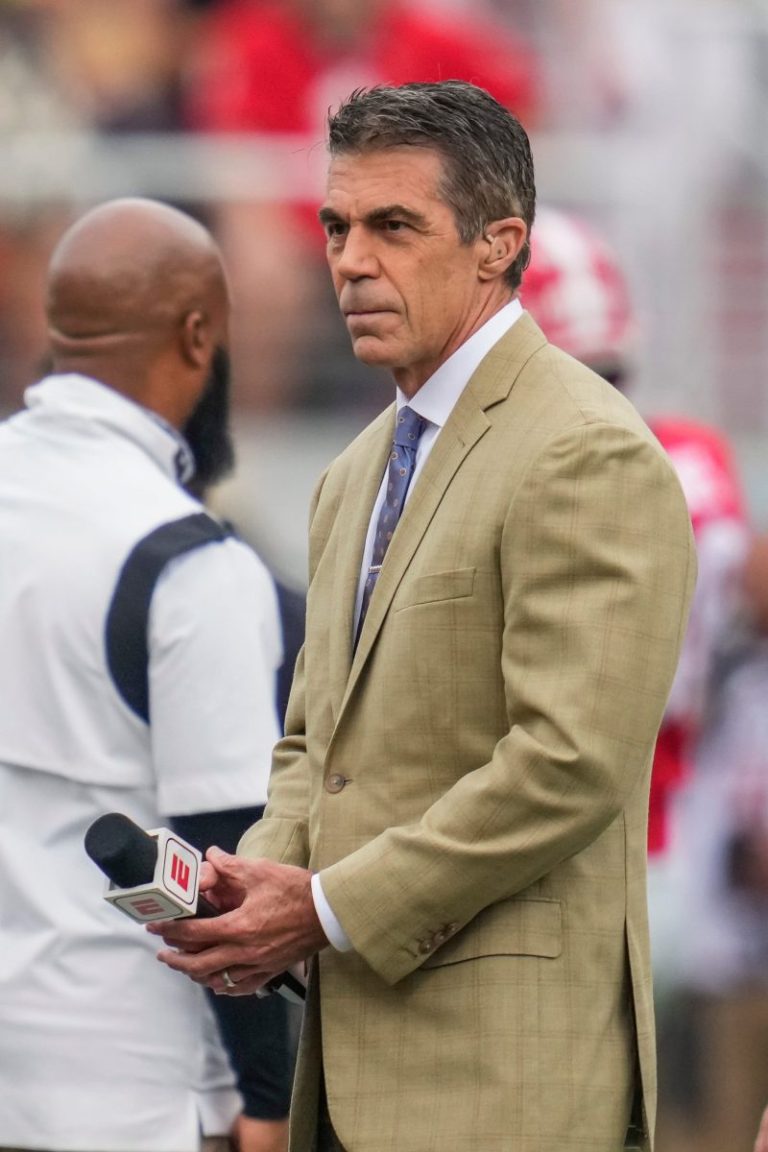
The nightcap of the Week 2 ‘Monday Night Football’ doubleheader featured ESPN announcer Chris Fowler on the mic flanked by analysts Louis Riddick and Dan Orlovsky.

Fowler, the network’s top voice on college football but has added the NFL to his portfolio as ESPN’s acquired more standalone games, didn’t sound like himself during the opening. His voice improved during the first quarter, but observers noted he sounded under the weather 48 hours after he and Kirk Herbstreit called Georgia’s victory over Tennessee.

It has been a busy month for Fowler. In addition to his weekly college football responsibilities, he is the main voice for the US Open, a competition that kept him busy during the end of August and beginning of September.

Chris Fowler schedule

The US Open ran from Aug. 24-Sept. 7. While Fowler wasn’t on the call every day (Saturdays, for example), he worked plenty of match days, including the men’s final on Sept. 7.

That was right after flying overnight from Oklahoma-Michigan during Week 2 of college football. In Week 1, he called LSU-Clemson. And on Saturday Sept. 13, he had the Georgia-Tennessee top-15 matchup, which went into overtime.

All to say Fowler has been quite occupied over the last few weeks.

This post appeared first on USA TODAY