Author

admin

Browsing

It was a full day of winners’ bracket action in the Little League World Series on Monday, Aug. 18.

Every team that took the field in Williamsport, Pennsylvania, sported at least one victory in the 2025 tournament, and those teams squared off during a slate of four games.

The action on Day 6 began with Venezuela, representing the Latin America region, blanking Japan 4-0 in an International bracket game. The second International game featured the same 4-0 scoreline with Chinese Taipei (Asia-Pacific region) beating Aruba (Caribbean region).

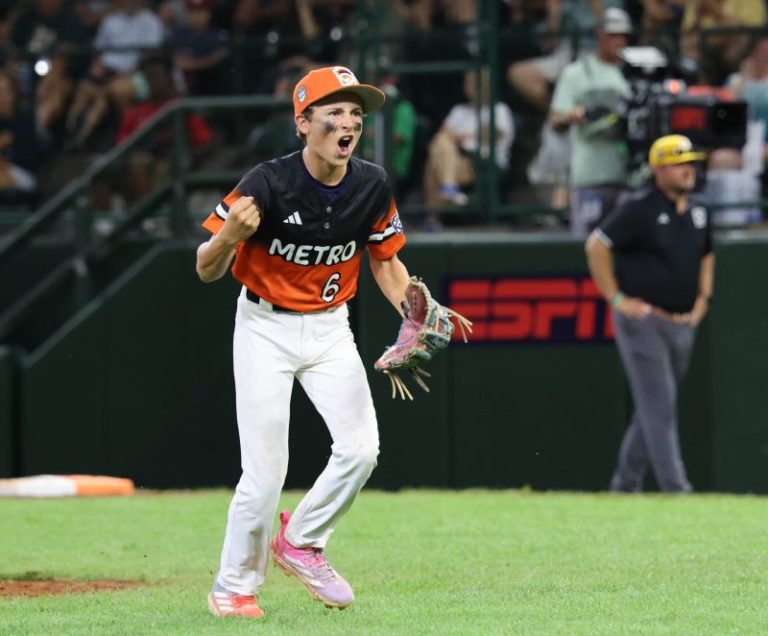
In the U.S. bracket, the Mountain region team from Nevada needed an extra frame to beat South Carolina (Southeast region) 1-0 in seven innings. And in the nightcap, a close game early became a huge rout late as Connecticut (Metro region) poured it on to beat South Dakota (Midwest region) 13-1.

The losers of Monday’s games will now come back and play on Tuesday, Aug. 19, while the winners get a day off before their next games.

Little League World Series Day 6 scores

  • Game 21 (International): Venezuela (Latin America) 4, Japan 0
  • Game 22 (U.S.): Nevada (Mountain) 1, South Carolina (Southeast) 0
  • Game 23 (International): Chinese Taipei (Asia-Pacific) 4, Aruba (Caribbean) 0
  • Game 24 (U.S.): Connecticut (Metro) 13, South Dakota (Midwest) 1

FINAL: Connecticut 13, South Dakota 1

Luca Pellegrini threw a two-hitter and struck out six, giving up just an unearned run in six innings, while the Connecticut bats turned a 1-0 deficit into a 13-1 rout in the final three innings to remain undefeated in the 2025 tournament. South Dakota took an 1-0 lead in the first inning and held it through three innings before the Fairfield National LL bats came to life with runs in the fourth, fifth and sixth innings. Tommy D’Amura went 2-for-3 with a triple and three RBIs, and Jimmy Taxiltaridis went 2-for-2 with a double and two RBIs to lead Connecticut.

Connecticut turns close game into huge rout

Connecticut ballooned its lead to 13-1 over South Dakota in the top of the sixth inning, using seven singles, a double and five walks. South Dakota recorded the first out of the inning before Fairfield National LL loaded the bases. Tommy D’Amura then drove in two runs with single to right, while Jimmy Taxiltaridis followed up with an RBI single to center.

Things didn’t get any easier for South Dakota after that. Dante Madera and Ben Herbst each hit RBI singles before Boden Dunlap plated two more with a double to right to make it 10-1. The 11th run scored on a bases-loaded walk, and Charlie McCullough plated run No. 12 with a line drive to right before another bases-loaded walk brough home the 13th run. South Dakota used a total of four pitchers in the inning before finally getting the final out

Pellegrini stays under pitch limit

It’s been tough for South Dakota to get through Connecticut starter Luca Pellegrini. If they could just force him out of the game via the pitch count, maybe they’d stand a better chance of winning this game. However, the fifth inning did not go exactly to plan for South Dakota.

Yes, they had two hitters reach base via walks, but Pellegrini is still eight pitches under the limit, meaning he’ll be able to return to the mound for the sixth inning. South Dakota is down to their final three outs as we head to the sixth inning. Connecticut leads 3-1.

Colin Curley’s double doubles Connecticut’s lead

Nursing a one-run lead, Connecticut’s Colin Curley thought his team could use a little more. Curley laced a two-out shot down the left field line, driving in Ben Herbst and extending Connecticut’s lead to two runs. While Curley would not come around to score, a two-run lead in what has primarily been a pitcher’s duel could wind up being the difference maker in this game. South Dakota heads to the plate with six outs to spare and two runs to make up.

Tony D’Amura ties game with a triple

Despite a tremendous effort from Bohde Larson in center field, laying out to try to make the catch, the ball found the ground. The outstretch Larson had a tough time getting up as well, allowing D’Amura to reach third with a triple.

The hit scored Logan Gryga from second base, tying this game up. Immediately afterwards, Jimmy Taxiltaridis would smoke a hard grounder to third. South Dakota third baseman Devin Aukes could not make the play, allowing D’Amura to score the go-ahead run.

South Dakota gets ahead early

The bottom of the first inning was filled with close calls that nearly ended the inning for Connecticut. With two outs, a close play at first nearly ended the inning, but instead, both the ball squirted away from first, allowing runners to advance.

That was followed up with a laser shot to center field from Kenson Henderson, just out of the reach of the diving center fielder, Dante Madera. That scored the first run of the game and put runners at second and third for Landon Vavruska. Although Vavruska would strike out looking on a full count, the damage had been done. South Dakota heads into the second inning up 1-0.

FINAL: Taipei 4, Aruba 0

A tremendous pitching effort from Taipei’s staff practically sealed the deal in this game. All in all, Taipei would record 13 strikeouts, meaning only five outs came from batted balls. It’s tough to score runs when your team doesn’t make contact and Aruba learned that the hard way.

Aruba ended the day with just three hits, which isn’t bad when considering that Taipei only recorded four hits. However, the big difference were the walks. Taipei tallied five walked in the first 3.1 innings alone, while Aruba could only muster two walks all day.

Taipei’s win will match them up with Venezuela for a journey to the international championship match on the line. Aruba, meanwhile, will take on Canada in a win-or-go-home contest tomorrow.

Taipei doubles their lead again

After being held scoreless in the third, Chinese Taipei made sure to tack on two runs in the fourth, courtesy of a single from Lai Yu-Han.

Despite two runs already coming across this inning, there remains only one out with a runner on first for Jian Zih-De.

Taipei pitcher has eight strikeouts through three innings

In the previous game, both starters had double-digit strikeouts. However, their impressive numbers might get blown out of the water if Taipei pitcher Liu Wei-Heng keeps this up. Through three innings, Wei-Heng has struck out eight batters, while surrendering only two hits.

Wei-Heng is also on pace to finish the game at 84 pitches as well, which would be under the pitch limit. While 16 strikeouts would not be the record − 22 by Taipei’s Chin-Mu Hsu, 1971 − it would certainly be a statement figure that should scare every other team in the international bracket.

Taipei extends lead in second

After a strategic run in the first, Taipei leaned on raw power to score their second. With only one out, Chen Shi-Hong lifted a high fly ball to deep left field. The ball was misplayed by the left fielder Emerson Mercado, allowing Shi-Hong to coast into second with a double, and scoring Jian Zih-De.

Delayed steal winds up scoring for Taipei

With runners at first and second and only one out, Taipei made a bold move, having Tsai Yu-Ge steal third on a delay. The throw was close, but Yu-Ge’s leg just barely got in before the tag.

Aruba pitcher Jayderick Wederfoor would end up striking out the batter, but the final strike would get by the catcher, allowing Yu-Ge to score. Without that delayed steal, Taipei would still be tied, but instead, they head to the bottom of the first up 1-0.

FINAL: Nevada 1, South Carolina 0

Nevada knew they needed to outlast Giulietti to give themselves the best chance to win. Finally, in the seventh inning, after Giulietti was forced out, Nevada didn’t just pick up their first hit, they picked up their second and the game-winning run.

With two outs and a runner in scoring position, Cutter Ricafort smacked a single to right field. The ball was misplayed by right fielder Ryder Tillitz, allowing Griffin Vargas to score from second. After six no-hit innings, South Carolina comes up heartbreakingly short, falling 1-0.

Nevada’s next game will be Wednesday, August 20, against the winner of the other U.S. game happening today. Meanwhile, South Carolina moves to the loser’s bracket and will face Hawaii tomorrow.

D’Ambrosio clutches up

After South Carolina bunted the ghost runner over to third to start the top of the seventh, D’Ambrosio faced the tall task of trying to hold that runner. He did just that, striking out both Brody Miller and Ryder Tillitz to end the inning.

D’Ambrosio’s excitement was evident, as he bounced off the mound, shouting the whole way to the dugout. Nevada needs just one run to take this game home. In fact, two sacrifice bunts could win Nevada the game without recording a single hit. Wouldn’t that be something?

We’re headed to extras

Giulietti had just 11 pitches to work with in order to push this game to extra innings. After falling behind 3-1 to the first batter of the inning, Giulietti bounced back to strike out two of the three hitters he faced and was never forced out of the game, meaning we are heading to extras for the first time in the 2025 LLWS.

Giulietti unfortunately may not earn the win despite throwing a no-hitter, but his effort will not go unnoticed. Regardless, this game just became that much more important for South Carolina as a loss would force the team to play several games in the loser’s bracket before Giulietti can return to the mound on Saturday.

D’Ambrosio avoids trouble

With Gallegos out, Luke D’Ambrosio needed to shut the door to give his team a shot at winning before heading into extras. With two outs, South Carolina reached base via an infield single and a walk, putting the go-ahead run in scoring position. D’Ambrosio came through though, striking out Brady Westbrooks to return his team to the dugout with a chance to win.

Obviously, it will be tough to score right now for Nevada. South Carolina pitcher Joe Giulietti still has 11 pitches to work with and has only allowed one baserunner, via a walk. However, if Nevada can waste a few pitches and force Giulietti out, perhaps they’ll gain the advantage they’ve been searching for all game.

Gallegos out, D’Ambrosio in for Nevada

After five and one-third stellar innings for Gallegos, Nevada is swapping pitchers, opting for Luke D’Ambrosio instead.

Gallegos did well to limit this South Carolina squad, tossing 58 of 85 pitches for strikes, and holding the Southeast reps to just five hits and one walk while striking out 12. The game remains scoreless, but Gallegos will be unavailable to pitch until Saturday, which might not be a big issue if Nevada wins here, but a loss in this game could be a big problem as Nevada would be forced to trudge through the loser’s bracket without their ace.

No-hitter still alive for South Carolina’s Joe Giulietti

Giulietti can thank his shortstop, Preston Ware, from not panicking after initially muffing a ball hit to him. Ware calmly gathered the ball and threw to first to beat the runner. No-hit is still alive and Giulietti picked up his 10th strikeout – so now both starting pitchers have over 10 strikeouts in the game. Still scoreless after five innings.

Have a day, Garrett Gallegos

South Carolina has peppered Gallegos for five hits, but none of them have turned into runs yet. Conversely, Gallegos is stopping South Carolina with strikeouts (12 to be exact). We are scoreless after the top of the fifth inning.

Still scoreless between South Carolina and Nevada

South Carolina and Nevada have put together one of the best games of the Little League World Series this year. Through four innings, we are scoreless in large part due to both starting pitchers. Nevada’s Garrett Gallegos has scattered four hits, allowed one walk but more importantly has 10 strikeouts to keep South Carolina off the scoreboard. Meanwhile, South Carolina’s Joe Giulietti has matched that performance with four shutout innings and has allowed only one walk and has struck out nine Nevada batters.

We officially have a pitcher’s duel between South Carolina and Nevada

We’ve seen very few baserunners so far today. South Carolina’s Joe Giulietti has faced seven batters and has four strikeouts. Nevada’s Garrett Gallegos has faced nine batters and has four strikeouts. We are scoreless after two innings.

Scoreless after one inning

Nevada’s Garrett Gallegos and South Carolina’s Joe Giulietti each faced four batters in the first inning. Giulietti had to throw 26 pitches though compared to Gallegos’ 16 pitches. No score after one inning.

South Carolina vs Nevada up next in the LLWS

South Carolina (1-0), which defeated last year’s LLWS champion in the Southeast Region, plays its second game in Williamsport while Nevada (2-0) is one of two 2-0 teams.

FINAL: Venezuela 4, Japan 0

Juan Reyes’ unofficial nickname? How about the ‘shutout king’. The Venezuela ace labored through a 26-pitch bottom of the sixth inning but Japan still wasn’t able to score on him despite getting a runner in scoring position. He finished with a complete game three-hitter with nine strikeouts, including three in the bottom of the sixth inning. Venezuela makes some Little League World Series history by becoming only the sixth team to have shutouts in its first three games in the LLWS, according to ESPN. South Dakota in 2021 was the last team to have three consecutive shutouts to start their LLWS journey. That year, South Dakota finished in fourth place. Now, Venezuela stays in the winner’s bracket and moves on to Wednesday’s 1 p.m. ET game against Chinese Taipei/Aruba winner. Meanwhile, Japan drops into the loser’s bracket and will face Mexico at 1 p.m. ET Tuesday in an elimination game.

Venezuela’s Juan Reyes making a case for best pitcher in the LLWS

Reyes has thrown 11 shutout innings so far in Williamsport. He had a complete game four-hitter with nine strikeouts in a 5-0 victory versus Puerto Rico on Wednesday, August 13. He’s blanked Japan for five more shutout innings so far while only giving up two hits but he’s got six strikeouts.

Japan’s Ryusei Hayaski cruises through the fifth inning

Hayaski is keeping Japan’s chances alive by tossing his second 1-2-3 inning. Overall, he’s recorded nine outs (came on in relief in the third) on only 18 pitches. Reminder, the winner of this winner’s bracket game would only need one more win (Wednesday, August 20 at 1 p.m. ET) to make it to the Little League World Series International Championship game on Saturday, August 23 at 12:30 p.m. ET

Venezuela’s Juan Reyes showing why he’s an ace

Reyes has tossed four shutout innings for Venezuela so far today. He’s allowed two hits and one walk but has struck out five batters as his country leads 4-0 after four innings.

Japan’s Ryusei Hayashi slows down Venezuela

Hayashi, who came on in relief in the third inning, tosses a three-pitch inning in the fourth (pop out, pop out and groundout) to keep Venezuela off the bases for the first time today.

Juan Reyes is in a groove for Venezuela

Reyes get a 1-2-3 inning via a strikeout, a fly out and another strikeout and he’s retired eight batters in a row. It is still 4-0 Venezuela after three innings.

Venezuela adds to lead

Venezuela forced Japan to go to its third pitcher of the game and the runs kept coming. Juan Reyes’ RBI-single and Jesus Gomez’s sacrifice fly pushed the lead to 4-0 after the top of the third inning.

Japan goes to its third pitcher of the game

Japan’s manager must have seen something he didn’t like with the way Itsuki Masuyama was throwing because he only faced two batters before being lifted. Masuyama (five pitches) is available on Tuesday, if Japan loses.

Itsuki Masuyama is the new pitcher for Japan

Starter Tensei Yazawa went two and one-third innings before Masuyama took over. If Japan loses, Yazawa (37 pitches) wouldn’t be eligbile to pitch Tuesday. If Japan wins, Yazawa could return to the mound on Wednesday.

Sebastian Lopez with the web gem, Juan Reyes has 6-pitch inning

Reyes got the first two batters to swing on the first pitch, both ended in outs. The second out was a web gem by Lopez, the starting centerfielder. He reached up into the air while backpedaling to make a fantastic catch. Lopez then strikes out the final batter in the bottom of the second inning.

Venezuela can’t capitalize on wild pitch

Venezuela gets its fourth and fifth hit to start the top of the second inning and then a wild pitch by Japan’s Tensei Yazama put two runners in scoring position with one out. However, Yazama got a fly out to end the threat.

Japan has one-out threat

Japan got runners to first and second with one out but Venezuela’s catcher handle a high chopper in front of the plate with ease to get the second out and Juan Reyes struck out the final batter to end the bottom of the first inning.

Venezuela strikes first

Venezuela loads the bases with three straight singles and then gets two runs on a fielder’s choice play followed by a throwing error to first base.

Venezuela vs Japan starts Monday’s LLWS action on ESPN

Two undefeated international teams begin Monday’s games from Williamsport, Pennsylvania. It will be Venezuela (2-0) facing Japan (1-0) at 1 p.m. ET on ESPN.

What time does Little League World Series start today?

The first game on Monday, Aug. 18 starts at 1 p.m. ET with the final game starting at 7 p.m. ET. All games take place in Williamsport, Pennsylvania, in either Howard J. Lamade Stadium or Little League Volunteer Stadium.

Little League World Series Day 6 schedule

Monday, Aug. 18

All times Eastern

  • Game 21 (International): Venezuela (Latin America) vs. Japan, 1 p.m. | ESPN
  • Game 22 (U.S.): South Carolina (Southeast) vs. Nevada (Mountain), 3 p.m. | ESPN
  • Game 23 (International): Chinese Taipei (Asia-Pacific) vs. Aruba (Caribbean), 5 p.m. | ESPN
  • Game 24 (U.S.): Connecticut (Metro) vs. South Dakota (Midwest), 7 p.m. | ESPN

Little League World Series 2025: TV, time and how to watch

The Little League World Series began Wednesday, Aug. 13 and concludes on Sunday, Aug. 24. Games will be presented across ABC, ESPN, ESPN2, ESPN Deportes and ESPN+. Viewers can also watch with Fubo, which offers a free trial for new users.

  • Times: Coverage begins at 1 p.m. ET
  • TV: ESPN
  • Streaming: ESPN+, Fubo

Watch 2025 Little League World Series in Fubo

Little League World Series Day 5 results

Sunday, Aug. 17

  • Game 17 (U.S.): Washington 3, Massachusetts 2
  • Game 18 (International): Canada 12, Australia 0
  • Game 19 (U.S.): Hawaii 9, Illinois 1
  • Game 20 (International): Mexico 2, Panama 1

Little League World Series Day 4 results

Saturday, Aug. 16

  • Game 13 (International): Australia 5, Czechia 3
  • Game 14 (U.S.): Massachusetts 7, Texas 3
  • Game 15 (International): Mexico 11, Puerto Rico 5
  • Game 16 (U.S.): Illinois 3, Pennsylvania 2

Little League World Series Day 3 results

Friday, Aug. 15

  • Game 9 (International): Venezuela 4, Canada 0
  • Game 10 (U.S.): Nevada 5, Washington 3
  • Game 11 (International): Aruba 8, Panama 2
  • Game 12 (U.S.): Connecticut 5, Hawaii 1

Little League World Series Day 2 results

Thursday, Aug. 14

  • Game 5 (International): Japan 12, Czechia 0
  • Game 6 (U.S.): South Carolina 13, Massachusetts 0
  • Game 7 (International): Chinese Taipei 3, Mexico 0
  • Game 8: (U.S.): South Dakota 2, Pennsylvania 0

Little League World Series Day 1 results

Wednesday, Aug. 13

  • Game 1 (International): Venezuela 5, Puerto Rico 0
  • Game 2 (U.S.): Nevada 16, Illinois 1
  • Game 3 (International): Panama 7, Australia 2
  • Game 4 (U.S.): Connecticut 1, Texas 0
This post appeared first on USA TODAY

Philadelphia Phillies pitcher Zack Wheeler underwent a successful removal of a blood clot near his throwing shoulder, the club announced Aug. 18.

Wheeler, 35, was placed on the injured list Aug. 16 by the Phillies after complaining of ‘heaviness,’ as an athletic trainer said, following his start the night before. Subsequent examinations by doctors in Washington revealed the clot.

A timeline for Wheeler’s recovery has not yet been determined, the team said, and manager Rob Thomson told reporters he won’t know if and when Wheeler can return to the mound this season until they receive more information.

Wheeler, the 2024 National League Cy Young Award runner-up and Philadelphia’s undoubted ace, had complained of shoulder soreness that resulted in an Aug. 8 start getting pushed back two days, but the club indicated the clot was not related to his pitching-related malady.

The pitcher underwent a thrombolysis procedure, which Penn Medicine defines as a treatment that dissolves blood clots to restore normal blood flow; the thinners are administered intravenously or directly into the blood clot through a catheter.

‘A lot of people ask me about the pitching staff and the team, and right now, my thoughts are just about him,’ says Thomson. ‘Like I said the other day, this isn’t a hamstring, or a calf. This is real. This is life.’

Phillies’ pitching plans without Zack Wheeler

The club was set to go to a six-man rotation with the Aug. 17 activation of Aaron Nola, and Thomson indicated that may still be a possibility, noting that he watched a playback of top prospect Andrew Painter’s start at Class AAA the previous night.

For now, Nola, left-handers Cristopher Sanchez, Ranger Suárez and Jesús Luzardo and veteran righty Taijuan Walker comprise the rotation.

Zack Wheeler: Stats

Wheeler was closing in on a second consecutive 200-inning season before he was placed on the IL. After striking out 12 and pitching a one-hitter July 6 at Cincinnati, Wheeler had a 2.17 ERA in 18 starts, pitching into the seventh inning in eight of them.

In his six starts since, including a five-inning outing on Aug. 15 that preceded his IL placement, Wheeler has failed to complete six innings in three of them, with a 4.55 ERA and a 1.25 WHIP, compared to his season-long 0.94 mark.

The Phillies remain five games ahead of the New York Mets in the NL East.

This post appeared first on USA TODAY

The Minnesota Vikings have spent most of training camp and the preseason operating without their top receiving weapon.

The good news for Vikings fans? Jefferson appears ready to return to the field, well ahead of the Vikings’ Week 1 ‘Monday Night Football’ game against the Chicago Bears on Sept. 8.

Here’s what to know about Jefferson’s injury and his status moving forward.

Justin Jefferson injury update

Minnesota coach Kevin O’Connell announced Jefferson would be returning to Vikings practice on Monday.

‘You’ll see him,’ O’Connell told reporters when asked about Jefferson’s status. ‘He will begin to take part in practice. It’ll be kind of a ramp up. You’ll see him take part in bits and pieces of it here, but he will officially be back to work and be ramping up from here.’

Jefferson had been sidelined since suffering a hamstring injury during the Vikings’ second training camp practice. At the time, O’Connell referred to the injury as mild and said Jefferson would be re-evaluated in a week.

Jefferson’s absence ended up lasting longer than that. Minnesota held him out of action until Monday’s session, marking 24 days between practices for the star receiver.

But now, it appears the 26-year-old is back to full strength, though the Vikings are preparing to ease him back into action with about three weeks remaining until the start of the 2025 NFL season.

Justin Jefferson stats 2024

Jefferson was the Vikings’ top receiver in 2024, as he posted his fifth consecutive 1,000-yard receiving season to open his career and posted more than 100 catches for the third time.

Below is a look at Jefferson’s stats from the 2024 NFL season:

  • Games: 17
  • Targets: 154
  • Receptions: 103
  • Receiving yards: 1,533
  • Receiving TDs: 10
  • Yards per catch: 14.9

Jefferson was named an All-Pro first-teamer for his strong performance in 2024, marking the second time he had received the honor.

Justin Jefferson fantasy outlook

Jefferson figures to once again be one of the best fantasy football wide receivers in 2025. The 26-year-old has proven to be one of the most consistent pass-catchers in the NFL over the last half-decade; his history of success should allow him to retain his billing as the No. 2 fantasy receiver behind only Ja’Marr Chase.

There are a couple of concerns with Jefferson. Notably, the Vikings are set to pivot to first-year starter J.J. McCarthy as their top quarterback; if the 2024 first-round pick gets off to a slow start, Jefferson might start the season on a slower-than-average pace.

Jefferson’s injury was also a point of pain for prospective fantasy managers before his return to practice. Now that he’s back on the field, fantasy managers can feel confident selecting the 26-year-old as a top-five player in their fantasy football drafts. He should have plenty of time to ramp up to full speed before the regular season begins – barring any setbacks.

Vikings WR depth chart

Jefferson is the clear-cut No. 1 receiver on Minnesota’s depth chart. He figures to see an especially large target share in the first three weeks of the season, as Jordan Addison will be serving a three-game suspension during that time.

Below is the pecking order of Minnesota’s top-six receivers according to the Vikings’ most recent depth chart:

  • Justin Jefferson*
  • Jordan Addison*
  • Jalen Nailor
  • Lucky Jackson
  • Tai Felton
  • Jeshaun Jones

* Denotes starter.

The Vikings also lost veteran receiver Rondale Moore for the season due to a knee injury, so their depth at receiver figures to be tested early in the season.

This post appeared first on USA TODAY

As somebody who played his college golf at St. John’s University in Queens, the United States’ Ryder Cup captain is familiar with the area around Bethpage Black Golf Course – considered one of the most difficult tracks in all of golf – in Old Bethpage, New York. The 45th Ryder Cup is scheduled for Sept. 23-28.

‘I think going to St. John’s and being on Long Island, being in Queens, has really taught me how important Bethpage is to the locals here in New York City and on Long Island,’ Bradley told USA TODAY Sports on Monday. ‘They’re passionate about their golf course. They’re passionate about America.

‘They’re going to be loud and proud and I look forward to that.’

From the locals who learn to play on the grounds at the other courses and the energy and mystique of it all, it’s a responsibility Bradley doesn’t take lightly.

‘Our team needs to represent the qualities that Bethpage has,’ he said.

Who made the 2025 Tour Championship? FedEx Cup Playoff standings, points update

Regardless of where the international tournament is held, it’s a high-pressure environment, Bradley said. The intensity is similar to what players experience in majors.

‘But this is another step up,’ Bradley said.

Bradley spoke to USA TODAY Sports through Ralph Lauren, which unveiled the Americans’ uniforms on Monday.

‘There’s nothing more American than Ralph Lauren and the red, white and blue,’ said Bradley, who particularly likes the pieces of apparel emblazoned with the American flag. “I love when the Ryder Cup team is in red, white and blue head-to-toe.’

For Bradley, who was named the Ryder Cup captain last July, the event always felt off in the distance. In the blink of an eye, he said, the deadline of Aug. 27 to pick his 12-member squad is here. Six spots are given to automatic qualifiers, with Scottie Scheffler, J.J. Spaun, Xander Schauffele, Russell Henley, Harris English and Bryson DeChambeau officially joining the squad Sunday.

But six more picks must be made.

‘It feels like it’s coming up on us fast, which is really fun as well,’ he said.

Complicating matters is that Bradley – who at 39 years old is the youngest U.S. captain since Arnold Palmer held the role in 1963 – has to consider himself for one of the final six spots. His game has been trending well all season and he is ranked 12th in the Official World Golf Rankings (eighth among Americans).

Bradley’s approach has been that while he’s inside the ropes, he’s a player first. After tournaments, he reenters captain mode. That compartmentalization has been beneficial to him this year.

‘I’m just going to tackle what comes at me,’ Bradley said of his mindset. ‘It’s going to be chaos. It’s going to be tough. … It’s been tougher the last month or so.’

The 2025 season will go down as one of the years Bradley is most proud of. At times, he felt like he was playing the best golf of his life.

BMW Championship highlights, results: Scottie Scheffler surges to win

‘With all this chaos going on, it’s something that I’ll always look back on and be very proud of,’ he said.

The U.S. Ryder Cup team is one of the hardest teams in the world to make. There is a specific group of players that Bradley is evaluating, he said, and is following the plan.

‘We have a pretty good idea of where we’re going … and we’ll see in a week,’ he said.

Bradley will have to make some different phone calls – conversations with which he’s intimately familiar. His conversation in 2023 with former captain Zach Johnson was well-documented by the Netflix documentary ‘Full Swing.’

‘It’s going to be one of the most horrible things I’ve had to do in my life, and I know that,’ Bradley said. ‘Because I know how it feels when you get that call and the number pops up and you have no clue what’s on the other end. When it’s bad (news), it feels horrible. It breaks my heart to have to do it.’

But once that happens, it’s full speed ahead to Bethpage Black.

‘I’m especially proud to be the Ryder Cup captain at Bethpage,’ Bradley said. ‘I just think that place is absolutely stunning and amazing. I just think that everything it’s about is stunning and amazing.’

This post appeared first on USA TODAY

Questcorp Mining Inc. (CSE: QQQ,OTC:QQCMF) (OTCQB: QQCMF) (FSE: D910) (the ‘Company’ or ‘Questcorp’) is pleased to announce they have completed 25% of the planned drilling program on its La Union Project in northwest Sonora, Mexico. This work is being carried out by property vendor and operator Riverside Resources Inc. (TSXV: RRI).

Highlights

  • The Company has completed 300 metres of the planned drill program of 1200 to 1500m.
  • Drilling to test the carbonate-hosted replacement deposit (CRD) style of mineralization, with gold associated with mantos, chimneys, and along structural zones.
  • Angled drill holes are aimed at cutting perpendicular to stratigraphic targets and some structural targets which is typical in CRD systems
  • Structural features may have served as mineralizing conduits and are key targets in the current drill program.

Questcorp is capitalizing on the recent exploration work over the past three months by Riverside that improved the understanding of the structural geology and stratigraphy that is guiding current exploration efforts at La Union. The exploration target focus is for a large potential gold discovery that expands from previous smaller scale mine operations on the property. The drill program will begin to test the new concepts and expand past previous mining.

Saf Dhillon, President & CEO states, ‘Questcorp is pleased with the progress being made at this first ever drill program at La Union. The Riverside team has been able to work throughout these hot summers months to enable the successful completion of this Maiden drill.

Earlier this year, Questcorp entered into a definitive option agreement with Riverside’s wholly owned subsidiary, RRM Exploracion, S.A.P.I. DE C.V. to acquire a 100% interest in the La Union Project. As part of the agreement, Questcorp issued shares to Riverside, making Riverside a shareholder and aligning both parties’ interests in the Project’s success. With funding provided by Questcorp, an initial C$1,000,000 exploration program is now underway. This marks the first phase of a larger, C$5,500,000 work commitment, contingent on exploration results and Questcorp’s continued participation.

The Drill Program Targets include more than four different areas, beginning with this early-stage stratigraphic and orientation phase of drilling exploration aimed at evaluating the scale of alteration and indications of a mineralized system. This will be the first drilling ever conducted on most of the targets, despite past mining having occurred in the majority of these areas. The initial program will consist of one to three holes per area, primarily for orientation purposes. Follow-up drilling is planned and can be expanded based on initial results, which will help verify the stratigraphy, lithologies, and structural features allowing for improved modeling and next-stage discovery targeting. The four areas are listed below:

  • Union Main Mine Area – The program will use angled drill holes to test limestone and other carbonate stratigraphic hosts within the Clemente Formation, with the potential to reach the underlying Caborca Formation. These units are considered the primary hosts for replacement-style mineralization.
  • North Union Mine Area – The initial focus of the program will be on testing structural interpretations. Additional drilling is anticipated following this first phase, as results will help guide future drill testing of areas with past mining activity and various structural orientations.
  • Cobre Mine Area – The Clemente Formation is the primary host unit, and structural features combined with areas of past mining provide multiple target zones. Drilling will begin with an initial stratigraphic test hole to help orient around the thickness of the host unit and extend into the lower Caborca Formation, which is also a favorable host for CRD-style mineralization.
  • Central Union Area – Structural targets, as possible mineralization feeder zones, are a key focus in this past mining manto area. There are extensive additional target zones in the area, and this initial orientation drilling will provide vectoring for the next stage of drilling and further study of the Clemente Formation, and possibly into the Caborca Formation as currently interpreted.

General Overview of La Union Project

The Project is summarized in a recently published NI 43-101 Technical Report available under Questcorp’s SEDAR+ profile (www.sedarplus.ca). Riverside initially acquired the Project and subsequently consolidated additional inlier mineral claims, building a strong land position. Riverside then advanced the Project through surface access agreements and drill permitting, making it a turn-key exploration opportunity for Questcorp.

The Project was originally identified through Riverside’s exploration work in the western Sonora Gold Belt, conducted in collaboration with AngloGold Ashanti Limited, Centerra Gold Inc., and Hochschild Mining Plc. Earlier research by Riverside Founder John-Mark Staude also contributed to recognizing the district’s potential. Initial work by members of the Riverside team, drawing on more than two decades of geological compilation and analysis, further confirmed the region as highly prospective.

At the Project, historical mining by the Penoles Mining Company targeted chimney and manto-style replacement bodies within the upper oxide zones. As a result, the underlying sulfide zones represent immediate and compelling drill targets for further exploration.

At the La Union Project, immediate drill targets offer the potential for significant-scale discoveries. La Union is well positioned for near-term exploration success, with targets that include both oxide and deeper sulfide mineralization.

The La Union Project

The La Union Project is a carbonate replacement deposit (‘CRD’) project hosted by Neoproterozoic sedimentary rocks (limestones, dolomites, and siliciclastic sediments) overlying crystalline Paleoproterozoic rocks of the Caborca Terrane. The structural setting features high-angle normal faults and low-to-medium-angle thrust faults that sometimes served as mineralization conduits. Mineralization occurs as polymetallic veins, replacement zones (mantos, chimneys), and shear zones with high-grade metal content, as shown in highlight grades of 59.4 grams per metric tonne (g/t) gold, 833 g/t silver, 11% zinc, 5.5% lead, 2.2% copper, along with significant hematite and manganese oxides, consistent with a CRD model (see the technical report entitled ‘NI 43-101 Technical Report on the Union Project, State of Sonora, Mexico’ dated effective May 6, 2025 available under Questcorp’s SEDAR+ profile). These targets also demonstrate intriguing potential for large gold discoveries potentially above an even larger porphyry Cu district potential as the Company’s target concept at this time.

Questcorp cautions investors that grab samples are selective by nature and not necessarily indicative of similar mineralization on the property.

The technical and scientific information in this news release has been reviewed and approved by R. Tim Henneberry, P. Geo (BC), a director of the Company and a ‘qualified person’ under National Instrument 43-101 – Standards of Disclosure for Mineral Projects.

About Questcorp Mining Inc.

Questcorp Mining Inc. is engaged in the business of the acquisition and exploration of mineral properties in North America, with the objective of locating and developing economic precious and base metals properties of merit. The Company holds an option to acquire an undivided 100% interest in and to mineral claims totaling 1,168.09 hectares comprising the North Island Copper Property, on Vancouver Island, British Columbia, subject to a royalty obligation. The Company also holds an option to acquire an undivided 100% interest in and to mineral claims totaling 2,520.2 hectares comprising the La Union Project located in Sonora, Mexico, subject to a royalty obligation.

Contact Information

Questcorp Mining Corp.

Saf Dhillon, President & CEO

Email: saf@questcorpmining.ca
Telephone: (604) 484-3031

This news release includes certain ‘forward-looking statements’ under applicable Canadian securities legislation. Forward-looking statements include, but are not limited to, statements with respect to Riverside’s arrangements with geophysical contractors to undertake orientation surveys and follow up detailed survey to confirm and enhance the drill targets. Forward-looking statements are necessarily based upon a number of estimates and assumptions that, while considered reasonable, are subject to known and unknown risks, uncertainties, and other factors which may cause the actual results and future events to differ materially from those expressed or implied by such forward-looking statements. Such factors include but are not limited to: the ability of Riverside to secure geophysical contractors to undertake orientation surveys and follow up detailed survey to confirm and enhance the drill targets as contemplated or at all, general business, economic, competitive, political and social uncertainties, uncertain capital markets; and delay or failure to receive board or regulatory approvals. There can be no assurance that the geophysical surveys will be completed as contemplated or at all and that such statements will prove to be accurate, as actual results and future events could differ materially from those anticipated in such statements. Accordingly, readers should not place undue reliance on forward-looking statements. The Company disclaims any intention or obligation to update or revise any forward-looking statements, whether as a result of new information, future events or otherwise, except as required by law.

To view the source version of this press release, please visit https://www.newsfilecorp.com/release/262984

News Provided by Newsfile via QuoteMedia

This post appeared first on investingnews.com

Oversupply and trade concerns were the most impactful factors in the graphite market through the first half of 2025.

China’s control of much of the market also came into focus as the US launched an investigation into the security of numerous supply chains including anodes which are key end use for graphite.

Heading into 2025, the graphite market was expected to see continued divergence between China and ex-China regions. The split was further hampered by a glut in the market.

As such prices for graphite fell by 10-20 percent in 2024, as noted in an International Energy Agency report.

Analysts anticipated domestic Chinese prices to remain low, while US and European benchmarks were forecasted to climb as supply shifts away from China create tighter markets.

While excess inventory and high supply levels were forecasted to keep prices under pressure in the first half of 2025, analysts aren’t ruling out a moderate recovery in the second half as inventories normalize, though competition from synthetic graphite could limit gains.

Graphite prices hit multi-year lows

Caught in the cross hairs of tariff troubles between US and China, graphite prices fell to their lowest levels since 2018, according to Fastmarkets.

In January, The US Department of Commerce officially launched anti-dumping (AD) and countervailing duty (CVD) investigations into imports of active anode material from China, following petitions filed by the American Active Anode Material Producers (AAMP) in mid-December 2024.

These probes stem from concerns that Chinese producers are unfairly undercutting domestic manufacturers through subsidized or dumped pricing.

“The new antidumping and countervailing duty investigation on active anode imports from China demonstrates that the anode production is the most challenging part of the battery supply chain for the US to compete with China,” wrote Fastmarkets Georgi Georgiev in a February report.

He added: “The existing 25 percent tariff has had limited impact on anode imports from China, demonstrating that currently Chinese anode makers remain the cornerstone of global anode supply chains.”

In May, the Department of Commerce issued an affirmative preliminary finding in its countervailing duty probe, identifying subsidy rates as high as 721 percent for some producers, while others faced rates near 6.55 percent.

In the related anti-dumping investigation, a July 17 preliminary determination confirmed dumping, and a provisional 93.5 percent duty was imposed.

If both Commerce and the US International Trade Commission deliver final affirmative decisions, steep duties could be imposed as soon as fall 2025 and remain in place for at least five years.

Supply and demand woes intensify

Despite natural graphite mined supply growing year over year from 2020’s 966,000 metric tons to 1,600,000 metric tons in 2024, concerns abound about future supply.

“Rare earth elements appear to be sufficiently supplied in 2035 based on the project pipeline. However, supply concentration for rare earths and graphite remains a key vulnerability,” a recent IEA report read.

The energy oversight agency expects graphite demand to double between now and 2040, driven by an uptick in eclectic vehicle demand.

To ensure ample supply is available, the IEA recommends broad growth outside of China up and down the supply chain.

“Diversification is the watchword for energy security, but the critical minerals world has moved in the opposite direction in recent years, particularly in refining and processing. Between 2020 and 2024, growth in refined material production was heavily concentrated among the leading suppliers,” it read.

Refining capacity for critical minerals has become increasingly concentrated, with graphite among the most affected. By 2024, the top three refining nations controlled an average of 86 percent of global output for key energy minerals, up from about 82 percent in 2020.

In graphite’s case, China dominates the sector, accounting for nearly all recent supply growth, a trend mirrored by Indonesia in nickel and China again in cobalt and rare earths.Despite China’s stronghold of the market, the IEA sees that weakening over the next decade.

“There is some diversification emerging in the mining of lithium, graphite and rare earth elements. The share of mined lithium supply from the top three producers is set to fall below 70 percent by 2035, down from over 75 percent in 2024,” the IEA states. “ Graphite and rare earth elements also see some improvement as new mining suppliers emerge over the next decade – Madagascar and Mozambique for graphite and Australia for rare earths.”

While mine supply diversification is a positive first step, growth in refinement and processing capacity is unlikely to see the same ex-China growth trends.

The IEA expects refining capacity for critical minerals to remain heavily concentrated well into the next decade, with graphite among the most tightly controlled.

Although some diversification is emerging for lithium and select minerals, China’s dominance shows little sign of waning. By 2035, the country is projected to supply roughly 80 percent of the world’s battery-grade graphite, alongside similar market shares in rare earths, and more than 60 percent of refined lithium and cobalt.

Tariff battle shakes anode supply chain

To counter China’s control the US is moving aggressively to curb reliance on Chinese graphite anodes, which account for more than 95 percent of global anode output.

Since June 2024, tariffs on Chinese synthetic graphite anodes have risen from zero to 160 percent — including the existing 25 percent Section 301 tariff and additional levies. North American producers have petitioned for duties as high as 920 percent.

Chinese producers initially absorbed much of the cost of early tariffs, but analysts expect they will pass more of the recent increases on to buyers.

US automakers and battery makers are bracing for higher costs, with trade data showing that all US graphite anode imports for the EV sector came from China in 2024.

China has responded with its own 84 percent import tariff on US petroleum coke and needle coke. While China has reduced reliance on US supply, it still sources about 30 percent of each from American producers, meaning higher costs for Chinese synthetic graphite and downstream anode products.

“US electric vehicle and battery producers have battled in recent years to keep US imports of graphite anodes from China tariff-free, but their efforts have proved futile over the past nine months and the trade status of graphite anodes has shifted dramatically,” Amy Bennett, principal consultant of metals and mining at Fastmarkets wrote in a May market report.

Fragility of supply

Global demand for battery-grade graphite is projected to surge by 600 percent over the next decade as the energy transition and electric vehicle (EV) adoption accelerate.

Yet, at today’s depressed prices, developing new supply outside China remains economically unviable — a challenge that’s fueling a looming supply crunch.

The US, which mines no natural graphite, was entirely dependent on imports to meet domestic demand in 2024, according to the US Geological Survey, leaving it and other non-China markets in a vulnerable position.

History offers a cautionary precedent: in 2010, rare earth prices spiked tenfold after China restricted exports.

Should a similar disruption hit lithium, nickel or graphite, prices could surge five to ten times, pushing average global battery pack costs up by 20 to 50 percent, the IEA warns.

Such a jump would erode EV affordability, slow adoption and threaten the pace of the clean energy transition.

Securities Disclosure: I, Georgia Williams, hold no direct investment interest in any company mentioned in this article.

This post appeared first on investingnews.com

Iron ore prices have displayed volatility in the past half decade as the world has dealt with the economic uncertainty surrounding COVID-19 lockdowns, the Russia-Ukraine war, ongoing conflicts in the Middle East and rising trade tensions.

Prices for the base metal reached a record high of over US$220 per metric ton (MT) in May 2021, but that level wouldn’t hold for long as lower demand from China alongside rising supply levels caused prices to dropped drastically in late 2021.

Iron ore prices rebounded to trade in the US$120 to US$130 range in 2023, spurred on by supply issues in Australia and Brazil, as well as the Russia-Ukraine war; higher export duties in India and renewed demand from China have also contributed to the commodity’s higher prices.

However, that positive sentiment in the iron ore market evaporated in 2024 as the global economic outlook weakened on higher interest rates, lower demand and challenges in China’s property sector. After starting the year at a high of US$144 per MT, iron ore prices slid to finish out the year at about US$95.

A cyclical rebound in Chinese steel production in Q1 2025 did manage to push prices for the metal back above US$100 again to briefly touch US$107 per MT in February. However, in Q2 2025, China’s economic woes, a growing surplus in iron mine supply and steel and aluminum tariffs were responsible for pressuring iron ore prices back down below US$95 as of late June.

‘Geopolitical tensions have spurred some countries to explore alternative sources of iron ore, raising the profile of new geographic markets,” reports Fastmarket in its June 2025 iron ore market outlook. “The emergence of resource nationalism, where governments exert greater control over mineral resources, is further complicating trade. Policy changes in iron ore-consuming regions, driven by trade tensions and domestic priorities, have led to adjustments in global supply chains.”

To better understand the dynamics of the iron ore market, it’s helpful to know which countries are major producers. With that in mind, these are the top 10 for iron ore production by country in 2024, using the latest data provided by the US Geological Survey. Production data for public companies is sourced from the mining database MDO.

1. Australia

Usable iron ore: 930 million metric tons
Iron content: 580 million metric tons

Australia is the largest iron producing country by far, with usable iron ore production of 930 million metric tons in 2024. Australia’s leading iron ore producer is BHP Group (ASX:BHP,LSE:BHP,NYSE:BHP), and Rio Tinto (ASX:RIO,NYSE:RIO,LSE:RIO) and Fortescue (ASX:FMG,OTCQX:FSUMF) are also large iron producers.

The Pilbara region is the most notable iron ore jurisdiction in Australia, if not the world. In fact, Rio Tinto calls its Pilbara Blend ‘the world’s most recognised brand of iron ore.’ One of the company’s iron producing operations in the region is Hope Downs iron ore complex, a 50/50 joint venture with Gina Rinehart’s Hancock Prospecting. The complex hosts four open-pit mines with an annual production capacity of 47 million metric tons.

In June 2025, the partners announced a combined investment of US$1.6 billion to develop the Hope Downs 2 iron ore project, a part of the main JV. The project hosts the Hope Downs 2 and Bedded Hilltop deposits, which together will have a total annual production capacity of 31 million metric tons.

As for BHP, the major iron miner’s Western Australia Iron Operations joint venture comprise five mining hubs and four processing hubs. One such hub is Area C, which hosts eight open-cut mining areas alone. The company also has an operating 85 percent interest in the Newman iron operations.

2. Brazil

Usable iron ore: 440 million metric tons
Iron content: 280 million metric tons

In Brazil, iron production totaled 440 million metric tons of usable iron ore in 2024.

The largest iron ore districts in the country are the states of Pará and Minas Gerais, which together account for 98 percent of Brazil’s annual iron ore output. Pará is home to the largest iron ore mine in the world, Vale’s (NYSE:VALE) Carajas mine. Headquartered in Rio de Janeiro, Vale is the world’s biggest producer of iron ore pellets.

Vale announced plans in February 2025 to make significant investments in increasing its production at Carajas by 13 percent through 2030.

3. China

Usable iron ore: 270 million metric tons
Iron content: 170 million metric tons

China’s iron production amounted to 270 million metric tons of usable iron ore in 2024. The Asian nation is the world’s largest consumer of iron ore, despite being the third largest iron-producing country.

China’s top producing iron ore mine is the Dataigou iron mine in Laioning province, with production of 9.07 million metric tons in 2023. The underground mine is owned by Glory Harvest Group Holdings.

With China being the world’s largest producer of stainless steel, its domestic supply is not enough to meet demand. The country imports over 75 percent of global seaborne iron ore as of mid-2025.

3. India

Usable iron ore: 270 million metric tons
Iron content: 170 million metric tons

India’s iron production for 2024 totaled 270 million metric tons of usable iron ore, tying for third place with China.

India’s largest iron ore miner, NMDC (NSE:NMDC), operates the Bailadila mining complexes in Chhattisgarh state and the Donimalai and Kumaraswamy mines in Karnataka state. NMDC hit a production milestone in 2021 of 40 million metric tons per year, the first such company to do so in the country. NMDC is targeting an annual production rate of 100 million metric tons by 2030.

5. Russia

Usable iron ore: 91 million metric tons
Iron content: 53 million metric tons

Russia’s iron ore production came in at 91 million metric tons in 2024, making it the fifth largest iron-producing country in the world.

The region of Belgorod Oblast is home to two of the country’s biggest iron ore producing mines: Metalloinvest’s Lebedinsky GOK, which in 2023 produced an estimated 22.05 million metric tons of iron ore; and Novolipetsk Steel’s Stoilensky GOK, which that same year produced an estimated 19.56 million metric tons of iron ore.

In response to serious economic sanctions on the country over its aggressive war against Ukraine, Russia’s iron ore exports fell dramatically in 2022 to 84.2 million metric tons from 96 million metric tons in the previous year. Together, these two countries previously accounted for 36 percent of global iron or non-alloy steel exports. The European Union has restricted imports of Russian iron ore.

Last year, imports of iron ore from Russia to the EU seemingly fell off a cliff, dropping from 332,300 tons to 9,360 tons.

6. Iran

Usable iron ore: 90 million metric tons
Iron content: 59 million metric tons

Iran surpassed 90 million metric tons in iron production in the form of usable iron ore in 2024. The country’s iron output has been on the rise in recent years — now in sixth place, it was the eighth highest iron producer in 2022 and the 10th in 2021.

One of Iran’s most important iron ore mines is Gol-e-Gohar in Kerman province, which is also the country’s top producer. During the March 2024 to January 2025 period, the country’s major mining companies’ combined iron pellet production reportedly increased by 7 percent year-over-year.

The country’s iron mines are supplying its steel industry, which produced 31 million MT of steel in 2024. In its 20 year roadmap released in 2005, the Iranian government set an annual steel production target of 55 million MT by 2025. To better meet the requirements of domestic steel producers, Iran began levying a 25 percent duty on iron ore exports in September 2019. The exact rate has changed multiple times since, and in February 2024 the country cut duties on these products significantly.

7. South Africa

Usable iron ore: 66 million metric tons
Iron content: 42 million metric tons

South Africa’s iron production was 66 million metric tons of usable iron ore in 2024. The country’s output has declined significantly in the past few years, down from 73.1 million MT three years earlier. South Africa’s mining industry is grappling with transport and logistics issues, most notably due to railway maintenance challenges.

Kumba Iron Ore is Africa’s largest iron ore producer. The company has three main iron ore production assets in the country, including its flagship mine, Sishen, which accounts for a large majority of Kumba’s total iron ore output. Anglo American (LSE:AAL,OTC Pink:AAUKF) owns a 69.7 percent share of the company.

8. Canada

Usable iron ore: 54 million metric tons
Iron content: 32 million metric tons

Canada’s iron production totaled 54 million metric tons of usable iron ore in 2024. In June of that year, the Canadian government updated the nation’s Critical Minerals List ‘to include high-purity iron, citing the necessity of that mineral’s role in decarbonization throughout the steel supply chain,’ according to the USGS.

Champion Iron (TSX:CIA) is one company producing iron ore in Canada. It owns and operates the Bloom Lake complex in Québec. Champion Iron ships iron concentrate from the Bloom Lake open pit by rail, initially on the Bloom Lake Railway, to a ship loading port in Sept-Îles, Québec. A Phase 2 expansion, which entered commercial production in December 2022, increased annual capacity from 7.4 million metric tons to 15 million metric tons of 66.2 percent iron ore concentrate.

As of 2025, Champion is investing in upgrading half of its Bloom Lake mine capacity to a direct reduction quality pellet feed iron ore with up to 69 percent iron.

9. Ukraine

Usable iron ore: 42 million metric tons
Iron content: 26 million metric tons

Ukraine’s iron production for 2024 was 42 million metric tons of usable iron ore. The metal represents a key segment of the country’s economy. Metinvest and ArcelorMittal (NYSE:MT) are the leading producers of iron ore in the nation.

Despite the ongoing war, Ukraine’s iron ore mining industry has proved as resilient as the people, even though there have been temporary shutdowns. However, 2025 looks to be turning into a particularly hard year. In the January through April period, iron ore exports decreased by 20.9 percent in value terms and by 10.2 percent in physical volumes year-over-year. GMK Center predicted in May that by the end of this year, ‘Ukraine’s iron ore exports will decline by about 20% y/y to 27 million tons from 33.6 million tons in 2024.’

10. Kazakhstan

Usable iron ore: 30 million metric tons
Iron content: 9.2 million metric tons

Kazakhstan’s iron production came in at 30 million metric tons of usable iron ore in 2024.

Kazakhstan has several iron ore mines in operation, with four of the top five owned by Eurasian Resources Group. The largest of these iron ore mines is the Sokolovsky surface and underground mine located in Kostanay. In 2023, it produced an estimated 7.52 million tonnes per annum of iron ore.

The Sokolov-Sarybai Mining Production Association (SMPA) in Northern Kazakhstan was the main supplier of iron ore to Russia’s Magnitogorsk Iron and Steelworks prior to the country’s invasion of Ukraine. Since then, the SMPA has halted iron ore shipments to Magnitogorsk.

Securities Disclosure: I, Melissa Pistilli, hold no direct investment interest in any company mentioned in this article.

This post appeared first on investingnews.com

Focused on unlocking West Africa’s untapped mineral potential, Kobo Resources (TSXV:KRI) is advancing its flagship Kossou Gold Project in Côte d’Ivoire. Strategically located next to Perseus Mining’s (TSX:PRU) producing Yaouré Gold Mine, Kossou benefits from access to infrastructure, skilled local labor, and strong logistical advantages.

Kobo’s value proposition rests on a seasoned leadership team and backing from strategic partner Luso Global Mining, part of engineering giant Mota-Engil. Beyond capital, this partnership provides access to world-class mining expertise. With a phased exploration strategy, Kobo is advancing near-term catalysts—including updated technical reports, metallurgical studies, and a 2025 drill campaign aimed at delivering a maiden resource in 2026.

Aerial view of the Kossou gold project in proximity to nearby infrastructure and operators

The Kossou Gold Project (KGP) is Kobo Resources’ flagship asset in Côte d’Ivoire, located 40 km from Yamoussoukro and adjacent to Perseus Mining’s producing Yaouré Gold Mine. Covering 110 sq. km within the prolific Birimian greenstone belt, Kossou benefits from excellent infrastructure, logistical advantages, and strong exploration potential in one of West Africa’s fastest-growing mining jurisdictions.

Company Highlights

  • Mining-friendly and Underexplored Location – Côte d’Ivoire’s gold production has grown significantly but still trails neighboring countries.
  • Prime Location with Infrastructure Advantage – The Kossou Gold Project (KGP) is 40 km from Yamoussoukro and 9.5 km from a major operating gold mine.
  • Proven Gold Discoveries with Strike Continuity – 24,471 m drilled at KGP with multiple mineralized zones that remain open along strike and depth.
  • Promising Secondary Project – Kotobi gold project offers early-stage exploration upside in a highly prospective greenstone belt.
  • Aggressive Growth and Near-term Milestones – +/- 20,000 m 2025 drill program targeting priority zones and advancing toward a potential MRE in 2026 with a strong project pipeline.
  • Strong Team and Strategic Backing – Decades of exploration success combined with a strategic partnership with Luso Global Mining (Mota-Engil).

This Kobo Resources profile is part of a paid investor education campaign.*

Click here to connect with Kobo Resources (TSXV:KRI) to receive an Investor Presentation

This post appeared first on investingnews.com

Brian Robinson has been a key part of the Washington Commanders’ rushing attack since the team selected him in the third round of the 2022 NFL Draft. That could change ahead of the 2025 NFL season.

Fox Sports’ Jordan Schultz reports the Commanders are ‘shopping’ Robinson to teams around the league.

Robinson (6-1, 228 pounds) is coming off a season that saw him post career-highs in rushing yards (799), rushing touchdowns (8) and yards per carry (4.3). The big-bodied bruiser served as the leader of Washington’s backfield-by-committee approach, which also featured Austin Ekeler, Jeremy McNichols and Chris Rodriguez Jr.

The Commanders retained all four of those backs for 2025 and also added seventh-round rookie Jacory Croskey-Merritt to the mix. Robinson is entering the final year of his rookie contract, worth a base value of just over $3.4 million, so Washington might be attempting to trade him to thin a crowded running back room and retain value for the free agent-to-be.

Will the Commanders be able to find a taker for Robinson? Here’s a look at a few teams that could hold interest in the 26-year-old running back.

San Francisco 49ers

The 49ers have a great lead back in Christian McCaffrey, but they could use depth behind the 29-year-old star. Projected backup Isaac Guerendo and fifth-round rookie Jordan James are both dealing with injuries that could impact their early season availability.

Robinson’s mix of size and power would complement McCaffrey – a more elusive runner – well. Commanders general manager Adam Peters also used to work in the 49ers’ front office, so perhaps that could help get a deal done.

Dallas Cowboys

The Cowboys are projected to rely on a committee of Javonte Williams and Miles Sanders at running back early in the season. The two combined for 718 yards and six touchdowns on 194 carries last season; by comparison, Robinson totaled 799 yards and eight touchdowns himself on 187 carries.

As such, Robinson would represent a big upgrade for the Cowboys. But would Washington be willing to trade one of its leading rushers to a divisional rival? The Commanders would probably like to send Robinson somewhere else if they trade him, but if Dallas has the best offer, they could consider it.

Houston Texans

Joe Mixon’s status for Week 1 is uncertain as he deals with a foot injury. Houston signed Nick Chubb in free agency, but it isn’t clear whether he will be able to handle a full workload as he continues to come back from a catastrophic knee injury that limited him to a career-worst 3.3 yards per carry last season.

The Texans could rely on Dameon Pierce and rookie fourth-round pick Woody Marks to help support Chubb, but acquiring a proven runner to support C.J. Stroud might be the better move.

Kansas City Chiefs

The Chiefs made it to the Super Bowl last season despite Isiah Pacheco and Kareem Hunt averaging 3.7 and 3.6 yards per carry, respectively, during the season. Pacheco might bounce back as he gets further removed from a broken leg, but adding Robinson as insurance wouldn’t be a bad move for the Chiefs.

Robinson’s hard-nosed running style would fit the mold the Chiefs have sought in running backs in recent seasons. He’s also bigger than both Pacheco and Hunt and could help keep the more explosive Pacheco fresh as part of a rotation.

Los Angeles Chargers

Is Najee Harris healthy after he suffered an eye injury in a fireworks accident? Are Jim Harbaugh and Greg Roman willing to trust Kimani Vidal and Hassan Haskins to play in tandem with first-round rookie Omarion Hampton until Harris can return?

If the answer to either of those questions is no, the Chargers might look to add a veteran running back to provide extra depth in their run-heavy offense. Robinson would be a great, like-for-like replacement for his former Alabama teammate Harris and could allow Los Angeles to slow-play the 2021 first-round pick’s return.

This post appeared first on USA TODAY