Author

admin

Browsing

Rua Gold INC. (TSXV: RUA,OTC:NZAUF) (OTCQB: NZAUF) (‘Rua Gold’ or the ‘Company’) is pleased to announce that the Company will be uplisting to the Toronto Stock Exchange (the ‘TSX’). The common shares of the Company (the ‘Common Shares’) will be voluntarily delisted from the TSX Venture Exchange effective as of close of market on Friday, February 13, 2026, and will commence trading on the TSX effective at the opening of the market on Tuesday, February 17, 2026 under its current ticker symbol, ‘RUA’.

Robert Eckford, CEO of Rua Gold, commented: ‘Graduating to the TSX is a significant milestone for Rua Gold. The uplisting will enhance our visibility in the capital markets and enable us to continue to attract key institutional and retail investors as we continue to develop the Reefton Project and Glamorgan Project in New Zealand.’

Rua Gold will continue to remain a ‘reporting issuer’ under applicable Canadian securities laws, and the Common Shares will also remain listed on the OTCQB under the symbol ‘NZAUF’. Shareholders are not required to take any action in connection with the TSX uplisting.

About Rua Gold

Rua Gold is an exploration company, strategically focused on New Zealand. With decades of expertise, their team has successfully taken major discoveries into producing world-class mines across multiple continents. The team is focused on maximizing the asset potential of Rua Gold’s two highly prospective high-grade gold projects.

The Company controls the Reefton Gold District as the dominant landholder in the Reefton Goldfield on New Zealand’s South Island with over 120,000 hectares of tenements, in a district that historically produced over 2Moz of gold grading between 9 and 50g/t.

The Company’s Glamorgan Project solidifies Rua Gold’s position as a leading high-grade gold explorer on New Zealand’s North Island. This highly prospective project is located within the North Islands’ Hauraki district, a region that has produced an impressive 15Moz of gold and 60Moz of silver. Glamorgan is adjacent to OceanaGold Corporation’s biggest gold mining project, Wharekirauponga.

FOR FURTHER INFORMATION PLEASE CONTACT:
Robert Eckford
Phone: (604) 655-7354
Email: reckford@ruagold.com

Neither the TSXV nor its Regulation Services Provider (as that term is defined in the policies of the TSXV) accepts responsibility for the adequacy or accuracy of this release.

Forward-Looking Information

This news release includes certain statements that may be deemed ‘forward-looking statements’. All statements in this news release, other than statements of historical facts, that address events or developments that the Company expects to occur, are forward-looking statements. Forward-looking statements are statements that are not historical facts and are generally, but not always, identified by the words ‘expects’, ‘plans’, ‘anticipates’, ‘believes’, ‘intends’, ‘estimates’, ‘projects’, ‘potential’ and similar expressions, or that events or conditions ‘will’, ‘would’, ‘may’, ‘could’ or ‘should’ occur and specifically include statements regarding: the Company’s strategies, expectations, planned operations or future actions including but not limited to exploration programs at its New Zealand properties; the intended listing date on the TSX and the delisting date on the TSX Venture Exchange. Although the Company believes the expectations expressed in such forward-looking statements are based on reasonable assumptions, such statements are not guarantees of future performance and actual results may differ materially from those in the forward-looking statements.

Investors are cautioned that any such forward-looking statements are not guarantees of future performance and actual results or developments may differ materially from those projected in the forward-looking statements. A variety of inherent risks, uncertainties and factors, many of which are beyond the Company’s control, affect the operations, performance and results of the Company and its business, and could cause actual events or results to differ materially from estimated or anticipated events or results expressed or implied by forward looking statements. Some of these risks, uncertainties and factors include: general business, economic, competitive, political and social uncertainties; risks related to the effects of the Russia-Ukraine war; risks related to climate change; operational risks in exploration, delays or changes in plans with respect to exploration projects or capital expenditures; the actual results of current exploration activities; conclusions of economic evaluations; changes in project parameters as plans continue to be refined; changes in labour costs and other costs and expenses or equipment or processes to operate as anticipated, accidents, labour disputes and other risks of the mining industry, including but not limited to environmental hazards, flooding or unfavorable operating conditions and losses, insurrection or war, delays in obtaining governmental approvals or financing, and commodity prices. This list is not exhaustive of the factors that may affect any of the Company’s forward-looking statements and reference should also be made to the Company’s documents filed under its SEDAR+ profile at www.sedarplus.ca for a description of additional risk factors.

Forward-looking statements are based on the beliefs, estimates and opinions of the Company’s management on the date the statements are made. Except as required by applicable securities laws, the Company undertakes no obligation to update these forward-looking statements in the event that management’s beliefs, estimates or opinions, or other factors, should change.

To view the source version of this press release, please visit https://www.newsfilecorp.com/release/283786

News Provided by TMX Newsfile via QuoteMedia

This post appeared first on investingnews.com

CHICAGO — Cardi B was part of Bad Bunny’s Super Bowl halftime show. What she did exactly, well, that turned into a perplexing question for two major prediction markets.

At least one Kalshi trader filed a complaint with the Commodity Futures Trading Commission over how the prediction market handled Sunday’s appearance by the Grammy-winning rapper. The result of a similar event contract on Polymarket also drew the ire of some users on that platform.

Prediction markets provide an opportunity to trade — or wager — on the result of future events. The markets are comprised of typically yes-or-no questions called event contracts, with the prices connected to what traders are willing to pay, which theoretically indicates the perceived probability of an event occurring.

The buy-in for each contract ranges from $0 to $1 each, reflecting a 0% to 100% chance of what traders think could happen.

More than $47.3 million was wagered on Kalshi’s market for “ Who will perform at the Big Game? ” A Polymarket contract had more than $10 million in volume.

Celebrities including Pedro Pascal, Karol G and Cardi B during the Super Bowl halftime show on Sunday.Kevin Mazur / Getty Images for Roc Nation

Cardi B joined singers Karol G and Young Miko and actors Jessica Alba and Pedro Pascal on a starry front porch during the halftime spectacle. She danced to the music, but it was unclear whether she was singing along during the show, which included performances by Ricky Martin and Lady Gaga.

Due to “ambiguity over whether or not Cardi B’s attendance at the 2026 Super Bowl halftime show constituted a qualifying ‘performance,’” Kalshi cited one of its rules in settling the market at the last price before trading was paused: $0.74 for No holders and $0.26 for Yes holders. The platform returned all the money to its users.

Polymarket’s contract was resolved as Cardi B had performed, but the yes was disputed. A final decision on the contract is expected to be announced on Wednesday.

In the CFTC complaint — first reported by the Event Horizon newsletter and posted by Front Office Sports — the trader alleges that Kalshi violated the Commodity Exchange Act with how it resolved the Cardi B contract. The trader — a Yes holder — is seeking $3,700.

A CFTC spokesman declined comment on Wednesday.

The Super Bowl capped a big NFL season for prediction markets.

Kalshi reported a daily record high of more than $1 billion in total trading volume on the day of the game, an increase of more than 2,700% compared to last year’s Super Bowl. The season-long total for all Super Bowl winner futures was $828.6 million, up more than 2,000% from last year.

The increased activity on Sunday caused some deposit issues. Kalshi co-founder Luana Lopes Lara posted on X on Monday that the “traffic spike was way bigger than our most optimistic forecasts.” She said the platform had reimbursed processing fees on the effected deposits and added credits to users who experienced delays.

Robinhood Markets highlighted the strength of its prediction markets when it announced its financial results for the fourth quarter and full 2025 on Tuesday.

“I think we are just at the beginning of a prediction market super cycle that could drive trillions in annual volume over time,” CEO Vlad Tenev said during an earnings call. “This year is going to be a big year. Olympics are going on right now. World Cup coming in the summer.”

This post appeared first on NBC NEWS

MILAN, Italy — For Jordan Stolz, it’s one down and three to go.

The American speed skating phenom won the gold medal in the men’s 1,000 meters Wednesday, Feb. 11, officially starting his quest for four golds at the 2026 Winter Olympics.

In his first race at the Milano Speed Skating Stadium, Stolz set a new Olympic record with a time of 1:06.28 to go along with the world record he already owned (1:05.37), while racing in front of  Snoop Dogg and speed skating legend Eric Heiden.

“Yeah, it’s really cool that I was able to win in front of both of them, I guess,’’ Stolz said. “I’m sure they were enjoying it. I definitely didn’t disappoint them.’’

Jenning de Boo of the Netherlands took silver with a time 1:06.78, and Zhongyan Ning earned bronze in 1:07.34.

To collect four golds, Stolze, the 21-year-old from Wisconsin, will need to win each of his remaining races: the 500 meters on Saturday, Feb. 14, 1,500 meters on Feb. 19 and the mass start on Feb. 21.

“There’s a little less pressure now that I’ve got one gold medal,’’ he said, later adding, “The pressure was kind of rising towards this one. I could definitely feel it.’’

The achievement would elevate him to legendary status possessed by Heiden, the U.S. speed skater who in 1980 became the only athlete to win five gold medals in a single Winter Olympics.

“That would be a little bit crazy, super historical,’’ Stolz said. “I don’t know if it’s going to happen, right? It’s hard enough to get one gold medal.

“But one is huge.’’

The sound of Stolz on ice

Stolz raced against Jenning de Boo of the Netherlands, and 600 meters into race Stolz trained de Boo by 0.4 seconds.

“I had high hopes but his last lap it just incredible and I heard him coming at 800 meters,’’ De Boo said. “And then I just knew it was too late.’’

“You hear his skates coming and it’s pretty creepy. It’s as creepy and of course I’m getting used to it now. …That feeling when you know he’s coming, it’s not a nice feeling, of course.’’

De Boo had to settle for the silver medal.

Stil, Stolz acknowledged being nervous with 400 meters left to go in the race and de Boo leading.

“I knew I’d have to have a really good last lap,’’ he said. “I thought about it before the race …that I’d have to try to catch him over the last lap. I threw two arms down just because I really didn’t want to lose.’’

Waiting, and waiting some more

The crowd seemed gripped by the clock as it counted down 15 minutes. That’s how much time waited until a reskate by Dutch skater Joep Wennemars, who nearly fell when he was obstructed by his paired opponent in his first run.

The officials granted Wennemars a solo reskate, and he came back on the ice roughly 15 minutes after all the scheduled pairs had race.

Wennemars won the world championship in the 1,000 last year. But Stolz indicated he was far less nervous about the reskate than he was anxious to take a celebratory lap around the rink while holding the flag.

Stolz said he knew it would be hard to reskate 30 minutes after skating 1,000 meters. Sure enough, Wennemars failed to improve on his initial time, and then it was official. The gold belonged to Stolz.

“It’s pretty unlucky what happened to him,’’ Stolz said of Wennemars. “I wouldn’t want to have that to anybody…’’

What seems to have been more agonizing was the four years Stolz had to wait since his Olympic debut to get another shot at medaling, starting in the 1,000.

“It’s one thing to win all of them in the World Cup,’’ he said. “To finally have it right to do it in the Olympics, that’s something that takes a lot of planning and I think I did it well.’’

Watch Winter Olympics on Peacock

When does Jordan Stolz compete at Olympics?

Stolz will do four individual races at the Olympics: the 500 meters, the 1,000 meters, the 1,500 meters and the mass start. All begin at night in Italy, meaning he’ll be racing live when it’s daytime in the United States.

  • The 1,000 meters begins at 12:30 p.m. ET on Wednesday, Feb. 11.
  • The 500 meters begins at 11 a.m. ET on Saturday, Feb. 14.
  • The 1,500 meters begins at 10:30 a.m. ET on Thursday, Feb. 19.
  • The mass start is on Saturday, Feb. 21, with the semifinals at 9 a.m. ET and the finals at 10:40 a.m. ET.

Will Jordan Stolz be a medal favorite?

Stolz has dominated speed skating over the last three seasons. He won the 500-, 1,000- and 1,500-meter titles at the world championships in 2023 and 2024, and claimed the season titles in all three distances last year.

This year he’s unbeaten in the 1,000 and 1,500 meters in the World Cups, and has won five of the seven 500-meter races. He’s also made the podium twice in the mass start, including a win at the World Cup in Hamar, Norway, after not racing it in international competition the past two seasons.

Should Stolz win those four races in Milano Cortina, he would be second only to Eric Heiden for most medals at a single Winter Olympics. Heiden won a record five when he famously swept the speed skating events at the 1980 Olympics in Lake Placid.

Norwegian biathlon great Ole Einar Bjørndalen (2002) and Soviet speed skater Lidiya Skoblikova (1964) are the only athletes to win four golds at a single Winter Olympics.

This post appeared first on USA TODAY

Kyle Busch will start on the pole for the 68th annual Daytona 500 at Daytona International Speedway on Sunday, Feb. 15.

It’s Busch’s first time on the pole for the big race during a career that’s spanned over two decades.

‘It sounds really good right now,’ Busch said on the FS1 broadcast. ‘This feels really good. It would be really nice to be doing an interview like this on Sunday night after finishing No. 1.’

Busch will be one of just seven NASCAR Cup champs in the field this weekend. Chase Briscoe will start from the second position.

The rest of the Daytona 500 lineup will be set Thursday following two Daytona Duel races.

The Daytona Duel races use Wednesday’s qualifying results to determine the starting order. Whichever driver qualifies on the pole will start first in Duel 1 and the second-fastest driver will lead the way in Duel 2.

This year’s Daytona 500 marks the Cup Series debut of Connor Zilisch with Trackhouse Racing. Nine drivers are attempting to race without a charter and will have to qualify via the Duel races. There are 41 spots in the race and 45 drivers vying to compete.

Here’s the results from Wednesday night’s qualifying:

Kyle Busch on pole for Daytona 500

Kyle Busch will be on the pole for the Daytona 500 this weekend. Busch claimed the top spot with a time of 49.006 in the final round of qualifying on Wednesday. Chase Briscoe will start in the second position.

Dayton 500 final qualifying round results

  • Kyle Busch (49.006)
  • Chase Briscoe (49.023)
  • Ryan Preece (49.061)
  • Denny Hamlin (49.100)
  • Corey Heim (49.148)
  • Alex Bowman (49.152)
  • Kyle Larson (49.158)
  • Chris Buescher (49.184)
  • Chase Elliott (49.220)
  • Joey Logano (49.275)

Justin Allgaier qualifies for Daytona 500 as open driver

Justin Allgaier locked in a spot for the 2026 Daytona 500 after finishing the first round of qualifying with a time of 49.201. He also bumped Corey LaJoie out of the top 10.

Allgaier was also bumped out of the top 10 moments later after Joey Logano (49.138) jumped into the top 10. Regardless of his placement at the end of the round, Allgaier secured a spot in the Daytona 500 as one of the two fastest non-chartered drivers along with Corey Heim.

Corey Heim qualifies for Daytona 500

Corey Haim of 23XI Racing qualified for the Dayton 500 on time on Wednesday evening. Heim was ranked third with a time of 49.14 seconds (183.16 MPH) in the first round when he officially qualified.

Kyle Busch (48.932) and Ryan Preece (49.081) remain in first and second, respectively.

Noah Gragson’s time disallowed

Noah Gragson had his initial first-round time disallowed after he broke a new window rule.

NASCAR set a new rule that penalizes drivers who put their hand in the side window. Gragson was seen sticking his hand out of the netting of his car. The rule was set in place by NASCAR to prevent drivers from taking their hands off the wheel, according to the FS1 broadcast.

‘I forgot about that rule, … ‘ Gragson said on the FS1 broadcast. ‘I feel like an idiot.’

Gragson will return on Thursday to compete in the Duels. The duels will be two 150-mile qualifying races that help determine the third to 40th positions for the Daytona 500.

Kyle Busch, Ryan Preece lead pack early

Kyle Busch has jumped ahead of the field early, with the fastest qualifying time in round one so far, at 48.932 seconds through the first 17 drivers. Ryan Preece is currently second with a time of 49.081.

How to watch Daytona 500 pole qualifying

  • Date: Wednesday, Feb. 11
  • Time: 8:15 p.m. ET
  • Location: Daytona International Speedway in Daytona Beach, Florida
  • TV: FS1
  • Stream:Fubo, foxsports.com, Fox Sports app

How to watch and stream 2026 Daytona 500

  • Date: Sunday, Feb. 15
  • Time: 2:30 p.m. ET
  • Location: Daytona International Speedway in Daytona Beach, Florida
  • TV: Fox
  • Stream: Fubo, foxsports.com, Fox Sports app

Watch the 2026 Daytona 500 with a Fubo subscription

This post appeared first on USA TODAY

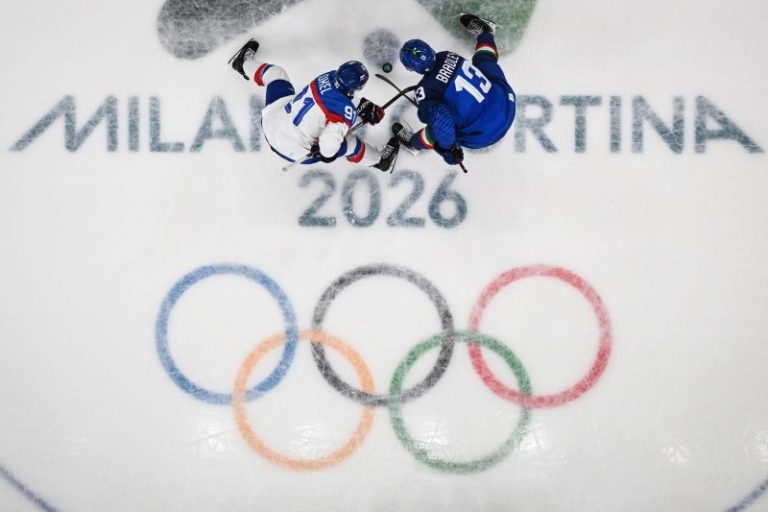
After the men’s Olympic hockey tournament kicked off at the 2026 Winter Olympics with a doubleheader on Wednesday with National Hockey League players participating for the first time in 12 years, eight nations will take the ice on Thursday.

Canada won the last two Olympics to feature NHL players, in 2010 and 2014, and looks to add their 10th gold overall, but Finland is the defending Olympic champion after its triumph at the 2022 Beijing Olympics.

The United States last won a gold medal in the event in 1980, part of the ‘Miracle on Ice’ run, and last medaled in 2010, taking home the silver after an overtime loss to Canada at the Vancouver games.

Here is the full men’s hockey Olympic schedule for Thursday, Feb. 12:

  • 6:10 a.m. – Switzerland vs. France | Milano Santagiulia Ice Hockey Arena | Peacock, NBCOlympics.com
  • 10:40 a.m. – Canada vs. Czechia | Milano Santagiulia Ice Hockey Arena | USA Network, Peacock, NBCOlympics.com
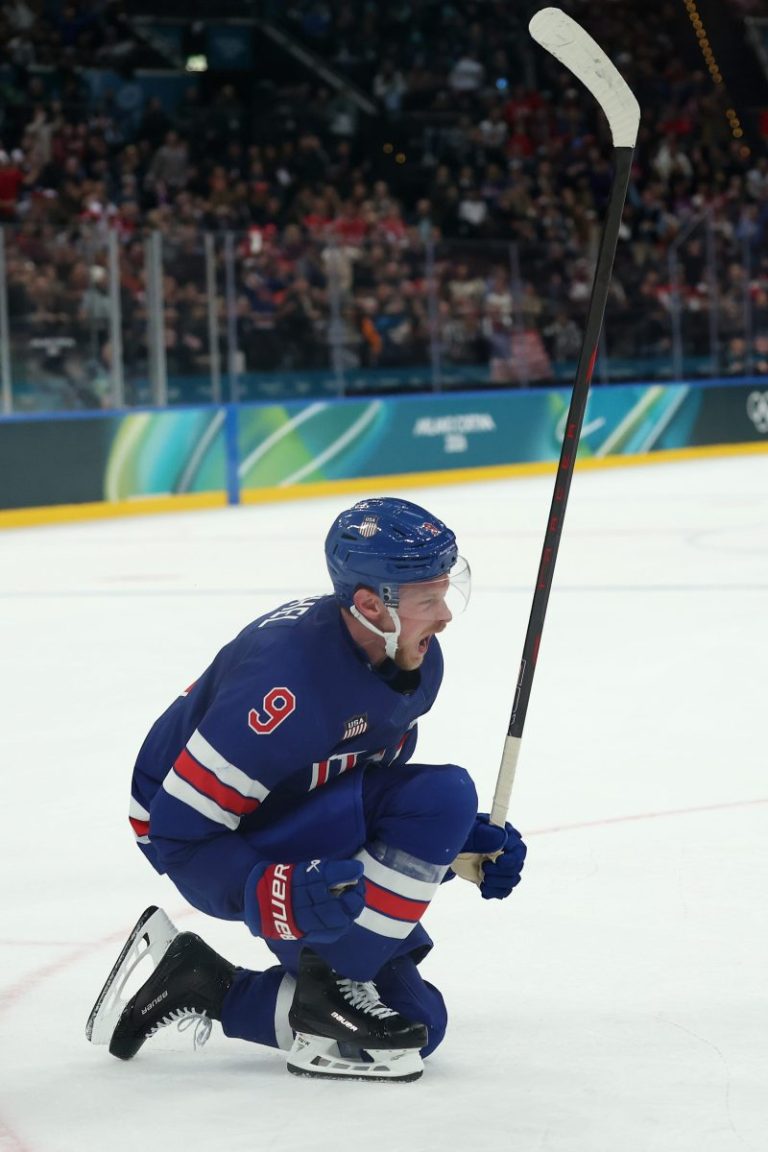
  • 3:10 p.m. – USA vs. Latvia | Milano Santagiulia Ice Hockey Arena | USA Network, Peacock, NBCOlympics.com
  • 3:10 p.m. –  Germany vs. Denmark | Milano Rho Ice Hockey Arena | Peacock, NBCOlympics.com
This post appeared first on USA TODAY

  • Former Colorado tight end Christian Fauria criticized coach Deion Sanders on a recent podcast.
  • Fauria said Sanders isn’t ‘very bright’ and said he has ‘brainwashed’ supporters.
  • Fauria’s son, Caleb, transferred from Colorado after Sanders was hired.

Two-time Super Bowl champion and former Colorado tight end Christian Fauria lambasted coach Deion Sanders for how he’s run the football program at Colorado, saying he’s not “very bright” and that “brainwashed” people support him “regardless of how stupid he is sometimes.”

Fauria, 54, made these comments this week when asked about Sanders on “The Zach Gelb Show.” Fauria played at Colorado from 1990 to 1994 under coach Bill McCartney before moving on to the NFL, where he won two Super Bowls as a member of the New England Patriots. Fauria’s son Caleb also was on theColoradoteam when Sanders was hired in December 2022 but then transferred to Delaware for the 2024 season.

“I’m just not a fan of the coach,” Fauria said on the podcast. “I’m not. I’ll never be a fan of the coach. I love the school. And this isn’t me picking on Deion Sanders, because I pick on (former NFL coach) Joe Gibbs. The worst coach I’ve ever had was Joe Gibbs (with the Washington NFL team), so me picking on Deion Sanders is nothing. I just don’t like the way he coaches football. I don’t think he’s very bright. I don’t think he can manage a game. I think there’s a lot of flash, but I think there’s no substance, you know. And he’s got a lot of people, like, brainwashed.”

Christian Fauria explains his issues with Deion Sanders

Fauria alluded to some issues other former Colorado players have had with Sanders, whose three-year record in Boulder is 16-21, including 3-9 in 2025. Some have been skeptical about how he flips the roster over every year with transfer players from other colleges, questioning how that builds a winning team culture, especially when they don’t learn the Colorado fight song. Sanders’ clock management also has been a sore subject among Colorado fans and alumni.

“Not a fan of his coaching style, not a fan of his messaging,” Fauria said. “There’s a lot of things internally that I know about that I’m not a fan of. And it’s just not worth my energy to sit there and follow it and then go back and forth with the emperor-has-no-clothes crowd that support him regardless of how stupid he is sometimes. So, yeah, that’s the way I feel about it, and it bugs me that a lot of alumni don’t just speak up about it.”

Gelb then asked Fauria about the notion Sanders at least has made Colorado “relevant” again after many years of futility before his arrival, including a 1-11 season in 2022. Colorado went 9-4 under Sanders in 2024 while winning a Heisman Trophy with two-way star Travis Hunter.

Fauria said he understands it’s “hard to win at Colorado” and that it takes a “special person” to do so, such as McCartney, who won a national championship there in 1990. Fauria said he backed Sanders initially and was “all for it.”

“But as time went on, I was just like, wait, none of this makes any sense,” Fauria said. “I’m like, ‘How long are they gonna to put up with this?’ And what else are we going to do? So if relevancy and having a sold-out crowd, having people talk about you on Twitter, if that’s what you want, well then congratulations. You’ve achieved it.”

‘Learn the fight song,’ former Colorado tight end says

Fauria outlined some things he’d like to see in Sanders’ program.

“Win games,” he said. “The way you win games. The way you recruit. Know everybody’s name. Give everybody the same attention. Sing the fight song. Learn the fight song. I would say then you’ve got business.”

Fauria closed the interview by making himself perfectly clear. He didn’t immediately return a message from USA TODAY Sports on whether he’d like to clarify any of these remarks.

“I’m not a fan,” he said on the podcast. “And I can really care less if anybody likes it or not. My give-a-(expletive) level is zero right now with people caring about my opinion of Deion Sanders.”

Follow reporter Brent Schrotenboer @Schrotenboer. Email: bschrotenb@usatoday.com

This post appeared first on USA TODAY

Bobsled, one of the oldest sports at the Winter Olympics, returns to the 2026 Milano Cortina Games and will showcase athletes with nerves of steel as they steer a high-tech sled down a fast, icy track with multiple turns.

Veteran U.S. bobsledders Kaillie Humphries and Elana Meyers Taylor are set to make their fifth appearance at the Winter Games and are heavy favorites to podium. Humphries and Meyers Taylor finished first and second respectively in the inaugural women’s monobob event at the 2022 Beijing Winter Olympics.

Bobsled includes a total of four events, which will be contested at the Cortina Sliding Centre in Cortina d’Ampezzo.

When did bobsled become a Winter Olympic sport?

Bobsled has been part of the Winter Olympics since the inaugural 1924 Chamonix Winter Games, although it wasn’t contested in Squaw Valley in 1960 to cut down expenses by not building a bobsled track. The two-man event was added to the program at the 1932 Lake Placid Winter Games and the two-woman race made its Olympic debut in Salt Lake in 2002. The Olympic women’s monobob was first held at the 2022 Games in Beijing.

How does Olympic bobsled work?

Each sled has one driver, while others push the sled from the starting gate before jumping into the back of the sled for the rest of the ride. Bobsled events each last two days, with two runs each day. The fastest combined time determines the winner. Men and women each compete in their own events:

Men

  • 4-man bobsled: One driver and three pushers in each sled
  • 2-man bobsled: One driver and one pusher in each sled

Women

  • 2-women bobsled: One driver and one pusher in each sled
  • Monobob: One driver, no pushers

Top Team USA athletes

  • Kaillie Humphries: The 40-year-old pilot won gold for the U.S. in monobob at the 2022 Beijing Games and also won gold in two-man in 2014 and 2010 while representing Canada. She joined short-track speedskater Viktor Ahn as the only Winter Olympians to win gold for different countries. Milano Cortina marks her fifth Games and first as a mother after giving birth to son Aulden in June 2024.
  • Elana Meyers Taylor: The 41-year-old pilot/brakeman enters Milano Cortina, her fifth Winter Games, with five Olympic medals, including three silvers and two bronzes. She earned a silver medal in the inaugural women’s monobob at the 2022 Beijing Winter Olympics and a bronze in the two-woman bobsled race with Sylvia Hoffman to become the most decorated Black athlete in Winter Olympics history.
  • Kaysha Love: The up-and-coming bobsledder won gold in women’s monobob at the 2025 IBSF World Championships. Love, 28, made her Olympic debut at the 2022 Beijing Winter Games, less than two years after beginning bobsled following a track and field career at the University of Nevada, Las Vegas.

International landscape

German bobsledder Francesco Friedrich is in pursuit of a record fifth gold medal. His four gold medals are tied for the most in the sport after winning the two-man and four-man event in Pyeongchang in 2018 and Beijing in 2022. Milano Cortina will mark his fourth Winter Games. Germany’s Laura Nolte is also a top contender after winning gold in the two-woman bobsleigh in 2022 in Beijing.

The USA TODAY app gets you to the heart of the news — fastDownload for award-winning coverage, crosswords, audio storytelling, the eNewspaper and more.

This post appeared first on USA TODAY

Investor Insight

Tartisan Nickel offers investors exposure to a high-grade, advanced-stage nickel sulfide project with existing infrastructure and clear near-term catalysts, alongside a past-producing silver asset providing significant upside and growth potential.

Overview

Tartisan Nickel (CSE:TN,OTCQX:TTSRF,FSE:8TA) is a Canadian exploration and development company focused on advancing high-quality critical mineral assets in Ontario. The company’s primary asset, the Kenbridge nickel project in Northwestern Ontario, is an advanced-stage nickel sulfide deposit hosting nickel, copper and cobalt. Management’s strategy for Kenbridge is straightforward and execution-focused: increase the size and confidence of the Kenbridge resource through drilling, extend mine life, and continue de-risking the project.

The Kenbridge project has undergone extensive historical work, including more than 100,000 meters of drilling.

At the same time, Tartisan controls the Sill Lake silver project, a past-producing silver-lead property near Sault Ste. Marie, Ontario. With strong commodity fundamentals across nickel, copper and silver, management views Tartisan as a company with “more than one leg under the table,” offering investors exposure to multiple value drivers within a single platform.

Company Highlights

  • Clear focus on drilling-driven value creation, with active programs designed to upgrade inferred resources, expand the deposit at depth, and extend mine life into the mid-teens
  • Low-capex development profile relative to many peer nickel projects, supported by a historic shaft, road access, and established infrastructure
  • Sill Lake Silver Project provides additional, underappreciated value, offering exposure to silver through a brownfields, past-producing asset with a defined historic resource
  • Experienced leadership team with deep capital markets and mine development experience, focused on disciplined capital allocation and unlocking value from opportunity-acquired assets

Key Projects

Kenbridge Nickel-Copper-Cobalt Project

The Kenbridge project is Tartisan’s flagship asset and the company’s primary focus. It is a high-grade, Class 1 nickel sulfide deposit located in a mining-friendly jurisdiction with established infrastructure and access. Kenbridge benefits from extensive historical work, including more than 100,000 metres of drilling and a three-compartment shaft extending to a depth of approximately 622 metres, placing the project closer to development than many earlier-stage peers.

A preliminary economic assessment (PEA) completed in 2022 outlined a potentially economic underground mining operation, supported by relatively modest initial capital requirements compared to large, low-grade nickel projects.

Current drilling is aimed at upgrading inferred resources to measured and indicated categories, and expanding the deposit both along strike and at depth, where historical data indicate improving grades.

The company’s near-term objective is to meaningfully extend the mine life beyond the nine years outlined in the PEA, with the longer-term goal of positioning Kenbridge as a strategic asset in a tightening nickel market. With existing road access, proximity to power, and ongoing engagement with Treaty #3 First Nations, Kenbridge is viewed as an advanced project with clear pathways to further value creation.

Tartisan Nickel has been engaging with Treaty # 3 First Nations since May 2007.

Sill Lake Silver-Lead Project

The Sill Lake project is a 100-percent-owned, past-producing silver-lead asset located approximately 30 kilometres north of Sault Ste. Marie, Ontario. The property hosts an NI 43-101-compliant historic mineral resource and benefits from existing underground development, including ramp access and historic workings.

Tartisan considers Sill Lake a brownfields opportunity with relatively low capital intensity, particularly in the context of stronger silver prices. Planned work includes validation of historic data, evaluation of multiple mineralized trends, and the potential for future drilling and bulk sampling. Importantly, management believes Sill Lake’s value is largely unrecognized by the market, providing investors with additional upside that is not currently built into Tartisan’s valuation.

Management Team

Mark Appleby – President, CEO and Director

Mark Appleby has more than 38 years of experience in investment banking, corporate finance and capital markets. He has led numerous public resource companies through exploration, development and financing cycles, and brings a strong focus on disciplined capital allocation and asset-driven value creation.

Yves Clément – Director

Yves Clément is a professional geologist with more than 35 years of experience in mineral exploration and development across Canada, South America and West Africa, contributing deep technical oversight at the board level.

Carl J. McGill – Director

Carl McGill has over 30 years of experience in capital markets and financial management, with a background spanning banking, corporate finance and public company leadership.

Dean MacEachern – Geological Advisor

Dean MacEachern has more than 35 years of global exploration experience and has worked on the Kenbridge project under previous ownership, providing valuable continuity and geological insight as a Qualified Person under NI 43-101.

Greg Edwards – Project Manager

Greg Edwards brings over 25 years of Canadian exploration and project development experience and plays a key role in advancing Kenbridge while supporting community and First Nations engagement.

Get access to more exclusive Nickel Investing Stock profiles here

This post appeared first on investingnews.com

Investor Insight

TomaGold is advancing a portfolio centered on Québec’s Chibougamau Mining Camp, combining owned assets with near-term, catalyst-driven exploration at its optioned Berrigan Mine project. Recent deep drilling and downhole geophysics at Berrigan have identified sulphide mineralization and EM conductors that the company is using to prioritize follow-up targets, while it continues to advance the owned Obalski project and a broader pipeline of Chibougamau-area options.

Overview

TomaGold (TSXV:LOT,OTC:TOGOF) is a Canadian exploration company focused on precious and base metal opportunities, with a primary emphasis on gold and copper in Québec and Ontario. The company’s core assets are located in Québec’s Chibougamau Mining Camp, where it owns the Obalski and Chicot projects and holds options to earn up to 100 percent interests in multiple additional properties, including the Berrigan Mine, David, Radar and Dufault projects. TomaGold also holds a 24.5 percent joint venture interest in the Baird gold project near Ontario’s Red Lake camp, and maintains early-stage lithium and rare earth element (REE) exposure in Québec’s James Bay region.

In January 2026, TomaGold reported deep drilling results from Berrigan Mine, including a broad interval of semi-massive to massive sulphide mineralization in hole TOM-25-015 and described the “Berrigan Deep” zone as open at depth. In February 2026, the company reported results from a borehole electromagnetic (BHEM) survey, stating that modeled conductive plates correlate with mineralization intersected in multiple holes and identifying a priority plate (BER-14C) for follow-up drilling and additional geophysical work.

Company Highlights

  • Portfolio anchored in Québec’s Chibougamau Mining Camp, combining owned assets (including Obalski and Chicot) with multiple optioned projects that provide pipeline depth.
  • Near-term exploration catalysts focused on Berrigan, supported by recent deep drilling and BHEM interpretation used to prioritize conductors for follow-up.
  • Berrigan Mine: January 2026 drilling highlighted a broad sulphide interval in hole TOM-25-015 and introduced the “Berrigan Deep” zone; February 2026 BHEM interpretation identified a priority conductor (BER-14C) described as open at depth and to the northeast.
  • Obalski is a 100 percent owned project with extensive historical work and multiple zones, providing a second core asset within the company’s Chibougamau footprint.
  • Management describes a disciplined, data-driven reinterpretation of existing datasets, targeted drilling and geophysics to generate technical newsflow and refine targets over time, with the objective of advancing projects toward updated NI 43-101-compliant technical disclosure.

Key Projects

Berrigan Mine Project (Option to Acquire 100 percent)

The Berrigan Mine project comprises 16 claims totaling 483 hectares and is located approximately 4 km NNW of Chibougamau in the Chibougamau Mining Camp. TomaGold holds an option to acquire a 100 percent interest in the property from Chibougamau Independent Mines. The project has a significant historical database and has been the focus of the company’s recent exploration drilling and geophysics. Any historical resource estimates referenced for the project are historical in nature, are not current NI 43-101 compliant, and should not be relied upon.

In January 2026, TomaGold reported drilling results including hole TOM-25-015, which intersected 98.5 metres of semi-massive to massive sulphide mineralization and was presented as a new “Berrigan Deep” zone that remains open at depth. The company also reported additional intervals from drilling designed to test extensions of mineralization at depth. In February 2026, TomaGold reported interpretation from a borehole electromagnetic (BHEM) survey, stating that conductive plates modeled from downhole data correlate with mineralization intersected in holes TOM-25-009 through TOM-25-015. The company highlighted a priority target plate (BER-14C), described as approximately 160 x 300 metres and open at depth and to the northeast, and outlined follow-up steps including additional drilling and EM work.

TomaGold has stated it reverted to reporting elemental assays rather than metal-equivalent grades due to uncertainty around metallurgical recovery assumptions at the current stage of evaluation.

Obalski Project (100 percent owned)

The Obalski project is 100 percent owned and consists of 75 claims totaling 2,724 hectares located roughly 2 km south of Chibougamau. The project hosts multiple mineralized zones and has seen extensive historical exploration and drilling. TomaGold highlights Obalski as a core owned asset within its Chibougamau platform, supported by a large database and multiple target zones that remain open along strike and at depth.

David Project (Option to Earn 100 percent)

The David project consists of 49 claims totaling approximately 20.09 sq km and is located within the Chibougamau camp. The project hosts multiple mineral occurrences and is positioned by the company as part of its broader Chibougamau consolidation strategy.

Radar Project (Option to Earn 100 percent)

The Radar project consists of 14 claims totaling approximately 7.75 sq km and is located north of Chibougamau. The company highlights multiple showings and historical work that support ongoing target development within the district.

Dufault Project (Option to Earn 100 percent)

The Dufault project consists of 14 claims totaling approximately 5.22 sq km and is located north of Chibougamau. The company highlights the project as prospective within the camp and references historical drilling that supports continued evaluation.

Other Assets and Optional Exposure

TomaGold’s portfolio also includes the Chicot project (owned) and additional Chibougamau-area properties (optioned) that provide pipeline optionality. Outside of Chibougamau, the company holds a 24.5 percent joint venture interest in the Baird gold project near Ontario’s Red Lake camp, and early-stage lithium and REE exposure in Québec’s James Bay region through the Star Lake (REE) and Brisk Extension (lithium/REE) projects.

Management Team

David Grondin — President and CEO

David Grondin is a seasoned mining financial entrepreneur and developer with over 25 years of experience in acquiring, financing, and advancing mining assets across the Americas and Europe.

Martin Nicoletti — CFO

Martin Nicoletti is the founder of SKTM Financial and a certified accountant with more than 32 years of corporate experience.

Jean Lafleur — VP Exploration

Jean Lent is a highly skilled professional geologist with 45 years of global experience in mineral exploration, resource evaluation, and project assessment and development.

Michel E. Labrousse — Senior Advisor

For the past twenty years, Michel Labrousse has developed various businesses in investment banking and financial markets in Europe and Asia.

Board of Directors

The board includes David Brousse, Jean-Sébastien Jacquetin and Caitlin Jeffs.

Get access to more exclusive Gold Investing Stock profiles here

This post appeared first on investingnews.com

TomaGold (TSXV:LOT;OTC:TOGOF) is a Canadian exploration company targeting precious and base metals, with a strong focus on gold and copper projects in Québec and Ontario. Its flagship assets are in Québec’s Chibougamau Mining Camp, where it owns the Obalski and Chicot projects and holds options to earn up to 100 percent interests in several additional properties, including Berrigan Mine, David, Radar and Dufault. The company also holds a 24.5 percent joint venture stake in the Baird gold project near Ontario’s Red Lake camp, along with early-stage lithium and rare earth element (REE) exposure in Québec’s James Bay region.

In January 2026, TomaGold reported deep drilling results from the Berrigan Mine, highlighted by a broad interval of semi-massive to massive sulphide mineralization in hole TOM-25-015. The company also noted that the “Berrigan Deep” zone remains open at depth, underscoring further exploration potential.

In February 2026, TomaGold released results from a borehole electromagnetic (BHEM) survey, stating that modeled conductive plates correlate with mineralization intersected in multiple holes. The survey also identified a priority plate, BER-14C, as a target for follow-up drilling and additional geophysical work.

This TomaGold profile is part of a paid investor education campaign.*

Click here to connect with TomaGold (TSXV:LOT) to receive an Investor Presentation

This post appeared first on investingnews.com