Author

admin

Browsing

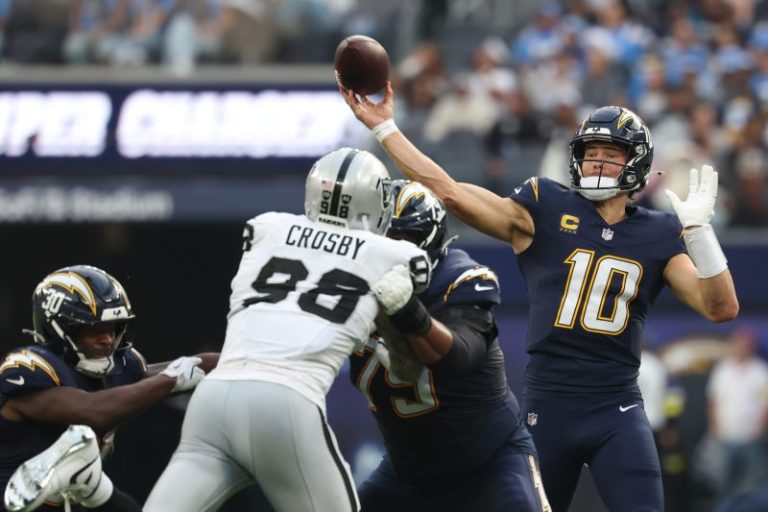
INGLEWOOD, CA —  Justin Herbert and the Los Angeles Chargers’ 31-14 victory over the Las Vegas Raiders didn’t come without a scare.

Herbert left the game briefly in the first half due to a fracture in his left hand. He returned to the game with a white glove on the injured hand.

“He’s as tough as they come. Taped it up with a glove,” Chargers coach Jim Harbaugh said. “He played a great game.”

Sunday’s victory improved the Chargers (8-4) to 4-0 in the AFC West, and they currently occupy fifth place in the AFC playoff picture.

However, Herbert’s health looms large. Herbert is scheduled to undergo a procedure to repair his left hand on Monday, a week before the Chargers host the Philadelphia Eagles. The Chargers quarterback is optimistic he’ll be able to play in the prime-time game.

Herbert’s been under constant pressure this season as the Chargers adjust to life without starting offensive tackles Rashawn Slater (knee) and Joe Alt (ankle), who are both out for the year.

Herbert faced pressure an NFL-high 188 times entering Week 13, according to Pro Football Focus. He was sacked three times and hit another four times Sunday.  

The Chargers can ill-afford to be without Herbert for any duration if they hope to get into the playoffs. Los Angeles is currently second in the AFC West behind the Denver Broncos (9-2). Surpassing Denver in the division appears unlikely, so a wild-card spot seems to be the team’s most realistic path to the postseason. Sunday’s win gave the Chargers a 61% chance to reach the postseason as the calendar flips to the December stretch run.

However, the Chargers are approaching a daunting five-game stretch to close the regular season as they face the Eagles, Kansas City Chiefs, Dallas Cowboys, Houston Texans and Broncos to end the year. All five opponents are .500 or better and in the playoff hunt. Week 13’s tilt was a game the Chargers needed to have as they embark on a five-game gauntlet.

‘We got some great teams coming up, all playoff caliber teams,’ Chargers safety Derwin James said. “This was a big win moving forward. And any time you can stay 4-0 on the division, you give yourself a chance with five games left.”

Chargers players know what’s on the horizon, beginning with the Eagles, but they insist they aren’t looking too far ahead.

“For us to be able to come away with a win (Sunday) was big for us,” Herbert said. “I think it’s just week by week. We got to do our job. Especially when we when we play on Sundays, or whether we’re playing on Monday. All we can control is our attitude, our effort, and how we take care of business. Anything outside of that is out of our control. You can monitor it, but you can’t do too much to change it.”

The Chargers did “take care of business” against the lowly Raiders (2-10). But it came with an injury scare. The Chargers’ most indispensable player needs a fracture in his left non-throwing hand repaired, and questions about the team’s ability to protect him are bound to persist.  

All the while, the next handful of games will determine their playoff fate.

Follow USA TODAY Sports’ Tyler Dragon on X @TheTylerDragon.

This post appeared first on USA TODAY

Treylon Burks, take a bow.

The Washington Commanders receiver entered his name into the catch of the year conversation on ‘Sunday Night Football’ in Week 13, hauling in an unbelievable touchdown grab against the Denver Broncos.

Like most things this time of year, seeing is believing. Take a look:

With a corner fade in the end zone, Marcus Mariota lofted one up for Burks, who made the one-handed catch despite falling backwards and taking contact from Broncos cornerback, Riley Moss – who was, fittingly, ‘Mossed’ on the play.

It was an exclamation point on Burks’ second career touchdown and his first since 2022.

The play had a remarkable resemblance to the famous Odell Beckham Jr. catch for the New York Giants on ‘Sunday Night Football’ on Nov. 23, 2014. Nearly 11 years ago to the day, Burks proved that history does repeat itself sometimes.

Beckham was quick to point out the connection on X, even including that Burks is wearing the same No. 13.

Of course, Beckham’s catch was on a longer throw, and he snagged it after the ball was beyond his head, but that doesn’t take away from the degree of difficulty on this one.

While SEC rivalries have been all the rage over Thanksgiving weekend, this Arkansas Razorback and LSU Tiger can share a moment in the spotlight.

After all, imitation is the sincerest form of flattery.

This post appeared first on USA TODAY

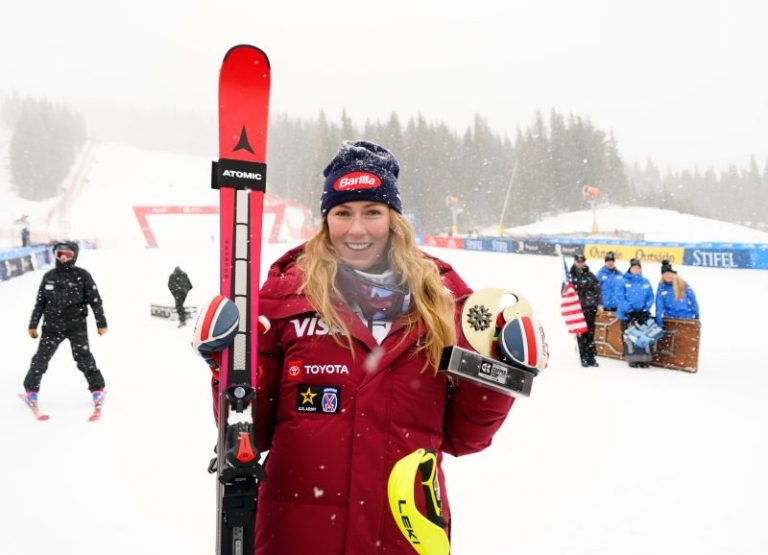
COPPER MOUNTAIN, Colo. — Mikaela Shiffrin’s skiing greatness doesn’t come from the wins or the records.

It comes from the quiet moments in training, when she’s obsessing over the tiniest of details and repeating a drill over and over to perfect her technique. Without those moments, the ones only her team sees, you wouldn’t get the big moments the whole world sees.

‘The attention to detail, that’s where she’s got it,’ Karin Harjo, Shiffrin’s head coach, said after Shiffrin won the slalom at Copper Mountain for her 104th World Cup victory.

‘What’s great is that she’s getting into this place, especially in slalom, where she’s really comfortable and she’s bringing the training scheme to racing,’ Harjo continued. ‘And that speed is something that I think for the world to see is great because it’s pushing the level of sport, showing what is possible, and I think that’s one of the coolest things that you can ever do.’

It may seem as if Shiffrin’s entire career has occurred in rarefied air. A World Cup winner at 17. The youngest to win the Olympic slalom. A five-time overall champion. A two-time Olympic gold medalist. Winner of a record 17 World Cups in a single season. Most World Cup wins of any skier, male or female.

But Shiffrin is human, and her current dominance came out of that frailty.

It was a year ago this weekend that Shiffrin suffered a puncture wound in her abdomen in a crash during the second run of the giant slalom at the World Cup in Killington, Vermont. She would miss the next two months of the season and, even after she returned, struggled with PTSD about the GS. Slalom was safer, but she was still fighting to regain her rhythm and momentum.

The offseason gave Shiffrin a chance to reset and immerse herself in the process, her favorite thing about skiing.

Some people ski for the medals or fame or money. Shiffrin skis for the joy she gets from making good turns and figuring out how to squeeze another tenth of a second or two out of herself.

‘I am so obsessed with the feeling that I get in between the start and the finish when it’s good,’ Shiffrin said Sunday. ‘It’s just such a beautiful feeling, and when I can improve that a little bit, that’s motivating. The second run was the motivating thing for me. And then to do it and to anticipate it, to visualize it and then to execute it and to actually get to the bottom and see that it was indeed well done, that’s the best feeling.’

That feeling feeds her confidence. And her confidence feeds her skiing.

She talked after the first run of being able to trust her slalom skiing. She hasn’t had a lot of time training slalom of late, but what she did have was solid and that allows her to trust that the work she’s put in will carry over onto the race course.

‘She’s found a place in which she can start to push again,’ said Paula Moltzan, who has been skiing with Shiffrin since they were teenagers.

‘I think after the crash in GS, she lacked confidence. She could clearly still win, but you just see that confidence coming back into her every turn, every race,’ Moltzan said. ‘That second run, the conditions are really tough, it’s a hometown crowd and she just handles everything with such grace. It’s pretty inspiring.’

The wins, the results — they just reinforce that it’s pushing herself in training that matters. It’s that constant challenge of making her turns just a tad quicker, just a bit tighter that’s her superpower.

‘Everybody talks about momentum, and really momentum is just an action or force that leads to the next step,’ Harjo said. ‘And so we’re always looking forward and taking the next step and working hard. Results in the past, both successful and not successful, happen. But we keep moving forward.’

Shiffrin is still trying to replicate what she’s doing in slalom in GS, which is no surprise given the trauma of last season. But she knows she is getting closer.

Though she finished 14th in the GS on Saturday, she was able to make adjustments from the first run to the second. After being 18th in the first run, she was 10th in the second, and was briefly atop the leaderboard.

‘It was another step,’ Harjo said. ‘I think sometimes people forget the mental side, how long it takes to come back from that. They have an expectation that she’s just going to dominate everything.’

Shiffrin isn’t worried about meeting other peoples’ expectations or even being back on the podium in GS or racing super-G. She is searching for that sweet spot in her training, because she knows once she finds it, it’ll be there on race day, too.

‘It’s going to just continue to take time,’ Shiffrin said. ‘But that’s a really motivating thing.’

Because it’s those little things that make her many, many great things possible.

Follow USA TODAY Sports columnist Nancy Armour on social media @nrarmour.

This post appeared first on USA TODAY

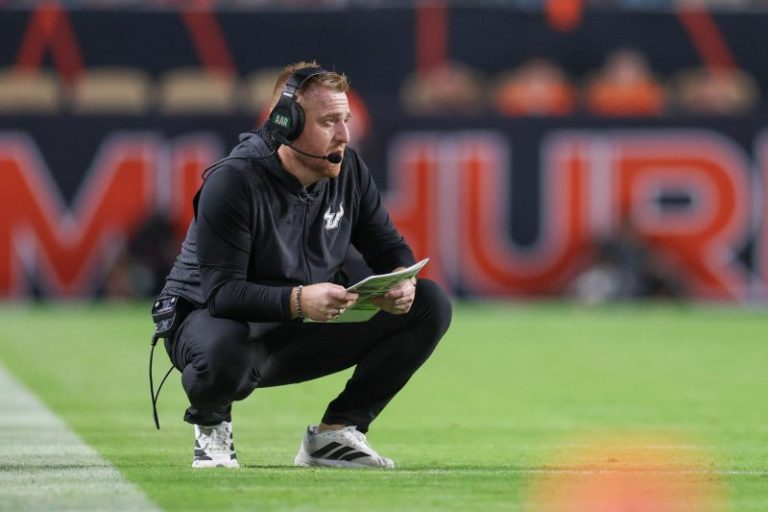
Alex Golesh to Auburn may have gone under the radar considering Lane Kiffin grabbed the spotlight and Florida had Steve Spurrier and Urban Meyer gloss its new hire.

Golesh led South Florida to a 9-3 record this season, the program’s most wins in eight years. Over his three-year tenure at USF, Golesh went 23-15. He took over a Bulls program that had gone just 4-29 in the three seasons before he was hired.

Under the 41-year-old Golesh, the Bulls finished among the top 35 FBS teams in scoring offense in each of his three seasons. This season, it averaged 43 points per game, the fourth-best mark in the FBS.

Here’s who we grade the Tigers’ hire:

Grade: B-

Auburn needs help on offense to pull it out of yearslong rut, and Golesh shows some chops for the assignment. He’s worked inside the SEC and was Josh Heupel’s offensive coordinator when Tennessee toppled Alabama in 2022 and the Vols’ up-tempo spread system led the nation in offense.

Golesh did a solid job at South Florida in his first coaching gig. The Bulls were 1-11 the year before he arrived. By this season, Golesh’s Year 3, the Bulls upset Florida and went 9-3. They fizzled a bit in the second half of the schedule. USF enjoys an advantage as one of the best-resourced programs in the American Conference, and it’s located in enviable recruiting territory.

Golesh can’t expect such a head-start on his SEC peers while at Auburn, and USF fans were appropriately disappointed Golesh couldn’t get this year’s team to the American Conference championship game, after peaking early in wins against Boise State and Florida.

Golesh is a more unproven hire than Auburn’s past two, but after Bryan Harsin and Hugh Freeze failed miserably, you could argue it’s worth taking a shot on a rising 41-year-old talent.

The up-tempo spread system Golesh is trained in has become less novel inside the SEC in recent years. Golesh will join Heupel, Lane Kiffin and Jeff Lebby as coaches who operate a version of this offense. Does that increase in familiarity sacrifice some of the advantage Tennessee enjoyed while Golesh was there? Perhaps.

He also must prove himself as a recruiter while going toe-to-toe with the likes of Kirby Smart, Kalen DeBoer and others in blue-chip battles.

Golesh is a bit of a gamble, but not a total Hail Mary, and he’s a hopeful choice after the retread shot with Freeze flopped.

This post appeared first on USA TODAY

Here’s a quick recap of the crypto landscape for Friday (November 28) as of 9:00 p.m. UTC.

Get the latest insights on Bitcoin, Ether and altcoins, along with a round-up of key cryptocurrency market news.

Bitcoin and Ether price update

Bitcoin (BTC) was priced at US$91,192.19, down by 0.2 percent over 24 hours.

Bitcoin price performance, November 28, 2025.

Chart via TradingView.

However, the expert added that whale selling is keeping upside momentum fragile, preventing Bitcoin’s recovery from becoming a sustained trend. Hasn also noted that while derivatives market indicators show some stabilization, the rebound lacks the aggressive leverage buildup that typically supports strong rallies.

Friday’s derivatives data reinforces this view. Open interest fell 0.13 percent over four hours as traders trimmed positions. Liquidations hit US$23.74 million, mostly in longs, clearing excess bets without sparking fresh buying.

The slightly negative funding rate of -0.001 percent shows shorts paying longs with no bullish premium, while Bitcoin’s relative strength index of 58 signals neutral momentum, not the overextension needed for a strong rally.

As Hasn explained:

“Bitcoin’s resilience this week is therefore being shaped by a supportive macro environment rather than internal strength. The mixed whale distribution pattern and the lack of sustained accumulation still underline that the market remains vulnerable. The next phase will likely depend on whether improving sentiment in equities can translate into more durable inflows across the crypto market.”

Meanwhile, Ether (ETH) was at US$3,057.17, up by 0.7 percent over 24 hours. Ether derivatives showed balanced consolidation: US$8.83 million in mixed long/short liquidations cleared positions evenly, while a 0.06 percent rise in open interest signals modest new bets. However, neutral funding at 0.001 percent lacks a bullish premium.

Altcoin price update

  • XRP (XRP) was priced at US$2.19, down by 1.8 percent over 24 hours.
  • Solana (SOL) was trading at US$137.88, down by 3.3 percent over 24 hours.

Fear and Greed Index snapshot

CMC’s Crypto Fear & Greed Index continued to climb steadily after plunging into ‘extreme fear’ territory in the last two weeks. It has currently settled at 20 and is inching closer to ‘fear.’

Bitcoin’s rebound from the mid-US$80,000 zone has triggered a swift shift in market sentiment. After the price briefly cooled near US$80,000, many expected a sluggish recovery phase. Instead, optimism snapped back, with the sentiment index rising 10 points over the week and marking one of its sharpest moves in recent months.

The increase corresponds with heavier buying activity and reduced caution among traders who had previously stayed on the sidelines during the cryptocurrency’s pullback.

CMC Crypto Fear and Greed Index, Bitcoin price and Bitcoin volume.

Chart via CoinMarketCap.

Today’s crypto news to know

Major CME Group outage halts futures trading

CME Group (NASDAQ:CME) experienced a major outage on Friday due to a chiller plant malfunction at the CyrusOne CHI1 facility, halting trading in futures and options across equities, currencies, commodities, treasuries and FOREX.

The disruption started late on Thursday (November 27) and affected the Globex platform, which handles 90 percent of CME Group’s volume. The outage halted trading in Bitcoin and Ether futures for about nine to 11 hours, disrupting access to quotes and positions, but leaving spot crypto markets largely unaffected.

Visa expands stablecoin settlement push with Aquanow partnership

Visa (NYSE:V) has deepened its stablecoin strategy by teaming up with Aquanow to support faster settlement across Central and Eastern Europe, the Middle East and Africa.

The deal plugs Aquanow’s infrastructure directly into Visa’s payment rails, allowing banks and payment firms in the region to settle transactions in approved stablecoins such as USDC.

Visa says the upgrade is aimed at institutions seeking cheaper and quicker cross-border settlement options as demand for digital asset rails grows. The company also aims to modernize the “back-end plumbing” of payments by reducing reliance on traditional networks with multiple intermediaries. Aquanow, which processes billions in crypto transactions each month, will provide liquidity and technical support for the integrations.

The collaboration follows Visa’s recent stablecoin payout pilot, Visa Direct, which lets businesses fund transactions in fiat while recipients opt to receive stablecoins directly in their wallets.

UK backs “no gain, no loss” tax model for DeFi activity

The UK government has endorsed a major shift in how DeFi transactions are taxed, moving to eliminate capital gains charges when users deposit tokens into lending protocols or liquidity pools.

Under the current rules, deposits can be treated as disposals, often generating tax liabilities even when investors haven’t realized any economic gain. HM Revenue & Customs’ updated guidance supports a “no gain, no loss” approach that would tax users only when they withdraw assets and eventually sell them.

The proposal comes after two years of industry feedback from firms, many of which argued that the existing system distorts reality and burdens ordinary users with excessive record keeping. The new model would apply to both simple lending and automated market makers, ensuring that only genuine gains or losses are captured for tax purposes.

Australia introduces digital assets bill

Australia has tabled a new digital assets bill aimed at ending years of regulatory uncertainty and preventing a repeat of past offshore failures such as FTX and Celsius.

The proposed Corporations Amendment (Digital Assets Framework) Bill 2025 would require platforms holding customer crypto to meet the same licensing and conduct standards applied across the financial sector.

Officials said the legislation is designed to bring crypto businesses fully into the regulated economy, ensuring transparency, custody safeguards and clear accountability.

The bill includes exemptions for smaller operators that process under US$10 million annually and hold less than US$5,000 per customer, mirroring existing thresholds for low-risk financial products. The government argues that modernizing the rules could unlock as much as US$24 billion a year in productivity and efficiency gains.

Securities Disclosure: I, Giann Liguid, hold no direct investment interest in any company mentioned in this article.

Securities Disclosure: I, Meagen Seatter, hold no direct investment interest in any company mentioned in this article.

This post appeared first on investingnews.com

West African gold explorer Asara Resources Limited (ASX: AS1; Asara or Company) is pleased to announce the second set of results from 11 drill holes (totalling 2,455m) from the Phase 1 Reverse Circulation (RC) drilling program within the Massan deposit Mineral Resource Estimate (MRE) area at its flagship Kada Gold Project (Kada) in Guinea.

HIGHLIGHTS

  • Drilling to date has focused on increasing geological confidence and on extending the down-dip mineralisation envelope at the Massan deposit within the Kada project.
  • The latest results demonstrate continuity between drillholes across the remaining Inferred areas, reinforcing confidence in the geological model and confirming consistent, broad zones of mineralisation.
  • Depth-extension drilling beyond the US$1,800/oz pit shell confirms that mineralisation continues at depth, returning robust gold intersections within fresh rock and identifying new zones of deeper mineralisation.
  • Phase 2 drilling will target strike extensions to the north and south to further grow the resource footprint.
  • Notable gold intersections from the assays received for the most recent eleven drillholes include:
    • MSRC25-014: 55m @ 1.0 g/t gold from 17m. Including,
      7m @ 3.1 g/t gold from 28m.
      12m @ 1.35 g/t gold from 239m. Including,
      5m @ 2.3 g/t gold from 244m.
    • MSRC25-015: 26m @ 0.9 g/t gold from 121m.
    • MSRC25-016: 7m @ 1.4 g/t gold from 143m.
      18m @ 1.1 g/t gold from 154m. Including,
      5m @ 2.0 g/t gold from 146m.
    • MSRC25-017: 23m @ 1.2g/t gold from 64m. Including,
      6m @ 3.8 g/t gold from 64m.
    • MSRC25-018: 12m @ 3.0g/t gold from 22m. Including,
      7m @ 4.1 g/t gold from 26m.
      18m @ 1.0g/t gold from 221m. Including,
      6m @ 2.0 g/t gold from 227m.
      6m @ 2.0g/t gold from 282m.
    • MSRC25-019: 1m @ 20.8g/t gold from 21m. 90m @ 1.0g/t gold from 226m. Including,
      9m @ 1.8 g/t gold from 234m; and
      10m @ 3.0 g/t gold from 301m.
    • MSRC25-020: 5m @ 2.9g/t gold from 6m.
      13m @ 2.1g/t gold from 29m. Including,
      4m @ 4.8 g/t gold from 35m.
      30m @ 1.9g/t gold from 109m. Including,
      16m @ 3.0 g/t gold from 118m.
      20m @ 2.3g/t gold from 144m. Including,
      9m @ 4.1 g/t gold from 144m.
    • MSRC25-021: 57m @ 1.2g/t gold from 3m. Including,
      12m @ 2.0 g/t gold from 12m.
    • 41m @ 0.7g/t gold from 64m.
    • MSRC25-023: 33m @ 0.5 g/t gold from 41m.
    • MSRC25-023B: 8m @ 0.7 g/t gold from 0m.
    • MSRC25-024: 19m @ 1.5 g/t gold from 0m. Including,
      8m @ 2.1 g/t gold from 0m.
      56m @ 0.7 g/t gold from 23m.
      10m @ 1.3 g/t gold from 156m. Including,
      5m @ 2.2 g/t gold from 156m.

Additional RC Drilling Results Confirm High-Grade Continuity at Massan Prospect

The Company is pleased to announce the receipt of assay results from a further eleven RC drill holes, totalling 2,455 metres, completed at the Massan prospect (Figure 1 and Figure 2). This phase of drilling has been strategically designed to both infill the existing drilling dataset by improving geological confidence in the mineralised zones to a vertical depth of ~150 metres, and to test the down-dip depth extensions of the deposit beyond previously defined depth limits (Figure 3 and Figure 4).

As with the previous set of assay results reported in September, this batch of assay results from the drill holes drilled within the central portion of the Massan deposit has again returned significant mineralised intersections, reinforcing the continuity and robustness of the mineralisation within the core zone and validating the accuracy of the geological model against which drillhole planning has been based.

Matt Sharples, CEO of Asara, commented:

“The latest batch of assay results from the Phase 1 drilling program at the Massan deposit at Kada is highly encouraging. Not only do they confirm the widths and tenures of the expected grades, but most importantly, the intercepts were encountered exactly where predicted. This validates the accuracy of our geological model, strengthens our understanding of the genesis of the gold and derisks our exploration targeting. This enhances our success rate and continues to lower our $/oz discovery cost at a deposit which continues to grow in scale.

Both the reported depth-extension results and the near-surface infill drilling have validated our targeting and underscore the scale of Massan. We will continue to refine and update our drill plan, and we look forward to receiving the next batch of assays, which will further guide and shape our near-term exploration strategy to increase geological confidence and confirm depth extensions.

Drilling activity at Massan is due to ramp up with the imminent arrival of the Sahara Resources AC/RC rig, which will undertake a strike extension drilling campaign, designed to confirm the scale of the Massan deposit along strike, north and south, and potentially grow the Inferred Mineral Resource component of the Kada Project.”

Click here for the full ASX Release

This post appeared first on investingnews.com

Trading in the securities of Corazon Mining Limited (‘CZN’) will be halted at the request of CZN, pending the release of an announcement by CZN.

Unless ASX decides otherwise, the securities will remain in trading halt until the earlier of:

  • the commencement of normal trading on Wednesday, 3 December 2025; or
  • the release of the announcement to the market.

CZN’s request for a trading halt is attached below for the information of the market.

Issued by
ASX Compliance

Click here for the full ASX Release

This post appeared first on investingnews.com

Perth, Australia (ABN Newswire) – Locksley Resources Ltd (ASX:LKY,OTC:LKYRF) (FRA:X5L) (OTCMKTS:LKYRF) announced that it has been progressing a sponsored Level 1 American Depositary Receipt (‘ADR’) program with The Bank of New York Mellon (‘BNY’), the global leader in depositary receipt services. The Company has been advised that the ADR program will be available on or after 3rd of December 2025 onwards. Each ADR will represent 20 ordinary shares.

Why ADRs benefit Locksley and the Market

The establishment of an ADR program represents a significant step forward in Locksley’s global capital markets positioning, moving beyond the perception of an ASX microcap and into a structure trusted by major global institutions.

An ADR is a U.S dollar-denominated trading instrument that allows U.S. investors to gain exposure to non-US companies without the need for cross-border or cross-currency complexities. Importantly, the establishment of the ADR program is not a new offer of securities, therefore no additional shares will be issued or any capital raised.

Key benefits include:

– Institutional Accessibility: Many U.S. funds are restricted from investing directly in ASXlisted small caps. A U.S.-traded ADR opens access to tier-one U.S. institutions, wealth managers, and ETFs that otherwise cannot participate.

– Credibility and Perception Uplift: Partnering with BNY Mellon is widely regarded as a strong indicator of governance quality and market standing

– Liquidity & Marketability: ADRs trade in U.S. dollars during U.S. market hours, improving visibility, liquidity and ease of settlement for U.S investors

– Peer Alignment: ADRs are already used by leading Australian and global resources companies, placing Locksley alongside a well-recognised peer group

– Future Capital Pathway: The ADR framework establishes early infrastructure for potential future U.S exchange listings and builds a trading history with U.S Investors

Background on BNY Mellon

– BNY is the world’s largest provider of depositary receipt services, with a 41% global market share and a 68% share in Australia. The firm acts as depositary for 12 of the 14 Australian companies currently listed on Nasdaq and provides depositary services to over 90% of Fortune 100 companies worldwide

– BNY’s dedicated Depositary Receipts platform provides issuers with a full suite of services, including investor relations advisory, U.S. capital markets connectivity, dividend and proxy management, and access to the largest team of DR specialists in the market

Precedent Companies

Many Australian and global companies utilise ADR programs as part of their U.S. investor engagement strategies, including BHP, Rio Tinto, Fortescue Metals, QBE, Telstra, and CSL. Locksley’s ADR program will provide U.S. investors with streamlined access to the Company’s Mojave Critical Minerals Project in California, a project strongly aligned with U.S. government and defence supply chain priorities. The program will enhance Locksley’s visibility among U.S. institutions, funds and retail investors seeking exposure to critical minerals.

Kerrie Matthews, Locksley CEO commented:

‘Progressing with The Bank of New York Mellon to establish an ADR program represents another important step in Locksley’s U.S. capital markets strategy. Since commencing as CEO, I have focused on positioning Locksley not just as another Australian junior, but as a company of global strategic importance.’ ‘The ADR program enables U.S. institutions and investors to participate in our vision to deliver a 100% U.S. Mine to Market antimony solution. This uplifts our profile, expands our investor reach and sets the stage for long term capital pathways as we fast-track Mojave’s development.’

About Locksley Resources Limited:

Locksley Resources Limited (ASX:LKY,OTC:LKYRF) (FRA:X5L) (OTCMKTS:LKYRF) is an ASX listed explorer focused on critical minerals in the United States of America. The Company is actively advancing exploration across two key assets: the Mojave Project in California, targeting rare earth elements (REEs) and antimony. Locksley Resources aims to generate shareholder value through strategic exploration, discovery and development in this highly prospective mineral region.

Mojave Project

Located in the Mojave Desert, California, the Mojave Project comprises over 250 claims across two contiguous prospect areas, namely, the North Block/Northeast Block and the El Campo Prospect. The North Block directly abuts claims held by MP Materials, while El Campo lies along strike of the Mountain Pass Mine and is enveloped by MP Materials’ claims, highlighting the strong geological continuity and exploration potential of the project area.

In addition to rare earths, the Mojave Project hosts the historic ‘Desert Antimony Mine’, which last operated in 1937. Despite the United States currently having no domestic antimony production, demand for the metal remains high due to its essential role in defense systems, semiconductors, and metal alloys. With significant surface sample results, the Desert Mine prospect represents one of the highest-grade known antimony occurrences in the U.S.

Locksley’s North American position is further strengthened by rising geopolitical urgency to diversify supply chains away from China, the global leader in both REE & antimony production. With its maiden drilling program planned, the Mojave Project is uniquely positioned to align with U.S. strategic objectives around critical mineral independence and economic security.

Tottenham Project

Locksley’s Australian portfolio comprises the advanced Tottenham Copper-Gold Project in New South Wales, focused on VMS-style mineralisation

Source:
Locksley Resources Limited

Contact:
Kerrie Matthews
Chief Executive Officer
Locksley Resources Limited
T: +61 8 9481 0389
Kerrie@locksleyresources.com.au

News Provided by ABN Newswire via QuoteMedia

This post appeared first on investingnews.com

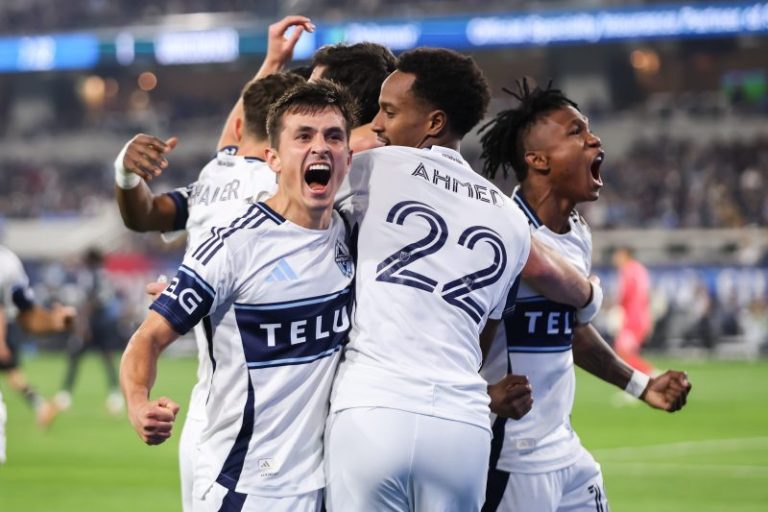
The Vancouver Whitecaps will play in their first MLS Cup after defeating San Diego FC, 3-1, in the Western Conference final on Saturday, Nov. 29.

Brian White — Vancouver’s leading goal-scorer during the regular season — had a brace in the win at San Diego’s Snapdragon Stadium.

The Whitecaps’ reward as the Western Conference’s representative in MLS Cup is a showdown with Lionel Messi and Inter Miami, which easily dispatched New York City FC in the Eastern Conference final. The 2025 MLS Cup will be held at Chase Stadium in Fort Lauderdale, Florida, on Saturday, Dec. 6 (2:30 p.m. ET on Apple TV and FOX).

Reaching MLS Cup is the latest milestone in what has been a monumental season under first-year head coach Jesper Sørensen. Earlier this year, Vancouver played in the Concacaf Champions Cup final, losing to Cruz Azul of Liga MX. Vancouver eliminated Messi and Inter Miami in the Concacaf Champions Cup semifinals. The Whitecaps also won a fourth consecutive Canadian Championship.

Vancouver also is the first Canada-based MLS club since Toronto FC in 2019 to reach MLS Cup.

San Diego FC was aiming to become the first MLS expansion team to reach the league final since the Chicago Fire won MLS Cup in 1998. Instead, that quest fell two wins short of unprecedented championship glory.

Inter Miami and the Vancouver Whitecaps will be the 20th and 21st different clubs to appear in MLS Cup.

Vancouver Whitecaps vs. San Diego FC Western Conference final highlights

When is MLS Cup 2025?

  • Date and time: Saturday, Dec. 6 at 2:30 p.m. ET
  • Location: Chase Stadium, Fort Lauderdale, Florida
  • TV and streaming: FOX and Apple TV

USA TODAY Sports’ 48-page special edition commemorates 30 years of Major League Soccer, from its best players to key milestones and championship dynasties to what exciting steps are next with the World Cup ahead. Order your copy today!

This post appeared first on USA TODAY