Author

admin

Browsing

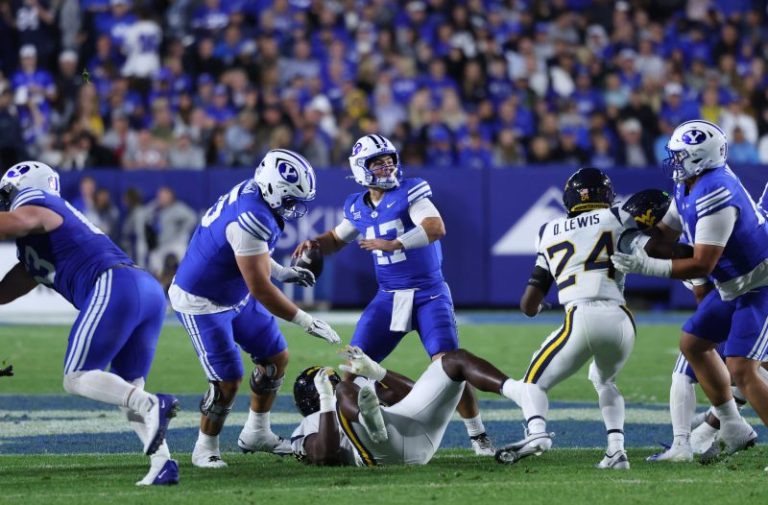
The No. 23 BYU Cougars improved to 5-0 to start the season after beating the West Virginia Mountaineers 38-24 at LaVell Edwards Stadium in Provo, Utah, on Friday night.

It’s the ninth 5-0 start in BYU’s history and the fourth with coach Kalani Sitake at the helm.

Quarterback Bear Bachmeier completed 18 of 25 passes for a career-high 351 yards in the Cougars’ win. He threw for a touchdown and had an interception. Bachmeier also rushed for 43 yards and a touchdown on 12 carries.

Running back LJ Martin finished with 90 yards and two touchdowns on 21 carries. Receiver Parker Kingston added to the offense with 112 all-purpose yards and two total touchdowns.

It was BYU’s first victory over West Virginia, which won the first two games in the all-time series back in 2016 and 2023.

USA TODAY Sports provided updates, scores and highlights from the game. Check it out:

BYU vs West Virginia: Score, schedule and result

BYU vs. West Virginia highlights

Final: BYU 38, West Virginia 24

West Virginia quarterback Scotty Fox Jr. completed a pass to Cam Vaughn for a 29-yard touchdown with 1:14 left in the fourth quarter. Kade Hensley made the PAT. The touchdown was not enough as BYU improved to 5-0 on the season.

BYU defense stops West Virginia

The BYU defense came up big with a stop on fourth-and-goal for West Virginia. Diore Hubbard was handed the ball out of the backfield but was unable to gain the one yard needed to score. The Mountaineers have nothing to show for a 12-play, 74-yard drive.

LJ Martin scores again

Running back LJ Martin scores his second touchdown of the night with a 1-yard score with 8:50 left in the fourth quarter.

3Q: BYU 31, West Virginia 17

Following a fumble recovery by the West Virginia defense, quarterback Khalil Wilkins ran for 6 yards to score with 37 seconds left in the third quarter. The run capped off a five-play, 22-yard drive.

BYU, West Virginia exchange turnovers

BYU safety Tanner Wall caught an interception off a pass thrown by quarterback Khalil Wilkins, after the ball bounced out of the hands of a West Virginia receiver.

Khalil Wilkins helps West Virginia close the gap

West Virginia quarterback Khalil Wilkins had a 6-yard run for a touchdown with 37 seconds left in the third quarter. Kicker Kade Hensley made the PAT. It was a five-play, 22-yard drive.

BYU adds to its lead

BYU kicker Will Ferrin made a 37-yard field goal to increase the lead to 31-10 with 6:53 left in the third quarter. Ferrin missed his first field goal attempt in the first half.

Halftime: BYU 28, West Virginia 10

Quarterback Bear Bachmeier scored on a 2-yard touchdown run in the final moments before halftime. The touchdown capped off a nine-play, 73-yard drive.

Bachmeier completed 10 of 14 passes for 249 yards with a touchdown and an interception in the first half. He also rushed for 17 yards and a touchdown on eight carries.

Receiver Chase Roberts had 140 yards on three catches for the Cougars. Receiver Parker Kingston scored a rushing and receiving touchdown in the first half.

West Virginia quarterback Khalil Wilkins completed just four of 10 passes for 20 yards and had an interception. He has 60 rushing yards on 13 carries in the first half. Running back Diore Hubbard had 20 yards and a touchdown on 10 carries.

West Virginia answers back

The Mountaineers continue to show some fight, converting a turnover into some late points in the first half. Fred Perry swatted BYU quarterback Bear Bachmeier’s shovel pass attempt, resulting in a 12-yard loss and a fumble. Perry did manage to recover the ball and provided the West Virginia offense with good field position.

Diore Hubbard scored on a 3-yard run on the very next play for West Virginia with 1:58 left in the second half. It’s 21-10.

BYU is pulling away in first half

LJ Martin capped off a two-play, 89-yard drive for the Cougars. Martin scored a 4-yard touchdown to increase BYU’s lead to 21-3 with 5:17 left in the second quarter. Kicker Will Ferrin made the PAT.

Quarterback Bear Bachmeier started the drive, connecting with Chase Roberts for an 85-yard gain.

Kade Hensley scores for West Virginia

Kade Hensley put the Mountaineers on the scoreboard with a 45-yard field goal with 14:15 left in the second quarter.

1Q: BYU 14, West Virginia 0

Parker Kingston scored his second touchdown of the first quarter after being on the receiving end of a short pass by quarterback Bear Bachmeier with 3:41 left in the opening period. The short pass resulted in a 54-yard gain and the touchdown. Kicker Will Ferrin made the PAT.

BYU takes advantage of mistakes, scores first

BYU wide receiver Parker Kingston scored on a 1-yard touchdown run to give BYU the early lead over West Virginia with 9:09 left in the first quarter. Kicker Will Ferrin made the PAT.

West Virginia quarterback Khalil Wilkins threw an interception to defensive back Therrian Alexander III. Alexander returned the ball 47 yards to put his team in good field position. He nearly scored a touchdown before he was tackled by Wilkins, who was called for a penalty because of a horse collar tackle in the process.

BYU misses chance at early lead

BYU kicker Will Ferrin missed a 48-yard field goal attempt. Quarterback Bear Bachmeier helped lead the Cougars within field goal range on a seven-play, 57-yard drive.

What time does BYU vs. West Virginia start?  

  • Date: Friday, Oct. 3
  • Time: 10:30 p.m. ET
  • Where: LaVell Edwards Stadium, Provo, Utah

What TV channel is BYU vs. West Virginia on today?  

  • TV: ESPN
  • Streaming: FUBO (offers free trial)
  • How to watch online: Watch ESPN (here’s how to stream it live)

BYU vs. West Virginia game odds

All college football odds via BetMGM

  • Spread: BYU -18.5 (-115), West Virginia +18.5 (-105)
  • Money Line: BYU -1200, West Virginia +725
  • Over-Under: Over 47.5 (-110), Under 47.5 (-110)

BYU vs. West Virginia predictions

  • Riley Donald,College Sports Wire: BYU is a focused team taking on a West Virginia team traveling across multiple time zones without an answer on offense. Cougars, big.
  • Jeremy Cluff, Arizona Republic: The Cougars won their first close game of the season in Week 5 against Colorado. Can they move to 2-0 in the conference? We think so. Freshman QB Bear Bachmeier has moxie.

West Virginia schedule 2025

Here is West Virginia’s schedule and results.

  • Game 1: Win vs. Robert Morris Colonials, 45-3
  • Game 2: Loss vs. Ohio, 17-10
  • Game 3: Win vs. Pittsburgh, 31-24
  • Game 4: Loss to Kansas, 41-10
  • Game 5: Loss to Utah, 48-14
  • Game 6: at BYU (tonight)
  • Game 7: at UCF (Oct. 18)
  • Game 8:  vs. TCU (Oct. 25)
  • Game 9: at Houston (Nov. 1)
  • Game 10: vs. Colorado (Nov. 8)
  • Game 11: at Arizona State (Nov. 15)
  • Game 12: vs. Texas Tech (Nov. 29)

BYU schedule 2025

Here is BYU’s schedule and results.

  • Game 1: Win vs. Portland State, 69-0
  • Game 2: Win vs. Stanford, 27-3
  • Game 3: Win at East Carolina, 34-13
  • Game 4: Win at Colorado, 24-21
  • Game 5: vs. West Virginia (tonight)
  • Game 6: at Arizona (Oct. 11)
  • Game 7: vs. Utah (Oct. 18)
  • Game 8: at Iowa State (Oct. 25)
  • Game 9: at Texas Tech (Nov. 8)
  • Game 10: vs. TCU (Nov. 15)
  • Game 11: at Cincinnati (Nov. 22)
  • Game 12: vs. UCF (Nov. 29)
This post appeared first on USA TODAY

An embarrassing controversy involving the WNBA and its biggest names exploded into public view just this week, but its roots go back almost a year and a half, to April 15, 2024, the day Caitlin Clark was drafted. 

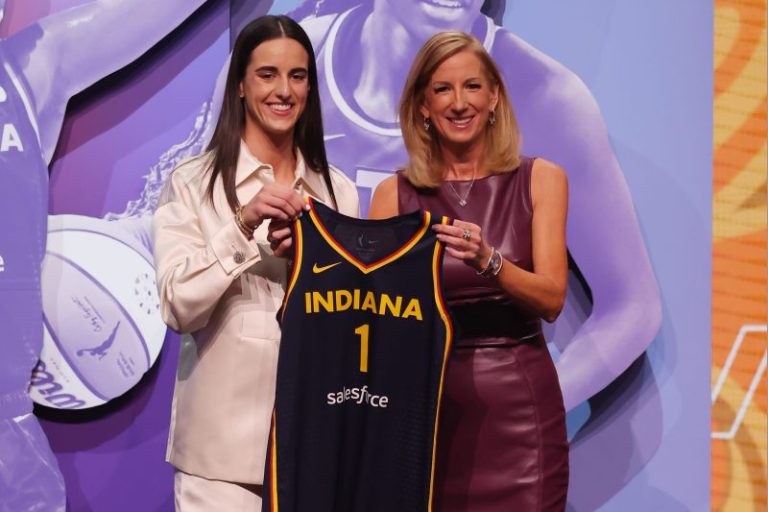
From that moment, the WNBA has found itself curiously out of step with the nation’s fondness for Clark. She’s theirs, but sometimes you wonder if they really want her. The league and the women’s basketball ecosystem that surrounds it has twisted itself into knots trying to minimize Clark’s immense and historic impact rather than embrace it. Both the WNBA and the NBA, its big brother and longtime business partner, appeared to be stunningly unprepared for the arrival of the most significant female team sport athlete, and the most popular women’s basketball player, of all time.

When Clark arrived from Iowa and the Big Ten, she brought a following of millions to a league desperately seeking attention after being virtually ignored for decades by the male-dominated mainstream sports media. Instead of welcoming this development, the league — players, coaches, owners, commissioner — at times seemed to recoil from her, sometimes even making snide remarks. 

Washington Mystics owner Sheila Johnson spoke on CNN about players’ “hard feelings” when Time magazine was “singling out” Clark for its Athlete of the Year award last December, going so far as to say she wanted “the whole WNBA on that cover” — even as Johnson made hundreds of thousands of dollars off Clark by moving two 2024 Mystics home games with Indiana to the 20,000-seat Capital One Arena that was filled to capacity to see Clark.

Commissioner Cathy Engelbert couldn’t manage to say Clark’s name in a 27-minute season-ending 2024 press conference in which she trumpeted records and milestones that occurred only because of Clark.

Even ESPN was acting strangely. The WNBA’s media business partner sent out a post on X in July proclaiming “historic viewership’ for the ’25 #WNBAAllStarWeekend.” Only problem was it wasn’t historic. It was a massive decline. ESPN left out 2024, Clark’s rookie year, referring to it only in the fine print. In 2025, with Clark injured, 2.2 million watched the All-Star Game. In 2024, with Clark starting, 3.44 million watched. 

As Clark packed Big Ten arenas while barnstorming the country her senior year, then drew four million more viewers for the women’s NCAA championship game than the men’s final the following night, one might have thought the WNBA and NBA would have been preparing security and travel plans for this immensely popular player. She had become not only one of the most famous athletes in the country, she was one of the most famous people in the country. 

Instead, the WNBA demanded she fly commercial, something that would have been unthinkable for a male athlete of her caliber until a journalist (me) called and asked about it. Four days later, Clark and the WNBA had charter flights. What kind of leadership was that? 

Race, of course, plays a massive role in the league’s acceptance of Clark, with 74% of WNBA players identifying as Black or mixed race. Many of us who have covered the women’s game for decades would have loved Black women like Lisa Leslie or Maya Moore to have had the fan support and national television impact of Clark, who is white, but that unfortunately did not happen. 

Yet now, the spotlight shining on Clark also shines on Black players who deserved attention for years but never received it — until now. Clark’s teammate Kelsey Mitchell, who is Black, has spoken about the opportunities she is receiving because she is a teammate of Clark’s. And four-time league MVP A’ja Wilson’s fame has skyrocketed since Clark arrived. Wilson received 95,860 votes for the All-Star Game in 2023, when Clark was still in college. But with Clark’s name on the ballot, she jumped to 607,300 in 2024 and 986,662 in 2025.

If race is the reason some want to minimize Clark, that’s terribly unfortunate, Briana Scurry, the first Black superstar on the U.S. women’s soccer team, said in my book On Her Game: Caitlin Clark and the Revolution in Women’s Sports.

“Caitlin Clark’s presence, while polarizing for some people, is really a watershed moment for the league, and I just hope that all these amazing Black players are taking full advantage of the fact that the spotlight is on what they’re doing now,’ Scurry said. ‘I understand there’s a lot of frustration and there’s some anger because the league has been around for 27 years before she came. But my goodness, it’s having this moment right now. And please, please, please, as players in the league, do not let this opportunity pass you by to get yours.”

So here we are: chaos out in the open, two seasons in the making. Watching the powers that be in women’s basketball have such trouble adjusting to Clark’s star power, it isn’t surprising that Engelbert uttered the now well-known comment that Minnesota Lynx star Napheesa Collier said she said this week:

“Caitlin should be grateful she makes $16 million off the court because without the platform that the WNBA gives her, she wouldn’t make anything.”

Clark came into the WNBA having made more than $3 million in college NIL deals and having signed an eight-year, $28 million deal with Nike, so even before playing her first game as a pro, she was making almost double what Engelbert said she was making. 

If the women’s pro basketball ecosystem doesn’t love Clark, the U.S. marketplace certainly does. And that makes things very interesting as the players’ union and the league try to negotiate a new CBA with a looming Oct. 31 deadline.

“This is straight up the most important moment in this league’s history,” Clark said Thursday. “This league’s been around for 25-plus years and this is a moment we have to capitalize on.”

To fight for more money, the players undoubtedly will bolster their case by relying on recent historic TV viewership and attendance in the league. Caitlin Clark is the reason those ground-breaking statistics exist. Perhaps they will even say her name. 

This post appeared first on USA TODAY

The gold price continued to move this week, approaching the US$3,900 per ounce level and setting a fresh all-time high on the back of a US government shutdown.

The closure came after Congress failed to reach an agreement on a spending bill ahead of the new American fiscal year, which began on Wednesday (October 1).

Democrats and Republicans are at odds as Democrats push for changes to the bill, including an extension to billions of dollars in Obamacare subsidies; meanwhile, President Donald Trump has threatened thousands of permanent layoffs, not just temporary furloughs.

This shutdown is the 15th since 1981, and according to Senate Majority Leader John Thune, it could continue on until next week as the two sides negotiate. The longest government shutdown happened between 2018 and 2019, during Trump’s first presidency, and lasted for 35 days.

Part of the reason market watchers see this shutdown as significant is that it will delay the release of the latest nonfarm payrolls report, which was set to come out on Friday (October 3).

Depending on how long the shutdown lasts, September consumer price index data, which is scheduled for publication on October 15, may also not be on time.

The US Federal Reserve is due to meet later this month, from October 28 to 29, and normally would use this and other data to help make its decision on interest rates. The central bank cut rates by 25 basis points at its September meeting, and CME Group’s (NASDAQ:CME) FedWatch tool currently shows strong expectations for another 25 basis point reduction at the next gathering.

Although gold took a breather after nearing US$3,900, it remains historically high, with many market watchers suggesting US$4,000 is in the cards in the near term.

In the longer term, some experts have even loftier expectations — for example, Adam Rozencwajg of Goehring & Rozenwajg sees a path to a five-figure gold price.

‘It’s not going to happen under normal circumstances — it’s not going to happen when everything’s going great. But by the end of this cycle, will we get there? I think we probably will,’ he said.

It’s also worth touching on silver, which pushed past the US$48 per ounce mark this week. Unlike gold, silver has not yet broken its all-time high during this bull run — it’s pushing up against uncharted territory, raising questions about how high it can go this time.

On that note, David Morgan of the Morgan Report shared several factors that would tell him the market is reaching a top. Here’s what he said:

‘You want to look at exchange-traded fund flows like the GDX, GDXJ, SIL and SILJ. At the same time, more important than almost anything is trading volume at the stock level. When mid-tier and smaller producers suddenly trade three, four or five times their normal daily volume, and prices are rising, that isn’t random. That’s retail money coming back into the market, and fund buying and probably institutions.

‘One more layer of confirmation is relative to performance. When the mining sector starts to outperform the S&P 500 (INDEXSP:.INX), which it has, and the Nasdaq (INDEXNASDAQ:.IXIC), which it has, it’s a telltale sign that the generalist money, not just the hard money crowd, is beginning to rotate in.’

Bullet briefing — CEO shakeup at Barrick, Newmont

Barrick Mining (TSX:ABX,NYSE:B) and Newmont (NYSE:NEM,ASX:NEM) both announced major executive changes this week, with the CEOs of both companies departing.

Barrick’s Mark Bristow unexpectedly stepped down from his position on Monday (September 29) after nearly seven years at the helm of the firn. His exit, which was effective immediately, comes after big changes at the firm, including a shift toward copper and an asset divestment program designed to hone the company’s focus on tier-one assets.

It also follows persistent issues in Mali, where Barrick lost control of its gold-mining complex and had 3 metric tons of the yellow metal seized by the government.

According to Reuters, Bristow’s handling of that ongoing situation was the final straw that prompted the company’s board to push for a change in leadership.

Newmont announced the retirement of Tom Palmer the same day. He had held the position since 2019, and will be succeeded by the company’s president and COO. Analysts note that Newmont had been signaling that a succession plan was in the works.

Similar to Barrick, the company has been in the midst of an extensive program geared at streamlining its portfolio. Newmont acquired Newcrest Mining in 2023, and in February 2024 announced a program to sell non-core assets. It completed the program in April of this year, but has continued to make portfolio adjustments, and to pursue other cost-saving measures.

Market watchers note that despite efforts to boost efficiency, Barrick and Newmont have both failed to match the performance of their peers during today’s bull market.

Year-on-year share price performance of major gold miners.

Chart via Google Finance.

With gold-mining companies conscious of not repeating missteps made during the precious metal’s last runup, investors will no doubt be keen to see how they perform under new management.

Securities Disclosure: I, Charlotte McLeod, hold no direct investment interest in any company mentioned in this article.

This post appeared first on investingnews.com

The big news impacting markets this week is the shutdown of the US government.

While lawmakers were trying to find a funding solution, Democratic and Republican lawmakers were at loggerheads over maintaining funding for Medicaid programs. It marks the first time in seven years that the government has been shut down — the last time came during negotiations over the disputed US-Mexico border wall in December 2018.

President Donald Trump has resolved to use the closure to push through the firing of thousands of federal government employees and cut funding to projects promised by Democrats.

Additionally, the jobs report, scheduled for release on Friday (October 3), was delayed, causing greater uncertainty for analysts and investors who were trying to gauge the strength of the economy in September.

Despite the lack of official government data, payroll processor ADP reported a loss of 32,000 jobs in September. The decline represents a significant difference from the 45,000 jobs analysts had expected to be added.

Lawmakers aren’t scheduled to return to the negotiating tables until early next week.

For more on what’s moving markets this week, check out our top market news round-up.

Markets and commodities react

Canadian equity markets were in positive territory this week by the end of trading Friday.

The S&P/TSX Composite Index (INDEXTSI:OSPTX) continued its record breaking performance this week, gaining 2.33 percent on the week to close Friday at 30,471.68.

The S&P/TSX Venture Composite Index (INDEXTSI:JX) performed even better, ending the week up 4.38 percent to 964.04. The CSE Composite Index (CSE:CSECOMP) was up 3.3 percent on to close out the week at 180.03.

The gold price continued to climb this week, setting another new record, as it achieved an intraday high of US$3,893.82 per ounce on Thursday (October 2). It was still up 3.63 percent on the week at US$3,884.19 by Friday’s close.

The silver price saw more significant gains, rising 6.31 percent to set a year-to-date high of US$48.30 per ounce during trading on Friday before settling at US$47.95 per ounce by 4:00 p.m. EDT.

The silver price is trading at 14 year highs and has been closing in on records set in April of that year.

Copper had sizable gains this week as the fallout from the closure of Freeport’s Grasberg mine continued to ripple through the market. The copper price was up 7.13 percent this week to US$5.11 per pound.

The S&P Goldman Sachs Commodities Index (INDEXSP:SPGSCI) fell 2.12 percent to end Friday at 546.27.

Top Canadian mining stocks this week

How did mining stocks perform against this backdrop?

Take a look at this week’s five best-performing Canadian mining stocks below.

Stocks data for this article was retrieved at 4:00 p.m. EDT on Friday using TradingView’s stock screener. Only companies trading on the TSX, TSXV and CSE with market caps greater than C$10 million are included. Mineral companies within the non-energy minerals, energy minerals, process industry and producer manufacturing sectors were considered.

1. Prospector Metals (TSXV:PPP)

Weekly gain: 355.56 percent
Market cap: C$128.18 million
Share price: C$1.23

Prospector Metals is a gold explorer working to advance its flagship ML project in the Yukon, Canada.

The 10,869 hectare property, situated near Dawson City, is located within the Tintina Gold Belt, which is home to significant historic mining operations and current exploration and development projects.

Exploration at the site has led to the discovery of more than two dozen high-grade gold surface occurrences, including the Bueno target, which has delivered samples with grades of up to 156 grams per metric ton (g/t).

Shares of Prospector surged following the release of assay results on Wednesday (October 1). In its announcement, the company reported significant near-surface, high-grade assays, with one highlighted sample returning grades of 13.79 g/t gold over 44 meters, and another showing 21.93 g/t gold over 24.65 meters, including 288 g/t gold over 1 meter.

2. Sokoman Minerals (TSXV:SIC)

Weekly gain: 200 percent
Market cap: C$45.92 million
Share price: C$0.165

Sokoman Minerals bills itself as a discovery-oriented company with a portfolio of gold projects and one of the largest land positions in Newfoundland and Labrador, Canada. It also owns a 40 percent stake in the Killick lithium project, a 40/40/20 joint venture with Benton Resources (TSXV:BEX) and Piedmont Lithium (ASX:PLL).

Its primary focus is its flagship Moosehead gold project, located in Central Newfoundland. The project consists of 98 claims covering 2,450 hectares and hosts an orogenic Fosterville-style gold system, according to Sokoman. The company has defined seven zones with high-grade mineralization through over 130,000 meters of drilling.

Sokomon reported on September 12 that it planned to start diamond drilling at the site with a focus on testing the Eastern and Western Trend zones for depth extensions, as well as undiscovered parallel zones. Additionally, the company said on September 2 that it had expanded its land position at the Crippleback Lake gold-copper property to 13,000 hectares and planned to mobilize for induced-polarization surveys, sampling and mapping of the site.

The most recent news from the company came on Monday (September 29), when it announced that Denis Laviolette was appointed to the roles of director, executive chair and CEO. Laviolette joins the company with over two decades of experience in the mining industry, including roles in geology and production, and as an industry analyst.

The company also announced that Timothy Froude will be transitioning to the role of company president, having previously held both the president and CEO roles. Additionally, Gary Nassif, former senior vice president of Lode Gold Resources (TSXV:LOD,OTCQB:LODFF), was appointed as a director, and Greg Matheson, former COO of New Found Gold (TSXV:NFG,NYSEAMERICAN:NFGC), was named vice president of exploration.

3. Kesselrun Resources (TSXV:KES)

Weekly gain: 118.18 percent
Market cap: C$10.82 million
Share price: C$0.12

Kesselrun Resources is an explorer working to advance the Huronian gold project in Ontario, Canada.

The project is located in a region with significant exploration and mining assets, including Agnico Eagle Mines’ (TSX:AEM,NYSE:AEM) Hammond Reef project and New Gold’s (NYSE:NGD,TSX:NGD) Rainy River mine. Historic indicated resources at Huronian are 45,000 ounces of gold, with inferred quantities of 501,000 ounces or gold.

Shares of Kesselrun surged this week after Gold X2 Mining (TSXV:AUXX,OTCQB:GSHRF) announced on Wednesday that it had signed a definitive agreement to acquire Kesselrun. Gold X2 said the transaction will give it a 100 percent interest in the Huronian project, which is located adjacent to its own Moss gold project.

4. Royal Road Minerals (TSXV:RYR)

Weekly gain: 104.35 percent
Market cap: C$55.80 million
Share price: C$0.235

Royal Road is an exploration company working to advance its Güintar and Margaritas projects and the El Aleman mining concession in Colombia. The company acquired the adjacent Güintar and Margaritas properties, located near Medellin, from major miner AngloGold Ashanti (NYSE:AU,JSE:ANG) in 2019. Since that time, Royal Road has drilled a total of 13,700 meters across 45 drill holes at Güintar, while Margaritas remains untested.

Assays have produced a highlighted intersection of 1 g/t gold equivalent over 303.7 meters, which includes 2.1 g/t gold, 12.4 parts per million silver and 0.6 percent copper over 62 meters.

Shares of Royal Road gained this week alongside a pair of news releases. On Monday, the company announced that Rio2 (TSXV:RIO,OTCQX:RIOFF) has acquired approximately 15 percent of Royal Road’s issued and outstanding shares as part of a block trade; they were previously held by a single investor.

The other release came on Tuesday (September 30), when Royal Road reported that it has engaged with state and local authorities, as well as the local community, to restart work at Güintar and Margaritas.

5. StrikePoint Gold (TSXV:SKP)

Weekly gain: 103.85 percent
Market cap: C$12.06 million
Share price: C$0.265

StrikePoint Gold is an explorer with a focus on its Hercules gold project in Nevada, US.

The 100 square kilometer site, located within the Walker Lane Trend, hosts five drill-tested targets, with over 300 holes. The company acquired the property in August 2024 from Elevation Gold Mining for a total consideration of C$250,000, along with a 3 percent royalty on certain claims. On April 28, the company released results from its spring drilling program, with one highlighted assay returning values of 0.54 g/t gold and 4.62 g/t silver from 32.04 meters below surface; that includes an interval of 1.14 g/t gold and 10.53 g/t silver over 4.57 meters.

The most recent news from the project was announced on September 23, when StrikePoint said it had received drill permits for the Pony Meadows target. The company noted that it is permitted to mobilize up to three rigs, and will focus on a 2.6 kilometer structure that was revealed during surface exploration.

StrikePoint said it has two additional permits for the Sirens and Como Comet targets.

FAQs for Canadian mining stocks

What is the difference between the TSX and TSXV?

The TSX, or Toronto Stock Exchange, is used by senior companies with larger market caps, and the TSXV, or TSX Venture Exchange, is used by smaller-cap companies. Companies listed on the TSXV can graduate to the senior exchange.

How many mining companies are listed on the TSX and TSXV?

As of May 2025, there were 1,565 companies listed on the TSXV, 910 of which were mining companies. Comparatively, the TSX was home to 1,899 companies, with 181 of those being mining companies.

Together, the TSX and TSXV host around 40 percent of the world’s public mining companies.

How much does it cost to list on the TSXV?

There are a variety of different fees that companies must pay to list on the TSXV, and according to the exchange, they can vary based on the transaction’s nature and complexity. The listing fee alone will most likely cost between C$10,000 to C$70,000. Accounting and auditing fees could rack up between C$25,000 and C$100,000, while legal fees are expected to be over C$75,000 and an underwriters’ commission may hit up to 12 percent.

The exchange lists a handful of other fees and expenses companies can expect, including but not limited to security commission and transfer agency fees, investor relations costs and director and officer liability insurance.

These are all just for the initial listing, of course. There are ongoing expenses once companies are trading, such as sustaining fees and additional listing fees, plus the costs associated with filing regular reports.

How do you trade on the TSXV?

Investors can trade on the TSXV the way they would trade stocks on any exchange. This means they can use a stock broker or an individual investment account to buy and sell shares of TSXV-listed companies during the exchange’s trading hours.

Article by Dean Belder; FAQs by Lauren Kelly.

Securities Disclosure: I, Dean Belder, hold no direct investment interest in any company mentioned in this article.

Securities Disclosure: I, Lauren Kelly, hold no direct investment interest in any company mentioned in this article.

This post appeared first on investingnews.com

Global equities climbed this week as investors weighed looming risks from the US government shutdown, which delayed the release of essential jobs data on Friday (October 3).

Macro headlines emphasized the possible economic impact. However, despite uncertainty, both the S&P/TSX Composite Index (INDEXTSI:OSPTX) and Wall Street advanced this week, with the S&P 500 (INDEXSP:.INX) and Nasdaq Composite (INDEXNASDAQ:.IXIC) touching multiple record intraday highs.

The strength of the technology sector was a key driver behind these gains.

Chipmakers, tech infrastructure companies and artificial intelligence (AI) stocks led the rally, with gains to NVIDIA (NASDAQ:NVDA) and other semiconductor stocks underpinning broader market optimism.

The Nasdaq rose about 1.36 percent over the week’s five sessions.

Nasdaq Composite performance, September 29 to October 3, 2025.

Chart via Google Finance.

3 tech stocks that moved markets this week

1. CoreWeave (NASDAQ:CRWV)

CoreWeave landed up to US$14.2 billion in new business from Meta Platforms (NASDAQ:META) on the heels of a US$6.5 billion deal with OpenAI. Investors view this as affirmation of CoreWeave’s rising importance in the rapidly growing AI hardware market. CoreWeave climbed 11.6 percent, from US$120.71 to US$134.79, this week.

2. Shopify (NYSE:SHOP)

This Canadian e-commerce company’s shares soared after it received a price target upgrade this week.

TD Securities reinstated its ‘hold’ rating for Shopify and raised its price target from US$130 to US$156, citing strong revenue growth prospects and a strategic partnership with OpenAI to enable merchants to sell products directly through ChatGPT. Shopify’s share price climbed 13.68 percent this week, rising from US$141.75 to US$161.14.

3. Intel (NASDAQ:INTC)

Reports of a major chip-manufacturing agreement between Intel and Advanced Micro Devices (NASDAQ:AMD) surfaced on Friday. The deal reportedly involves Intel producing AMD-designed chips at its foundries.

The report was well received by investors, contributing to Intel’s strong share price performance and reflecting positive momentum for Intel’s manufacturing capabilities and growth strategy. AMD’s official response was a brief acknowledgment of the ongoing speculation, with no explicit denial. Shares of Intel saw a 6.69 percent increase this week, climbing from US$34.52 to US$36.83. AMD advanced by 2.84 percent.

Shopify, CoreWeave and Intel performance, September 29 to October 3, 2025.

Chart via Google Finance.

ETF performance

This week, the VanEck Semiconductor ETF (NASDAQ:SMH) gained 3.68 percent, while the Invesco PHLX Semiconductor ETF (NASDAQ:SOXQ) increased by approximately 3.39 percent.

For its part, the iShares Semiconductor ETF (NASDAQ:SOXX) advanced about 3.06 percent.

These gains reflect ongoing investor optimism for AI innovation and infrastructure buildup.

Other tech market news

            Tech news to watch next week

            Despite political wrangling and macro uncertainty, the technology sector has entered the fourth quarter showing positive momentum. AI hardware remains a pivotal theme, while landmark deals and investment rounds underscore bullish sentiment among both corporate insiders and institutional investors.

            Careful navigation of evolving US policy, global supply chain challenges and shifting capital flows will be critical for tech sector leadership as the final quarter of 2025 progresses.

            Next week, investors will await commentary following a planned meeting between Canadian Prime Minister Mark Carney and US President Donald Trump in Washington on October 6 to negotiate a deal to reduce US tariffs.

            Their meeting precedes a scheduled review of the US-Mexico-Canada Agreement.

            US Federal Reserve discussions and related market updates will continue shaping investor sentiment as markets await more clarity on monetary policy and inflation dynamics. The likelihood of delays in key economic data releases remains high due to the ongoing US government shutdown.

            Q3 earnings from Applied Digital (NASDAQ:APLD), set for release on October 9, will provide insights into the company’s progress on its AI-focused data center expansions. The report could be a key indicator of trends and demand in the rapidly growing AI infrastructure market, potentially influencing broader industry sentiment.

            Securities Disclosure: I, Meagen Seatter, hold no direct investment interest in any company mentioned in this article.

            This post appeared first on investingnews.com

            Apollo Silver Corp. (‘ Apollo Silver ‘ or the ‘ Company ‘) (TSX.V:APGO, OTCQB:APGOF, Frankfurt:6ZF0) is pleased to announce that due to strong investor demand from current shareholders, the Company has elected to increase the size of its previously announced non-brokered private placement offering and will now offer up to 7,437,680 (the ‘ Units ‘) of the Company at a price of $3.60 per Unit, for aggregate gross proceeds of up to $26,775,648 (the ‘ Upsized Offering ‘).

            Each Unit issued pursuant to the Upsized Offering will consist of one common share (a ‘ Share ‘) in the capital of the Company and one common Share purchase warrant (a ‘ Warrant ‘). Each Warrant entitles the holder thereof to purchase one Share at an exercise price of $5.50 for 24 months from the closing date of the Offering. The Warrants will be subject to an acceleration provision, such that if at any time after the date that is four months and one day after the closing, the Company’s Shares trade on the TSX Venture Exchange (the ‘ TSXV ‘) at a closing price of $7.50 or greater per Share for a period of ten (10) consecutive trading days, the Company may accelerate the expiry of the Warrants by giving notice to the holders thereof and, in such case, the Warrant will expire on the thirtieth (30th) day after the date of such notice (the ‘ Acceleration Provision ‘)

            All securities issued in connection with the Upsized Offering will be subject to a four-month hold period from the date of closing. Finder’s fees may be payable on some or all of the funds raised, in accordance with the policies of the TSXV. The Company intends on using the net proceeds from the Upsized Offering to continue advancing the Calico Silver Project in San Bernardino, California; to support community relations initiatives at Cinco de Mayo Silver Project in Chihuahua, Mexico; to cover ongoing property maintenance costs at both projects; and for general corporate purposes.

            Closing of the Upsized Offering is subject to final regulatory approval including that of the TSXV.

            Insider Participation

            The Upsized Offering will include participation by certain insiders of the Company, which constitutes a ‘related party transaction’ under Multilateral Instrument 61-101 – Protection of Minority Security Holders in Special Transactions (‘MI 61-101’). The issuance of securities to insiders will be exempt from the formal valuation requirement pursuant to section 5.5(b) of MI 61-101, as the Company’s shares are not listed on a specified market, and from the minority shareholder approval requirement pursuant to section 5.7(a) of MI 61-101, as the fair market value of the securities issued to related parties does not exceed 25% of the Company’s market capitalization.

            The Shares have not been, and will not be, registered under the United States Securities Act of 1933, as amended (the ‘ U.S. Securities Act ‘), or any U.S. state securities laws, and may not be offered or sold in the United States without registration under the U.S. Securities Act and all applicable state securities laws or compliance with the requirements of an applicable exemption therefrom. This news release shall not constitute an offer to sell or the solicitation of an offer to buy securities in the United States, nor shall there be any sale of these securities in any jurisdiction in which such offer, solicitation or sale would be unlawful.

            About Apollo Silver Corp.

            Apollo is advancing one of the largest undeveloped primary silver projects in the US. The Calico project hosts a large, bulk minable silver deposit with significant barite credits – a critical mineral essential to the US energy and medical sectors. The Company also holds an option on the Cinco de Mayo Project in Chihuahua, Mexico, which is host to a major carbonate replacement (CRD) deposit that is both high-grade and large tonnage. Led by an experienced and award-winning management team, Apollo is well positioned to advance the assets and deliver value through exploration and development.

            Please visit www.apollosilver.com for further information.

            ON BEHALF OF THE BOARD OF DIRECTORS

            Ross McElroy
            President and CEO

            For further information, please contact:

            Email: info@apollosilver.com

            Telephone: +1 (604) 428-6128

            Neither the TSX Venture Exchange nor its Regulation Services Provider (as that term is defined in the policies of the TSX Venture Exchange) accepts responsibility for the adequacy or accuracy of this release.

            Cautionary Statement Regarding ‘Forward-Looking’ Information

            This news release includes ‘forward-looking statements’ and ‘forward-looking information’ within the meaning of Canadian securities legislation. All statements included in this news release, other than statements of historical fact, are forward-looking statements including, without limitation, statements with respect to the expected timing for completion of the Upsized Offering; and the intended use of proceeds from the Offering. Forward-looking statements include predictions, projections and forecasts and are often, but not always, identified by the use of words such as ‘anticipate’, ‘believe’, ‘plan’, ‘estimate’, ‘expect’, ‘potential’, ‘target’, ‘budget’ and ‘intend’ and statements that an event or result ‘may’, ‘will’, ‘should’, ‘could’ or ‘might’ occur or be achieved and other similar expressions and includes the negatives thereof.

            Forward-looking statements are based on the reasonable assumptions, estimates, analysis, and opinions of the management of the Company made in light of its experience and its perception of trends, current conditions and expected developments, as well as other factors that management of the Company believes to be relevant and reasonable in the circumstances at the date that such statements are made. Forward-looking information is based on reasonable assumptions that have been made by the Company as at the date of such information and is subject to known and unknown risks, uncertainties and other factors that may have caused actual results, level of activity, performance or achievements of the Company to be materially different from those expressed or implied by such forward-looking information, including but not limited to: risks associated with mineral exploration and development; metal and mineral prices; availability of capital; accuracy of the Company’s projections and estimates; realization of mineral resource estimates, interest and exchange rates; competition; stock price fluctuations; availability of drilling equipment and access; actual results of current exploration activities; government regulation; political or economic developments; environmental risks; insurance risks; capital expenditures; operating or technical difficulties in connection with development activities; personnel relations; and changes in Project parameters as plans continue to be refined. Forward-looking statements are based on assumptions management believes to be reasonable, including but not limited to the price of silver, gold and barite; the demand for silver, gold and barite; the ability to carry on exploration and development activities; the timely receipt of any required approvals; the ability to obtain qualified personnel, equipment and services in a timely and cost-efficient manner; the ability to operate in a safe, efficient and effective matter; and the regulatory framework regarding environmental matters, and such other assumptions and factors as set out herein. Although the Company has attempted to identify important factors that could cause actual results to differ materially from those contained in forward-looking information, there may be other factors that cause results not to be as anticipated, estimated or intended. There can be no assurance that forward-looking statements will prove to be accurate and actual results, and future events could differ materially from those anticipated in such statements. Accordingly, readers should not place undue reliance on forward looking information contained herein, except in accordance with applicable securities laws. The forward-looking information contained herein is presented for the purpose of assisting investors in understanding the Company’s expected financial and operational performance and the Company’s plans and objectives and may not be appropriate for other purposes. The Company does not undertake to update any forward-looking information, except in accordance with applicable securities laws .

            News Provided by GlobeNewswire via QuoteMedia

            This post appeared first on investingnews.com

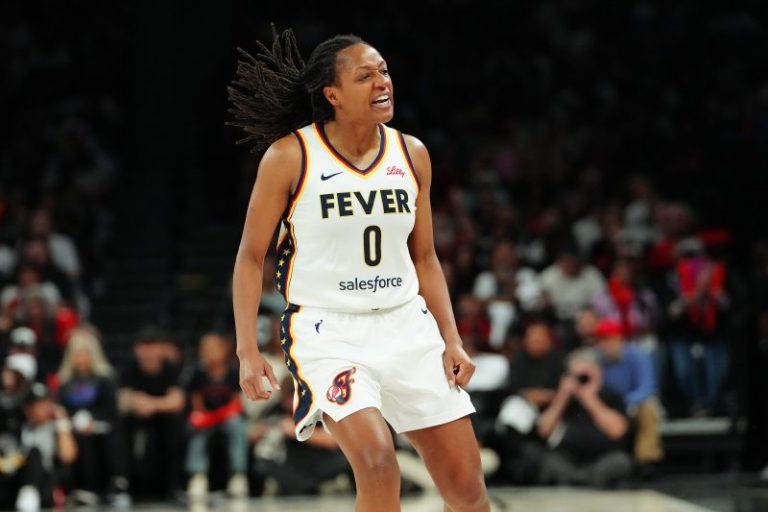
            All-Star guard Kelsey Mitchell was asked about her future with the Indiana Fever at the team’s exit interviews on Thursday, Oct. 2 in Indianapolis. Her answer was a dire warning.

            ‘I hope we got a league,’ Mitchell said. ‘I hope that when it’s all said and done … we can have a season, period. For all the girls, every person, that has aspirations to be in the league … that’s the start.

            ‘Having a league is kind of big for us.’

            The collective bargaining agreement is set to expire on Oct. 31, and the WNBA and its players are not close to a deal. The players union opted out of the CBA, which was set to expire in 2027, last year. Indiana’s Caitlin Clark was succinct when stating how big October will be for the WNBA. The All-Star guard, who brought many fans to the league after her record-setting career at Iowa, emphasized working together to find a solution.

            ‘We are in the biggest moment in WNBA history. … Everybody that’s in a place of power has a true responsibility,’ the All-Star guard said. ‘We have a responsibility to make sure that this game is in a great place going forward with the CBA, caring for our players and building this league to make sure it’s in a great spot for many years to come.

            ‘We’re in a moment in time where the WNBA has never been hotter, there’s never been more fans.’

            Revenue sharing is the biggest obstacle for both sides in getting to a new agreement. The maximum salary in the league under the current CBA is $215,000 and the average is $130,000. Revenues are climbing with a new $200 million-a-year media deal set to start next season, sold-out arenas and fans buying merchandise. Players want a share of that growth.

            Fever guard Sophie Cunningham said the players will get a ‘much needed’ update on CBA talks on a call Thursday afternoon. They are also looking to lock in charter flights, which were never codified in the CBA, and talk about safety, given the number of injuries and concern about officiating.

            WNBA commissioner Cathy Engelbert has a news conference scheduled with reporters Friday night in Las Vegas ahead of Game 1 of the WNBA Finals between the Phoenix Mercury and Las Vegas Aces.

            ‘I promise you: We’re not going to play until they give us what we deserve,’ Cunningham said. ‘And that (a lockout) is where it’s headed, unfortunately, which would be the dumbest basketball decision business-wise ever considering all the momentum the W has now.”

            This post appeared first on USA TODAY

            NEW YORK – A fourth-inning blitz and a 6-foot-6 beast of a rookie were all the New York Yankees needed to finally conquer their heated rivals in an elimination game.

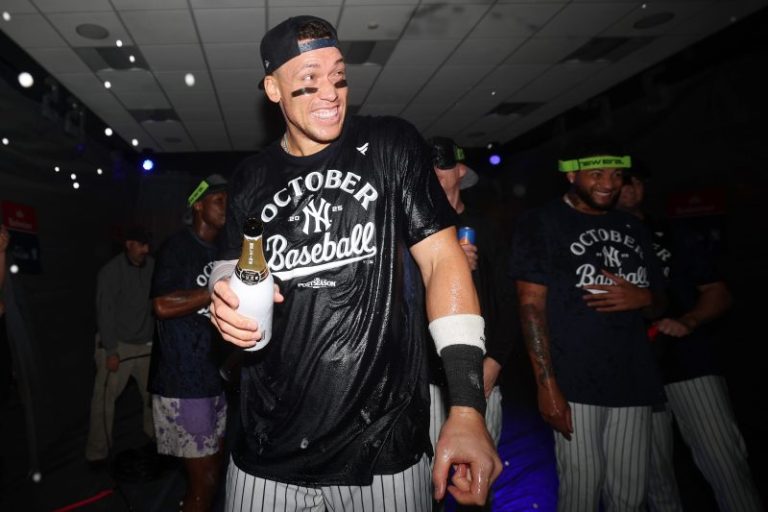
            Cam Schlittler, touching 98 to 100 mph on 64 of his 107 pitches, blasted through a largely overmatched Boston Red Sox lineup to strike out 12 and toss eight shutout innings, and a four-run rally started by a well-placed bloop double gave him more than enough support as the Yankees defeated the Red Sox 4-0 in the decisive Game 3 of their American League wild-card series Oct. 2.

            The Yankees advance to the AL Division Series against the Toronto Blue Jays, beginning Oct. 4 at Rogers Centre as they aim to vanquish two division rivals on their path to defending their pennant.

            ASK US ANYTHING: Get your burning MLB questions answered

            They won 94 games this season, five more than Boston and as many as Toronto, yet had to take the long, difficult and ultimately historic path to advancing out of this best-of-three series.

            In the four-year history of this format, the 14 teams that won Game 1 went on to win the series, with the Detroit Tigers and Chicago Cubs taking care of business in their Game 3s by the time the first pitch was thrown at Yankee Stadium.

            But the Yankees fell 3-1 in Game 1 and battled back for a 4-3 victory in Game 2, setting up this clash of rookies in the finale.

            And it was taut, and tension-filled – for the first three innings.

            Schlittler, who set a Yankees rookie record for strikeouts in a playoff start, and Red Sox lefty Connelly Early were equally on point, each striking out five through three innings, a relief to their managers after a pair of late-night bullpen wars in the first two games. But when Cody Bellinger skied a fly between a trio of Red Sox fielders in shallow right center field, Yankee Stadium thrummed with energy to start the bottom of the fourth.

            Early’s most crucial mistake came next – a walk to Giancarlo Stanton, which preceded consecutive singles by Amed Rosario, Jazz Chisholm and Anthony Volpe to give New York a 2-0 lead.

            The game was all but iced a batter later, when Austin Wells yanked a hard-hit ball right at Boston first baseman Nathaniel Lowe. He could not make the short-hop pick, and the ball ricocheted into right field. Two more runs, and a 4-0 advantage that Schlittler never put in jeopardy.

            When he came back out for the top of the eighth inning, the crowd roared in approval – and got even louder when he struck out Romy Gonzalez to start the inning. It reached a crescendo when he induced a groundout of Trevor Story to end the eighth – retreating to a series of high fives from his dugout.

            A scoreless ninth from David Bednar ended it and halted the Red Sox’s three-game streak of elimination game triumphs over New York, beginning with the gutting 2004 ALCS Game 7 loss, continuing with the 2018 ALDS and the 2021 wild-card game.

            This time, there’d be no Boston magic – just third baseman Ryan McMahon going head-over-heels to snare a foul pop from Jarren Duran and secure the second out in the eighth.

            As he flipped over, his No. 19 was exposed for all the world to see – the same number Aaron Boone wore in 2003 ALCS Game 7, when his home run sent Boston home for the winter.

            Now, the demons of their past three meetings have been exorcised – and the Yankees, once again, will play on.

            – Gabe Lacques

            Cam Schlittler tosses eight scoreless innings

            With a 4-0 lead, Aaron Boone made a surprise decision to bring Cam Schlittler back out for the eighth and the rookie rewarded his manager, getting through the inning on just seven pitches. He added his 12th strikeout of the night and third baseman Ryan McMahon made an unbelievable grab falling into the Red Sox dugout to catch a foul ball.

            Cam Schlitter becoming Yankees legend?

            The Yankees are six outs from advancing to the ALDS as Cam Schlittler has allowed five hits and no runs, while striking out 11 and no walks on 100 pitches through six innings.

            The last time the Yankees blew a four-run lead in the postseason was Game 5 of the 2024 World Series against the Los Angeles Dodgers, a game they lost 7-6, which handed the Dodgers the championship.

            Schlittler’s 11 strikeouts are the most by a Yankees rookie pitcher in a postseason game.

            Yankees break open game in fourth inning

            Two Boston outfielders and the second baseman failed to catch a high pop-up to center by Cody Bellinger, allowing him to end up with a leadoff double. Amed Rosario plated the game’s first run with a single to left, and Anthony Volpe’s bases-loaded single to right scored another run.

            Austin Wells then chopped a ball to first that was mishandled by Nathaniel Lowe, scoring two more for a 4-0 New York lead, ending the night of Red Sox starter Connelly Early. The rookie went 3 ⅔ innings, allowing three earned runs on six hits with five strikeouts and one walk in 78 pitches. Early was replaced by reliever Justin Slaten, who hit Aaron Judge with a pitch to load the bases but got Cody Bellinger to fly out and end the inning after 10 Yankees came to the plate.

            Yankees waste Giancarlo Stanton’s leadoff double

            Giancarlo Stanton got the bottom of the second started with a leadoff double to deep left, but the Yankees couldn’t capitalize, as Ben Rice struck out swinging on a filthy sweeper, Amed Rosario popped out to center and Jazz Chisholm Jr. struck out looking.

            Connelly Early makes quick work of Yankees in first

            Connelly Early, the 23-year-old starter for the Red Sox, started by quickly striking out Trent Grisham on five pitches. Aaron Judge then flew out to center, and Cody Bellinger grounded out to shortstop on consecutive pitches. Very efficient start for Early.

            Nothing doing for Red Sox in first inning

            Yankees starter Cam Schlittler took the hill on a 60-degree night and didn’t look like a rookie in the first inning, getting leadoff hitter Jarren Duran to line out to second, before Trevor Story popped out and Alex Bregman ended the inning by striking out looking.

            Bucky Dent throws first pitch at Yankee Stadium

            Red Sox lineup today

            1. Jarren Duran (L) LF
            2. Trevor Story (R) SS
            3. Alex Bregman (R) 3B
            4. Masataka Yoshida (L) DH
            5. Ceddanne Rafaela (R) CF
            6. Nathaniel Lowe (L) 1B
            7. Carlos Narváez (R) C
            8. Wilyer Abreu (L) RF
            9. Romy Gonzalez (R) 2B

            Yankees lineup today

            1. Trent Grisham (L) CF
            2. Aaron Judge (R) RF
            3. Cody Bellinger (L) LF
            4. Giancarlo Stanton (R) DH
            5. Ben Rice (L) 1B
            6. Amed Rosario (R) 3B
            7. Jazz Chisholm Jr. (L) 2B
            8. Anthony Volpe (R) SS
            9. Austin Wells (L) C

            Connelly Early is Red Sox starting pitcher

            NEW YORK — Who is Connelly Early, you ask?

            He’s less than a month removed from his major league debut, which came Sept. 9, which was just a little more than a year since he was toiling for the Class A Greenville (S.C.) Drive in the South Atlantic League.

            And now? A win-or-go-home game, before nearly 50,000 in Yankee Stadium, barely two years removed from the University of Virginia.

            Nervous, kid?

            ‘Let’s go. Let’s do it,’ Early said after the Red Sox suffered a 4-3 loss in Game 2, and roughly a couple minutes after pitching coach Andrew Bailey told him it was his ball for Game 3.

            – Gabe Lacques

            Jarren Duran

            Jarren Duran tries to get over Game 2 misplay

            NEW YORK — Technically, Jarren Duran was not charged with an error on Aaron Judge’s fifth-inning fly to left that he came in on, dove for and then, simply, dropped. Catching it would’ve ended the inning, kept the score tied 2-2, and Trevor Story’s homer the next inning would’ve given Boston the lead, rather than tie it.

            The final four innings had enough drama that Duran’s semi-muff got largely forgotten. Duran will have a lot more trouble turning the page.

            “This one’s going to sting a little bit. I know this game is 100% on me,” Duran said. “Trevor hits the homer, we take the lead. I messed it up, gave them momentum. But that one’s on me. I’m going to have to wear that one.

            “I’m excited to play tomorrow and redeem myself.”

            – Gabe Lacques

            This post appeared first on USA TODAY

            Sophie Cunningham hasn’t been at a press conference in a minute. The guard, who played 30 games before tearing the MCL in her right knee in August, had plenty to share at her Indiana Fever exit interview on Thursday.

            Cunningham took aim at WNBA officials and leadership in her 12 minutes at the dais.

            ‘Our leadership needs to be held accountable,’ Cunningham said. ‘I think that there are a lot of people in position of power. They might be really great business people, but they don’t know s— about basketball.’

            The Las Vegas Aces eliminated the Indiana Fever from the postseason in overtime in Game 5 of the semifinals Tuesday. Cunningham alluded to player safety as it relates to officiating and said the WNBA’s powerbrokers may not have a handle on what needs to change.

            “It’s bad when fans and players, especially players, when we’re competing at the highest level, and it’s like a battlefield out there,’ Cunningham said. ‘(Opposing players are) agreeing on the court because of how awful the officials are. That’s saying something. Listen to us.

            “There is room for improvement to change the criteria (for flagrant fouls) when the whole league is asking for it,’ she added.

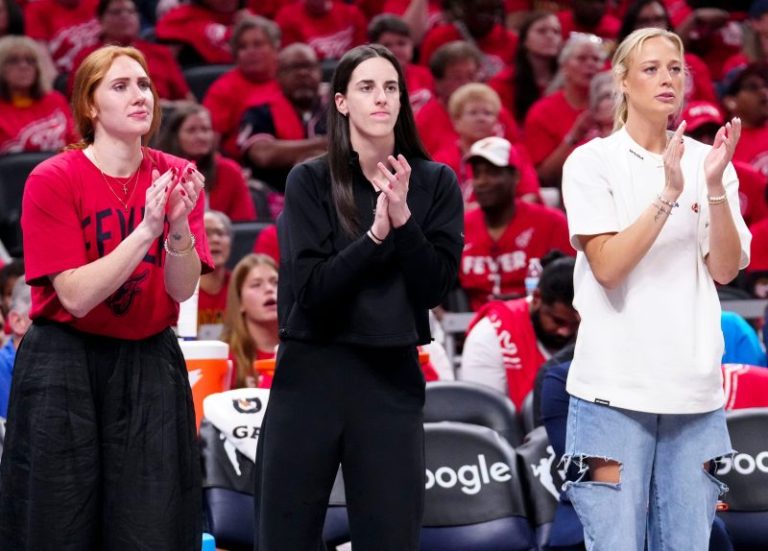
            Cunningham said she was proud of how the Fever fought to stay alive in the playoffs despite losing five players, including Caitlin Clark, to season-ending injuries. They finished 24-20 and advanced to the postseason for the second straight year, upsetting the Atlanta Dream in the first round before falling to the Aces.

            ‘The way fans embraced us from all over the world, reaching out to us, it was truly awesome, inspiring,’ she said ‘But it was also the season from hell and hopefully this never happens again.’

            Cunningham, who was on a one-year deal after playing six seasons with the Phoenix Mercury, said she will listen to all offers this offseason but did not rule out returning to the Fever.

            ‘I love being here and I don’t think that’s news to anybody.’ the Missouri grad said. ‘Just being back in the Midwest, being around girls who you truly do love.

            ‘I had a great time here and I’d like to continue that.’

            This post appeared first on USA TODAY

            Longtime MLB scout Dick Groch died Wednesday, according to his family. He was 84 years old.

            A cause of death was not disclosed.

            Groch worked in the scouting department throughout his MLB career with the New York Yankees, Montreal Expos and Milwaukee Brewers.

            The Yankees held a moment of silence for Groch before Game 3 of their American League Wild Card Series against the Boston Red Sox on Thursday.

            For the Yankees, Groch was tasked with scouting Derek Jeter in 1992 and determining whether he was considering playing at the University of Michigan.

            Groch thought highly of Jeter. He believed Jeter had the potential to be a Hall of Fame player. 

            The scout said, per the Yankees, ‘He’s not going to the University of Michigan; the only place Derek Jeter is going is Cooperstown.”

            After 20 years with the Yankees, the shortstop was selected as a first-ballot Hall of Famer in 2020.

            ‘RIP Dick Groch. My Yankees scout who believed in me and signed me,’ Jeter wrote on social media. ‘Thoughts and prayers are with your family and loved ones.’

            Groch left the Yankees in 2002, following Doug Melvin to the Milwaukee Brewers.

            This post appeared first on USA TODAY