Author

admin

Browsing

It would appear that Mr. Finebaum might want to go to Washington.

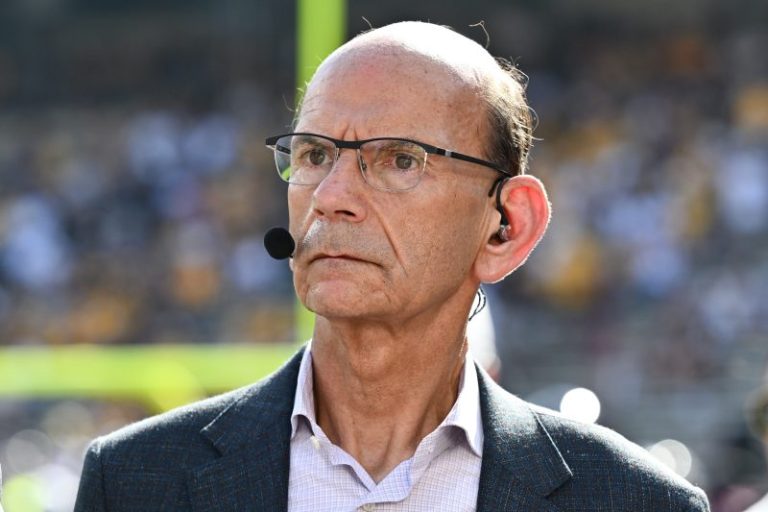
Paul Finebaum, ESPN host and dean of college football radio, said in an interview with Outkick published Sept. 29 that he is interested in running for a U.S. Senate seat in Alabama that will be contested in the 2026 mid-term elections.

“The biggest issue is the direction of ‘Where are we going [as a country]?’ And I don’t like some of that,” Finebaum said. 

He added that he would like to make a decision within the next 30 to 45 days.

“I’ve been made aware that the qualifying deadline is in January. That’s ideal. I’d love to get to the end of the season. I don’t know if that’s realistic,” Finebaum said. The deadline to jump into the primary race is Jan. 23, 2026, according to Ballotpedia.

Finebaum would not be the first Alabama college sports figure linked to the seat of former Auburn head football coach Tommy Tuberville. Former Auburn head basketball coach Bruce Pearl said in his retirement announcement that he considered a run for the seat but decided against it.

“Many of you know that I thought and prayed about maybe running for United States Senate,” Pearl said. “That would have required leaving Auburn, and instead, the university has given me an opportunity to stay here and be Auburn’s senator.”

Finebaum told Outkick that Pearl’s announcement that he would not jump into the race opened the door to considering it.

“I ended up talking to someone… who made it clear that there was a desire for me to be involved. And this person… was compelling and compassionate in the approach to me, and I started thinking about this,” he said.

Charlie Kirk’s murder inspired Finebaum’s Senate aspirations

Finebaum pointed to the killing of conservative commentator Charlie Kirk on Sept. 10 as an inspiration to consider jumping into the political arena.

“It’s hard to describe, not being involved in politics, how that affected me and affected tens of millions of people all over this country. And it was an awakening,” Finebaum said.

Outkick, the conservative sports outlet, reported that Finebaum has been hesitant to discuss his politics due to ESPN policy and not to alienate his audience.

The host of “The Paul Finebaum Show” said that he recently moved back to Alabama, where his career began as a reporter and columnist for the Birmingham Post-Herald, after relocating from North Carolina, and he would run as a Republican. He added that he would run if asked by President Donald Trump.

“Impossible to tell him no. There’s no way I could,” Finebaum said.
This post appeared first on USA TODAY

The next domino in college athletes’ rights and Name, Image and Likeness legislation tipped Monday night.

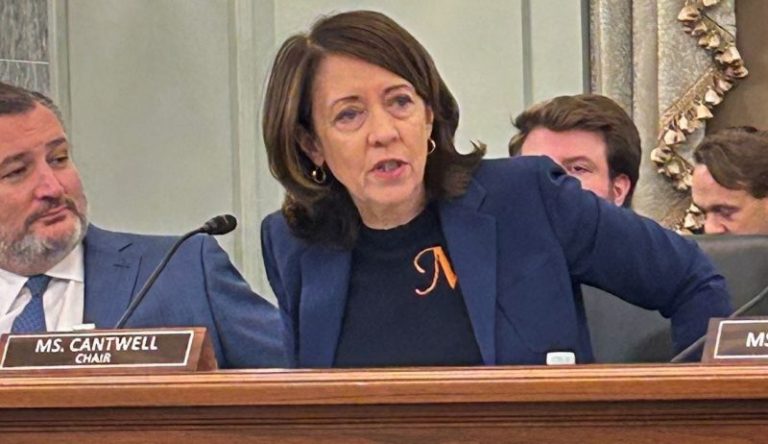
U.S. Sens. Maria Cantwell (D-Wash.), Cory Booker (D-N.J.), and Richard Blumenthal (D-Conn.) introduced the Student Athlete Fairness and Enforcement (SAFE) Act, aiming ‘to codify athletes’ rights and protections in law, expand revenue for all schools, support women’s and Olympic sports and bring much-needed stability to the college sports system.’

The key provisions in the bill provide federal NIL protections, pooling of media rights, new broadcast revenue for Olympic and women’s sports, local market broadcast access for football and basketball, protections from bad actor agents, national standards for the transfer portal and preserves the House vs. NCAA settlement’s 22% revenue share cap.

‘This legislation is a path through the new world of NIL,’ Cantwell said in a statement. ‘This bill will protect athlete rights, preserve women’s and Olympic sports and help smaller schools compete. It is a fair shake for everyone, instead of the biggest, richest schools.’

Cantwell released a report in August showing how the SEC and Big Ten have severely outpaced the remaining conferences in financial firepower, primarily with their lucrative media rights payments.

The bill proposes amending the Sports Broadcasting Act of 1961 to allow schools to negotiate media rights as a group to increase value without violating antitrust laws. It states schools must use increased media rights revenues to keep the same number of scholarships and roster sports for non-revenue generating and women’s sports as provided during 2023-24 academic year.

And it says football and basketball games must be provided to local markets on a local broadcast outlet and not behind a paywall.

‘Those closest to college sports — including student-athletes and leaders of America’s colleges and universities at all levels — have consistently called on Congress to take action and address the actual threats facing college athletics,’ NCAA senior vice president for external affairs Tim Buckley said in a statement. ‘This includes protecting student-athletes from being forced to become employees, and ensuring academic standards and other commonsense rules can be applied consistently. There has never been more momentum in Congress to address these challenges and the NCAA will continue to work with all lawmakers to maximize opportunities for America’s 500,000-plus student-athletes.’

Among its provisions, if passed through Congress the SAFE Act would:

  • Provide federal NIL rights, replacing patchwork state-by-state laws.
  • Establish health and safety standards for heat exertion, brain injury, asthma; provide five years of post-eligibility medical coverage for sports-related injuries.
  • Protect scholarships, a 10-year guarantee.
  • Provide NIL contracts that outline what athletes must do under the contract and how much they’ll be paid.
  • Require agents cap their fees at 5% and to register with a state.
  • Allow students to transfer twice without having to sit out for a year; students can transfer without having to sit out for a year if their sport is cut or reduced.

This legislation is in response to the House introducing the Student Compensation and Opportunity through Rights and Endorsements (SCORE) Act. Cantwell, the top Democrat on the U.S. Senate Commerce Committee, on Aug. 25 sent a letter to NCAA Division I school chief executive officers and governing boards to “express my deep concerns” about a Republican-authored college-sports bill that has passed two House of Representatives committees.

The SCORE Act, the bill would establish a variety of national rules concerning how college sports operate. It includes antitrust-exemption language that specifically would allow the NCAA, and potentially the new College Sports Commission, to make operational rules affecting schools and athletes in areas that have come into legal dispute in recent years. That would include rules about transfers and the number of seasons for which athletes can compete.

Cantwell specifically claimed the bill’s language would allow the NCAA to alter the House settlement’s basic metric for determining the amount of money athletes would be able to receive in so-called revenue-sharing payments from schools so that it could increase from the 22% of certain revenues of the association’s power-conference schools.

‘In stark contrast to harmful legislation being considered in the House, our bill preserves athletes’ rights to advocate for themselves and ensures meaningful avenues for accountability,’ said Booker, who played football at Stanford. ‘Playing college football was one of the great gifts of my life – and it instilled in me a lasting conviction to fight for justice and fairness for athletes today and into the future.’

(This story was updated to add new information.)

This post appeared first on USA TODAY

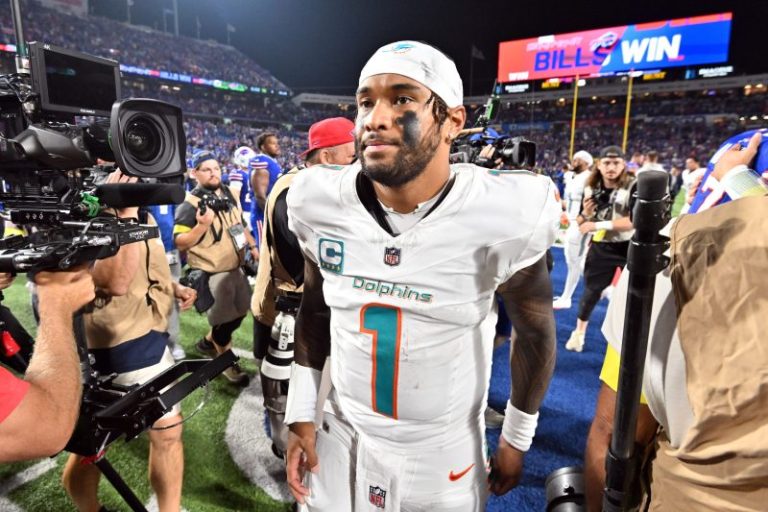
For a second straight Miami Dolphins home game, air traffic over Hard Rock Stadium was conspicuously busy.

The Dolphins are hosting their second home game of the season on Monday night in a prime-time clash with the New York Jets. And Dolphins fans are sponsoring a second plane banner to fly over the team’s home stadium this season to voice their frustrations.

‘Help wanted: new coach, new GM, new QB,’ read the banner flying over Hard Rock Stadium on Monday night.

Two weeks prior, ahead of the Dolphins’ home opener against the New England Patriots, a plane flew over the stadium with a different banner that read, ‘Fire (Dolphins general manager Chris) Grier. Fire (Dolphins head coach Mike) McDaniel.’

Monday night’s banner notably added a new subject of Dolphin fan frustration: quarterback Tua Tagovailoa.

Through three games, Tagovailoa has thrown four interceptions and fumbled twice while failing to record more than 200 passing yards in two out of his three outings. That’s led to a ranking of 31st of 34 NFL quarterbacks with a minimum of 64 plays in expected points added per play (-0.84), a PFF grade (52.9) that ranks 34th of 38 quarterbacks and a QBR (35.2) ranked 29th of 33.

The only quarterbacks with consistently worse or similar rankings in each category this season are Tennessee Titans rookie quarterback Cam Ward and the Cleveland Browns’ 40-year-old, veteran gunslinger Joe Flacco.

Meanwhile, Grier has been the team’s head executive since 2016, making him the third-longest-tenured GM in the team’s history. Miami holds a 75-76 record since he took over and are 0-3 in the playoffs.

McDaniel joined Miami as its head coach in 2022. He’s led the team to a 28-26 record since, including two playoff appearances in 2022 and 2023. Both ended with losses in the wild-card round.

The Dolphins lost their Week 1 game against the Indianapolis Colts, 33-8, hosted the New England Patriots in a 33-27 home opener loss in Week 2 and fell to the Buffalo Bills, 31-21, in Week 3’s ‘Thursday Night Football’ game.

This post appeared first on USA TODAY

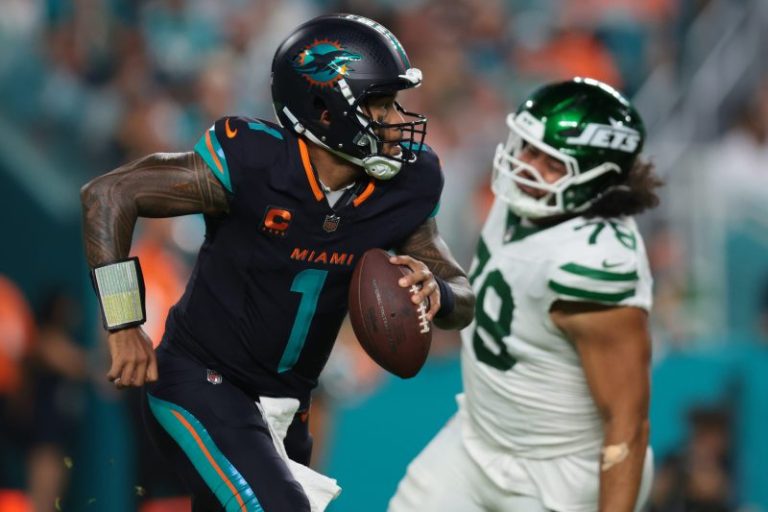
Off to an 0-3 start and with coach Mike McDaniel seemingly on one of the league’s hottest seats, the Miami Dolphins are already in deep water to start the 2025 NFL season. So maybe it’s a good time for them to break out their Nike “Rivalries” uniforms – the Fins’ version dubbed “Dark Waters.” Miami becomes the second team to don the new alternates, revealed by the sportswear apparel giant last month, joining the Arizona Cardinals, who rocked their “Built to Last” alternates Thursday.

Per Nike, Miami’s look is meant to convey speed and South Florida’s night life in what’s officially a “dark pitch-blue” colorway with hits of “Turbo Green,” and the club’s standard aqua and orange.

What’s new about the Dolphins’ ‘Rivalries’ uniforms?

For a team that’s historically embraced South Florida’s vibrant colors – aqua, orange or white jerseys – this dark version is quite a departure for the Dolphins, who are basically offering their fans something akin to the black alternates so many pro teams have in their wardrobes.

Per the team’s website, “This design is unlike any before, featuring dark aquatic tones made to represent a team who hunts in dark waters. Complete with orange accents and sleek dark blue touches throughout, these uniforms are as fierce as the competition between longtime rivals when they meet in prime time.”

“Go Fins” is embroidered inside the collar. Miami’s 305 area code appears above the facemask.

“The Jets have always been our biggest rival,” legendary Dolphins wideout Nat Moore told Nike in conjunction with the uniform launch in August.

“They’re the team that, no matter what their record is, they’re always going to play us tough. Whether the game was down in Miami or up in New York, you just knew how important it was to the fans. And with so many New Yorkers living in South Florida, the rivalry just feels that much more real.”

What are NFL ‘Rivalries’ uniforms by Nike?

Think of them as the football version of the sports apparel company’s NBA ‘City Edition’ uniforms or Major League Baseball’s ‘City Connect’ jerseys. Signaled during the NFL draft and unveiled in August, Nike has strived to create something that further strengthens NFL teams’ bonds to their unique civic environments. And, as “rivalries” would suggest, all of them will be worn in intra-divisional matchups.

‘The 2025 Rivalries uniforms will celebrate storied local traditions and unite fan communities with designs unique to select cities and teams,” Nike announced during the rollout.

‘The designs are rooted extensively in the legacies and inspirations true to each team, serving as authentic, competitive expressions of community pride while giving athletes and fans an opportunity to connect like never before.’

Which NFL teams have ‘Rivalries’ uniforms?

Eventually all of them. But for 2025, each team in the AFC East and NFC West is scheduled to wear their “Rivalries” unis one time this season. Two additional divisions will be added to the rotation in each of the next three seasons, and the “Rivalries” option then becomes part of a team’s closet for the following three years.

When will NFL teams wear ‘Rivalries’ uniforms in 2025?

 Buffalo Bills: Oct. 5 vs. New England Patriots

 Los Angeles Rams: Nov. 16 vs. Seattle Seahawks

 New England Patriots: Nov. 13 vs. New York Jets

 New York Jets: Dec. 7 vs. Miami Dolphins

 San Francisco 49ers: Jan. 4, 2026 vs. Seattle Seahawks

 Seattle Seahawks: Dec. 18 vs. Los Angeles Rams

This post appeared first on USA TODAY

Copper Quest Exploration (CSE:CQX, OTCQB:IMIMF, FRA:3MX) is focused on creating shareholder value through the exploration and development of its North American critical mineral portfolio, with more than 40,000 hectares across tier-one jurisdictions in Canada and the US.

In British Columbia, the company’s assets include the Stars copper-molybdenum discovery in the Bulkley Porphyry Belt, the Stellar property with historic showings and new anomalies, an earn-in on the Rip project, a large porphyry copper-molybdenum system, and the Thane Project in the Toodoggone Belt, prospective for copper-gold-molybdenum.

The Stars project is a 9,694-hectare, road-accessible copper-molybdenum property in the prolific Bulkley Porphyry Belt, home to past producers such as Imperial Metals’ Huckleberry mine and Newmont’s Equity Silver Mine. Stars is defined by a 5 × 2.5 km annular magnetic anomaly coincident with a mineralized monzonite intrusion. Drilling in 2018 confirmed a significant porphyry system at the Tana Zone, highlighted by intercepts of 0.466 percent copper over 195.1 meters from 23 meters, including 40 meters averaging nearly 1 percent copper, and 0.20 percent copper over 396.7 meters from 28 meters. All holes to date have returned copper levels well above background, with alteration, intrusive textures, and veining typical of productive porphyry systems.

Company Highlights

  • Large, Tier-one Land Position: More than 40,000 hectares across British Columbia’s Bulkley and Toodoggone Porphyry Belts, plus a newly acquired copper-gold porphyry project in Idaho, USA.
  • Flagship Discovery at Stars: Drill intercepts of 0.466 percent copper over 195.1 m confirm a fertile porphyry copper-molybdenum system with over 30 km of untested intrusive contacts.
  • Multiple Copper Systems: Canadian portfolio includes Stars, Stellar, Rip (earn-in up to 80 percent) and Thane, each offering district-scale potential in proven belts.
  • Idaho Acquisition: The Nekash copper-gold porphyry project in Lemhi County, Idaho, is a milestone acquisition aligned with its strategy to build a portfolio of highly prospective copper assets across North America.

This Copper Quest Exploration profile is part of a paid investor education campaign.*

Click here to connect with Copper Quest Exploration (CSE:CQX) to receive an Investor Presentation

This post appeared first on investingnews.com

Golconda Gold (TSXV:GG) is a growth-focused junior producer with operations in prolific gold districts in South Africa and the US. Positioned as one of the sector’s highest-torque opportunities, Golconda offers investors profitable production, exposure to both gold and silver, and a disciplined, capital-efficient path to meaningful growth.

Golconda Gold is anchored by two cornerstone assets: Galaxy, its cash-flowing South African gold mine, and Summit, a high-grade silver-gold project in New Mexico set for restart. Together, they provide self-funded growth, U.S. exposure, and strong leverage to rising gold prices.

Galaxy, Golconda’s cornerstone asset, is a producing mine in South Africa’s prolific Barberton Greenstone Belt. The operation hosts 941,000 oz gold (M&I, 2.79 g/t) and 1.37 Moz inferred (2.62 g/t), supported by strong infrastructure and access to skilled mining services.

Company Highlights

  • Significant Production Growth: On track to triple production over three years at Galaxy while bringing Summit online in Q2 2026.
  • Summit Restart and Spin-out: Fully permitted past-producing mine in New Mexico, expected to restart in Q2 2026 and spin out as a standalone US-focused gold-silver producer in Q4 2026.
  • No Dilution Strategy: Growth funded through operating cash flow rather than equity raises, ensuring torque to gold without shareholder dilution.
  • Insider Alignment: Management and insiders control more than 40 percent of shares, aligning leadership directly with shareholder interests.
  • Jurisdictional Strengths: Operations in South Africa’s Barberton Greenstone Belt (long history of gold mining, strong infrastructure) and in the US southwest.
  • Exploration Upside: Both Galaxy and Summit hold substantial untested upside with additional ore bodies and underexplored zones.

This Goldconda Gold profile is part of a paid investor education campaign.*

Click here to connect with Goldconda Gold (TSXV:GG) to receive an Investor Presentation

This post appeared first on investingnews.com

Locksley Resources (ASX:LKY,OTCQB:LKYRF,FSE:X5L) is a US-focused critical minerals company advancing high-grade rare earth elements (REEs) and antimony at its flagship Mojave project in California. Located just 1.4 kilometers from Mountain Pass — North America’s only producing REE mine — Locksley is strategically positioned to support the U.S. drive to onshore critical mineral supply chains, reduce dependence on China, and secure essential inputs for defense, clean energy, and advanced technologies.

The Mojave Project, Locksley’s flagship asset, is among the most strategically located critical minerals projects in the US Spanning 491 claims adjacent to MP Materials’ world-class Mountain Pass mine, Mojave offers Tier-1 infrastructure with highway access and proximity to Las Vegas. Drilling permits for REE and antimony targets are approved, and the 2025 exploration program is fully funded.

Company Highlights

  • US-focused Critical Minerals Strategy: Targeting antimony and rare earths, both on the US critical minerals list, at the Mojave project in California, within a federally prioritized supply chain hub.
  • Tier-1 Location: Just 1.4 km from the Mountain Pass mine, the only REE producer in the US, with highway access, infrastructure and proximity to major defense and technology industries.
  • Drill-ready and Fully Funded: Approvals secured for both antimony and REE drilling programs, with initial campaigns set for 2025.
  • Downstream Innovation: Partnership with Rice University to advance DeepSolv solvent-based processing technology for antimony and investigate applications in next-generation energy storage.
  • Government and Institutional Pathways: Positioned to benefit from US policies, Department of Defense initiatives, EXIM Bank financing and Department of Energy funding.

This Locksley Resources profile is part of a paid investor education campaign.*

Click here to connect with Locksley Resources (ASX:LKY,OTCQB:LKYRF,FSE:X5L) to receive an Investor Presentation

This post appeared first on investingnews.com

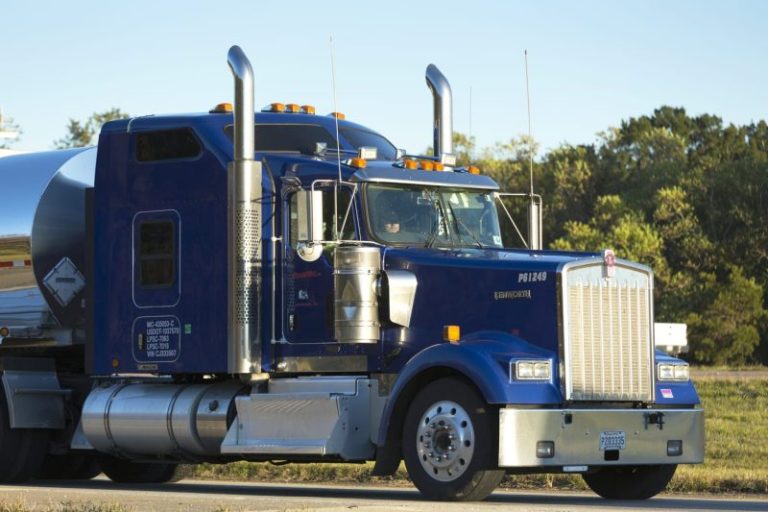
President Donald Trump on Thursday announced a new round of punishing tariffs, saying the United States will impose a 100% tariff on imported branded drugs, 25% tariff on imports of all heavy-duty trucks and 50% tariffs on kitchen cabinets.

Trump also said he would start charging a 30% tariff on upholstered furniture next week.

He said the new heavy-duty truck tariffs were to protect manufacturers from “unfair outside competition” and said the move would benefit companies such as Paccar-owned PCAR.O Peterbilt and Kenworth and Daimler Truck-owned DTGGe.DE Freightliner.

Trump has launched numerous national security probes into potential new tariffs on a wide variety of products.

He said the new tariffs on kitchen, bathroom and some furniture were because of huge levels of imports that were hurting local manufacturers.

“The reason for this is the large-scale ‘FLOODING’ of these products into the United States by other outside Countries,” Trump said, citing national security concerns about U.S. manufacturing.

The U.S. Chamber of Commerce urged the department not to impose new tariffs, noting the top five import sources are Mexico, Canada, Japan, Germany and Finland “all of which are allies or close partners of the United States posing no threat to U.S. national security.”

Mexico is the largest exporter of medium- and heavy-duty trucks to the United States. A study released in January said imports of those larger vehicles from Mexico have tripled since 2019.

Higher tariffs on commercial vehicles could put pressure on transportation costs just as Trump has vowed to reduce inflation, especially on consumer goods such as groceries.

Tariffs could also affect Chrysler-parent Stellantis STLAM.MI, which produces heavy-duty Ram trucks and commercial vans in Mexico. Sweden’s Volvo Group VOLVb.ST is building a $700 million heavy-truck factory in Monterrey, Mexico, set to start operations in 2026.

Mexico is home to 14 manufacturers and assemblers of buses, trucks, and tractor trucks, and two manufacturers of engines, according to the U.S. International Trade Administration.

The country is also the leading global exporter of tractor trucks, 95% of which are destined for the United States.

“We need our Truckers to be financially healthy and strong, for many reasons, but above all else, for National Security purposes!” Trump added.

Mexico opposed new tariffs, telling the Commerce Department in May that all Mexican trucks exported to the United States have on average 50% U.S. content, including diesel engines.

Last year, the United States imported almost $128 billion in heavy vehicle parts from Mexico, accounting for approximately 28% of total U.S. imports, Mexico said.

The Japanese Automobile Manufacturers Association also opposed new tariffs, saying Japanese companies have cut exports to the United States as they have boosted U.S. production of medium- and heavy-duty trucks.

This post appeared first on NBC NEWS

Investor Insight

With a growth-oriented strategy, Golconda Gold is positioning itself as one of the highest-torque junior gold producers in the sector with assets in prolific gold districts in South Africa and the US. For investors bullish on gold, Golconda is a unique opportunity: a profitable producer with meaningful growth ahead, exposure to both gold and silver, and the discipline to deliver shareholder value in a capital-efficient way.

Overview

Golconda Gold (TSXV:GG;OTCQB:GGGOF) is an unhedged gold producer and explorer with operations in South Africa and the United States. The company is focused on optimizing its current mining and processing operations, reducing costs, and growing organically while pursuing accretive acquisition opportunities.

Its growth story is underpinned by two cornerstone assets: Galaxy Gold, the company’s cash-flowing, long-life South African operation; and Summit, a high-grade silver-gold project in New Mexico poised for a restart. Galaxy provides a steadily growing, self-funded production base, while Summit is positioned as the next major catalyst for Golconda, broadening investor exposure to silver and US operations. These assets enable Golconda to deliver meaningful production growth without dilution, providing investors direct leverage to gold prices at a time when juniors remain undervalued relative to commodity prices.

With strong insider ownership and a disciplined approach to capital, Golconda offers investors a unique combination of operating stability, near-term growth and upside exploration potential.

Company Highlights

  • Significant Production Growth: On track to triple production over three years at Galaxy while bringing Summit online in Q2 2026.
  • Summit Restart and Spin-out: Fully permitted past-producing mine in New Mexico, expected to restart in Q2 2026 and spin out as a standalone US-focused gold-silver producer in Q4 2026.
  • No Dilution Strategy: Growth funded through operating cash flow rather than equity raises, ensuring torque to gold without shareholder dilution.
  • Insider Alignment: Management and insiders control more than 40 percent of shares, aligning leadership directly with shareholder interests.
  • Jurisdictional Strengths: Operations in South Africa’s Barberton Greenstone Belt (long history of gold mining, strong infrastructure) and in the US southwest.
  • Exploration Upside: Both Galaxy and Summit hold substantial untested upside with additional ore bodies and underexplored zones.

Key Projects

Galaxy Gold Mine

Galaxy is Golconda’s cornerstone asset and currently the company’s sole producing mine. Situated in the Barberton Greenstone Belt, one of South Africa’s most prolific gold districts with nearly 150 years of mining history, the mine benefits from established infrastructure, sealed-road access and proximity to skilled mining services. The property hosts a large resource base of 941,000 oz of gold in the measured and indicated categories grading 2.79 grams per ton (g/t), plus 1.37 million oz (Moz) inferred at 2.62 g/t.

Snapshot of Galaxy Gold Mine Operations

The operation is an underground, trackless mechanized mine, currently producing at a run rate of ~12,000 oz/year, with a multi-stage ramp-up plan to 25,000 oz/year by 2027 and up to 45,000 oz/year by 2028. Ore is processed through a 50,000 tonnes per month (tpm) crush-mill-float plant, which was refurbished with a new mill, concentrate tanks, and a filter press. The plant is already capable of handling the full ramp-up capacity, allowing it to expand with minimal capital outlay.

Galaxy produces a refractory gold concentrate sold directly to Ocean Partners, eliminating the need for BIOX or other complex high-capex processing routes. This low-risk sales model enables Galaxy to operate profitably and reinvest cash flow into mine development. The mine plan leverages both the Princeton and Galaxy ore bodies, with development into additional levels and ore bodies among the 21 known mineralized zones on the property. Over its history, Galaxy (formerly, the Agnes mine) has produced more than 1.3 Moz of gold, with current exploration drilling continuing to identify significant upside at depth and along strike.

Economically, Galaxy is highly accretive: at $3,000/oz gold, the operation generates an after-tax NPV5 percent of US$201 million, with life-of-mine free cash flow exceeding US$270 million on conservative assumptions. The operation has a projected all-in sustaining cost (AISC) of ~US$1,000/oz once ramp-up is complete, positioning it competitively within the global cost curve.

Summit Gold-Silver Mine and Banner Mill

The Summit mine, located in the Steeple Rock Mining District of southwestern New Mexico, is a high-grade past-producing underground operation. The New Mexico portfolio also includes the Banner mill, a 240 tpd flotation facility located 57 miles from Summit via paved highways and sealed roads. Golconda acquired the project from Waterton in 2021, along with a streamlined land package totaling ~4,000 acres of patented and unpatented claims.

Summit Mine and Banner Mills snapshot

Summit hosts a defined resource of 1.4 Moz silver and 26,000 oz gold in measured and indicated categories, plus 5.1 Moz silver and 74,000 oz gold inferred. The mine is fully permitted and is expected to restart in Q2 2026, with first concentrate production within 9 to 12 months. The restart strategy is fully funded internally from Galaxy cash flows, ensuring no dilution to shareholders.

The planned annual production profile targets ~10,000 oz gold and 444,000 oz silver at steady state, with an average AISC of US$1,600/oz gold equivalent. At $3,000/oz gold and $35/oz silver, Summit delivers an after-tax NPV5 percent of US$105 million, with cumulative free cash flow of ~US$135 million over its mine life. The project is structured to be spun out into a standalone US-only gold-silver producer by Q4 2026, broadening investor appeal and potentially unlocking a higher valuation multiple.

The Banner Mill 240-tpd flotation facility 57 miles from the Summit mine

Exploration upside at Summit is significant. The Billali Zone, northwest of the main deposit, has returned historical intercepts including 681 g/t silver and 9.38 g/t gold over 4.4 m and hosts a 1992 historical resource of 288,000 tonnes grading 121 g/t silver and 3.67 g/t gold. The nearby Mohawk Area features a 2,000 ft IP anomaly with drill intercepts including 1.5 m at 437.5 g/t silver and 9.34 g/t gold at depth. Both zones remain open and underexplored, providing clear potential to extend mine life and scale production.

Summit’s restart and planned spin-out will give Golconda a second producing asset in a Tier 1 jurisdiction, diversify its commodity mix with silver exposure, and broaden its investor base, while maintaining the company’s no-dilution philosophy.

Management Team

Ravi Sood – Chairman and CEO

Ravi Sood has more than 25 years of experience in capital markets and operations. He is the founder and former CEO of Navina Asset Management, and director of Elemental Altus Royalties and Sparq Systems. He founded and/or co-founded multiple companies in mining, energy and renewables.

Andrew Bishop – Chief Financial Officer

A chartered accountant with more than 22 years of financial and mining experience in Africa and North America, Andrew Bishop brings strong financial discipline and operational insight to Golconda. He was previously with Aureus Mining, Avesoro Resources and Golden Star.

Wayne Hatton Jones – Chief Operating Officer

Wayne Hatton Jones is a mining professional with 38 years of experience in Africa, Asia and Europe. He previously worked at Goldridge, Avocet, Randgold and Harmony. His expertise includes mine development, metallurgy and operations.

This post appeared first on investingnews.com