Author

admin

Browsing
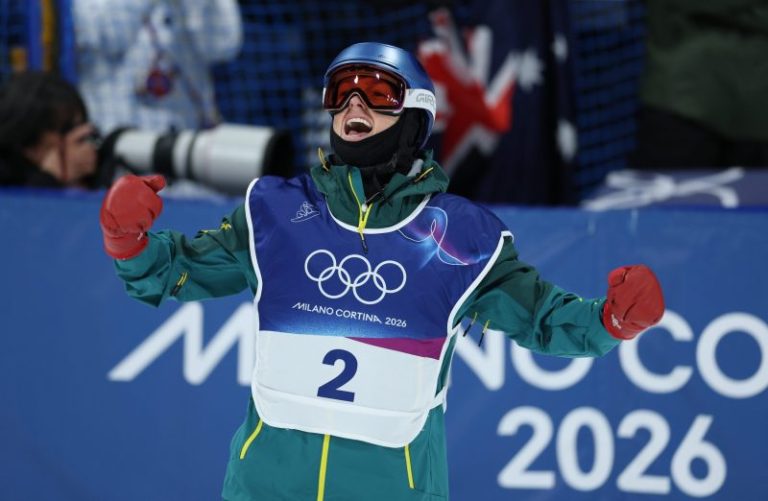
  • Japan’s Yuto Totsuka won the gold medal in a highly competitive men’s halfpipe final.
  • Australian Scotty James took silver, while Japan’s Ryusei Yamada earned the bronze.
  • The event showcased a significant progression in the sport, with the top four riders all scoring in the 90s.
  • A broadcast camera cable snapped during the final run but did not affect the competition’s outcome.

LIVIGNO, Italy – This is what sports are about. This is what the Olympics are about. What happened Feb. 13 in the men’s halfpipe final is the gold standard – pun intended – for high-level athletics.

What a treat it truly was.

Competitors pushed each other, and the sport, to levels that would have been incomprehensible even a few years ago. One country, Japan, dominated the top of the leaderboard, a display of the might they carry on the international snowboarding circuit in between the spotlight the Olympics provides the sport every four years. Plenty of heartbreak to go around, from those who gave their all to those who even made the podium. A nearly shocking moment – the cable of the overhead camera snapped during the final run of the night, with the gold medal very much still up for grabs – that did not actually, and thankfully, affect the integrity of the competition.

In the end, Yuto Totsuka of Japan stood atop the podium. His compatriot Ryusei Yamada took bronze. Between them was Australia’s Scotty James, still in search of that elusive gold medal, yet clearly successful in his quest to push the sport to the next stratosphere.

Because that’s where these guys were flying. The conditions were perfect – a cool but not too cold night, a slick pipe that was perfect for both speed and landing (the opposite of what the women dealt with in their finals a night earlier).

Campbell Melville Ives of New Zealand went for it all on his three runs and fell on his last hit as he ran out of room on the pipe each time. The lack of landing zone did not prevent his daring. South Korea’s Chaeun Lee was inconsolable after he put down an astounding final run after falling on his first two. But when his score of 87.50 (sixth place) came up, he was simply devastated. Japan’s Ruka Hirano had to be peeled off the snow once he realized he wouldn’t stand on the podium. Ziyang Wang of China spun like a thimble. The top four riders all had scores in the 90s, with 1.50 points separating Totsuka (95.00) and James (93.50).

Even the two Americans who occupied the final qualifying spots, Jake Pates and Chase Josey, threw down runs they were more than proud of – as they should have been.

Aussie Valentino Guseli, who went 5.8 meters in the air on his first hit of his last run and ended up with an 88.00 and a shrug that said “well, what can ya do,” understood why many of the women could not put down the runs they wanted the night prior in their final. The Olympic pressure is real, he said.

Scotty James’ gamble on final run backfires, but what a show it was

Like the best Olympic events, the gold medal came down to the final moment, with James needing another huge run to leapfrog Totsuka.

But James couldn’t land his final run. To put the exclamation point on the night, he went for a backside 1620, instead of settling for a 1440. The 1440 perhaps could have been enough for gold, Guseli said. James wasn’t feeling that last hit Friday night and during training. He tried it anyway.

For his own conscience – and he snowboards for Scotty James, not for the judges, not for the fans, not for his family – he needed to try the 1620.

That’s the sign of a healthy sport. He wasn’t thinking about the medal. He was thinking about the run, the process, the bettering of the product without an emphasis on the – literally subjective – results.

“I’ll have to keep pushing in the future, I guess,” he said, adding: “The difference was me. If I executed well, I feel pretty confident I would have won.”

Had James landed his first run, he believed, from an execution standpoint, it would have generated more than the 1.50 points needed to overtake Totsuka and he’d leave Italy with a different-colored medal.

“What I can live with is that I tried my best,” James said.

James admitted he was numb and in that in the next 24 hours he’ll have a “bit of a cry.” Nonetheless, he exuded pride in winning a medal for Australia as he became the country’s most-decorated Winter Olympian ever with a second silver to join a bronze. James, wearing his customary red mittens that resemble boxing gloves, waved to doting fans who called his name as he hugged his family after the medal ceremony, when he kept his eyes down for half of the Japanese national anthem.

A cable that held the broadcast camera hovering over the halfpipe snapped as James tried to complete the 1620 of his final run. Fortunately, it fell harmlessly into the bottom of the pipe. James did not notice the commotion.

“Everyone’s talking about the cable. I should blame it on the cable,” James joked.

Guseli thought, at first, it was a good omen from the “shred gods.”

“He was riding that pipe, he was tearing it apart … like it was the craziest thing that ever happened … I guess they weren’t with him,” he said.

Watching the progression of the sport over the duration of his Olympic career, which dates back to 2010, has been “crazy,” he said. Even wilder, James added, is how rapidly it has advanced in the last 12 months.

“It’s times where I was like ‘I hope it slows down, but it didn’t,’” he said with a smile. “And I’m pushing it myself as well. I’m pushing it, so they’re pushing it, so I’m equally responsible. But yeah, it’s been cool to be a part of it.”

Japan exerts its dominance in men’s halfpipe

Even in defeat, James held empathy for others, such Hirano, who has been his biggest rival along with Totsuka over the past 12 years. Seeing him on the ground hurt James, too. He’s been there. He’s been on the winning side over Totsuka, one of his rivals, plenty of times over the years.

“I just respect them as a country, as riders,” James said of Japan, which had four of the top seven riders, including 2022 gold medalist Ayumu Hirano. “It’s hard to see anyone be upset with a result like that.”

What’s clear is that Japan’s place as the epicenter of men’s halfpipe is not going away anytime soon with that deadly combination of depth and success.

“I think they just are born with snowboards on their feet, honestly,” he joked. “They’re amazing. I think they have a natural ability and gift in skateboarding and snowboarding that, to be honest, you don’t really see that from anyone else.”

In all seriousness, James said, the collective work ethic makes them an overwhelming force on the world stage. The Japanese reign does not appear to be ending any time in the near future.

“I’ve competed in many events before, but today’s competition was among the highest caliber,” Totsuka said. “The level was exceptionally high right from the qualifiers.”

And on this stage, that’s exactly how it should be.

This post appeared first on USA TODAY

Here’s a quick recap of the crypto landscape for Friday (February 13) as of 9:00 p.m. UTC.

Get the latest insights on Bitcoin, Ether and altcoins, along with a round-up of key cryptocurrency market news.

Bitcoin (BTC) was priced at US$68,987.01, up 5.2 percent over the last 24 hours.

Bitcoin price performance, February 13, 2026.

Chart via TradingView.

A constructive scenario over the next three to six months depends on gradual improvement in global liquidity, moderation in yields and steady exchange-traded fund (ETF) inflows.

According to Tran, if financial conditions tighten or additional liquidity stress occurs, the market may need another washout to rebalance leverage. Ultimately, the return of confidence, reflected through durable and sustainable capital inflows, is what matters most for the transitional phase.

Ether (ETH) was priced at US$2,054.76, up by 7 percent over the last 24 hours.

Altcoin price update

  • XRP (XRP) was priced at US$1.41, up by 4.7 percent over 24 hours.
  • Solana (SOL) was trading at US$85.01, up by 10.2 percent over 24 hours.

Today’s crypto news to know

Coinbase posts US$667 million Q4 loss

Coinbase Global (NASDAQ:COIN) reported a fourth quarter net loss of US$667 million as falling crypto prices weighed on its revenue and the value of its investment portfolio. The company’s revenue came in at US$1.78 billion, below analysts’ expectations, making a 22 percent decline from a year earlier.

The firm attributed much of the loss to a US$718 million drop in portfolio value, largely unrealized, alongside weaker transaction activity. Shares slid ahead of the release and have fallen more than 55 percent over the past six months as cryptocurrencies retreated. Despite the surprise slide, CEO Brian Armstrong sought to reassure investors, saying the firm remains “deliberately well capitalized” with US$11.3 billion in cash and equivalents.

He added that retail customers are largely holding rather than selling, even as volatility persists.

Bitcoin ETFs lose US$410 million

Spot Bitcoin ETFs saw US$410 million in outflows on Thursday (February 12), extending a rocky stretch that has drained nearly US$1.5 billion over two weeks.

The iShares Bitcoin Trust ETF (NASDAQ:IBIT) led the pullback, followed by Fidelity and Grayscale products, as institutional investors recalibrated positions amid macro uncertainty.

Treasury chief pushes CLARITY Act as crypto selloff deepens

US Secretary of the Treasury Scott Bessent urged Congress to pass the Digital Asset Market CLARITY Act this spring, arguing that it will provide stability to markets rattled by volatility.

Speaking on CNBC and later before the Senate Banking Committee, Bessent said the bill will give “great comfort to the market,” and warned that parts of the crypto industry are resisting what he called “very good regulation.”

“There seems to be a nihilist group in the industry who prefers no regulation over this very good regulation,” he told lawmakers, drawing support from Senator Mark Warner.

The legislation has stalled amid disputes over stablecoin yield, DeFi oversight and token classifications, with critics — including Coinbase CEO Brian Armstrong — raising objections. Bessent cautioned that a bipartisan coalition backing the bill could fracture if Democrats retake the House in November. Warner, meanwhile, stressed unresolved concerns around illicit finance and national security risks tied to DeFi.

HIVE’s BUZZ HPC platform secures US$30 million in AI cloud contracts

BUZZ High Performance Computing (HPC), a Hive Digital Technologies (TSXV:HIVE,NASDAQ:HIVE) platform, announced that it has signed customer agreements valued at approximately US$30 million over two year fixed terms for artificial intelligence (AI) cloud contracts. The new contracts will support the initial phase of BUZZ’s AI-optimized GPU deployment at its Canada West location in Manitoba, with compute capacity expected to be online during the quarter ending on March 31, 2026. This phase consists of 504 liquid-cooled Dell Technologies (NYSE:DELL) server-based GPUs.

This initial phase is expected to generate about US$15 million in annual recurring revenue (ARR) to BUZZ’s cloud business once fully operational, increasing HIVE’s total annualized HPC segment revenue to roughly US$35 million.

HIVE said it aims to scale its HPC GPU AI cloud business toward approximately US$140 million in ARR over the next year. The company is using vendor financing and strategic partnerships to scale efficiently and pursue a “dual-engine strategy” of hashrate services and GPU-accelerated AI computing across its facilities in Canada, Sweden and Paraguay.

Taurus and Blockdaemon partner to expand institutional staking

Taurus, a Swiss fintech firm that provides digital asset infrastructure for banks and financial institutions, announced an agreement with blockchain infrastructure company Blockdaemon that will allow banks to offer staking yields to their clients without having to move those assets out of tightly controlled, regulated custody.

Taurus will integrate Blockdaemon’s staking infrastructure into its custody product, Taurus‑PROTECT, which is designed to keep digital assets safe inside banks’ own systems under financial regulator rules.

Taurus also has an agreement to provide digital asset custody, tokenization and node management technology that State Street uses to power its full‑service digital asset platform for institutional investors. Additionally, BNY Mellon (NYSE:BK) is broadening its digita asset platforms by partnering with infrastructure providers, including Blockdaemon.

Securities Disclosure: I, Meagen Seatter, hold no direct investment interest in any company mentioned in this article.

Securities Disclosure: I, Giann Liguid, hold no direct investment interest in any company mentioned in this article.

This post appeared first on investingnews.com

We also break down next week’s catalysts to watch to help you prepare for the week ahead.

In this article:

    This week’s tech sector performance

    The Nasdaq Composite (INDEXNASDAQ:.IXIC) ended in the green on Monday (February 9) despite a weaker open.

    A rally in tech companies drove US stocks higher ahead of an economic data release, while Asian indexes also rose, led upward by Japan’s tech‑heavy Nikkei 225 (INDEXNIKKEI:NI225).

    It hit new record highs after Prime Minister Sanae Takaichi’s Liberal Democratic Party secured a landslide victory in the Lower House, clearing the path for tax cuts and higher defense spending.

    Tax planning and wealth management stocks fell on Tuesday (February 10) after financial software provider Altruist unveiled an artificial intelligence (AI) tool for creating tax strategies, echoing last week’s selloff in legal software stocks following the debut of a lawyer-focused AI platform.

    Broader tech‑driven weakness and softer‑than‑expected retail‑sales data dragged the Nasdaq down in Tuesday’s session. The index rose again on Wednesday (February 11) after January data showed labor market stability, potentially allowing the US Federal Reserve to keep interest rates steady as it monitors inflation.

    Software stocks resumed their slide, with Alphabet (NASDAQ:GOOGL) at one point down more than 2 percent, Microsoft (NASDAQ:MSFT) falling over 2.5 percent and Amazon (NASDAQ:AMZN) slipping about 1 percent.

    Personal computer makers also fell after Lenovo Group (HKEX:0992,OTCPL:LNVGF) warned of shipment pressure from a memory chip shortage. HP (NYSE:HPQ) and Dell Technologies (NYSE:DELL) each lost about 4.5 percent.

    After a muted close, investors turned their AI disruption fears to yet another corner of the market on Thursday (February 12). This time, it was logistics and trucking stocks, which plummeted after AI logistics firm Algorhythm Holdings (NASDAQ:RIME) said it has scaled freight volumes by 300 to 400 percent without increasing headcount.

    This event showed traders that AI is now affecting sectors previously thought to be resistant to automation and AI‑driven efficiency gains, leading to selloffs that also spilled into real estate and drug distribution.

    All three major indexes closed lower, with the Nasdaq hit hardest.

    A softer-than-expected US consumer price index report released on Friday (February 13) morning reinforced beliefs that the Fed is likely to cut interest rates this year, while global concerns about potential AI-driven disruptions kept investors cautious. European and Asian indexes lost ground, tracking Wall Street’s losses.

    While the S&P 500 (INDEXSP:.INX) closed slightly ahead on the day, mega-cap tech stocks dragged on the Nasdaq, which closed the week 1.77 percent below Monday’s open.

    3 tech stocks moving markets this week

    1.Cloudflare (NYSE:NET)

    Cybersecurity firm Cloudflare saw its share price surge after its sales guidance for the current quarter exceeded expectations. Shares closed 13.07 percent higher for the week.

    2. Applied Materials (NASDAQ:AMAT)

    Applied Materials, a provider of materials engineering solutions for the semiconductor sector, saw its share price rise sharply after reporting better-than-forecast quarterly financial results. Shares advanced 10.05 percent.

    3. Taiwan Semiconductor Manufacturing Company (NYSE:TSM)

    Taiwan Semiconductor Manufacturing Company rose after D.A. Davidson analyst Gil Luria gave it a ‘buy’ rating with a US$450 price target and called it a top AI foundry name. Shares advanced 5.02 percent.

    Cloudflare, TSMC and Applied Materials performance, February 9 to 13, 2026.

    Chart via Google Finance.

    Top tech news of the week

        • Alphabet completed two bond sales this week, raising a combined total of nearly US$52 billion. On Monday, the company sold US$20 billion in US dollars, followed by a nearly US$32 billion multi‑currency bond sale in British pounds and Swiss francs completed within 24 hours on Tuesday.

                                    Tech ETF performance

                                    Tech exchange-traded funds (ETFs) track baskets of major tech stocks, meaning their performance helps investors gauge the overall performance of the niches they cover.

                                    This week, the iShares Semiconductor ETF (NASDAQ:SOXX) advanced by 2.56 percent, while the Invesco PHLX Semiconductor ETF (NASDAQ:SOXQ) advanced by 1.89 percent.

                                    The VanEck Semiconductor ETF (NASDAQ:SMH) also increased by 2.19 percent.

                                    Tech news to watch next week

                                    Tech stocks face a quieter earnings backdrop next week, with no mega‑cap AI giants reporting; instead, the sector will be trading on macro cues and any guidance hints from mid‑tier semis and software names.

                                    Key US data includes jobs‑related releases and consumer confidence surveys.

                                    Securities Disclosure: I, Meagen Seatter, hold no direct investment interest in any company mentioned in this article.

                                    This post appeared first on investingnews.com

                                    Rio Tinto (ASX:RIO,NYSE:RIO,LSE:RIO) and Glencore (LSE:GLEN,OTCPL:GLCNF) said they will no longer be pursuing a merger, with Rio Tinto noting that the combination of the businesses would not deliver value to its shareholders.

                                    Glencore responded to Rio Tinto by saying that under the terms of the proposal, the Rio Tinto executive group would retain both the chair and CEO roles, which would undervalue Glencore’s contribution to the combined company.

                                    The deal would have created the world’s largest mining company with a combined market cap of US$260 billion. While the collapse of the proposed merger is drawing headlines, it comes at an accelerated pace for mergers and acquisitions in the industry, as majors seek to replenish their project pipelines and mid-cap producers look to grow their businesses.

                                    Among other notable mergers still on the books is Anglo American’s (LSE:AAL,OTCQX:NGLOY) merger with Canada-based Teck Resources (TSX:TECK.A,TECK.B,NYSE:TECK). That deal is currently working its way through regulatory approvals, with the most recent update that it is heading toward antitrust clearance in Europe.

                                    On Wednesday (February 11), Indonesia’s resources ministry ordered Eramet (EPA:ERA,OTCPL:ERMAF) and its joint venture partners, Tsingshan Holding Group, to slash production at the world’s largest nickel mine.

                                    Under the new work and budget plan, PT Weda Bay Nickel has been granted an initial quota of 12 million metric tons, down from the 42 million metric tons it was allowed in 2025.

                                    Nickel has been elevated this year, trading as high as US$18,725 on February 2. Although prices have fallen since that high, the announcement gave nickel some momentum, pushing prices to US$17,720 per metric ton on the London Metal Exchange on Wednesday. Prices eased again on Thursday (February 12), but remain well above 2025 averages.

                                    For more on what’s moving markets this week, check out our top market news round-up.

                                    Markets and commodities react

                                    Canadian equity markets were mixed this week.

                                    The S&P/TSX Composite Index (INDEXTSI:OSPTX) gained 2.88 percent over the week to close Friday (February 13) at 33,073.71, while the S&P/TSX Venture Composite Index (INDEXTSI:JX) shed 0.48 percent to 991.99.

                                    The CSE Composite Index (CSE:CSECOMP) dropped 2.7 percent to 163.24

                                    The gold price was largely flat, losing just 0.07 percent to close at US$5,032.68 per ounce on Friday at 4:00 p.m. EST. The silver price fared worse, closing the week down 8.43 percent at US$76.92 on Friday.

                                    In base metals, the Comex copper price recorded a 2.35 percent decrease this week to US$5.83.

                                    The S&P Goldman Sachs Commodities Index (INDEXSP:SPGSCI) was down 0.13 percent to end Friday at 583.86.

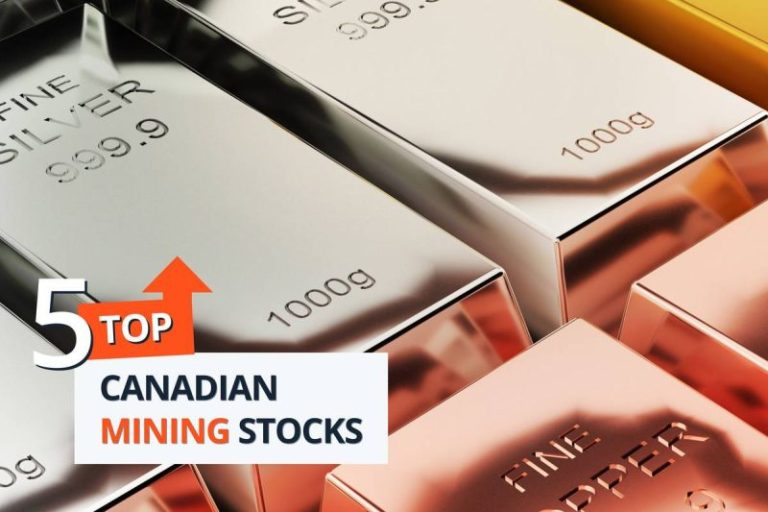
                                    Top Canadian mining stocks this week

                                    How did mining stocks perform against this backdrop?

                                    Take a look at this week’s five best-performing Canadian mining stocks below.

                                    Stocks data for this article was retrieved at 4:00 p.m. EST on Friday using TradingView’s stock screener. Only companies trading on the TSX, TSXV and CSE with market caps greater than C$10 million are included. Mineral companies within the non-energy minerals, energy minerals, process industry and producer manufacturing sectors were considered.

                                    1. Trinity One Metals (TSXV:TOM)

                                    Weekly gain: 104.55 percent
                                    Market cap: C$12.83 million
                                    Share price: C$0.45

                                    Trinity One Metals is a silver exploration and development company with a portfolio of mineral projects, including the recently acquired Silver 1 project in Ecuador.

                                    The property consists of the Silver-1 mine concession, which covers an area of 3,108 hectares and lies within the same mineral belt as Lundin Gold’s (TSX:LUG,OTCQX:LUGDF) Fruta Del Norte mine. Past mining at the site occurred between 1989 and 1994 and included 3,600 meters of underground development, along with a historic resource of 200,000 to 700,000 metric tons of ore averaging 400 to 800 grams per metric ton (g/t) silver and 3 g/t gold.

                                    The company announced the closing of the property acquisition on February 4 for a total consideration of US$540,000. In the release, the company said it will work swiftly to confirm the historic resource to modern standards.

                                    The news was followed on Tuesday (February 10), when the company announced a C$3.3 million non-brokered private placement, which was upsized to C$5.3 million on Thursday. The company said it will use proceeds from the placement to advance exploration projects across its portfolio.

                                    2. Cordoba Minerals (TSXV:CDB)

                                    Weekly gain: 74.68 percent
                                    Market cap: C$123.82 million
                                    Share price: C$1.38

                                    Cordoba Minerals is an explorer whose flagship project is Alacran in Colombia. The asset is a 50/50 joint venture with JCHX Mining Management (SHA:603979). The 20,000 hectare property hosts copper, gold and silver mineralization across five deposits: Alacran, Alacran North, Montiel East, Montiel West and Costa Azul.

                                    A feasibility study for the project released in February 2024 demonstrates an after-tax net present value of US$360 million with an internal rate of return of 23.8 percent and a payback period of three years.

                                    The resource estimate for the Alacran deposit and historical tailings shows an indicated resource of 99.46 million metric tons of ore with an average grade of 0.41 percent copper, 0.24 g/t gold and 2.65 g/t silver. Contained metal totals 904.53 million pounds of copper, 765,400 ounces of gold and 8.47 million ounces of silver.

                                    Following the completion of JCHX’s earn in for 50 percent of the project in July 2025, Cordoba said it had entered into a definitive agreement to sell its remaining 50 percent interest in Alacran.

                                    However, on January 2, the company reported that not all conditions for the sale had been met, and on Tuesday, announced that it had entered into an amended agreement.

                                    Under the new terms, the closing payment was increased to US$128 million from US$88 million, payable in a lump sum at closing. The release states that the bulk of the cash payment will be distributed to shareholders after settling liabilities and obligations, with the company retaining US$10 million for corporate purposes.

                                    3. Rio Silver (TSXV:RYO)

                                    Weekly gain: 52.38 percent
                                    Market cap: C$23.74 million
                                    Share price: C$0.64

                                    Rio Silver is an exploration company advancing its Maria Norte project in Peru.

                                    The property has changed hands several times in the 18 years prior to Rio’s acquisition in March 2025, but has seen little exploration during that time. However, in a February 5 release, the company notes that historic mining occurred at the site due to the presence of a reclaimed waste dump. The property covers the western portion of the Tangana West vein system, and although it has not yet completed an economic assessment for the property. In the announcement, the company said it plans to advance surface mapping and sampling in the third quarter of 2026.

                                    Throughout January, the company made several announcements regarding its exploration and development timeline. On January 6, the company reported results from technical work at the site, confirming the presence of silver mineralization with grades up to 991 g/t in a 0.7-meter channel sample.

                                    The company also announced on January 29 that it was launching a metallurgical program at the site, which it said will assist the company in determining the project’s potential value.

                                    4. Barksdale Resources (TSXV:BRO)

                                    Weekly gain: 48.15 percent
                                    Market cap: C$28.04 million
                                    Share price: C$0.2

                                    Barksdale Resources is a copper explorer focused on advancing its Sunnyside asset in Arizona, US. The property covers approximately 21 square kilometers, south of Tucson, Arizona. It hosts an intrusive complex that the firm believes to be an extension of the copper-zinc-lead-silver system found at South32’s (ASX:S32,OTCPL:SOUHY) Taylor deposit.

                                    In 2025, the company achieved several milestones under its earn-in agreement and completed the initial 51 percent in September following a C$1 million cash payment. Prior to the payment in June, Barksdale said it would work toward increasing its interest in the property to 67.5 percent.

                                    On January 21, the company announced plans to raise C$5 million to fund a Phase 2 drill plan required to increase its ownership stake in the Sunnyside project.

                                    On Wednesday, Barksdale announced the opening of an additional private placement to raise C$930,000. Funds raised from this round will also be used to fund exploration activities at Sunnyside.

                                    5. Pirate Gold (TSXV:YARR)

                                    Weekly gain: 48 percent
                                    Market cap: C$129.48 million
                                    Share price: C$0.37

                                    Formerly Sokoman Minerals, Pirate Gold is a discovery-oriented company with a portfolio of gold projects and one of the largest land positions in Newfoundland and Labrador, Canada.

                                    It also owns a 40 percent stake in the Killick lithium project, a 40/40/20 joint venture with Benton Resources (TSXV:BEX,OTCPL:BNTRF) and Piedmont Lithium.

                                    In October, the company combined its Moosehead and Crippleback claims to form the Treasure Island project, which hosts the largest mineral license and longest strike length along the Valentine Lake fault.

                                    Along with new claims, Pirate Gold’s land holdings in the area cover approximately 58,775 hectares and host multiple untested anomalies identified through historic data and exploration efforts by Pirate Gold.

                                    On Friday, Pirate Gold announced the initiation of project-scale surveys at Treasure Island, as well as the advancement of a 50,000 meter drill program, with two rigs mobilized to the site.

                                    Additionally, the company also said it had received drill permits to operate at the Crippleback Lake and Stony Lake areas, which would allow it to extend its exploration beyond the current footprint at Moosehead and test other high-priority targets along the fault zone.

                                    FAQs for Canadian mining stocks

                                    What is the difference between the TSX and TSXV?

                                    The TSX, or Toronto Stock Exchange, is used by senior companies with larger market caps, and the TSXV, or TSX Venture Exchange, is used by smaller-cap companies. Companies listed on the TSXV can graduate to the senior exchange.

                                    How many mining companies are listed on the TSX and TSXV?

                                    As of December 2025, 898 mining companies and 71 oil and gas companies are listed on the TSXV, combining for more than 60 percent of the 1,531 total companies listed on the exchange.

                                    As for the TSX, it is home to 175 mining companies and 51 oil and gas companies. The exchange has 2,089 companies listed on it in total.

                                    Together, the TSX and TSXV host around 40 percent of the world’s public mining companies.

                                    How much does it cost to list on the TSXV?

                                    There are a variety of different fees that companies must pay to list on the TSXV, and according to the exchange, they can vary based on the transaction’s nature and complexity. The listing fee alone will most likely cost between C$10,000 to C$70,000. Accounting and auditing fees could rack up between C$25,000 and C$100,000, while legal fees are expected to be over C$75,000 and an underwriters’ commission may hit up to 12 percent.

                                    The exchange lists a handful of other fees and expenses companies can expect, including but not limited to security commission and transfer agency fees, investor relations costs and director and officer liability insurance.

                                    These are all just for the initial listing, of course. There are ongoing expenses once companies are trading, such as sustaining fees and additional listing fees, plus the costs associated with filing regular reports.

                                    How do you trade on the TSXV?

                                    Investors can trade on the TSXV the way they would trade stocks on any exchange. This means they can use a stock broker or an individual investment account to buy and sell shares of TSXV-listed companies during the exchange’s trading hours.

                                    Article by Dean Belder; FAQs by Lauren Kelly.

                                    Securities Disclosure: I, Dean Belder, hold no direct investment interest in any company mentioned in this article.

                                    Securities Disclosure: I, Lauren Kelly, hold no direct investment interest in any company mentioned in this article.

                                    This post appeared first on investingnews.com

                                    Thanks to Wednesday night’s pole qualifying, we know who will start on the front row for the 68th annual Daytona 500. Two-time Cup Series champion Kyle Busch will lead the field for Sunday’s 500-mile race at Daytona International Speedway.

                                    Alongside Busch’s Richard Childress Motorsports Chevrolet will be Chase Briscoe in the Joe Gibbs Racing Toyota. Briscoe missed out by less than two-hundredths of a second to Busch for pole position.

                                    Thursday night in Daytona Beach it was all about sorting out the rest of the order.

                                    Busch led the field in Duel 1 with the starting order for the inside lane on the line from Daytona International Speedway. Ford-powered cars quickly took the lead with Ryan Preece and Chris Buescher pacing the field.

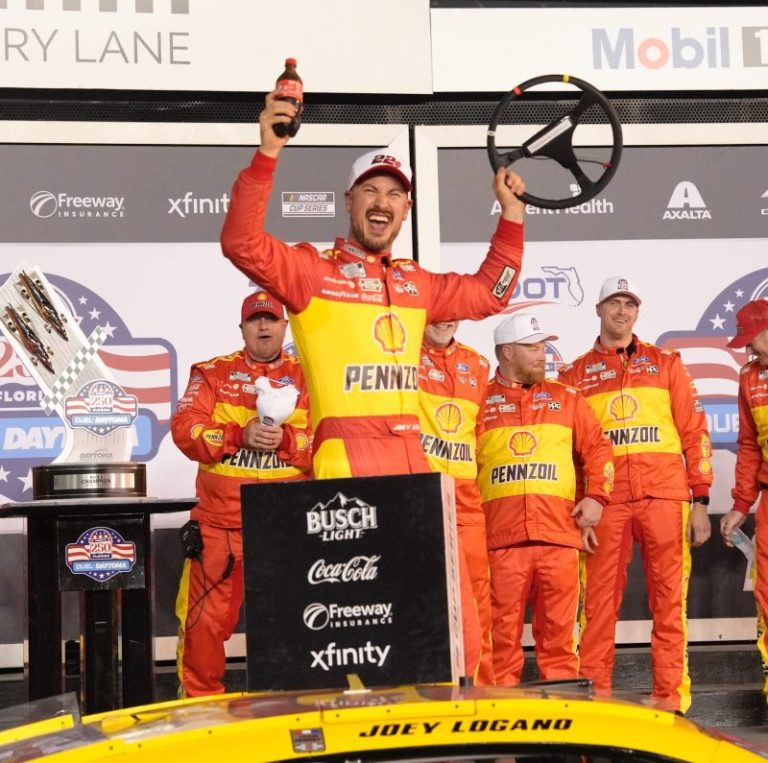
                                    But late contact between Noah Gragson and Casey Mears brought out a caution period, forcing an overtime finish. Another wreck started by Bubba Wallace’s spin meant a jumbled finish led by Joey Logano. The three-time Cup Series champion will line up behind Busch for Sunday’s race.

                                    The second Duel at Daytona was far less eventful. Briscoe held the lead for most of the 60-lap race. The pit stops jumbled the order and Chase Elliott made a late charge past Carson Hocevar for the win. Elliott will start Sunday’s race behind Briscoe.

                                    Here’s the final starting order – and a recap of what happened Thursday from Daytona.

                                    Daytona 500 starting grid

                                    1. Kyle Busch, No. 8 Richard Childress Racing
                                    2. Chase Briscoe, No. 19 Joe Gibbs Racing
                                    3. Joey Logano, No. 22 Team Penske
                                    4. Chase Elliott, No. 9 Hendrick Motorsports
                                    5. Ryan Blaney, No. 12 Team Penske
                                    6. Carson Hocevar, No. 77 Spire Motorsports
                                    7. Austin Dillon, No. 3 Richard Childress Racing
                                    8. Kyle Larson, No. 5 Hendrick Motorsports
                                    9. Brad Keselowski, No. 6 RFK Racing
                                    10. Michael McDowell, No. 71 Spire Motorsports
                                    11. John Hunter Nemechek, No. 42 Legacy Motor Club
                                    12. Christopher Bell, No. 20 Joe Gibbs Racing
                                    13. Shane van Gisbergen, No. 97 Trackhouse Racing
                                    14. Josh Berry, No. 21 Wood Brothers Racing
                                    15. Daniel Suarez, No. 7 Spire Motorsports
                                    16. Ricky Stenhouse Jr., No. 47 Hyak Motorsports
                                    17. Casey Mears, No. 66 Garage 66
                                    18. Todd Gilliland, No. 34 Front Row Motorsports
                                    19. Ryan Preece, No. 60 RFK Racing
                                    20. Ty Gibbs, No. 54 Joe Gibbs Racing
                                    21. Alex Bowman, No. 48 Hendrick Motorsports
                                    22. Denny Hamlin, No. 11 Joe Gibbs Racing
                                    23. Cole Custer, No. 41 Haas Factory Team
                                    24. Erik Jones, No. 43 Legacy Motor Club
                                    25. Noah Gragson, No. 4 Front Row Motorsports
                                    26. Tyler Reddick, No. 45 23XI Racing
                                    27. Bubba Wallace, No. 23 23XI Racing
                                    28. Riley Herbst, No. 35 23XI Racing
                                    29. Corey Heim, No. 67 23XI Racing
                                    30. Zane Smith, No. 38 Front Row Motorsports
                                    31. Jimmie Johnson, No. 84 Legacy Motor Club
                                    32. Connor Zilisch, No. 88 Trackhouse Racing
                                    33. Cody Ware, No. 51 Rick Ware Racing
                                    34. Ty Dillon, No. 10 Kaulig Racing
                                    35. AJ Allmendinger, No. 16 Kaulig Racing
                                    36. Austin Cindric, No. 2 Team Penske
                                    37. Ross Chastain, No. 1 Trackhouse Racing
                                    38. Anthony Alfredo, No. 62 Beard Motorsports
                                    39. William Byron, No. 24 Hendrick Motorsports
                                    40. Justin Allgaier, No. 40 JR Motorsports
                                    41. Chris Buescher, No. 17 RFK Racing

                                    Daytona Duel 2 update: Chase Elliott ekes out victory

                                    The Hendrick Motorsports driver made it through the field and held the lead into the last lap over Carson Hocevar. Elliott managed to keep Hocevar at bay entering the final turns and didn’t let the Spire Motorsports driver get a run on him to end the race.

                                    Daytona Duel 2 update: Hocevar leads entering final 10-lap stretch

                                    Nine laps remain in Duel 2 at Daytona. After the field made its pit stops, Carson Hocevar emerged as the leader and paces the field from the front ahead of Chase Elliott, Denny Hamlin, Michael McDowell and Tyler Reddick.

                                    Daytona Duel 2 update: Briscoe holding lead ahead of pit stops

                                    As we reach Lap 40, Briscoe continues to hold the lead out front. Hamlin’s dropped back slightly to fifth with Ty Dillon and Ricky Stenhouse Jr. as the main challengers to Briscoe at the front.

                                    Daytona Duel 2 update: Briscoe, Hamlin leading the way

                                    We are one-third of the way through the second Daytona Duel of the night and second-place qualifier Chase Briscoe continues to hold the lead. Chase Elliott, Christopher Bell and Kyle Larson round out the top five.

                                    Daytona Duel 2: Chase Briscoe leads the green flag racing

                                    The second Duel at Daytona is underway from Daytona International Speedway with Briscoe leading after qualifying second.

                                    Daytona Duel 1 update: Joey Logano wins under caution

                                    The Team Penske driver made his way to the front during the big wreck by Wallace and held on for his fourth Duel win. Logano will start from third position on Sunday’s race on the inside track behind polesitter Busch.

                                    Ryan Blaney, Austin Dillon, John Hunter Nemechek and Brad Keselowski round out the top five of Duel 1. Casey Mears made a last-lap push during the Duel to make it into the Daytona 500 for Garage 66 Ford.

                                    Daytona Duel 1 update: Race heads to overtime after big wreck

                                    With less than 10 laps to go, Bubba Wallace got spun out in his 23XI Racing Toyota and collected multiple cars in the Duel 1 race. The running order looks much different but Fords remain in front with Joey Logano and Ryan Blaney pacing the field ahead of an overtime sprint to the finish.

                                    Daytona Duel 1 update: Mears, Gragson contact brings out caution

                                    Casey Mears and Noah Gragson decided to pit on Lap 46 and made contact entering pit road. Mears locked up his brakes and lost control, spinning into Gragson as the two went to take on fuel. The race is now under caution.

                                    Daytona Duel 1 update: Fords continue to pace the field

                                    Ryan Preece remains in the lead of Duel 1 on Lap 40 ahead of Chris Buescher, Corey LaJoie and Brad Keselowski with the lone pit stop of the race looming.

                                    Daytona Duel 1 update: Preece, Buescher leading the way

                                    A third of the way through the first Duel race, it’s a competition between Ford-powered drivers. Ryan Preece, winner of the Cook Out Clash, currently leads the way over Chris Buescher. Corey LaJoie, Brad Keselowski and John Hunter Nemechek round out the top five.

                                    Daytona Duel 1: Green flag racing is on

                                    The field is roaring around the Daytona International Speedway to determine half of the running order for Sunday’s race with Kyle Busch leading the way.

                                    What are the Duels at Daytona? What to know about unique qualifying

                                    For the biggest race of the year, the Daytona 500 uses a unique qualifying format. Things start off with the usual time-based format last night for pole qualifying. From there, everything changes.

                                    The Duels at Daytona use two 60-lap races to set the grid. Duel 1, led by the pole winner from pole qualifying, features the odd-numbered finishers from qualifying. The finishing order from Duel 1 will determine the inside lane order for Sunday’s Daytona 500.

                                    Duel 2, led by the second-fastest driver in pole qualifying, includes the even-numbered finishers from the qualifying session. This race’s finishing order determines the outside lane order for Sunday’s Daytona 500.

                                    How to watch the Duels at Daytona: Time, TV channel, live stream

                                    • Date: Thursday, Feb. 12
                                    • Duel 1 Time: 7 p.m. ET
                                    • Duel 2 Time: 8:45 p.m. ET (approximate)
                                    • TV: FS1 (both duel races)
                                    • Streaming: Fubo, FoxSports.com and the Fox Sports app

                                    Watch the 2026 Daytona Duels with Fubo

                                    What time do the Duels at Daytona start?

                                    Following an electric night at Daytona 500 qualifying, the Duels at Daytona will get started on Thursday at 7 p.m. ET. The Duel 2 race will kick off roughly at 8:45 p.m. ET.

                                    Daytona 500 final qualifying round results

                                    Wednesday night’s Daytona 500 final qualifying round results:

                                    • Kyle Busch (49.006)
                                    • Chase Briscoe (49.023)
                                    • Ryan Preece (49.061)
                                    • Denny Hamlin (49.100)
                                    • Corey Heim (49.148)
                                    • Alex Bowman (49.152)
                                    • Kyle Larson (49.158)
                                    • Chris Buescher (49.184)
                                    • Chase Elliott (49.220)
                                    • Joey Logano (49.275)

                                    Daytona 500 odds

                                    • Ryan Blaney (+1200)
                                    • Joey Logano (+1200)
                                    • William Byron (+1400)
                                    • Denny Hamlin (+1400)
                                    • Austin Cindric, Chase Elliott and Kyle Busch at +1600

                                    Justin Allgaier qualifies for Daytona 500 as open driver

                                    Justin Allgaier locked in a spot for the 2026 Daytona 500 after finishing the first round of qualifying with a time of 49.201. He also bumped Corey LaJoie out of the top 10.

                                    Allgaier was also bumped out of the top 10 moments later after Joey Logano (49.138) jumped into the top 10. Regardless of his placement at the end of the round, Allgaier secured a spot in the Daytona 500 as one of the two fastest non-chartered drivers along with Corey Heim.

                                    This post appeared first on USA TODAY

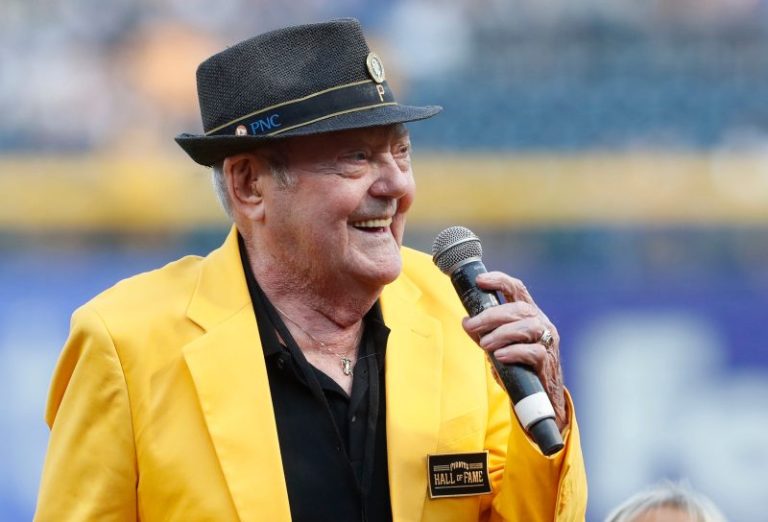
                                    Elroy Face, an All-Star pitcher with the Pittsburgh Pirates and World Series champion, has died at the age of 97, the Pirates announced on Feb. 12.

                                    ‘It is with heavy hearts and deep sadness that we mourn the passing of Pirates Hall of Famer Elroy Face, a beloved member of the Pirates family,’ Pirates chairman Bob Nutting said in a statement. “I was fortunate to get to know Elroy personally, and I will always be proud that we had the chance to honor him with his induction into the Pirates Hall of Fame.’

                                    Nicknamed ‘The Baron of the Bullpen,’ Face was a groundbreaking pitcher, performing in a role that evolved into the modern-day closer. Face holds the National League record for wins in relief (96). Face also holds Pirates franchise records for appearances (802) and saves (188). His NL record for saves was not broken until 1982, when Hall of Famer Bruce Sutter surpassed Face’s total.

                                    Face made All-Star Game appearances in three consecutive seasons from 1959-1961. The peak of his career coincided with the Pirates winning the 1960 World Series, a Fall Classic made famous by Bill Mazeroski’s walk-off Series-winning home run in Game 7. Face recorded three saves in that World Series win over the New York Yankees.

                                    It was Face’s 1959 season that was his finest. He went 18-1 with a 2.70 ERA over 57 appearances, finishing seventh in NL MVP voting. During his career, he was a three-time league leader in saves and twice led the league in games pitched.

                                    Face spent 15 seasons with the Pirates before pitching briefly with the Detroit Tigers and Montreal Expos to close out his storied career.

                                    This post appeared first on USA TODAY

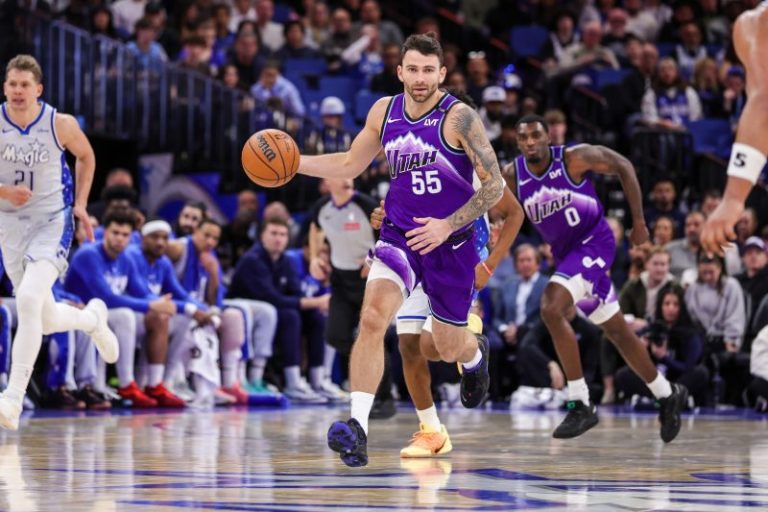
                                    Commissioner Adam Silver and the NBA sent a forceful message on Thursday about tanking, hitting the Utah Jazz with a $500,000 fine and handing the Indiana Pacers a $100,000 fine for recent game management and roster decisions, the league announced.

                                    Utah’s fine was related to a Feb. 7 game against the Orlando Magic and Feb. 9 game against the Miami Heat.

                                    ‘During those games, the Jazz removed two of the team’s top players, Lauri Markkanen and Jaren Jackson Jr., before the beginning of the fourth quarter and did not return them to the game, even though these players were otherwise able to continue to play and the outcomes of the games were thereafter in doubt,’ the NBA said.

                                    Utah entered the fourth quarter of its Feb. 7 game with a 94-87 lead but scored just 23 points in the final frame and lost 120-117. It won the game against Miami, 115-111, and won Wednesday night against the Sacramento Kings to move to 18-37 on the season, third-worst in the West.

                                    The Pacers, the second-worst team in the Eastern Conference at 15-40, were found to be in violation of the Player Participation Policy for a Feb. 3 game against the Jazz, per the league statement.

                                    ‘Following an investigation, including review by an independent physician, the NBA determined that Pascal Siakam, a star player under the Policy, and two other Pacers starters, neither of whom participated in the game, could have played under the medical standard in the Policy, including by playing reduced minutes. Alternatively, the team could have held the players out of other games in a way that would have better promoted compliance with the Policy,’ the NBA said.

                                    The Pacers lost that game to the Jazz, 131-122.

                                    The league’s statement on the fines was capped by a strong message directly from Silver.

                                    ‘Overt behavior like this that prioritizes draft position over winning undermines the foundation of NBA competition and we will respond accordingly to any further actions that compromise the integrity of our games,’ Silver said. ‘Additionally, we are working with our Competition Committee and Board of Governors to implement further measures to root out this type of conduct.’

                                    This post appeared first on USA TODAY

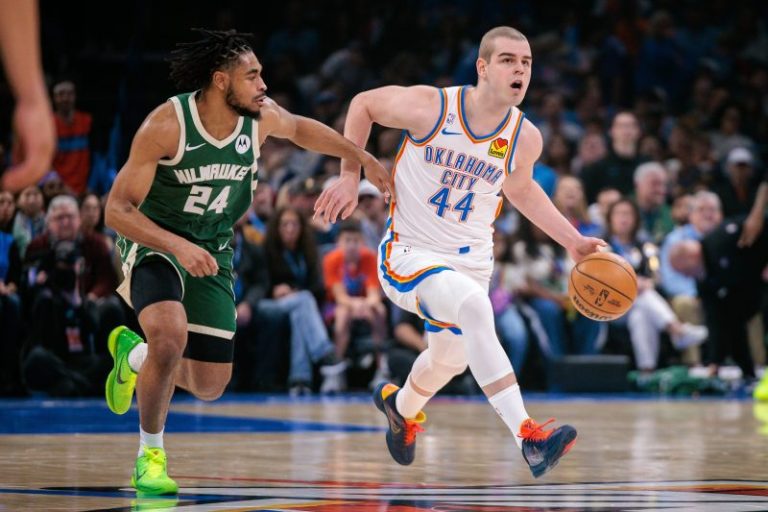
                                    Oklahoma City Thunder guard Nikola Topić made his NBA debut against the Milwaukee Bucks on Thursday night, four months after he was diagnosed with cancer.

                                    The 6-foot-6 Serbian had been unavailable after being diagnosed with testicular cancer in October and undergoing chemotherapy.

                                    He received a standing ovation from the home crowd at Paycom Center after checking into the game with 1:55 left in the first quarter.

                                    Topić was the 12th overall pick in the first round of the 2024 NBA Draft by the Thunder. He played in just one preseason game before having surgery and undergoing chemotherapy.

                                    Topić went 1-for-3 from the field, scoring his first official NBA points, in 12 minutes. He also had a rebound and an assist.

                                    This post appeared first on USA TODAY

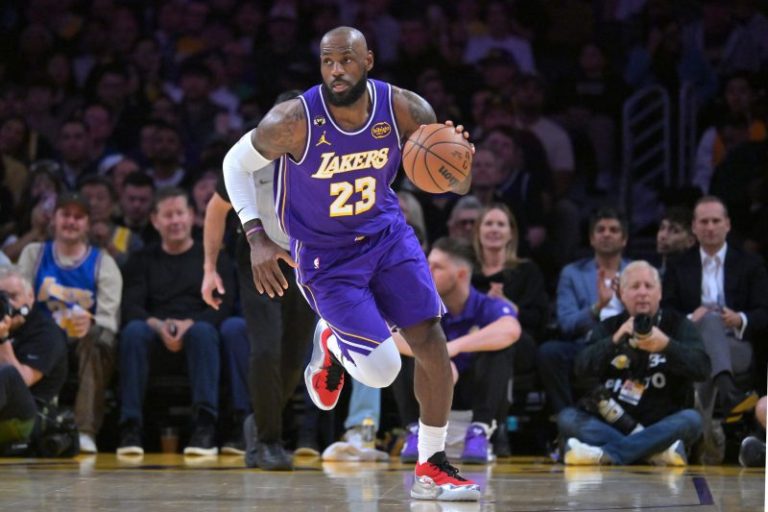
                                     LeBron James continues to add his name to the NBA history books.

                                    In his 23rd season, the 41-year-old became the oldest player to produce a triple-double.

                                    James produced 28 points, 12 assists and 10 rebounds, leading his team in all three categories as the Los Angeles Lakers beat the Dallas Mavericks, 124-104, at home on Thursday, Feb. 12.

                                    It’s also his first triple-double of the season. James finished the 2024-25 season with 10.

                                    He is fifth on the NBA’s all-time regular-season triple-doubles list with 123. He trails just Russell Westbrook (207), Nikola Jokic (184), Oscar Robertson (181) and Magic Johnson (138).

                                    LeBron James stats vs. Mavericks

                                    • Points: 28
                                    • FG: 10-for-20 (2-for-7 3-point shooting)
                                    • Free Throws: 6-for-7
                                    • Rebounds: 10
                                    • Assists: 12
                                    • Steals: 0
                                    • Blocks: 1
                                    • Turnovers: 4
                                    • Fouls: 0
                                    • Minutes: 35

                                    Lakers vs. Mavericks highlights

                                    The biggest stories, every morning. Stay up-to-date on all the key sports developments by subscribing to USA TODAY Sports’ newsletter.

                                    This post appeared first on USA TODAY

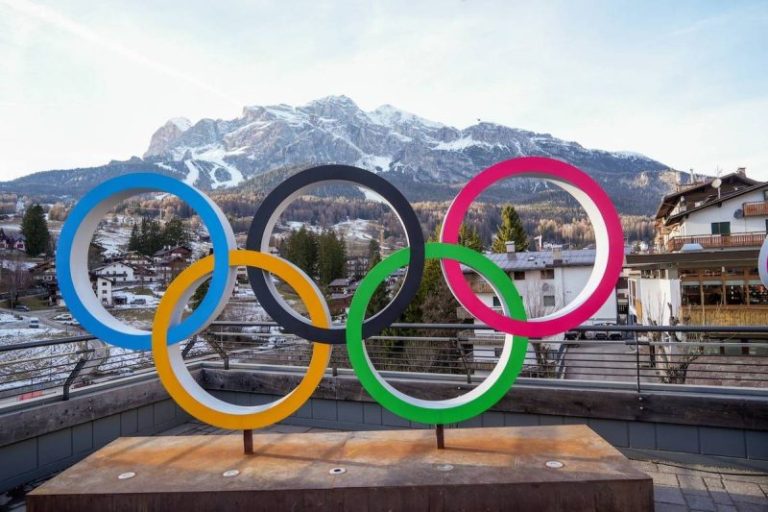
                                    As organizers award the medals for the Milan Cortina 2026 Winter Olympics, fans and spectators alike may have pondered a singular question at some point: how much is an Olympic gold medal actually worth?

                                    The short answer is far less—and far more—than most people assume.

                                    How is an Olympic gold medal made, and what is it worth?

                                    Despite the name, Olympic gold medals are not made of solid gold. Under International Olympic Committee rules, they are primarily composed of silver and plated with a thin layer of gold.

                                    Still, with gold prices now hovering at historic highs, even the thin coating carries more value than it once did.

                                    Using the official size and weight specifications for the Milan Cortina 2026 medals, precious metals firm Dillon Gage calculated what a gold medal would be worth if it were cast entirely in solid gold.

                                    Each Milan Cortina medal measures 80 millimeters in diameter and 10 millimeters thick. Based on those dimensions, Dillon Gage estimates a medal of that size would have a volume of approximately 47.6 cubic centimeters and would contain about 919 grams of gold if produced entirely from the metal.

                                    At the current spot gold price of US$5,061.45 per troy ounce, that equates to roughly US$149,600 in intrinsic metal value alone, all before factoring in craftsmanship or symbolism.

                                    But this is a hypothetical scenario. The actual gold medal that will hang around an athlete’s neck in Italy will contain 500 grams of .999 fine silver and just 6 grams of .9999 gold plating.

                                    Using current spot prices of gold at US$5,061.45 per troy ounce and silver at US$87.00 per troy ounce, the combined intrinsic metal value of a 2026 Olympic gold medal comes to approximately US$2,375.

                                    A silver medal, made of 500 grams of .999 silver, carries a metal value of about US$1,402 at today’s prices.

                                    A bronze medal, composed of 420 grams of copper priced at roughly US$5.90 per pound, has a melt value of about US$5.46.

                                    “The value of gold medals is a curious inquiry we receive, especially around the time of the Olympics,” said Terry Hanlon, president of Dillon Gage Metals. “It’s one of the most recognizable medals in the world, so it’s natural for people to wonder what it’s made of and what it’s actually worth. While Olympic gold medals are not solid gold, the silver content alone carries far more value today than it did just a few years ago, reflecting how much precious-metal markets have changed.”

                                    The medals themselves were designed by a multidisciplinary team led by Raffaella Paniè and produced by the Italian State Mint and Polygraphic Institute (IPZS). Their split-surface design symbolizes the union of Milan and Cortina, as well as the shared effort behind every Olympic achievement.

                                    Precious metals on the rise

                                    Still, as eye-catching as the design may be, the math behind the medals offers a telling snapshot of today’s precious metals market.

                                    When the Paris 2024 Olympic medals were unveiled two years ago, gold was trading around US$2,400 per troy ounce. At that time, the intrinsic metal value of a gold medal was under US$1,000.

                                    Today, gold prices have more than doubled. The theoretical value of a solid-gold Milan Cortina medal now approaches US$150,000, and even the thin six-gram plating layer carries over US$975 in gold value alone.

                                    The surge reflects broader trends in global markets where gold has rallied amid inflation concerns, geopolitical tensions, and rising investor demand for safe-haven assets.

                                    Silver has also strengthened, contributing significantly to the base value of Olympic medals that are largely silver by weight.

                                    But what is it really worth?

                                    Yet despite the fun computation experiment, their actual worth undeniably lies elsewhere: the years of training, the sacrifices, the split-second finishes, and the history attached to standing atop a podium as the world watches.

                                    By the time the flame is lit in Milan and Cortina, more than 5,000 athletes will compete for a place in Olympic history.

                                    While its actual value will technically be worth a few thousand dollars in weight, for the world-class athletes showcasing their prowess, each medal is priceless in their own right.

                                    No matter how high gold prices climb, the opportunity to win on the Olympic stage remains beyond calculation.

                                    Securities Disclosure: I, Giann Liguid, hold no direct investment interest in any company mentioned in this article.

                                    This post appeared first on investingnews.com