Basin Energy (BSN:AU) has announced Acquires Extensive Uranium and Rare Earth Portfolio
Download the PDF here.
This post appeared first on investingnews.com

Basin Energy (BSN:AU) has announced Acquires Extensive Uranium and Rare Earth Portfolio
Download the PDF here.

Blackstone Minerals (BSX:AU) has announced BSX Secures JV Partner & Funding for Ta Khoa Nickel Project
Download the PDF here.
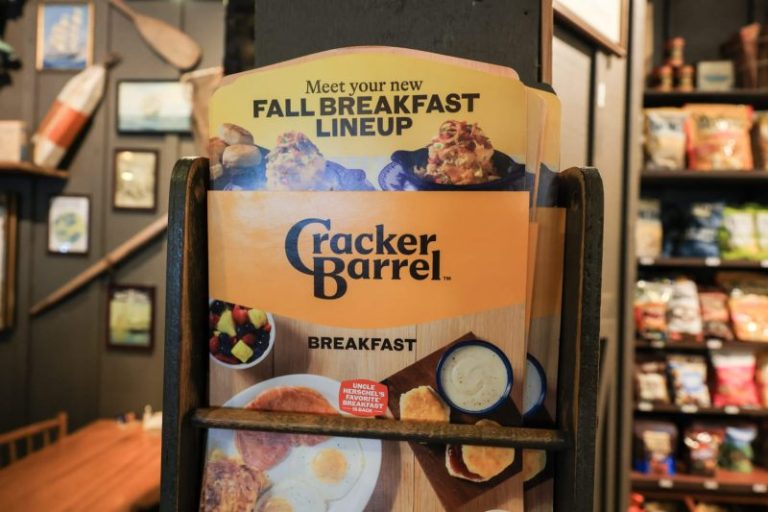
Cracker Barrel tried to reassure customers Monday that its values have remained the same after it received criticism following a new logo reveal and general brand refresh.
The company promised customers in a statement that while its logo may be different, its values — “hard work, family, and scratch-cooked food made with care’ — are not.
“You’ve shown us that we could’ve done a better job sharing who we are and who we’ll always be,” the statement read, adding that Cracker Barrel will remain “a place where everyone feels at home, no matter where you’re from or where you’re headed.”
Last week, the company unveiled a new logo that no longer features a man leaning against a barrel or the words ‘Old Country Store.’ Instead, it featured the company’s name, in a color scheme that it said was inspired by the chain’s scrambled eggs and biscuits.
The change was part of a ‘strategic transformation’ that aimed to update the chain’s visual elements, spaces, food and retail offerings. The company’s shares are down about 8.5% since the reveal ignited criticism, especially from those in conservative circles.
Donald Trump Jr., the president’s son, amplified a post Wednesday suggesting that the logo change was intended to erase the American traditions aspect of the branding and make it more general and lean into diversity, equity and inclusion efforts.
On Monday, the chain also shared an update on the man in the original logo, Uncle Herschel, who is said is still featured on menus and road signs and in stores.
‘He’s not going anywhere — he’s family,’ the company said in the statement.
Cracker Barrel said its focuses remain country hospitality and generous portions of food at fair prices. The refresh, it said, was to ensure the restaurant will be there for the next generation.
‘That means showing up on new platforms and in new ways, but always with our heritage at the heart,’ it said.
‘We know we won’t always get everything right the first time, but we’ll keep testing, learning, and listening to our guests and employees.’

Corazon Mining Ltd presents a compelling investment case driven by a strategic pivot to WA gold exploration, capitalising on its recent acquisition of the Two Pools gold project. This acquisition offers significant near-term exploration upside, while the company retains a high-quality portfolio of base and battery metals projects, providing long-term optionality and leverage to the evolving critical minerals market. This strategy positions Corazon to deliver shareholder value through potential high-impact discovery and future project development.
Corazon Mining Ltd (ASX:CZN) is an Australian junior exploration company focused on high-quality gold and critical minerals projects in Australia and Canada.
Simon Coyle is a mining executive with over 20 years’ experience in the resources sector, spanning across gold, iron ore, manganese and lithium. He is a graduate of the Western Australian School of Mines and has held a number of senior operational leadership roles across both private and publicly listed companies.
Most recently, Coyle served as CEO and president of TSXV-listed Velox Energy Materials. Prior to this, he held senior roles at Pilbara Minerals, including general manager – operations, where he was instrumental in the development and expansion of its flagship lithium project, establishing it as one of the world’s leading spodumene concentrate producers. Coyle currently serves as non-executive director of Kali Metals.
Kristie Young is a professional Board Director who began her career as a mining engineer in the mid 90’s across both underground and open cut operations (incl. Hamersley Iron, Mt Isa Mines, Plutonic Gold, New Hampton Goldfields, Surpac), feasibility studies and project evaluation. She holds a BEng(Mining) Hons from the University of Queensland.
Over 25 years’ industry experience, including business development director roles with both EY and PwC. She brings more than 15 years’ experience on boards and committees and currently serves as a non-executive director of Brazilian Rare Earths (ASX:BRE), Livium (ASX:LIT), Tasmea Ltd (ASX:TEA), and MinEx CRC.
She is a Fellow of the AusIMM and a graduate and Fellow of the AICD.
Scott Williamson is a highly experienced mining engineer with an Engineering and Commerce degree from the West Australian School of Mines and Curtin University. With more than 20 years of experience spanning technical and corporate roles in the mining and finance sectors, he brings a wealth of industry expertise and strategic insight. A proven leader in business development, Scott has extensive experience in equity capital markets, complementing his strong technical skill set.
Currently, he serves as managing director of Blackstone Minerals and non-executive Director of Leeuwin Metals.
Scott also holds a WA First Class Mine Manager’s Certificate and is a member of the Australasian Institute of Mining and Metallurgy.
Robert Orr manages Corazon’s financial operations and corporate governance, ensuring compliance and effective financial management.

U.S. taxpayers are now the largest shareholders in Intel. What comes next isn’t so clear.
The Trump administration announced Friday that the government had taken a 10% stake in the California-based computer chipmaker, which has fallen behind rivals Nvidia and AMD in the artificial intelligence race. Over the past five years, Intel’s share price has declined more than 50%.
The administration has not provided any details about when or under what circumstances it would sell the Intel shares — or whether it would sell them at all. Nor did it say whether the United States would benefit from any dividends, although Intel has not paid out any since last year. The administration does not plan to take any board seats and has said it will vote against the company only in “limited” circumstances.
While Commerce Secretary Howard Lutnick suggested Friday that national security was a key motivator for taking the stake, President Donald Trump focused Monday more on the prospect of financial gains.
“I will make deals like that for our Country all day long,” Trump said on Truth Social. “I love seeing their stock price go up, making the USA RICHER, AND RICHER. More jobs for America!” he added.
Intel’s shares have climbed about 4% since the transaction was announced. Some experts said that while there is a potential upside to the agreement, it represents another norm-shattering expansion of presidential authority by Trump into the business world — and most likely not the last.
Already, the Trump administration has taken a “golden share” in Japan’s Nippon Steel as part of a deal granting approval to that company’s bid for U.S. Steel and giving the government a say in future Nippon transactions. Last month, the Defense Department announced it had purchased $400 million in rare earth miner MP Materials, making it the company’s largest shareholder. The White House also plans to take a cut of the sales that chipmakers Nvidia and AMD make to China.
Trump told reporters Monday that he hopes to see “many more” deals like Intel’s, adding that nobody “realizes how great it will be.” Kevin Hassett, director of Trump’s National Economic Council, said similar deals could help form the basis of a sovereign wealth fund, an idea that the administration had floated earlier as a way of giving U.S. taxpayers direct stakes in companies but had yet to fully develop.
“At some point there’ll be more transactions, if not in this industry, in other industries,” Hassett said on CNBC.
The U.S. stake in Intel does not amount to a complete government takeover. While the federal government has assumed total control of private corporations before, such incidents have usually happened during times of crisis — and not with the direct intention of trying to play the markets.
“He’s doing all this in a spooky, controversial way,” said Clyde Wayne Marks, a fellow in regulatory studies at the Competitive Enterprise Institute, a libertarian think tank. “Right now there is no crisis.”
President Woodrow Wilson nationalized railroads, as well as the telegraph, telephone, radio and wireless stations, during World War I. Nearly two decades ago, the government bailed out a host of private firms during the 2008-09 global financial crisis.
While the bailout involved holding corporate assets on the U.S. government’s books with the goal of returning earnings to taxpayers, there was never any serious intention to own them over the long term. And a Government Accountability Office study concluded in 2023 that the program ultimately came at a net cost of about $31 billion.
The U.S. government has long provided subsidies to private corporations in the form of loans and grants, to varying degrees of success. Two high-profile examples came during the Obama administration, when the Energy Department provided loans to a solar power company called Solyndra and to electric vehicle maker Tesla. Solyndra ultimately went bankrupt, while today Tesla is worth $1.2 trillion on the stock market.
Some have argued that the United States would have benefited from having taken a stake in Tesla. Yet at the time Tesla received the loan, in 2010, beliefs about the free market and the need to limit the government’s role in it prevailed not just among Republicans, but among Democrats, as well, experts say.
“Our system has not typically been built that way — it’s not how free enterprise is typically run,” said Dan Reicher, a former Energy Department official under Presidents Bill Clinton and Barack Obama. “History has proven that the more free-market approach, making the bottom line the bottom line for the companies running these operations, is a smarter way to go.”
Intel’s fortunes have sagged. Its manufacturing segment lost $3.2 billion in the second quarter, and last month it said it would lay off 15% of its workforce by year’s end while canceling billions in planned investments and delaying the completion date for a $28 billion chip plant near Columbus, Ohio.
In a securities filing Monday, Intel warned investors of the potential risks involved in the U.S. investment, among them that the arrangement may actually limit its ability to secure grants down the road, depending on its future performance. It could also harm international sales and make Intel subject to additional regulations and restrictions, both at home and abroad, it said.
On Monday, Trump was asked whether the Intel investment represented a new way of doing industrial policy.
“Yeah. Sure it is,” Trump said. “I want to try to get as much as I can.”
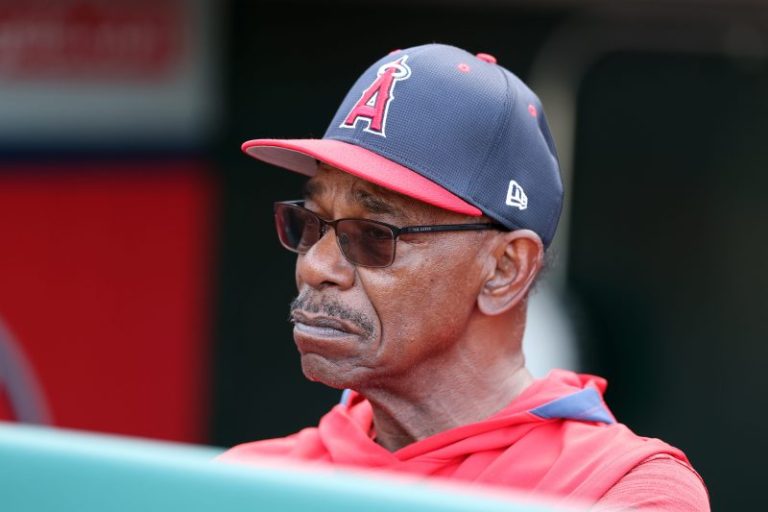
Ron Washington was back where he belonged Monday.
In a baseball uniform, and in the Los Angeles Angels clubhouse.
Washington, who has been on medical leave as manager of the Angels since June 27, returned to see his team for the first time since he had quadruple heart bypass surgery.
Washington, 73, said he was concerned about his health during the Angels’ trip to New York June 16-19. His ankles were swollen, and he alerted the Angels’ training staff, which had him checked by New York doctors who wanted to keep him in New York.
Washington elected to return to Anaheim, California, with the team and was admitted to a local hospital on June 23. He was diagnosed with blockage in his arteries, which led to the bypass surgery.
He was discharged on July 7 and returned home to New Orleans.
“It just happened so fast,’’ Washington said at a news conference on Aug. 25 at Globe Life Field in Arlington, Texas, “I didn’t have a chance to say much to anyone.’’
Washington, however, remained in great spirits and was always confident, in messages and conversations with USA TODAY Sports during his absence, that he would return in full health. He has stopped smoking and is eating healthier, and said he should be fully recovered by December.
He plans to return to Anaheim to be with the team in September, and expressed again Monday that he definitely wants to continue managing the Angels. Washington is in the final year of his two-year contract and the Angels have a club option for 2026.
Follow Nightengale on X: @Bnightengale
WASHINGTON – As four days of tryouts for the inaugural season of the Women’s Professional Baseball League drew to a close with a pair of scrimmages Aug. 25, Maybelle Blair remained awestruck by what she was witnessing.
Now 98, Blair remains tack-sharp and retains the fighting spirit it took to play in the World War II-era All-American Girls Professional Baseball League – along with the ability, still, to bridge generations.
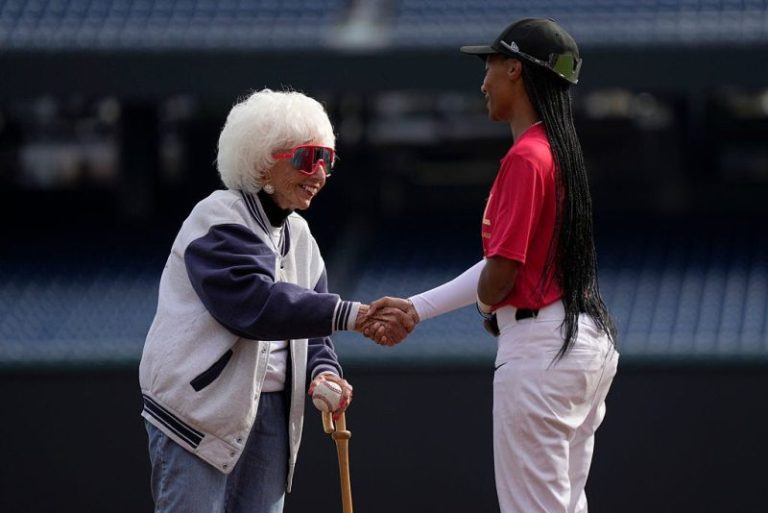
As dozens of women waited to take the field under a gorgeous morning sky at Nationals Park, here was Blair, throwing out the first pitch to Mo’Ne Davis, the 25-year-old former Little League World Series star who saw the arc of women’s sports come all the way around to create a league to house her unique athletic abilities.
They’re separated by nearly 75 years, yet on this day, very much connected.
“I never ever in my whole life figured we would have another league of our own,” Blair said, referencing the 1992 movie that chronicled the, at that time, largely forgotten AAGPL.
“I’m re-living my life through these girls. The good old boys in baseball always wanted to keep baseball for the boys. ‘You should play softball No, we shouldn’t. We should play baseball.
“I’m still on this side of the grass to witness it.”
Blair could have scarcely imagined the modern trappings and the access to the game the hundreds of women enjoyed. Baserunning oven mitts and arm guards, catchers in a one-knee-down stance, pitchers using the most modern techniques to workshop pitches and increase velocity – this generation has lived through much of the game’s revolution.
It’s just that now, at a booming time for women’s sports, there’s an outlet for their skills.
It is coming quickly: The Women’s Professional Baseball League will announce the half dozen teams competing at one to three fixed sites next month. The inaugural draft, for which these women were trying out, will be held in October.
And in May, the league will launch, a pinch-me moment for players accustomed to playing with men or getting shuttled to other sports.
“The WPBL is here,” league co-founder Justine Siegal said in addressing the players. “It’s now. And it’s never leaving.”
To be certain, the league does not have the backbone of a parent league like the WNBA-NBA relationship, nor the network television access NBC provided the W at the outset. Yet it does have eyes on a model for growth and penetrating the attention economy.
The league has a partnership with Fremantle, the production and distribution company behind America’s Got Talent, American Idol and dozens of other original content vehicles. The company is producing a docuseries but perhaps more important, will be responsible for content distribution.
“This is an incredible moment,” says league co-founder Keith Stein, a Canadian baseball executive. “I think the stock of women’s sports leagues has way more upside. And we can build a league that’s designed, that’s tailored for this type of climate, this social media world we live in.
“Linear TV has changed, the whole media landscape has changed. So, we don’t have to try to fit a square peg into a round hole. And that’s why we’re thinking a lot about innovations we can implement in the game itself to make it more compelling to fans, and more compelling for the media world we live in.”
Of course, compelling will have to come from the players.
Kelsie Whitmore has seen just about every dimension of the bat-ball sports world – from high school baseball to college softball to Women’s World Cup International competition to independent pro ball against former major leaguers.
Now, she’s one of three current members of the barnstorming Savannah Bananas playing in the WPBL. And after years of playing with men, trying to find a catch partner or a person to split a meal with or sit near on the bus, the scope of this experience dawned on her this weekend.
She and several other players were going out to dinner Sunday when it dawned on her: They were pro ballplayers going to socialize with each other.
“It was a moment that gave me chills,” says Whitmore. “Being a woman in a male environment, trying to make conversation. The little things like that mean a lot. It brings freedom. It allows you to feel so free with yourself.”
And the competition this past weekend was eye-opening for another reason. Whitmore has played for the U.S. Women’s National Team since she was in high school, and invariably the countries claiming medals will be Japan (which has won the last seven championships), Canada and Team USA.
Yet Monday, Whitmore and longtime Canadian rival pitchers Jaida Lee and Alli Schroder, and Japanese legend Ayami Sato?
They were all on one field, playing for the same team, in a sense, even as they’ll be divvied up and distributed among a half-dozen teams. The uptick in the level of play was undeniable: Ninety feet between the bases shrank easily, fastballs from 60 feet hummed and curveballs landed with aplomb. Every throw from deep short made with ease, and a few balls found homes in Nationals Park’s gaps.
While not every elite player found their way to tryouts, these were truly the best players in the world.
“The word integration – that is huge,” says Whitmore, who pitched two scoreless innings in the early scrimmage. “I was just now realizing yesterday – someone was like, ‘How does it feel to be in a women’s baseball integrated league?’
“I love it. I love that we’re having so many backgrounds, girls from other countries. It gives me chills. It doesn’t matter who you are or where you come from – you belong in the game.”
Davis is far removed from the 2014 Little League World Series, where she threw a shutout and became a national icon, appearing on the cover of Sports Illustrated and becoming the subject of Spike Lee documentary.
She continued her basketball career, played collegiate softball at Hampton and went on to earn a graduate degree at Columbia. Competitive sports were in her past, baseball a distant memory.
Yet her competitive itch needed to be scratched, and she found that via flag football. And then, the WPBL opportunity came along.
In the decade since Davis dazzled the country, the women’s baseball ecosystem has gradually been growing. And so when Davis arrived for the league’s tryouts, she wondered how she’d be greeted in this new world.
“These last four days are some of the most fun I’ve had,” says Davis. “The women here are incredible. They’re very approachable. The first two people I met just came up and just started talking to me. Kind of felt right at home. This is my first time playing baseball with just women. The energy is great, no matter what’s going on.
“Hearing a lot of women say, this has been my dream, definitely touched my heart. Hearing them say they watched me and I inspired them – I was just out there playing a game.”
Davis’s learning curve was more apparent on the field. Facing 36-year-old Meggie Meidlinger, the 6-2 USWNT vet who won a gold medal in 2006, Davis faced a curveball the likes of which she probably had never seen and was caught looking for strike three.
Yet she is out here, and realizes the totality of what she represents.
“I never wanted to have a regret of not trying,” she says. “It means a lot that girls like me can have a future in the sport. Even on the men’s side, there’s not many African American men playing.
“It really shows that whatever you put your mind to, you have the opportunity.”
Now, she is on the ground floor of a league with a dizzying build-out the past few days. Nationals Park might be the biggest venue they play in for a while, as the league aims to right-size its fixed venues while constructing a fan base.
Regardless, the weekend was an emotional one for the league’s stakeholders. Siegal founded Baseball For All more than a decade ago and has seen it grow to more than 600 youth players for its annual national tournament – one Maybelle Blair says she’ll never miss “as long as I’m on this side of the dirt.”
The league soon will add to its front office and has lined up celebrity ambassadors for its launch. Growing pains are inevitable, but for this moment, Siegal and the players on the field were more than enough.
“I no longer feel alone,” says Siegal. “Now, we’re going to build.”

Wide receiver Amari Cooper is headed to Las Vegas.
The five-time Pro Bowler and the Las Vegas Raiders have agreed to terms on a one-year deal, according to reports. It’s a reunion for the two sides after Cooper played the first four years of his career (2015-2018) with the then-Oakland-based team.
Cooper, 31, is coming off of the least productive season of his career. The 10-year NFL veteran finished the season with 44 catches for 547 receiving yards and four touchdowns, all of which were career lows.
The lack of production from the former No. 4 overall pick can be explained in part by the lack of quality quarterback play during the first half of the season, while he was still on the Browns. The other factor in Cooper’s subpar year could be attributed to the difficulty in learning a new playbook and finding a role in a new offense after Cleveland traded him to the Bills.
Prior to 2024, Cooper had surpassed 1,000 yards in seven of his first nine seasons in the NFL.
He now joins the Raiders once again, where he’ll be Geno Smith’s newest pass-catching weapon, alongside tight end Brock Bowers and wide receiver Jakobi Meyers, who requested a trade earlier on Monday.
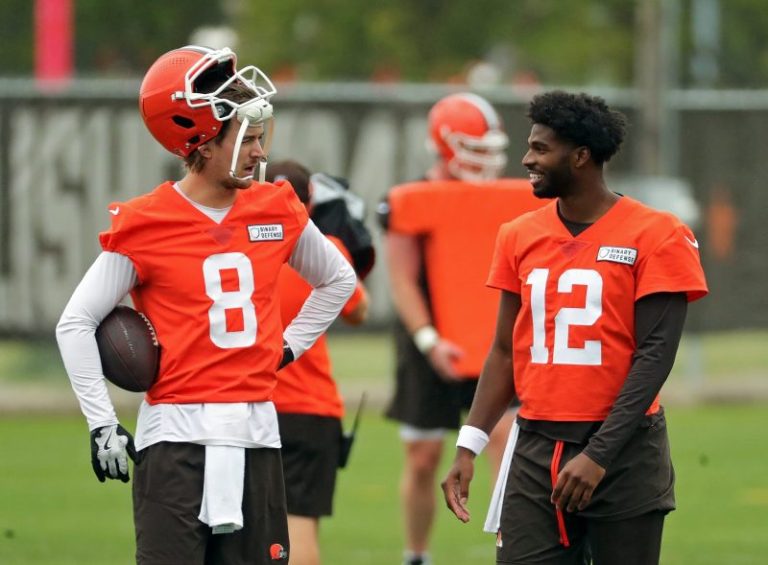
Shedeur Sanders just moved up the Cleveland Browns’ quarterback depth chart on Monday without doing anything.
According to multiple reports, the Browns traded backup quarterback Kenny Pickett to the Las Vegas Raiders on Monday evening. The news comes two days after Raiders backup Aidan O’Connell fractured his wrist and one day after Cleveland cut quarterback Tyler ‘Snoop’ Huntley.
The Browns’ trade of Pickett trims the team’s quarterbacks room to just three players after months-long speculation that Cleveland might keep four gunslingers on their active roster.
Here’s how the Browns’ quarterbacks depth chart looks now with just three quarterbacks remaining and just one veteran left standing:
Browns head coach Kevin Stefanski named 18-year veteran Joe Flacco the team’s Week 1 starter before Cleveland’s preseason finale against the Rams. Flacco is back in ‘The Land’ for a second stint after he took over late in the 2023 season and led the Browns to a playoff appearance.
Gabriel and Sanders are the two rookies that battled for the Browns’ backup spot on the roster all throughout training camp. Gabriel was a third-round pick in the 2025 NFL Draft, and Cleveland drafted Sanders two rounds later. Between the two, Gabriel had the more consistent performance in his two preseason outings.
Watson suffered a season-ending Achilles tear in Week 7 last year. In January, the Browns announced that the veteran underwent another surgery to repair the tendon after he had re-ruptured it during his recovery from the initial procedure.
Sanders received more fanfare than any of the participants in Cleveland’s quarterback competition during the 2025 NFL offseason. That said, the fifth-round rookie was always facing an uphill battle to emerge as a Week 1 starter.
Sanders was routinely listed as the No. 4 option on Cleveland’s depth chart during the 2025 NFL offseason. He was behind Flacco, Kenny Pickett and fellow rookie Gabriel, meaning he had to make up ground to get into the starting quarterback race.
However, Sanders was unable to build on that momentum in preseason Week 2. He suffered an oblique injury in practice and was held out of the team’s game against the Philadelphia Eagles. He followed up with a forgettable performance in preseason Week 3 vs. the Rams.
As such, Sanders simply ran out of time to state his case to climb the quarterback depth chart. That prevented him from emerging as a true challenger to Flacco. The Pickett trade should provide him an opportunity to climb the team’s depth chart, but he will still have to leap at least two passers ahead of him in order to get to the starting position.
USA TODAY Sports’ Jacob Camenker contributed to this article.

Alvopetro Energy Ltd. (TSXV: ALV,OTC:ALVOF) (OTCQX: ALVOF) announces initial production results from our recently completed 183-D4 Murucututu well (100% working interest) and an operational update.
President & CEO, Corey C. Ruttan commented:
‘The initial results from our 183-D4 well are extremely encouraging and have allowed us to post record daily natural gas production levels from our 100% owned Murucututu asset. This result reinforces our vision for Murucututu and our long-term growth objectives.’
Operational Update
Brazil
On our 100% owned Murucututu field, the 183-D4 well was drilled in the second quarter to a total measured depth of 3,072 metres. The well encountered the Caruaçu Member of the Maracangalha Formation 106 metres structurally updip of our 183-A3 well which has been on production since the fourth quarter of 2024. Based on cased-hole gamma ray logs and normalized gas while drilling, the well encountered potential natural gas pay in the Caruaçu Member of the Maracangalha Formation, with an aggregate 61 metres total vertical depth (‘TVD’) of potential natural gas pay between 2,439 and 2,838 metres TVD. We completed the well in seven intervals. The well went through an initial 116-hour cleanup period, recovering 2,620 barrels of completion fluid and 132 barrels of natural gas liquids. After this initial cleanup period, we flowed the well for 70 hours at a constant 32/64’choke at an average rate of 162 e 3 m 3 /d (5.7 MMcfpd, 953 boepd) with a 1,401psi flowing wellhead pressure. During this period, we also recovered a total of 995 barrels of completions fluid and 174 barrels of natural gas liquids. Average natural gas liquids (condensate) production during the flow period was 60 boepd. The flow rate over the last hour was 161 e 3 m 3 /d (5.7 MMcfpd, 947 boepd) with 1,384 psi flowing wellhead pressure. There are 12,190 barrels of 15,806 barrels of completions fluid left to recover. Given these extremely strong production results we are currently producing the Murucututu field from this single well as we are limited by our current facility capacity at Murucututu. As we continue to monitor these initial flow results, we will be evaluating options to improve production capacity of the system to allow for more production from the Murucututu field.
Our joint development on the unitized area (‘the Unit’) which includes our Caburé field commenced in the second quarter and four wells (2.2 net) have now been drilled. We have just commenced the completion program and expect to have the additional production online by the end of the third quarter. These development wells were primarily drilled to extend and enhance the productive plateau of the Unit and the results will also be incorporated into future Unit working interest redeterminations. The timing of drilling the fifth development well (0.6 net) is subject to the receipt of all necessary regulatory approvals.
Development Activities – Western Canada
In June, we further expanded our joint Mannville focused land based to 17,780 gross acres (8,890 net acres) and in July, two additional multi-lateral wells (1.0 net) were drilled with an aggregate of over 19 kilometers of open hole reservoir contact. Both wells have been completed and equipped and have just commenced production. Following a clean-up flow period, we will commence oil sales from these two new wells.
Corporate Presentation
Alvopetro’s updated corporate presentation is available on our website at: http://www.alvopetro.com/corporate-presentation .
Social Media
Follow Alvopetro on our social media channels at the following links:
Twitter – https://twitter.com/AlvopetroEnergy
Instagram – https://www.instagram.com/alvopetro/
LinkedIn – https://www.linkedin.com/company/alvopetro-energy-ltd
Alvopetro Energy Ltd. is deploying a balanced capital allocation model where we seek to reinvest roughly half our cash flows into organic growth opportunities and return the other half to stakeholders. Alvopetro’s organic growth strategy is to focus on the best combinations of geologic prospectivity and fiscal regime. Alvopetro is balancing capital investment opportunities in Canada and Brazil where we are building off the strength of our Caburé and Murucututu natural gas fields and the related strategic midstream infrastructure.
Neither the TSX Venture Exchange nor its Regulation Services Provider (as that term is defined in the policies of the TSX Venture Exchange) accepts responsibility for the adequacy or accuracy of this news release.
Abbreviations:
|
boepd = |
barrels of oil equivalent (‘boe’) per day |
|
bopd = |
barrels of oil and/or natural gas liquids (condensate) per day |
|
e 3 m 3 /d = |
thousand cubic metre per day |
|
m 3 = |
cubic metre |
|
m 3 /d = |
cubic metre per day |
|
Mcf = |
thousand cubic feet |
|
Mcfpd = |
thousand cubic feet per day |
|
MMcf = |
million cubic feet |
|
MMcfpd = |
million cubic feet per day |
|
NGLs = |
natural gas liquids (condensate) |
|
psi = |
pounds per square inch |
BOE Disclosure
The term barrels of oil equivalent (‘boe’) may be misleading, particularly if used in isolation. A boe conversion ratio of six thousand cubic feet per barrel (6 Mcf/bbl) of natural gas to barrels of oil equivalence is based on an energy equivalency conversion method primarily applicable at the burner tip and does not represent a value equivalency at the wellhead. All boe conversions in this news release are derived from converting gas to oil in the ratio mix of six thousand cubic feet of gas to one barrel of oil.
Well Results
Data obtained from the 183-D4 well identified in this press release, including cased-hole logging data, potential net pay and initial production results should be considered preliminary. There is no representation by Alvopetro that the data relating to the 183-D4 well contained in this press release is necessarily indicative of long-term performance or ultimate recovery. The reader is cautioned not to unduly rely on such data as such data may not be indicative of future performance of the well or of expected production or operational results for Alvopetro in the future.
Forward-Looking Statements and Cautionary Language
This news release contains forward-looking information within the meaning of applicable securities laws. The use of any of the words ‘will’, ‘expect’, ‘intend’, ‘plan’, ‘may’, ‘believe’, ‘estimate’, ‘forecast’, ‘anticipate’, ‘should’ and other similar words or expressions are intended to identify forward-looking information. Forward‐looking statements involve significant risks and uncertainties, should not be read as guarantees of future performance or results, and will not necessarily be accurate indications of whether or not such results will be achieved. A number of factors could cause actual results to vary significantly from the expectations discussed in the forward-looking statements. These forward-looking statements reflect current assumptions and expectations regarding future events. Accordingly, when relying on forward-looking statements to make decisions, Alvopetro cautions readers not to place undue reliance on these statements, as forward-looking statements involve significant risks and uncertainties. More particularly and without limitation, this news release contains forward-looking statements concerning future production and sales volumes, the expected timing of production and sales commencement from certain wells, and plans relating to the Company’s operational activities, proposed development activities and the timing for such activities. Forward-looking statements are necessarily based upon assumptions and judgments with respect to the future including, but not limited to the success of future drilling, completion, testing, recompletion and development activities and the timing of such activities, the performance of producing wells and reservoirs, well development and operating performance, expectations and assumptions concerning the timing of regulatory licenses and approvals, equipment availability, environmental regulation, including regulations relating to hydraulic fracturing and stimulation, the ability to monetize hydrocarbons discovered, the outlook for commodity markets and ability to access capital markets, foreign exchange rates, the outcome of any disputes, the outcome of redeterminations, general economic and business conditions, forecasted demand for oil and natural gas, the impact of global pandemics, weather and access to drilling locations, the availability and cost of labour and services, and the regulatory and legal environment and other risks associated with oil and gas operations. The reader is cautioned that assumptions used in the preparation of such information, although considered reasonable at the time of preparation, may prove to be incorrect. Actual results achieved during the forecast period will vary from the information provided herein as a result of numerous known and unknown risks and uncertainties and other factors. Current and forecasted natural gas nominations are subject to change on a daily basis and such changes may be material. In addition, the declaration, timing, amount and payment of future dividends remain at the discretion of the Board of Directors. Although we believe that the expectations and assumptions on which the forward-looking statements are based are reasonable, undue reliance should not be placed on the forward-looking statements because we can give no assurance that they will prove to be correct. Since forward looking statements address future events and conditions, by their very nature they involve inherent risks and uncertainties. Actual results could differ materially from those currently anticipated due to a number of factors and risks. These include, but are not limited to, risks associated with the oil and gas industry in general (e.g., operational risks in development, exploration and production; delays or changes in plans with respect to exploration or development projects or capital expenditures; the uncertainty of reserve estimates; the uncertainty of estimates and projections relating to production, costs and expenses, reliance on industry partners, availability of equipment and personnel, uncertainty surrounding timing for drilling and completion activities resulting from weather and other factors, changes in applicable regulatory regimes and health, safety and environmental risks), commodity price and foreign exchange rate fluctuations, market uncertainty associated with trade or tariff disputes, and general economic conditions. The reader is cautioned that assumptions used in the preparation of such information, although considered reasonable at the time of preparation, may prove to be incorrect. Although Alvopetro believes that the expectations and assumptions on which such forward-looking information is based are reasonable, undue reliance should not be placed on the forward-looking information because Alvopetro can give no assurance that it will prove to be correct. Readers are cautioned that the foregoing list of factors is not exhaustive. Additional information on factors that could affect the operations or financial results of Alvopetro are included in our AIF which may be accessed on Alvopetro’s SEDAR+ profile at www.sedarplus.ca . The forward-looking information contained in this news release is made as of the date hereof and Alvopetro undertakes no obligation to update publicly or revise any forward-looking information, whether as a result of new information, future events or otherwise, unless so required by applicable securities laws.
www.alvopetro.com
TSX-V: ALV, OTCQX: ALVOF
SOURCE Alvopetro Energy Ltd.
View original content: http://www.newswire.ca/en/releases/archive/August2025/25/c1020.html
News Provided by Canada Newswire via QuoteMedia