Author

admin

Browsing

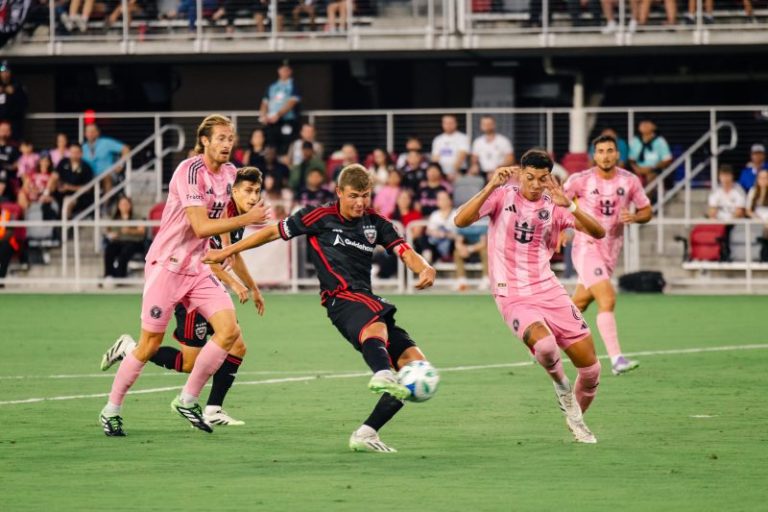
WASHINGTON — Without Lionel Messi, Inter Miami dropped points in the MLS Supporters’ Shield race, with a reserve-heavy lineup settling for a 1-1 draw against struggling D.C. United at Audi Field on Saturday, Aug. 23.

With Messi (right hamstring) and another big name, Jordi Alba (knee), both sidelined with injury, Miami head coach Javier Mascherano opted to swap out most of his starting lineup against one of MLS’s weakest teams. Sergio Busquets, Rodrigo De Paul, and Luis Suárez all began the game on the bench, though the trio of global stars did enter the match in the second half.

In the meantime, United took a shock 13th-minute lead via a fine finish from Jackson Hopkins, capping off a strong opening phase from the hosts. However, Miami improved in the second half, with Baltasar Rodríguez scoring a world-class half-volley to equalize in the 64th minute.

For Miami, a draw against United — who were eliminated from the playoff race with the result — will go down as a disappointment. The Herons (13W-7D-5L) currently sit in fifth place in the Eastern Conference with 46 points, and trail the Supporters’ Shield leaders Philadelphia Union by eight points.

Here are highlights and what to know about D.C. United vs. Inter Miami MLS game:

Inter Miami vs. D.C. United highlights

Inter Miami vs. D.C. United final score: 1-1

That’s full time at Audi Field, with D.C. United and Inter Miami playing to a 1-1 draw.

Jackson Hopkins’ first-half goal gave the hosts a lead in a livelier performance than their fans have seen in a while, but a rocket from Baltasar Rodríguez got Miami level midway through the second half. Both sides hit the post in the final stages, but the Herons will wonder how all their second-half pressure didn’t amount to a game-winner.

Inter Miami vs. D.C. United: De Paul hits post

Inter Miami has put D.C. United under intense pressure as the game wears down, and Rodrigo De Paul nearly claimed a game-winner in stoppage time just now.

It would have been very lucky, as his free kick missed all of its targets, but the ball bent towards goal and hit the post, with Luis Barraza beaten.

It remains 1-1 in the final seconds.

Inter Miami vs. D.C. United: Murrell goal called back, final subs

This game has turned into something of a thriller, with Jacob Murrell having a goal called back over what seemed like a very narrow offside call.

Inter Miami’s last sub sees defender Ryan Sailor replaced by Ian Fray, while D.C. United goes for broke by throwing forward Dominique Badji into the mix and taking off defender Connor Antley.

Inter Miami vs. D.C. United: Two more DCU subs

D.C. United has added more fresh legs, with René Weiler sending on João Peglow and Rida Zouhir for Jackson Hopkins and Brandon Servania in the 74th minute.

Meanwhile, one of Weiler’s earlier subs, Jacob Murrell, hit the post on an increasingly rare break forward for the hosts.

Goal Inter Miami! Rodriguez scores unreal goal

We’ve had a flurry of activity, most notably a sensational goal by substitute Baltasar Rodríguez in the 64th minute.

A seemingly wayward corner kick floated over another second-half substitute, Luis Suárez (like we said, a lot has happened in the last few minutes), and Rodríguez took advantage, hitting a spectacular half-volley that bent into the furthest reaches of the upper corner to equalize.

This came shortly after a flurry of substitutions from both teams. First, Javier Mascherano opted for a triple substitution, bringing on Sergio Busquets, Rodrigo De Paul, and Baltasar Rodríguez for Gonzalo Luján, David Ruíz, and Telasco Segovia. United made a double-swap of their own, sending Jared Stroud and Jacob Murrell on for Gabriel Pirani and Hosei Kijima, seconds before Suárez entered the fray in place of Tadeo Allende.

Second half underway between Inter Miami and D.C. United

No changes for either team as play resumes at Audi Field.

However, Inter Miami has Sergio Busquets and Rodrigo De Paul warming up, which could flip this game on its head should head coach Javier Mascherano bring them on.

Halftime: D.C. United leads Inter Miami 1-0

It’s a surprising scoreline at Audi Field, with D.C. United leading Inter Miami 1-0 on a 13th-minute Jackson Hopkins goal.

This may be a heavily rotated Inter Miami side, with Luis Suárez, Sergio Busquets, and Rodrigo De Paul on the sidelines, but it’s arguably a fair reflection of play. D.C. created some good looks in the first half-hour, and while Miami has played their way into the game, United goalkeeper Luis Barraza has had little to do.

Inter Miami vs. D.C. United: Peltola booked

D.C. United rapidly picks up a second yellow card, this time for holding midfielder Matti Peltola.

The Finn dove in trying to poke a loose ball away from Inter Miami’s Telasco Segovia, but his trailing leg wiped the Venezuelan out.

Inter Miami vs. D.C. United: Yellow card to Herrera

Aaron Herrera is the first player booked, with the D.C. United defender (playing as a midfielder for the second straight game) tripping up Fafà Picault as Inter Miami attempted a counter-attack.

Goal D.C. United! Hopkins gives hosts lead

Miami’s B-team lineup is struggling with D.C. United, who have created several chances and now lead 1-0 in the 13th minute.

The Herons partially cleared a corner kick, but when it was looped back into the area by Matti Peltola, United’s Jackson Hopkins provided an authoritative finish from 10 yards.

Inter Miami at D.C. United kicks off

Miami’s massively rotated lineup kicks off against a D.C. United side that needs to win to keep their incredibly remote playoff hopes alive.

Inter Miami starting lineup: No Messi vs. D.C. United

Inter Miami head coach Javier Mascherano has rotated heavily, even without Lionel Messi (hamstring) available. The Herons’ other biggest names are not available to start either, with Jordi Alba (knee) not in uniform after picking up his injury Wednesday.

Luis Suárez, Sergio Busquets, and Rodrigo De Paul are all on the bench, as a star-studded Miami side has turned heavily towards reserves and second-choice players.

How to watch Inter Miami vs. D.C. United: Time, TV, streaming

  • Date: Saturday, August 23
  • Time: 7:30 p.m. ET
  • Location: Audi Field (Washington, D.C.)
  • TV channel: None
  • Streaming: MLS Season Pass on Apple TV

Watch Inter Miami at D.C. United on MLS Season Pass on Apple TV

D.C. United starting lineup

Under new manager René Weiler (who oversaw his first match last weekend, a 1-1 road draw against CF Montréal), D.C. United has chosen a defense-first starting lineup.

Captain and star striker Christian Benteke is here at Audi Field in street clothes, as he and midfielder Boris Enow are both suspended due to yellow-card accumulation. United is also missing trade deadline addition Caden Clark, who was announced as out yesterday in Weiler’s first press conference.

This post appeared first on USA TODAY

Son Heung-min has his first goal for Los Angeles FC.

The club’s much-ballyhooed summer acquisition, netted his first LAFC goal on a free kick in the sixth minute during a 1-1 draw against FC Dallas on Saturday, Aug. 23.

Son took the free kick from a few yards beyond the 18-yard box and was on target and with enough pace to get past FC Dallas goalkeeper Michael Collodi. The free kick was earned when LAFC’s Denis Bouanga was fouled by Chris Cappis.

The goal comes a week after Son earned his first assist with LAFC in a 2-0 win over the New England Revolution on Aug. 16.

Son joined LAFC on Aug. 6 from Tottenham Hotspur of the England Premier League. The South Korean international had scored 173 goals in 10 seasons with the London-based club, captaining Tottenham its first trophy in 17 years as Spurs won the 2024-25 Europa League final in May.

This post appeared first on USA TODAY

A broad selloff in heavyweight tech stocks at the start of the week abruptly reversed after US Federal Reserve Chair Jerome Powell delivered a speech that bolstered expectations of a September interest rate cut.

Speaking at the Jackson Hole Economic Policy Symposium, Powell took a more dovish tone than investors may have been expecting, noting a slowdown in both worker supply and demand that could lead to employment risks.

He stated that the shifting balance of risks may warrant adjusting the Fed’s policy stance, stressing the need to balance both sides of the central bank’s dual mandate when goals are in tension.

This is a change from the Fed’s previous stance, which had been more focused on the need to keep rates high to fight inflation. Powell acknowledged the visible, though likely temporary, effects of tariffs, cautioning about the potential for persistent inflation, but signaled that the Fed is now also seriously considering the downside risks to employment.

A risk-on rally ensued, impacting various market sectors: the S&P 500 (INDEXSP:.INX), Dow Jones Industrial Average (INDEXDJX:.DJI) and Nasdaq Composite (INDEXNASDAQ:.IXIC) all closed up by more than 1.5 percent.

Bitcoin climbed above US$116,800, the Russell 2000 Index (INDEXRUSSELL:RUT) surged by 3.9 percent and 10 year treasury yields decreased by 0.07 percentage points to 4.26 percent. Traders now have higher expectations for a September rate cut, with probabilities exceeding 83 percent according to CME Group’s (NASDAQ:CME) FedWatch tool.

Here’s a look at the other drivers that shaped the tech sector this week.

1. Softbank to invest US$2 billion in Intel

Intel’s (NASDAQ:INTC) share price got a boost this week after a series of major announcements, beginning with SoftBank Group’s (TSE:9984) Monday (August 18) announcement that it plans invest US$2 billion in the company.

“Semiconductors are the foundation of every industry. For more than 50 years, Intel has been a trusted leader in innovation,’ said Masayoshi Son, chairman and CEO of SoftBank, in a press release.

‘This strategic investment reflects our belief that advanced semiconductor manufacturing and supply will further expand in the United States, with Intel playing a critical role,” he added.

Following that news, sources confirmed last week’s reports that the US government was seeking an equity stake in Intel in exchange for Biden-era Chips Act funding. Then, on Friday (August 22), US Secretary of Commerce Howard Lutnick announced that Intel had agreed to sell an 8.9 percent stake to the federal government, a move that will convert billions of dollars in previously awarded grants into a passive ownership stake.

Intel performance, July 28 to August 18, 2025.

Chart via Google Finance.

These developments have sent Intel’s market value soaring, with its share price increasing over 28 percent from the start of the month. Shares of Intel closed up on Friday at US$24.80.

2. Figure files for Nasdaq IPO

Figure Technology filed for an initial public offering (IPO) on the Nasdaq on Monday under the ticker symbol FIGR, joining a growing list of crypto-related companies looking to access public markets following the successful debut of stablecoin issuer Circle Internet Group (NYSE:CRCL).

Figure leverages blockchain to streamline financial services. The company’s filing reveals a strong financial performance, with profit reaching US$29 million in the first half of 2025, compared to a US$13 million loss in the same period last year. Its revenue for the first half of the year was US$191 million.

Goldman Sachs (NYSE:GS), Jefferies Financial Group (NYSE:JEF) and Bank of America Securities are acting as lead underwriters for the offering. The number of shares and price ranges are yet to be confirmed.

3. Google unveils new Pixel and more

Google (NASDAQ:GOOGL) made headlines this week with several new developments spanning its business lines.

The week kicked off with the tech giant announcing it has increased its stake in data center operator and Bitcoin miner TeraWulf (NASDAQ:WULF) to roughly 14 percent, worth US$3.2 billion.

The company also revealed a partnership with advanced nuclear startup Kairos Power and the Tennessee Valley Authority to power its data centers in Tennessee and Alabama using a new nuclear reactor.

On Wednesday (August 20), Google unveiled its latest Pixel smartphone, the Pixel 10, and accessories, with upgrades including a health coach powered by artificial intelligence (AI).

The week culminated with reports of a US$10 billion cloud computing agreement with Meta Platforms (NASDAQ:META) to provide the necessary servers and infrastructure for Meta’s expanding AI operations. The news sent Google’s share price up by over 3 percent and Meta’s up by over 2 percent.

4. NVIDIA tumbles amid China tension and chip sales

NVIDIA (NASDAQ:NVDA) experienced a volatile week, with its share price slipping in early trading on Monday following reports of renewed tensions with China. The downturn was triggered by news that Beijing will move to restrict sales of the H20 AI chip, the company’s most advanced product approved for the Chinese market.

China’s internet and telecom regulator, as well as the state planning agency, issued informal guidance to major tech companies, instructing them to halt new orders of the H20 chips, citing security concerns.

According to unnamed officials who spoke to the Financial Times, the decision was also influenced by “insulting” remarks from US Secretary of Commerce Howard Lutnick.

In response to the Chinese directive, NVIDIA has reportedly instructed its component suppliers, including Foxconn Technology (TPE:2354), Samsung Electronics (KRX:005930) and Amkor Technolgy (NASDAQ:AMKR), to suspend production of the H20 chip; the company also said it is working on a new AI chip for China.

Alphabet, NVIDIA, Palo Alto Networks and Meta Platforms performance, August 19 to 22, 2025.

Chart via Google Finance.

NVIDIA saw the greatest losses midweek, falling over 4 percent between Tuesday and Thursday. The company recovered some of its losses during Friday’s rally, but finished the week over one percent lower.

5. Palo Alto Networks rises on strong forecast

Palo Alto Networks (NASDAQ:PANW) surged over 7 percent on Tuesday after the cybersecurity company forecast that revenue and profit for its 2026 financial year will come in above estimates.

The company gave a strong performance in its 2025 fiscal year, with total revenue increasing 15 percent year-on-year to US$9.2 billion, fueled by an increase in revenue from newer, cloud-based security products. This growth occurred alongside a 24 percent rise in its future contracted business to US$15.8 billion.

The company also surpassed a US$10 billion revenue run rate while maintaining its “Rule-of-50” status — a measure of the balance between growth and profitability — for the fifth consecutive year.

Securities Disclosure: I, Meagen Seatter, hold no direct investment interest in any company mentioned in this article.

This post appeared first on investingnews.com

Statistics Canada released July’s consumer price index (CPI) data on Tuesday (August 19). The figures show that inflation decelerated in the month, posting a 1.7 percent year-on-year gain, down from the 1.9 percent recorded in June.

The most significant contributor to the fall was a 16.1 percent decline in gasoline prices from the same period last year.

Excluding the lower costs at the pumps, CPI remained steady at 2.5 percent, the same increase as May and June.

The national reporting agency released June’s mineral production survey on Wednesday (August 20).

The data indicates that production and shipments increased across the board, with copper production rising to 39.17 million kilograms, gold rising to 16,935 kilograms and silver increasing to 29,081 kilograms.

For shipments, copper increased to 45.96 million kilograms from 34.38 million kilograms, gold shipments rose to 18,554 kilograms from 16,725, and silver jumped to 31,391 kilograms from 27,614 kilograms.

On Thursday (August 21), Canadian Prime Minister Mark Carney had a phone call with US President Donald Trump. Although the prime minister’s office has provided few details, the two leaders reportedly had a “productive and wide-ranging conversation” about the current trade dispute, as well as economic and security relations.

Carney and Trump are expected to speak again soon.

South of the border, US Federal Reserve Chair Jerome Powell gave his speech at the Jackson Hole Economic Policy Symposium on Friday (August 22). In his remarks, he said that the Fed’s dual mandate goal is in balance, with the labor market remaining near maximum employment, while inflation has eased from post-pandemic highs.

However, he also said that “a shifting balance of risks may warrant adjusting our policy stance,” hinting at a near-term cut to the Fed’s benchmark interest rate. Expectations are high for a 25 basis point cut in September.

Markets and commodities react

Canadian equity markets were positive this week. The S&P/TSX Composite Index (INDEXTSI:OSPTX) was in record territory, closing the week up 1.44 percent to set at another all-time high of 28,333.13. The S&P/TSX Venture Composite Index (INDEXTSI:JX) did even better, climbing 2.45 percent to finish Friday at 803.61. The CSE Composite Index (CSE:CSECOMP) slumped mid-week but recovered on Friday to post a slight gain of 0.48 percent to 158.82.

US equity markets were mixed this week, but strong gains on Friday following Powell’s comments kept them in record high territory. The S&P 500 (INDEXSP:INX) was up 1.52 percent on Friday, but down by 0.16 percent over the past five days to 6,466.92, while the Nasdaq 100 (INDEXNASDAQ:NDX) rose 1.51 percent on Friday, but sank 1.33 percent on the week to 23,497.83 on Wednesday. Meanwhile, the Dow Jones Industrial Average (INDEXDJX:.DJI) was the sole weekly gainer, rising 1.89 percent on Friday and 1.04 percent on the week to post a new record high of 45,631.73.

The gold price was largely flat this week, but also surged on Friday after Powell hinted at a near-term rate cut, rising 1.11 percent on the week to US$3,373.21 per ounce by 4:00 p.m. EDT on Friday.

Silver saw similar movements, but ended the week with a more significant gain of 2.62 percent US$38.90 per ounce.

Copper saw little change again this week, posting a 0.22 percent decrease to US$4.52 per pound. The S&P GSCI (INDEXSP:SPGSCI) commodities index posted an increase of 1.92 percent by close on Friday, finishing at 545.11.

Top Canadian mining stocks this week

How did mining stocks perform against this backdrop?

Take a look at this week’s five best-performing Canadian mining stocks below.

Stock data for this article was retrieved at 4:00 p.m. EDT on Friday using TradingView’s stock screener. Only companies trading on the TSX, TSXV and CSE with market caps greater than C$10 million are included. Mineral companies within the non-energy minerals, energy minerals, process industry and producer manufacturing sectors were considered.

1. StrategX Elements (CSE:STGX)

Weekly gain: 63.64 percent
Market cap: C$11.57 million
Share price: C$0.18

StrategX Elements is advancing a portfolio of projects in the Northwest Territories and Nunavut, Canada.

Its most recent focus has been its Nagvaak project in Nunavut, which hosts a 6 kilometer mineralized zone with deposits of nickel, vanadium, cobalt, copper, silver and platinum-group metals.

On March 3, the company discovered a wide zone of high-grade graphite mineralization at Nagvaak, with one assay returning an average of 15 percent graphitic carbon over 32 meters, including an intersection of 22 percent graphitic carbon over 17 meters. StrategX said the hole also returned encouraging concentrations of other minerals, including nickel, copper and silver, supporting potential for a multi-mineral system.

The most recent news from the project came on July 30, when the company announced it was in the process of mobilizing for a 2025 drill program intended to delineate and validate the discoveries.

On Tuesday, the company completed a non-brokered private placement for 3.71 million shares, raising gross proceeds of C$296,960. It announced the placement on August 7 and said funds would be used for general working capital.

2. Max Resource (TSXV:MAX)

Weekly gain: 62.5 percent
Market cap: C$12.59 million
Share price: C$0.065

Max Resource is an explorer working to advance a portfolio of projects in Colombia.

Its Sierra Azul property is a district-scale copper and silver project consisting of 20 mining concessions covering an area of 188 square kilometers in northeastern Colombia.

The asset is covered by a May 2024 earn-in agreement with Freeport-McMoRan (NYSE:FCX), in which Freeport can receive up to an 80 percent stake by funding of C$50 million over 10 years. The site hosts multiple target areas with high-grade copper and silver mineralization, including a 20 kilometer red-bed style copper system at the AM district.

Max also owns the Florália hematite direct-shipping ore iron project located in the Minas Gerais region. The company completed the acquisition of the property in October 2024 from Jaguar Mining (TSX:JAG,OTCQX:JAGGF) for total cash considerations of US$1 million and 4 million performance share units, contingent upon reaching certain milestones. The site hosts hematite deposits with grades over 60 percent iron. Max intends to use a direct-shipping ore process to mine, crush and screen the ore before exporting the material directly to steel mills.

The company’s most recent announcement came this past Tuesday, when it secured the right to acquire Mora title, which lies adjacent to Aris Mining’s (TSX:ARIS,NYSEAMERICAN:ARMN) Marmato mine. The property hosts 40 historic workings with five active mines, with reserves with grades of 3.2 grams per metric ton (g/t) gold from 31.3 million metric tons and a resource of 9 million ounces of gold grading 3 g/t from 61.5 million metric tons.

3. Maple Gold Mines (TSXV:MGM)

Weekly gain: 50 percent
Market cap: C$45.6 million
Share price: C$0.105

Maple Gold Mines is a gold exploration company focused on the advancement of its Douay and Joutel projects located in the Abitibi greenstone belt in Québec, Canada.

The Douay project covers an area of 357 square kilometers. In a 2022 technical report, the company said the site hosts an indicated resource of 511,000 ounces of gold from 10 million metric tons with an average grade of 1.59 g/t gold, with an additional inferred resource of 2.53 million ounces from 76.7 million metric tons at 1.02 g/t.

Joutel is located directly south of Douay. The company announced on May 5 that it had staked an additional 128 mining claims, bringing the total land area at the property to 111 square kilometers from the original 39. The site hosts Agnico Eagle Mines’ (TSX:AEM,NYSE:AEM) past-producing Eagle-Telbel gold mine, which operated from 1974 to 1993. To date, the company has used 250,000 meters of historic drill results to create 3D models to aid in current exploration efforts.

The most recent news from Maple came on Wednesday when it announced a C$5 million non-brokered private placement led by strategic investor Michael Gentile. Additionally, the company reported that Agnico Eagle has indicated it intends to participate in the offering to maintain its pro rata ownership interest in Maple Gold.

The release also said that it has appointed Marc Legault and Chris Adams to the board of directors.

4. Capitan Silver (TSXV:CAPT)

Weekly gain: 40.45 percent
Market cap: C$113.2 million
Share price: C$1.25

Capitan Silver is an explorer focused on advancing silver and gold projects in Durango, Mexico.

The company’s flagship asset is the 100 percent owned Cruz de Plata project, in the heart of Mexico’s historic Penoles Mining District. The district is known for hosting significant silver mineralization and historic mining.

The Cruz de Plata project encompasses two historic silver mines — Jesus Maria and San Rafael — and the El Capitan oxide gold prospect, all within a 22.9 square kilometer land package.

To date, the company has completed 86 diamond drill holes totaling over 11,550 meters.

A 2020 technical report demonstratesd an inferred resource of 16.99 million ounces of contained silver and 331,000 ounces of contained gold from 28.3 million metric tons of ore with grades of 18.7 g/t silver and 0.36 g/t gold.

The most recent news from Capitan came on Friday, when it announced it executed a definitive agreement to acquire a strategic land package at its Cruz de Plata property from Fresnillo (LSE:FRES,OTC Pink:FNLPF) for total cash considerations of US$4 million. The transaction was initially announced in June.

The new parcel consists of seven mineral concessions covering an area of 2,171.4 hectares and increases its total holdings in the area by 85 percent and the surface expression of the silver and gold trend by 1.2 kilometers to the east.

5. District Metals (TSXV:DMX)

Weekly gain: 36.9 percent
Market cap: C$163.98 million
Share price: C$1.15

District Metals is a uranium exploration company focused on advancing a portfolio of assets in Sweden.

Its flagship Viken property covers an area of 38,657 hectares in Jämtland County and in addition to uranium hosts mineral deposits of vanadium, molybdenum, nickel, copper and zinc.

On June 13, District filed a technical report for the project’s updated mineral resource estimate. It shows an indicated resource of 176 million pounds of U3O8 from 456 million metric tons of ore with a grade of 175 parts per million (ppm) U3O8 and an inferred resource of 1.54 billion pounds of U3O8 from 4.3 billion metric tons with a grade of 161 ppm.

The company has also been advancing its Tomtebo-Stollberg zinc project in South-Central Sweden. The project is part of an October 2023 definitive agreement in which Boliden (STO:BOL) can earn an 85 percent interest in the property by spending C$10 million over four years and District can earn a 15 percent stake in Boliden’s Stollberg property.

Tomtebo covers an area of 5,144 hectares and hosts the historic Tomtebo and Lovas mines, while Stollberg covers an area of 5,180 hectares and is located near Boliden’s Garpengerg mine.

The most recent update from Tomtebo came on July 29, when District released assays from a five hole, 2,485 meter drill program conducted between February and April. One highlighted drill hole recorded multiple zones of silver and base metals mineralization, including 88 g/t silver, 3 percent zinc and 1.9 percent lead over 7.85 meters.

The company has not released any news since.

FAQs for Canadian mining stocks

What is the difference between the TSX and TSXV?

The TSX, or Toronto Stock Exchange, is used by senior companies with larger market caps, and the TSXV, or TSX Venture Exchange, is used by smaller-cap companies. Companies listed on the TSXV can graduate to the senior exchange.

How many mining companies are listed on the TSX and TSXV?

As of February 2025, there were 1,572 companies listed on the TSXV, 905 of which were mining companies. Comparatively, the TSX was home to 1,859 companies, with 181 of those being mining companies.

Together the TSX and TSXV host around 40 percent of the world’s public mining companies.

How much does it cost to list on the TSXV?

There are a variety of different fees that companies must pay to list on the TSXV, and according to the exchange, they can vary based on the transaction’s nature and complexity. The listing fee alone will most likely cost between C$10,000 to C$70,000. Accounting and auditing fees could rack up between C$25,000 and C$100,000, while legal fees are expected to be over C$75,000 and an underwriters’ commission may hit up to 12 percent.

The exchange lists a handful of other fees and expenses companies can expect, including but not limited to security commission and transfer agency fees, investor relations costs and director and officer liability insurance.

These are all just for the initial listing, of course. There are ongoing expenses once companies are trading, such as sustaining fees and additional listing fees, plus the costs associated with filing regular reports.

How do you trade on the TSXV?

Investors can trade on the TSXV the way they would trade stocks on any exchange. This means they can use a stock broker or an individual investment account to buy and sell shares of TSXV-listed companies during the exchange’s trading hours.

Article by Dean Belder; FAQs by Lauren Kelly.

Securities Disclosure: I, Dean Belder, hold no direct investment interest in any company mentioned in this article.

Securities Disclosure: I, Lauren Kelly, hold no direct investment interest in any company mentioned in this article.

This post appeared first on investingnews.com
ROCHESTER, Minnesota, Aug 22 (Reuters) – U.S. farmers will harvest a record corn crop in 2025 after ideal weather across much of the Midwest this summer, but the bounty will fall short of the U.S. government’s lofty outlook as pockets of plant disease and heat stress dented yields in spots across the farm belt, crop consultancy Pro Farmer said on Friday.

Growers are also expected to reap a bumper soybean crop, although dry conditions in parts of the eastern Midwest and pockets of disease pressure in Iowa may limit yield potential, Pro Farmer said after its annual four-day tour across seven top-producing states this week.

The United States is the world’s top corn exporter and No. 2 soybean exporter, and favorable weather in most of the main growing states supported crops but pushed futures prices to recent multi-year lows.

The warm and wet conditions that fueled crop growth also fostered fungal diseases such as tar spot, southern rust and northern blight in corn, and sudden death syndrome in soybeans.

“Each day we’ve noted the disease pressure in corn. Tar spot, southern rust more widespread than we’ve ever seen before. Those are going to be some real yield robbers,” said Lane Akre, Pro Farmer economist and one of the leaders of the tour’s eastern leg.

Pro Farmer projected 2025 U.S. corn production at a record 16.204 billion bushels, with an average yield of 182.7 bushels per acre, and soybean production at 4.246 billion bushels, with an average yield of 53.0 bpa.

The outlook is below the U.S. Department of Agriculture’s latest forecast for corn production at a record 16.742 billion bushels with yields averaging 188.8 bpa, and soybean production at 4.292 billion bushels with record average yields of 53.6 bpa.

Crop scouts on the Pro Farmer tour saw more disease-hit fields than normal across the Midwest farm belt this week, although it is not yet clear whether these diseases will blow up into significant yield loss.

At one stop in northwest Illinois, the corn field appeared healthy and green from the roadside, but 30 to 40 steps in, leaves were streaked with rust, leaving crop scouts covered in color. Overhead, bright yellow crop dusters banked low as they sprayed wide white plumes of fungicide.

Jake Guse, a Minnesota row crop farmer and crop scout on the eastern leg of the tour, said disease levels were the worst and most widespread that many crop scouts had ever seen on the tour.

“As we traveled across Indiana, we started seeing more (disease). In Illinois, started getting bad — and it was all over Iowa,” Guse said of three of the largest producing states.

However, crop scouts also found exceptional yield prospects that could help cushion any disease-related yield decline.

The strong production prospects may not be welcome news to farmers, who are facing a third straight year of declining corn prices due to excess supplies and only a modest improvement in soybean prices, according to USDA data.

Production costs remain high while trade tensions with key markets like China, the top soybean importer, have left demand uncertain.

While the USDA is forecasting that the nation’s farm economy will improve in 2025, that boost will largely come from a massive influx of federal funding the Trump administration plans to send to rural America, according to USDA data.

Corn and soybean futures on the Chicago Board of Trade firmed this week as reports from the crop tour suggested that recent USDA harvest forecasts may be too high.

The benchmark CBOT December corn contract CZ25 ended the week up 1.5%, its first weekly gain in a week in five weeks, while November soybeans SX25 also rose 1.5% and hit a one-month high.

This post appeared first on NBC NEWS

  • Sanders aims to destigmatize incontinence by openly discussing his experience and incorporating the product into his image.
  • The ad campaign follows Sanders’ surgery where his bladder was removed and replaced with a neobladder.
  • Sanders uses Depend to manage the changes in his bathroom habits post-surgery.

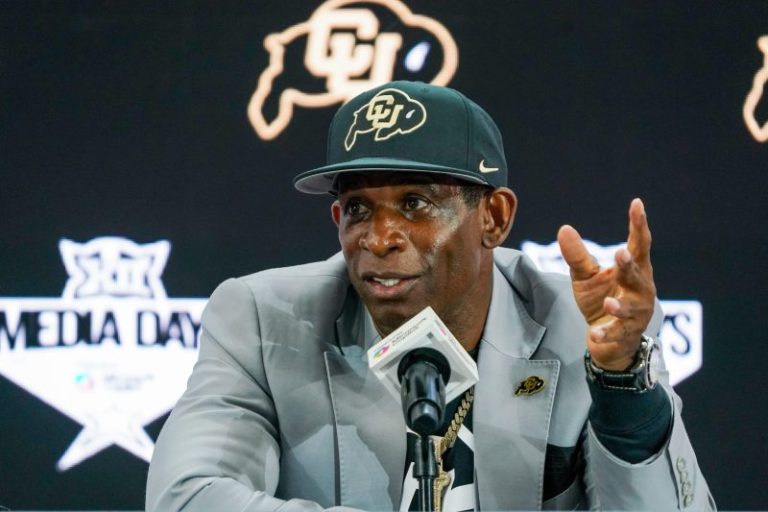
Colorado coach Deion Sanders did his first advertisement for the Depend adult diaper brand after having his cancerous bladder removed in May.

But it’s not just the latest sponsorship deal for Sanders, who also is seen in advertisements for Blenders eyewear, Aflac insurance and California Almonds.

This one is about his personal health.

PATH TO PLAYOFF: Sign up for our college football newsletter

“I wasn’t joking! I truly DEPEND on @Depend,” Sanders said on Instagram on Friday Aug. 22. “Ain’t NO SHAME in taking care of yourself. NO SHAME in getting health screenings. And there certainly ain’t NO SHAME in needing added protection or using Depend to stay in the game. That’s not weakness – that’s WINNING”

The ad shows packages of the underwear underneath his Nike shoes.

The company that owns the brand confirmed to USA TODAY Sports in July that it has a partnership with Sanders. Depend often is associated with jokes about old age and embarrassing problems with incontinence. But Sanders has said he wants to take the shame out of it by discussing it openly and associating it with his personal fashion.

‘I’m about to sexy ’em up,’ Sanders told retired NFL receiver Michael Irvin in an interview posted July 28.

Sanders said after bladder surgery that “I truly depend on Depend. I cannot control my bladder.”

After his bladder was removed, a neobladder was put in its place from his small intestine. It’s led to changes with how he goes to the bathroom. Sanders talked about it with Irvin.

“You have to push through your stomach and force the pee out,” Sanders said. “Like you can’t just pee, and when you feel like you gotta go pee, you need to pee or you gonna start leaking.”

This product helps him deal with that.

“No shame at all!” Depend responded to Sanders on social media site X. “We’re proud to help you stay in the game, Coach Prime.”

Sanders has recovered from cancer and is coaching his team as normal this month. His team opens the season Aug. 29 at home against Georgia Tech.

Follow Brent Schrotenboer @Schrotenboer. Email: bscrhotenb@usatoday.com

This post appeared first on USA TODAY

No more crazy playoff ideas. No more lone wolves. 

The Big Ten set the bar this summer for College Football Playoff change, and the SEC just met and exceeded it. 

Your move, Big Ten.

It’s time to see just how badly the Big Ten wants CFP expansion.

The SEC on Thursday, Aug. 22 made the first move to the center of the room, adding a ninth game to its annual conference schedule starting in 2026 — the one thing the Big Ten said it had to see before moving forward with CFP expansion.

The Big Ten has played nine conference games since 2016, and the SEC playing eight has been a sticking point between the super conferences. 

The Big Ten claimed it had a more difficult road to the playoff by playing nine. The SEC countered with, well, “We’re the SEC, and you’re not.” 

That all ended with the SEC’s long-awaited move to nine conference games. 

There’s nothing left to argue now for the Big Ten. It wanted the SEC on a level playing field, and the SEC called the Big Ten’s bluff.   

It not only moved to nine conference games, it kept a rule that forces league schools to schedule at least one non-conference game against a power conference opponent. 

Now the future of College Football Playoff expansion rests with the Big Ten, which can agree to the 5-11 format that every other Bowl Subdivision conference favors – automatic qualifiers from the five highest-ranked conference champions, and 11 at-large teams – or it can continue down the road of obstruction.

By demanding a unrealistic 4-2-1-3 format (it’s too dumb to explain), or an expansion to 24 or 28 teams (speaking of dumb), the Big Ten will expose its true desire: increased revenue at the cost of others.  

If the Big Ten still refuses the 5-11 format – which it said was more advantageous to the SEC because it could earn more at-large selections with an easier road of less conference games – it never cared about the SEC moving to nine games in the first place. 

For years, the SEC has been seen as the college football boogeyman, the all-powerful conference that controlled all things on and off the field. The death of fun, even.

It recruited the best players, won the most championships, and got the most breaks by whatever postseason plan was in place (hello, Alabama). An embarrassment of riches no one could deny or overcome. 

Until Michigan and Ohio State won back-to-back national titles the past two seasons, slowly pulling the SEC’s invincibility into question. The Big Ten then flexed and executed a power play, forcing the SEC to move off its eight-game conference schedule.

It even dragged the Big 12 into the fray, using the prop of the Big 12 playing nine conference games, too. So why couldn’t the SEC?

The Big Ten said it wanted everyone on the same page, including the ACC. Or maybe that was just another Alliance thing.

The next thing you know, SEC coaches left their conference spring meetings in May and declared their desire to play the Big Ten in non-conference games. As soon as possible. 

And for the first time, there was real momentum to move to a nine-game league schedule. Even the longtime holdouts – Kentucky, the Mississippi schools, Tennessee, Vanderbilt, South Carolina – moved toward the inevitability of it all.

“They’ve won the last two national titles,” LSU coach Brian Kelly. “We need to play them, they’re on top now.”

But you know the old southern adage, the higher you get on the ladder, the more your ass shows. The Big Ten is now in danger of this power play blowing up in its lap. 

In a perfect world, playoff strife ends quickly. The Big Ten sees the SEC’s move as genuine, and responds accordingly. 

The 5-11 format passes, and college football moves to a 16-team CFP field beginning with the 2026 season. 

It’s time to see how badly the Big Ten wants playoff expansion.

Or if it’s interested in showing more of its ass. 

Matt Hayes is the senior national college football writer for USA TODAY Sports Network. Follow him on X at @MattHayesCFB.

This post appeared first on USA TODAY

  • Hall of Fame jockey Ron Turcotte won the Triple Crown in 1973 with Secretariat.
  • Secretariat won the 1973 Belmont Stakes by 31 lengths, a record time of 2:24 that stands today.
  • Turcotte won 3,032 races and $28,606,490 in earnings during his career.

Hall of Fame jockey Ron Turcotte, who won the Triple Crown in 1973 with Secretariat, has died at the age of 84.

Turcotte’s family announced that the jockey died from natural causes on Friday, Aug. 22, at his home in Drummond, New Brunswick. He is best known for winning the Kentucky Derby, Preakness Stakes and Belmont Stakes in 1973 with the legendary horse Secretariat.

Secretariat won the 1973 Belmont Stakes by 31 lengths, a record time of 2:24 that stands today.

Turcotte also won the 1972 Kentucky Derby and Belmont Stakes aboard Riva Ridge. He won the 1965 Preakness aboard Tom Rolfe.

Turcotte won 3,032 races and $28,606,490 in earnings during his nearly two-decade career. However, his career ended in 1978 when he fell off a horse during a race, leaving him a paraplegic. He was inducted into the National Museum of Racing Hall of Fame in 1979.

‘The world may remember Ron as the famous jockey of Secretariat, but to us he was a wonderful husband, a loving father, grandfather, and a great horseman,’ the Turcotte family’s statement said according to the Associated Press.

This post appeared first on USA TODAY

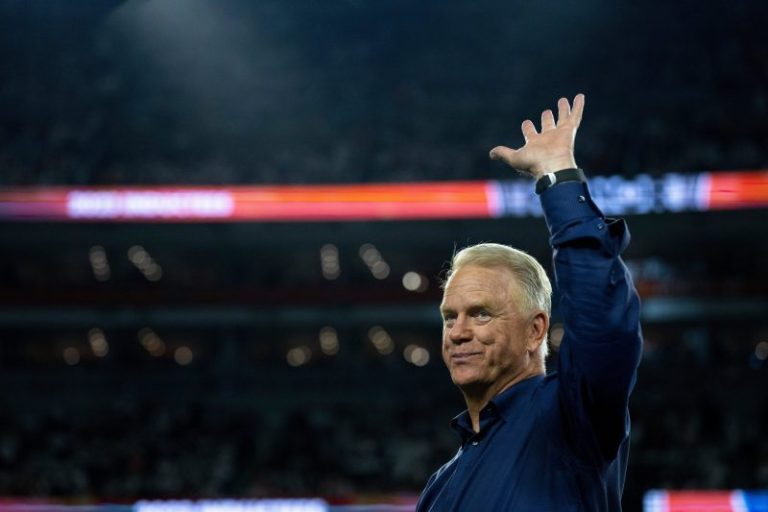
Boomer Esiason is one of the most decorated quarterbacks in Cincinnati Bengals history. He’s one of two Bengals players to win the NFL MVP award, winning it in 1988 as the team made a run to the Super Bowl.

The franchise created a Ring of Honor in 2021 and made him one of its early inductees in 2023.

He’s invited to the Bengals’ Ring of Honor ceremony this year on Oct. 26 when Cincinnati hosts the New York Jets. But Esiason took issue with his invitation, which he read out loud to co-host Greg Giannotti on his radio show ‘Boomer & Gio’ this week.

‘The Bengals organization is excited to celebrate our legends community and kindly invite you and a guest to join us in celebrating Dave Lapham and Lemar Parrish on Ring of Honor weekend in October, culminating at our game on Sunday, October 26, when the Bengals take on the New York Jets,’ Esiason read. ‘More details are below, and we kindly ask you to RSVP no later than Friday, August 22. You and a guest can receive two complementary tickets with an opportunity to purchase an additional one, if you wish.’

So far, so good. Esiason then got to the part of the invite he found troublesome.

‘If you are traveling in for the weekend from out of town, we have secured a block of rooms at the Renaissance Hotel at a preferred discounted rate,’ Esiason continued. ‘Rooms are limited, so please book directly for the early and the best rate. We look forward to hosting you in The Jungle for an unforgettable weekend. Don’t hesitate to reach out to me or another guy on the staff with any questions. Thank you. And Who Dey.’

‘Who Dey?’ Giannotti said. ‘Who Dey think they are making you pay for your own hotel room?’

Esiason admitted he’s unsure about attending the ceremony after receiving that invitation.

‘You think I’m an elitist if I say no to that?’ Esiason said.

This news comes as the Bengals remain in a contract stalemate with reigning NFL sack leader Trey Hendrickson. The two sides seem far apart on total compensation as the season gets closer.

As that’s happening to a current Bengals player, both Esiason and Giannotti were surprised that the team won’t pay for hotel rooms for franchise legends.

Giannotti added that the email invite didn’t seem very personal – a surprise given how few people are in the Bengals’ Ring of Honor.

‘How many people are in a Ring of Honor now? Eight? All right, so they should be getting different emails than this generic email,’ he said.

There are 10 people currently in the Bengals’ Ring of Honor ahead of the 2025 class of cornerback Parrish and former guard and current radio analyst Lapham.

At least Esiason got an invite. Bengals career rushing leader Corey Dillon said on X that he didn’t receive an email invitation at all.

‘At least my guy Boomer got an invite and email ,’ Dillon wrote.

Bengals Ring of Honor members

Esiason is one of two quarterbacks in the Bengals’ Ring of Honor in addition to the team’s career passing leader Ken Anderson. Here’s a list of each member and their year of induction:

*=denotes player/coach inducted into the Pro Football Hall of Fame

  • Coach Paul Brown (2021)*
  • QB Ken Anderson (2021)
  • OT Anthony Muñoz (2021)*
  • CB Ken Riley (2021)*
  • WR Isaac Curtis (2022)
  • OT Willie Anderson (2022)
  • WR Chad Johnson (2023)
  • QB Boomer Esiason (2023)
  • DT Tim Krumrie (2024)
  • RB Corey Dillon (2024)
This post appeared first on USA TODAY

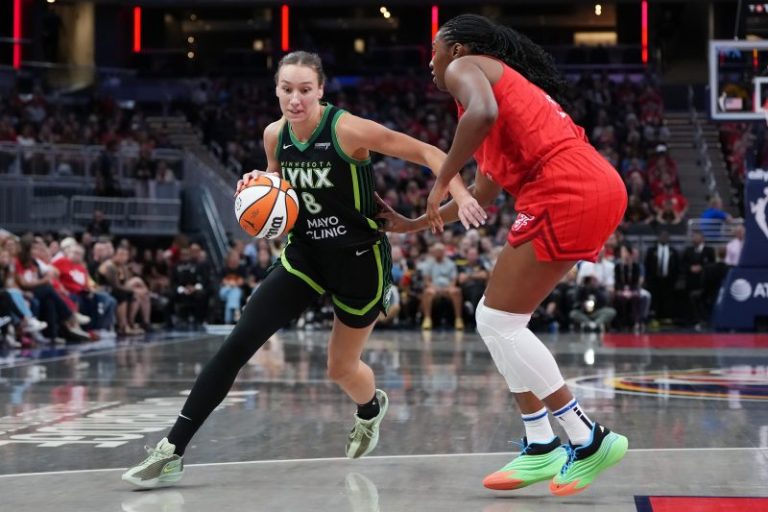
The Minnesota Lynx’s longest losing streak of the season ends at two.

The Lynx overcame a 12-point deficit to defeat the Indiana Fever 95-90 in Indianapolis Friday in a rematch of the 2025 WNBA Commissioner’s Cup title game. Lynx guard Kayla McBride led the way with a game-high 29 points (10-of-19 FGs, 4-of-8 on 3-pointers), five assists and one block. Center Jessica Shepard added 22 points, 11 rebounds and 11 assists, marking only the second triple-double in Minnesota franchise history.

Minnesota withstood a barrage of 3-pointers from the Fever, who knocked down 10 3-pointers in the first half alone and finished shooting 65% (13-of-20) from the 3-point line. The Lynx took its first lead of the game in the third quarter and extended it to 14 points, before the Fever came within five points.

Fever guard Kelsey Mitchell finished with a team-high 27 points and five assists in the loss, while Lexie Hull recorded a new career high with 23 points, four rebounds and two assists.

Fever guard Caitlin Clark (right groin) and Lynx forward Napheesa Collier (right ankle) were both ruled out of Friday’s matchup. It marked Clark’s 14th consecutive absence and Collier’s 7th consecutive game missed.

Minnesota (29-7) has already clinched a playoff bid marking their 14th in the past 15 seasons. Indiana (19-17) is in playoff contention, sitting in sixth place in the standings.

The Fever and Lynx will face each other two more times this season after Friday’s matchup. They will meet on Sunday, Aug. 24 in Minneapolis and on Sept. 9 in Indianapolis.

Here’s a recap of Friday’s matchup between the Fever and Lynx:

Halftime: Fever 52, Lynx 50

It’s raining 3-pointers in Indianapolis.

The Fever started the game 14-20 from the field and shot 71.4% from the 3-point line, knocking down 10-of-14 shots from beyond the arc. Fever guard Lexie Hull is up to 18 points in 18 minutes (3-of-5 3PT), surpassing her previous season-high of 17 points. She’s closing in on her career-high off 22 points scored against the Seattle Storm in 2024. Kelsey Mitchell (3-of-4 3PT) added 13 points and three assists.

Despite the Fever’s barrage of 3-pointers, the Lynx only trail by two heading into halftime. Minnesota, who is coming off a 75-73 loss to the Atlanta Dream on Thursday, isn’t playing bad by any means. The Lynx are shooting 54.1% from the field and 5-of-11 from the 3-point line and have been able to hang with the Fever on second-chance points. The Lynx had 22 rebounds (7 offensive) in the first half, compared to the Fever’s 14 (1 offensive).

Lynx guard Kayla McBride has a team-high 16 points (3-of-4 3PT), while center Jessica Shepard is on triple-double watch already with 11 points, 10 assists and nine rebounds. Minnesota guard Courtney Williams got off to a rough start and was held scoreless, going 0-of-4 from the field and 0-of-2 from 3 so far.

End of Q1: Fever 27, Lynx 22

The Fever led the Lynx by as many as nine points in the first quarter, but Minnesota cut its deficit to five points heading into the second quarter. Fever guard Lexie Hull came out on a mission on Friday, scoring 11 of the Fever’s 27 first-quarter points. The Fever are shooting 64.3% from the field and 71.4% from the 3-point line.

The Lynx collectively shot 58.8% from the field, but Minnesota gave up seven points on four turnovers, which marks the difference in the game. Center Jessica Shepard leads the Lynx with 10 points and three rebounds.

What time is Indiana Fever vs. Minnesota Lynx?

The Indiana Fever host the Minnesota Lynx in Indianapolis at 7:30 p.m. ET (4:30 p.m. PT) on Friday, Aug. 22 at Gainbridge Fieldhouse. The game will be broadcast on ION.

How to watch Indiana Fever vs. Minnesota Lynx: TV, stream

  • Time: 7:30 p.m. ET (4:30 p.m. PT)
  • Location: Gainbridge Fieldhouse (Indianapolis)
  • TV channel: ION
  • Streaming: Fubo (free trial to new subscribers)

Indiana Fever starting lineup

The Fever are sending guard Odyssey Sims, guard Kelsey Mitchell, guard Lexie Hull, forward Natasha Howard and Aliyah Boston to the floor.

Is Caitlin Clark playing today?

Clark (right groin) was ruled out of Friday’s matchup against the Lynx, marking her 14th consecutive absence and 23rd missed game overall this season. Sydney Colson (left knee), Aari McDonald (right foot) and Sophie Cunningham (right knee) are all out with season-ending injuries. Chloe Bibby (left knee) was also ruled out.

Minnesota Lynx starting lineup

Forward Bridget Carleton, forward Alanna Smith, center Jessica Shepard, guard Kayla McBride and guard Courtney Williams will start for the Lynx on Friday.

Napheesa Collier ruled out

Collier was listed as questionable ahead of Friday’s matchup against the Fever due to her right ankle, but the MVP frontrunner was downgraded to out less than an hour before tipoff.

The USA TODAY app gets you to the heart of the news — fastDownload for award-winning coverage, crosswords, audio storytelling, the eNewspaper and more.

This post appeared first on USA TODAY