
Author

admin

Browsing

This is the USA TODAY Sports NFL newsletter, 4th and Monday. If this newsletter isn’t already getting conveniently delivered to your inbox, click here to subscribe. USA TODAY Sports is now on Bluesky! Give us a follow for more of our NFL content.

Welcome to the annual USA TODAY Sports 4th & Monday NFL newsletter FANTASY FOOTBALL EXTRAVAGANZA!

The kickoff game for the 2025 NFL season – Dallas Cowboys at Philadelphia Eagles on Sept. 4 – is just two short weeks away (can you believe it?!?) and the preseason slate (thankfully!) concludes Saturday, thus unofficially kicking off fantasy football draft season1

And, we’re here to help you prepare for fantasy football success and league domination against your circle of friends/coworkers/mortal enemies by providing draft tips, player rankings, value picks, sleepers, potential busts, the ever-important ‘cheat sheet’ and more!

But wait, there’s even more! USA TODAY Sports Weekly’s annual blockbuster fantasy football edition has more great advice to help you rule your draft. Order your copy today so it arrives in time for your draft!

Fantasy football rankings

These top 200 overall player rankings2 are to be studied carefully and memorized to the best of your abilities for optimal fantasy football draft day needs:

  1. Ja’Marr Chase, WR, Cincinnati Bengals
  2. Bijan Robinson, RB, Atlanta Falcons
  3. Saquon Barkely, RB, Philadelphia Eagles
  4. Justin Jefferson, WR, Minnesota Vikings
  5. Jahmyr Gibbs, RB, Detroit Lions

Another vital guide to have handy is the position-by-position rankings for those ‘best player available’ draft-day decisions.

  • Quarterback: Josh Allen, Buffalo Bills
  • Running back: Bijan Robinson, Atlanta Falcons
  • Wide receiver: Justin Jefferson, Minnesota Vikings
  • Tight end: Brock Bowers, Las Vegas Raiders
  • Kicker: Brandon Aubrey, Dallas Cowboys
  • Defense/special teams: Denver Broncos

Fantasy must-haves: Draft strategy, value picks, sleepers, potential busts, top rookies

4 keys to nailing your draft: New head coaches. New offensive coordinators. Emerging rookie standouts. There is a lot to process on draft day. Lucky for you, Steve Gardner presents important core concepts to consider in your 2025 fantasy draft.

Value picks: Looking for players who might outperform their ADP (average draft position)? Ayrton Ostly lists a dozen such late-round possibilities.

  • 4 best value picks at quarterback
  • Value picks by position: Quarterbacks | Running backs | Wide receivers

Sleeper contenders: Fantasy football is all about finding quality value picks and sleepers who can exceed preseason expectations (then, later, finding gems on the waiver wire, but that’s a conversation for another day). Ayrton Ostly has identified candidates at every position to target in drafts.

  • Sleepers by position: Quarterbacks | Running backs | Wide receivers | Tight ends | Kickers

Potential busts: Not every highly-rated player is going to live up to expectations, and having too many of those type of players can lead to embarrassing last-place finishes and the subsequent punishments (if your league has such a penalty). Ayrton Ostly presents a player to avoid at every position.

Rookies who could be fantasy standouts: Speculating which rookies will emerge as fantasy football standouts is a difficult task in August. We present some rookie running backs and wide receivers who could be immediate make-or-break difference-makers in fantasy leagues.

  • Top second-year breakout candidates

RB draft strategy: Hero RB vs. Zero RB approach

Anybody who has played fantasy football knows how valuable premier running backs are to the team. But what if we told you that there’s a crazy draft strategy that suggests fantasy team owners put too much value on running backs and encourages you to pass on most (if not all) of the projected starting running backs? Sounds bonkers, right? Well, it’s also hard to pull off (but, you can try … let us know how it goes in the comments). There’s also another strategy that is a little less extreme.

  • Why should you use the Hero RB draft strategy?
  • What is the Zero RB draft strategy and does it really work?
  • Data-driven look at who could be this year’s RB1
  • Top 6 RB handcuffs to target

What should you name your fantasy team?

This is a big one! Whether you’re looking for a topical fantasy football team name suited for 2025, or just need to rebrand after a lousy 2024 fantasy season, we have some team name suggestions to help inspire you.

  • Funny team names by category
  • 160-plus names inspired by every NFL team
  • Taylor Swift-inspired team names

: Top 25 fantasy seasons since 2001: Quarterbacks | Running backs | Wide receivers | Tight ends

1 IMHO, if your league holds its draft before the end of the NFL preseason, you’re doing fantasy football wrong. There are exceptions, however, such as destination drafts that bring fantasy team owners in from far and wide for an in-person selection meeting.

2 Steve Gardner updates the top 200 rankings frequently, so please make sure to visit USA TODAY Sports’ fantasy football section regularly.

If you enjoy reading 4th & Monday , encourage your football fan friends to subscribe .

This post appeared first on USA TODAY

Copper has become a hot topic due to its role in the green energy transition and its necessity for urbanization. However, the lack of incoming supply in the long term has experts concerned.

Due to its importance in construction, energy transmission and new technologies, copper is a critical metal needed to power the future of our society. However, mined supply has not kept pace with demand, with few new operations coming online, and older mines facing decreasing grades and lower outputs.

The term “peak copper” was coined because some experts believe that copper reserves may be diminishing. According to the US Geological Survey (USGS), more than 700 million metric tons of copper have been mined throughout history, and current economic global copper reserves stand at 980 million metric tons.

Nearly all of that mined copper is still in circulation, as the red metal’s recycling rate is higher than that of any other engineering metal, but it is still not enough to keep up with escalating demand. As a result, it’s prudent to know the top copper reserves by country, especially when considering investing in the copper mining industry.

Reserve data for this article was sourced from the USGS’s 2025 Mineral Commodity Summary and supplemented with datasets from Mining Data Online (MDO) and the UN Comtrade Database.

Top 5 copper reserves by country

The countries with the largest copper reserves are Chile, Australia, Peru, the Democratic Republic of Congo (DRC) and Russia. These five countries hold more than 55 percent of the world’s total copper reserves and will be critical to a world with soaring demand for copper.

Read on to learn about these copper kingpins.

1. Chile

Copper reserves: 190 million metric tons

Chile holds the largest copper reserves globally at 190 million metric tons, nearly as much as Australia and Peru hold combined. Additionally, Chile is also the world’s top copper producer, with its 5.3 million metric tons of copper in 2024 representing nearly a quarter of global output.

The mining industry is essential to the Chilean economy, making up more than 50 percent of the country’s exports and contributing US$40 billion of its GDP in 2023. Copper alone accounting for more than US$29 billion of that total.

Due to the sheer quantity of copper in the country, it should come as no surprise that Chile is home to the world’s largest copper mine, Escondida. According to MDO, Escondida produced 927,000 metric tons of copper in concentrate in 2024 and sits atop proven and probable copper reserves of 37.62 million metric tons. The mine is a 57.5/30/12.5 joint venture between BHP (ASX:BHP,NYSE:BHP,LSE:BHP), Rio Tinto (ASX:RIO,NYSE:RIO,LSE:RIO) and Japan’s JECO.

2. Australia

Copper reserves: 100 million metric tons

Australian copper reserves are pegged at 100 million metric tons, tying it for the second largest country by copper reserves. The resource industry is an essential sector in Australia, contributing AU$385 billion during the 2024/2025 fiscal year. Of that, copper was the sixth largest contributor with AU$13.2 billion, a AU$1.8 billion increase over 2023/2024.

While Australia hosts significant copper reserves, it lags the other countries on the list with similarly sized reserves in terms of production at 800,000 metric tons in 2024. More than a quarter of that came from BHP’s Olympic Dam mine in South Australia, which produced 216,000 metric tons of copper cathode. The polymetallic mine contains substantial proven and probable copper reserves totaling 10.68 million metric tons.

Another significant operation in Australia is Newmont’s (TSX:NGT,NYSE:NEM,ASX:NEM) Cadia Valley mine, which hosts probable reserves of 3.1 million metric tons of contained copper. Cadia Valley produced 87,000 metric tons of copper in concentrate in 2024.

2. Peru

Copper reserves: 100 million metric tons

Copper reserves in Peru stand at 100 million metric tons, tying it with Australia for the second largest copper country. Much like its neighbor Chile, copper is an essential part of Peru’s economy, accounting for 49 percent of the value of its US$47.7 billion in mining exports.

Peru is home to some of the world’s biggest mining operations, and produced 2.6 million metric tons of copper last year. Two mines accounted for a third of the country’s total output.

The top producer in the country is the Cerro Verde Complex, a 55/21/19.6 venture with Freeport-McMoRan (NYSE:FCX), Sumitomo Metal Mining (TSE:5713) and Minas Buenaventura (NYSE:BVN). Cerro Verde hosts hosts proven and probable reserves of 11.45 million metric tons of copper and produced 949 million pounds of copper metal in concentrate in 2024.

Not to be outdone, the second highest is Antamina, a 33.75/33.75/22.5/10 joint venture between BHP, Glencore (LSE:GLEN,OTC Pink:GLCNF), Teck Resources (TSX:TECK.B,TSX:TECK.A,NYSE:TECK) and Mitsubishi (TSE:8058). Last year, output at the mine fell just short of Cerro Verde’s at 941 million pounds of copper in concentrate. Antamina hosts a proven and probable reserve of 4.53 million metric tons of contained copper.

The mine with the largest copper reserves in Peru is Southern Copper’s (NYSE:SCCO) Toquepala mine, home to 13.79 million metric tons of copper in proven and probable reserves. The mine produced 496 million pounds of copper in concentrate last year.

4. Democratic Republic of Congo

Copper reserves: 80 million metric tons

Copper reserves in the Democratic Republic of Congo stood at 80 million metric tons in 2024, making it the fourth largest country by copper reserves. The DRC’s economic copper reserves have seen a staggering rise in recent years, climbing from an estimated 19 million metric tons in 2019.

The mining sector has been critical to GDP growth in the DRC, with copper being the largest contributor. World Bank reports that the extraction sector has outpaced other segments of the DRC’s economy, increasing 12.8 percent in 2024, while non-mining sectors grew by only 3.2 percent.

According to data from the United Nations, in 2023 the DRC exported US$17 billion in refined copper and unwrought alloys, a large jump from US$7.34 billion in 2019. The country’s copper ore exports contributed US$2.16 billion in 2023, nearly double the US$1.11 billion four years prior.

Among the contributing factors in the rise in mining and export activity has been the development of the Lobito Corridor, which connects mineral-rich regions in Zambia, the DRC and Angola to the port at Lobito in Angola.

This link allows greater access for large-scale operations like Ivanhoe Mines (TSX:IVN) and Zijin Mining’s (HKEX:2899,SHA:601899) Kamoa-Kakula complex in the Southern DRC. One of the largest copper operations in the world, Kamoa-Kakula hosts a probable reserve of 17.69 million metric tons of contained copper and produced 964 million pounds of copper in concentrate in 2024.

4. Russia

Copper reserves: 80 million metric tons

Russia’s copper reserves are estimated to be 80 million metric tons, tying it with the DRC. While commodities are important to the Russian economy, contributing US$417 billion in 2024, the metals sector represented 15 percent of that total at US$60 billion.

Russia has been under significant sanctions since it invaded Ukraine in February 2022. According to the UN Comtrade Database, Russia’s copper exports from in 2021 were valued at US$5.98 billion.

In 2024, Russia produced 930,000 metric tons of copper, an increase from the 890,000 metric tons produced in 2023. Among the main contributing factors was a ramp-up in production at Udokan Copper’s Udokan mine in Siberia, which was expected to produce 135,000 metric tons in 2024 and, according to the mine’s website, hosts a JORC-compliant copper resource of 26.7 million metric tons.

Securities Disclosure: I, Dean Belder, hold no direct investment interest in any company mentioned in this article.

This post appeared first on investingnews.com

Alice Queen (ASX:AQX) is a gold exploration company focused on district-scale discoveries and near-term production opportunities. Its flagship asset is the Viani Gold Project in Fiji, where early drilling indicates a major epithermal gold system, comparable to other systems along the Pacific Ring of Fire. Fiji itself hosts the 10 Moz Vatukoula Gold Mine, underscoring the region’s proven prospectivity. With a portfolio spanning both the Pacific Ring of Fire and Australia’s most prolific gold belts, Alice Queen combines strong geological potential with strategic access to capital.

The company’s secondary asset, Horn Island, hosts over half a million ounces of gold in a JORC-compliant resource. A 2021 scoping study indicated an NPV of more than AU$500 million, based on an internal update using AU$5,000/oz gold. Ongoing discussions with development partners aim to unlock value from this project, which has the potential to generate over AU$800 million in free cash flow across an eight-year mine life.

Alice Queen’s shareholder base is anchored by Gage Resource Development (51 percent) and supported by significant, well-funded Australian investors with a long-term outlook. The company is advancing a balanced strategy focused on drilling success, strategic partnerships, and asset-level monetization.

Company Highlights

  • High-impact Discovery at Viani in Fiji: Drilling at the Viani project has confirmed a significant low-sulphidation epithermal gold system with mineralization over a ~5 km strike, with assay results from recent drilling expected imminently.
  • Established Gold Resource at Horn Island: The Horn Island project hosts a 524,000 oz JORC-compliant gold resource and is being advanced through potential development partnerships, offering near-term monetization opportunities.
  • Strategic Financial Backing: Backed by major shareholder Gage Resource Development, a subsidiary of Beijing-based Gage Capital (US$1.6 billion AUM), ensuring access to growth capital and long-term support.
  • Exceptional Leadership: Led by a highly experienced management team with a successful track record in global business and resource development.

This Alice Queen Limited profile is part of a paid investor education campaign.*

Click here to connect with Alice Queen (ASX:AQX) to receive an Investor Presentation

This post appeared first on investingnews.com

Stefan Gleason, CEO of Money Metals, shares his outlook for gold, silver and platinum.

He also weighs in on Tether Investments’ recent deal with Elemental Altus Royalties (TSXV:ELE,OTCQX:ELEMF) and advances in US sound money policies.

Securities Disclosure: I, Charlotte McLeod, hold no direct investment interest in any company mentioned in this article.

This post appeared first on investingnews.com

Walmart on Thursday raised its full-year earnings and sales outlook as its online business posted another quarter of double-digit gains, even as the company said costs are rising from higher tariffs.

The big-box retailer topped Wall Street’s quarterly sales estimates but fell short of earnings expectations, the first time it missed on quarterly earnings since May 2022. The company said it felt pressure on profits for the period, including from some one-time expenses, such as restructuring costs, pricier insurance claims and litigation settlements.

Walmart said it now expects net sales to grow 3.75% to 4.75% for the fiscal year, up from its previous expectations of 3% to 4%. It raised its adjusted earnings per share outlook slightly to $2.52 to $2.62, up from a prior range of $2.50 to $2.60 per share.

In an interview with CNBC, Chief Financial Officer John David Rainey said the company is working hard to keep prices low — including speeding up imports from overseas and stepping up the number of Rollbacks, or limited-time discounts, in its stores.

“This is managed on an item-by-item and category-by-category basis,” he said. “There are certainly areas where we have fully absorbed the impact of higher tariff costs. There are other areas where we’ve had to pass some of those costs along.”

But he added “tariff-impacted costs are continuing to drift upwards.”

Even so, Rainey said Walmart hasn’t seen a change in customer spending. For example, sales of private label items, which typically cost less than national brands, were roughly flat year over year, he said.

“Everyone is looking to see if there are any creaks in the armor or anything that’s happening with the consumer, but it’s been very consistent,” he said. “They continue to be very resilient.”

Yet on the company’s earnings call, CEO Doug McMillon said middle- and lower-income households have been more sensitive to tariff-related price increases, particularly in discretionary categories.

“We see a corresponding moderation in units at the item level as customers switch to other items, or in some cases, categories,” he said.

Here’s what the big-box reported for the fiscal second quarter compared with what Wall Street expected, according to a survey of analysts by LSEG:

Walmart shares fell about 2% in premarket trading Thursday.

Walmart’s net income jumped to $7.03 billion, or 88 cents per share, in the three-month period that ended July 31, compared with $4.50 billion, or 56 cents per share, in the year-ago quarter.

Revenue rose from $169.34 billion in the year-ago quarter.

Comparable sales for Walmart U.S. climbed 4.6% in the second quarter, excluding fuel, compared with the year-ago period, as both the grocery and health and wellness category saw strong growth. That was higher than the 4% increase that analysts expected. The industry metric, also called same-store sales, includes sales from stores and clubs open for at least a year.

At Sam’s Club, comparable sales jumped 5.9% excluding fuel, higher than the 5.2% that analysts anticipated.

E-commerce sales jumped 25% globally and 26% in the U.S., as both online purchases and advertising grew. In the U.S., Walmart said sales through store-fulfilled delivery of groceries and other items grew nearly 50% year over year, with one-third of those orders expedited. The company charges a fee for some of those faster deliveries, and others are included as a benefit of its subscription-based membership program, Walmart+.

Its global advertising business grew 46% year over year, including Vizio, the smart TV maker it acquired for $2.3 billion last year. Its U.S. advertising business, Walmart Connect, grew by 31%.

As Walmart’s online business drums up more revenue from home deliveries, advertising and commissions from sellers on its third-party marketplace, e-commerce has become a profitable business. The company marked a milestone in May — posting its first profitable quarter for its e-commerce business in the U.S. and globally.

Rainey said on Thursday that Walmart doubled its e-commerce profitability in the fiscal second quarter from the prior quarter.

In the U.S., shoppers both visited Walmart more and spent more on those trips during the quarter. Customer transactions rose 1.5% year over year and average ticket increased 3.1% for Walmart’s U.S. business.

As the largest U.S. retailer, Walmart offers a unique window into the financial health of American households. As higher duties have come in fits and starts — with some getting delayed and others going into effect earlier this month — Wall Street has tried to understand how those costs will ripple through the U.S. economy.

Walmart warned in May that it would have to raise some prices due to higher levies on imports, even with its size and scale. The company’s comments drew the ire of President Donald Trump, who said in a social media post that Walmart should “EAT THE TARIFFS.”

About a third of what Walmart sells in the U.S. comes from other parts of the world, with China, Mexico, Canada, Vietnam and India representing its largest markets for imports, Rainey said in May.

According to an analysis by CNBC of about 50 items sold by the retailer, some of those price changes have already hit shelves. Items that rose in price at Walmart over the summer included a frying pan, a pair of jeans and a car seat.

Rainey on Thursday declined to specify items or categories where Walmart had increased prices, saying the company is “trying to keep prices as low as we can.”

He said one of the company’s strategies has been bringing in inventory early, particularly for Sam’s Club as it gets ready for the second half of the fiscal year and its crucial holiday season. At the end of the quarter, inventory was up about 3.5% at Sam’s Club, Rainey said. It was up 2.2% for Walmart U.S.

On the company’s earnings call, McMillon said the impact of tariffs has been “gradual enough that any behavioral adjustments by the customer have been somewhat muted.”

“But as we replenish inventory at post-tariff price levels, we’ve continued to see our costs increase each week, which we expect will continue into the third and fourth quarters,” he said.

Yet even with higher costs from tariffs, Walmart has fared better than its retail competitors as it has leaned into its reputation for value, competed on faster deliveries to customers’ homes and attracted more business from higher-income households.

The Arkansas-based retailer’s performance has diverged sharply from rival Target, which posted another quarter of sales declines on Wednesday and named the new CEO who will be tasked with trying to turn around the company.

Walmart has gained from Target’s struggles. It has followed the Target playbook by launching more exclusive and trend-driven brands, including grocery brand BetterGoods and activewear brand Love & Sports. It has also expanded its third-party marketplace to include prestige beauty brands and more.

Sales of general merchandise, items outside of the grocery department, were a bright spot for Walmart in the fiscal second quarter, Rainey said. That category struggled during peak inflation in recent years, as consumers spent less on discretionary items because of rising grocery bills.

Comparable sales for general merchandise rose by a low-single-digit percentage and accelerated throughout the quarter, Rainey told CNBC. He added clothing and fashion sales “really shined for us.”

This post appeared first on NBC NEWS

NORTH KINGSTOWN, R.I. — The winged passenger ferry gliding over the surface of Narragansett Bay could be a new method of coastal transportation or a new kind of warship.

Its maker, Regent Craft, is betting on both.

Twelve quietly buzzing propellers line the 65-foot wingspan of Paladin, a sleek ship with an airplane’s nose. It looks nothing like the sailboats and fishing trawlers it speeds past through New England’s largest estuary.

“We had this vision five years ago for a seaglider — something that is as fast as an aircraft and as easy to drive as a boat,” said CEO Billy Thalheimer, jubilant after an hours-long test run of the new vessel.

On a cloudy August morning, Thalheimer sat in the Paladin’s cockpit and, for the first time, took control of his company’s prototype craft to test its hydrofoils. The electric-powered watercraft has three modes — float, foil and fly.

Billy Thalheimer, CEO and co-founder of REGENT, gestures after piloting the Viceroy Seaglider, a winged passenger ferry, following a test run on Narragansett Bay on Aug. 6.Charles Krupa / AP

From the dock, it sets off like any motorized boat. Farther away from land, it rises up on hydrofoils — the same kind used by sailing ships that compete in America’s Cup. The foils enable it to travel more than 50 miles per hour — and about a person’s height — above the bay.

What makes this vessel so unusual is that it’s designed to soar about 30 feet above the water at up to 180 miles per hour — a feat that hasn’t quite happened yet, with the first trial flights off Rhode Island’s seacoast planned for the end of summer or early fall.

If successful, the Paladin will coast on a cushion of air over Rhode Island Sound, lifting with the same “ground effect” that pelicans, cormorants and other birds use to conserve energy as they swiftly glide over the sea. It could zoom to New York City — which takes at least three hours by train and longer on traffic-clogged freeways — in just an hour.

As it works to prove its seaworthiness to the U.S. Coast Guard and other regulators around the world, Regent is already lining up future customers for commercial ferry routes around Florida, Hawaii, Japan and the Persian Gulf.

Regent is also working with the U.S. Marines to repurpose the same vessels for island-hopping troops in the Pacific. Those vessels would likely trade electric battery power for jet fuel to cover longer journeys.

With backing from influential investors including Peter Thiel and Mark Cuban, Thalheimer says he’s trying to use new technology to revive the “comfort and refined nature” of 1930s-era flying boats that were popular in aviation’s golden age before they were eclipsed by commercial airlines.

This time, Thalheimer added, they’re safer, quieter and emission-free.

“I thought they made travel easier in a way that made total sense to me,” Cuban said by email this week. “It’s hard to travel around water for short distances. It’s expensive and a hassle. Regent can solve this problem and make that travel fun, easy and efficient.”

Co-founders and friends Thalheimer, a skilled sailor, and chief technology officer Mike Klinker, who grew up lobster fishing, met while both were freshmen at the Massachusetts Institute of Technology and later worked together at Boeing. They started Regent in 2020.

They’ve already tested and flown a smaller model. But the much bigger, 12-passenger Paladin — prototype of a product line called Viceroy — began foil testing this summer after years of engineering research and development. A manufacturing facility is under construction nearby, with the vessels set to carry passengers by 2027.

The International Maritime Organization classifies “wing-in-ground-effect” vehicles such as Regent’s as ships, not aircraft. But a database of civilian ships kept by the London-based organization lists only six around the world, all of them built before it issued new safety guidance on such craft in 2018 following revisions sought by China, France and Russia.

The IMO says it treats them as marine vessels because they operate in the vicinity of other watercraft and must use the same rules for avoiding collisions. The Coast Guard takes a similar approach.

“You drive it like a boat,” Thalheimer said. “If there’s any traffic on the harbor, you’ll see it on the screen. If you see a boat, you’d go around it. We’re never flying over boats or anything like that.”

The REGENT Viceroy Seaglider on a test run on Aug. 6.Charles Krupa / AP

One of the biggest technical challenges in Regent’s design is the shift from foiling to flying. Hydrofoils are fast for a seafaring vessel, but far slower than the speeds needed to lift a conventional airplane from a runway.

That’s where air blown by the 12 propellers comes in, effectively tricking the wing into generating high lift at low speeds.

All of this has worked perfectly on the computer simulations at Regent’s headquarters in North Kingstown, Rhode Island. The next step is testing it over the water.

For decades, the only warship known to mimic such a ground-effect design was the Soviet Union’s hulking ekranoplan, which was built to fly under radar detection but never widely used. Recently, however, social media images of an apparent Chinese military ekranoplan have caught the attention of naval experts amid increasingly tense international disputes in the South China Sea.

Regent has capitalized on those concerns, pitching its gliders to the U.S. government as a new method for carrying troops and cargo across island chains in the Indo-Pacific region. It could also do clandestine intelligence collection, anti-submarine warfare and be a “mothership” for small drones, autonomous watercraft or medical evacuations, said Tom Huntley, head of Regent’s government relations and defense division.

They fly below radar and above sonar, which makes them “really hard to see,” Huntley said.

While the U.S. military has shown increasing interest, questions remain about their detectability, as well as their stability in various sea states and wind conditions, and their “cost at scale beyond a few prototypes and maintainability,” said retired U.S. Navy Capt. Paul S. Schmitt, an associate research professor at the Naval War College, across the bay in Newport, Rhode Island.

Schmitt, who has seen Paladin from afar while sailing, said he also has questions about what kind of military mission would fit Regent’s “relatively short range and small transport capacity.”

The possibilities that most excite Cuban and other Regent backers are commercial.

Driving Interstate 95 through all the cities that span Florida’s Atlantic Coast can take the better part of a day, which is one reason why Regent is pitching Miami as a hub for its coastal ferry trips.

The Viceroy seagliders can already carry more passengers than the typical seaplane or helicopter, but a growing number of electric hydrofoil startups, such as Sweden’s Candela and California-based Navier, are trying to stake out ferry routes around the world.

Thalheimer sees his vehicles as more of a complement than a competitor to electric hydrofoils that can’t travel as fast, since they will all use the same docks and charging infrastructure but could specialize in different trip lengths.

This post appeared first on NBC NEWS

The US Open tennis tournament showed it’s never too late to spice things up, even heading into its 145th year.

The mixed doubles competition, largely an afterthought in the past, debuted a revamped format this week and energized crowds at Arthur Ashe Stadium in New York. In part, that’s thanks to a star-studded, 16-team field that included names like Novak Djokovic, Emma Raducanu and Carlos Alcaraz.

Not to mention some riveting tennis like what was on display in the final Wednesday night, Aug. 21, when defending champions Sara Errani and Andrea Vavassori outlasted Iga Swiatek and Casper Ruud 6-3, 5-7, 10-6.

Oh, the 10-6 – that’s part of the adjusted scoring system that takes a little getting used to. Until the final, sets were played to four games, not six games, and there were no advantage points.

While purists might debate the merits of the scoring system, the play proved compelling – especially in the final.

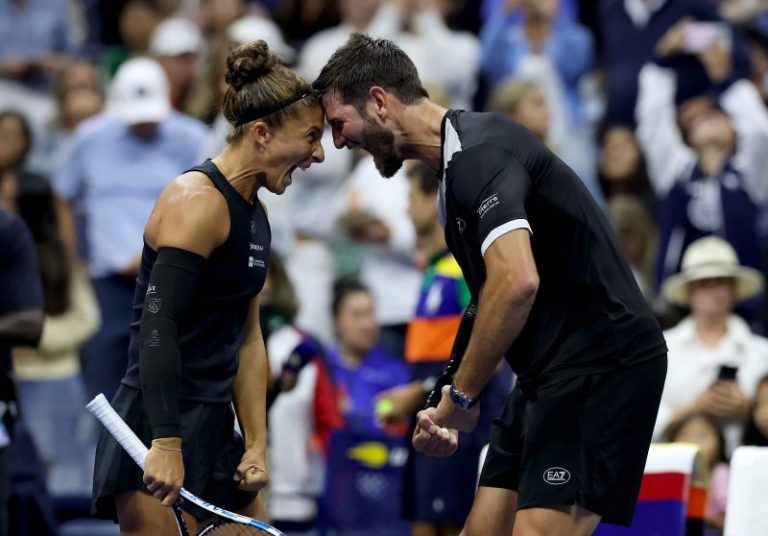
The 6-foot-4 Vavassori was brilliant at the net and overpowering with his serve. Errani, 38, looked youthful with her smart play. And together, the Italian duo proved mixed doubles specialists can hold their ground against the planet’s best singles players chasing compensation.

The champions won $1 million, up from the $200,000 that went to the winners last year. It clearly helped lure marquee players into the draw, and the fans responded.

A good chunk of the sellout crowd remained to cheer the Italians and Swiatek, the reigning Wimbledon champion, along with Ruud during the post-match trophy presentation. Ruud thanked the tournament for “going a little bold and trying this out.’

“It was fun for us, and I hope it was fun for the fans,’’ Ruud said. “It’s midnight on Wednesday and we’re still here on Arthur Ashe and I don’t think anyone expected that but it’s been really cool for us players to try it.’’

Vavassori called it “an amazing atmosphere’’ and said, “We showed today that doubles is a great product.’’

He thanked his partner, Errani, for her energy that looked in ample supply. She beamed at Vavassori.

“It’s a pleasure for me to be by your side,’’ she said.

Their wizardry set off cheers, as did Swiatek and Ruud when they staged a mid-match comeback.

The crowd noise grew to a roar. The tension thickened. An experiment involving mixed doubles at the 145th US Open appeared to be a success.

US Open mixed doubles final highlights

Sara Errani/Andrea Vavassori def. Iga Swiatek/Casper Ruud to win title

Italy’s Sara Errani and Andrea Vavassori won the US Open mixed doubles title for the second year in a row, holding off Iga Swiatek and Casper Ruud in the finals 6-3, 5-7, 10-6 Wednesday, Aug. 20 at New York’s Arthur Ashe Stadium.

The 6-foot-4 Vavassori was spectacular at the net and overpowering with his serve. And his 38-year-old partner, Errani, also was masterful during their two-day run through the 16-team field.

The Italians collected $1 million by winning the championship.

Sara Errani/Andrea Vavassori def. Danielle Collins/Christian Harrison

Italy’s Sara Errani and Andrea Vavassori gave themselves a chance to defend their title as US Open mixed doubles champs. They did it by powering past Americans Christian Harrison and Danielle Collins 4-2, 4-2 in the semifinals. The Italians did not lose a single point during their service games in the first set, and Vavassori’s serves were especially wicked. The Americans broke Errani’s service to knot the second set at 2-2, but the Italians promptly won the next two games and closed out the match.

Iga Swiatek/Casper Ruud def. Jessica Pegula/Jack Draper

Clutch play propelled Iga Swiatek and Casper Ruud past Jessica Pegula and Jack Draper in the semifinals (3-5, 5-3, 10-8). Down a set, Swiatek and Ruud rallied and won the second set, forcing a 10-point tiebreak. Swiatek, the reigning Wimbledon champion, and Ruud began to unravel, going down 8-4 after Swiatek’s double fault. But with the match hanging in the balance, Swiatek and Ruud were clutch again, reeling off six straight points for the victory.

US Open mixed doubles order of play today

All times Eastern. All matches are held at Arthur Ashe Stadium and televised on ESPN2.

Semifinals – Wednesday, Aug. 20

  • No. 1 Jessica Pegula/Jack Draper vs. No. 3 Iga Swiatek/Casper Ruud, 7 p.m.
  • Danielle Collins/Christian Harrison vs. Sara Errani/Andrea Vavassori, 8:30 p.m.

Final – Wednesday, Aug. 20

  • Semifinals winners, 10 p.m. | ESPN2

How to watch US Open mixed doubles 2025: TV and streaming

Wednesday, Aug. 20

  • Time: 7-10 p.m. ET
  • TV: ESPN2
  • Streaming: ESPN+ and Fubo
  • Location: Billie Jean King National Tennis Center (Flushing, New York)

Stream the 2025 US Open on Fubo

US Open mixed doubles 2025 format

Each match (other than the final) are best-of-three sets, and each set is first team to win four games. Unlike singles matches, there will be no-ad in games that reach a score of deuce (40-all), meaning that the winner of the next point wins the game. If each team has won four games in a set, a tiebreak will be played.

If the teams split sets, a 10-point match tiebreak will be played in lieu of a third set. The first team to win 10 points, with an advantage of two or more points, will win the match.

In the final, the first team to win six games wins the set, and the first team to win two sets wins the championship. If the teams split sets, a 10-point match tiebreak will be played in lieu of a third set.

US Open mixed doubles 2025 prize money

  • First round: $20,000
  • Quarterfinals: $100,000
  • Semifinals: $200,000
  • Runner-up: $400,000
  • Champion: $1 million

US Open mixed doubles results Tuesday

Quarterfinals

  • Iga Swiatek/Casper Ruud defeated Caty McNally/Lorenzo Musetti, 4-1, 4-2
  • Jessica Pegula/Jack Draper defeated Mirra Andreeva/Daniil Medvedev, 4-1, 4-1
  • Sara Errani/Andrea Vavassori defeated Karolina Muchova/Andrey Rublev, 4-1, 5-4 (7-4)
  • Danielle Collins/Christian Harrison defeated Taylor Townsend/Ben Shelton 4-1, 5-4 (7-2)

First round

  • Caty McNally/Lorenzo Musetti defeated Naomi Osaka/Gael Monfils 5-3 (4-3), 4-2
  • Iga Swiatek/Casper Ruud defeated Madison Keys/Frances Tiafoe 4-1, 4-2
  • Jessica Pegula/Jack Draper defeated Emma Raducanu/Carlos Alcaraz, 4-2, 4-2
  • Mirra Andreeva/Daniil Medvedev defeated Olga Danilovic/Novak Djokovic, 4-2, 5-3
  • Sara Errani/Andrea Vavassori defeated Elena Rybakina/Taylor Fritz 4-2, 4-2
  • Karolina Muchova/Andrey Rublev defeated Venus Williams/Reilly Opelka 4-2, 5-4 (7-4)
  • Taylor Townsend/Ben Shelton defeated Amanda Anisimova/Holger Rune, 4-2, 4-5 (7-2)
  • Danielle Collins/Christian Harrison defeated Belinda Bencic/Alexander Zverev, 4-0, 5-3
This post appeared first on USA TODAY

FORT LAUDERDALE, FL – Luis Suarez scored two penalty kicks for Inter Miami, after Tigres UANL defender Javier Aquino was penalized for a handball in the penalty area on two separate occasions.

Tigres forward Iván López nearly tied the match in added time, but his header hit the right post, bounced along the line to hit the left post, and diverted back into play.

Somehow, those instances don’t even measure up to the wildest thing that happened in Inter Miami’s 2-1 win over Tigres in their Leagues Cup quarterfinal match on Wednesday, Aug. 20.

Messi did not play in the match, nursing a right hamstring injury and watching from the on-field suites below Mascherano in the stands.

Suarez scored a penalty in the 23rd minute, then sealed the victory with another penalty kick in the 89th minute.

Tigres tied the match at 1 when Argentine World Cup champion Ángel Correa scored in the 67th minute. López nearly sent the match to a penalty shootout with his borderline goal in the 91st minute.

Check out these highlights from the Inter Miami-Tigres match:

Watch Leagues Cup matches on MLS Season Pass

Inter Miami vs. Tigres highlights

Inter Miami 2, Tigres 1: Iván López off the post, twice

Tigres’ Iván López nearly tied the match in added time, but his header hit the right post, bounced along the line to hit the left post, and bounced back into play to keep this match in Inter Miami’s favor.

Inter Miami 2, Tigres 1: Luis Suarez scores second penalty goal

Luis Suarez has scored his second penalty kick in the 89th minute, and Inter Miami leads 2-1 against Tigres in their wild quarterfinal match in the Leagues Cup. Tigres defender Javier Aquino, who had the handball called against him in the first half leading to the first Suarez penalty, was penalized for a handball again in the 86th minute.

Inter Miami 1, Tigres 1: Ángel Correa scores goal

Inter Miami coach Javier Mascherano coaches from stands after ejection

Inter Miami 1, Tigres 0: Javier Mascherano gets red card

Inter Miami is being led by assistant coach Leandro Stillitano, after coach Javier Mascherano was shown a red card at halftime for arguing with the referees. Mascherano appeared to contest the referee’s decision to play longer than four minutes of stoppage time at the end of the first half.

Inter Miami 1, Tigres 0: Jordi Alba leaves match due to injury

Inter Miami left-back Jordi Alba tried to play through a right leg injury, but came off shortly after the second half began. Alba appeared to collide with another player in the final minutes of the first half, and Inter Miami was able to finish the half with him on the sidelines.

Inter Miami 1, Tigres 0: Luis Suarez scores penalty kick

Luis Suarez has scored in the 23rd minute, converting on a penalty kick to help Inter Miami take a 1-0 lead against Tigres. The penalty was granted after Tigres defender Javier Aquino was called for a handball while defending Inter Miami’s Jordi Alba in the 20th minute.

Is Messi playing tonight?

No, Messi will not play tonight.

Inter Miami starting lineup vs. Tigres UANL

Messi was not listed as a starter or substitute in Inter Miami’s lineup for the match against Tigres.

What time is the Inter Miami vs. Tigres UANL Leagues Cup match?

The match is Aug. 20 at 8 p.m. ET (9 p.m. in Argentina).

How to watch Inter Miami vs. Tigres UANL Leagues Cup match on TV?

The match will be available on FS1 in English, and UniMás in Spanish.

How to watch Inter Miami vs. Tigres UANL match on live stream?

The match will be available to live stream on MLS Season Pass via Apple TV, and the Apple TV+ channel.

Here are the other Leagues Cup quarterfinal matches

  • Orlando City vs. Toluca,9 p.m. ET (MLS Season Pass and Apple TV+)
  • Seattle Sounders vs. Puebla, 11 p.m. ET (FS1 and UniMás on TV in the U.S.; MLS Season Pass and Apple TV+)
  • L.A. Galaxy vs. Pachuca, 11:45 p.m. ET (MLS Season Pass and Apple TV+)

Inter Miami vs. Tigres UANL betting odds

Inter Miami is a slight favorite at home during regulation, according to BETMGM.

  • Inter Miami: +115
  • Tie: +240
  • Tigres: +165
  • Over/under: 3.5 goals

Messi’s last match in Argentina? Here’s what we know

Argentina will host Venezuela on Sept. 4 at Mâs Monumental in Buenos Aires, then visit Ecuador on Sept. 9.

Argentina, the defending World Cup champions, has already qualified for the 2026 World Cup to be co-hosted by the United States, Canada and Mexico. Messi, 38, has not yet declared he will play in the World Cup. 

Messi upcoming schedule with Inter Miami, Argentina

  • Aug. 23: D.C. United vs. Inter Miami, 7:30 p.m. ET (MLS regular season)
  • Aug. 26 or 27: Leagues Cup semifinals (if applicable)
  • Aug. 30: Inter Miami vs. Chicago Fire, 7:30 p.m. ET (MLS regular season)
  • Aug. 31: Leagues Cup final and third-place match (if applicable)
  • Sept. 4: Argentina vs. Venezuela (World Cup qualifying)
  • Sept. 9: Ecuador vs. Argentina (World Cup qualifying)
  • Sept. 13: Charlotte FC vs. Inter Miami, 7:30 p.m. (MLS regular season)

USA TODAY Sports’ 48-page special edition commemorates 30 years of Major League Soccer, from its best players to key milestones and championship dynasties to what exciting steps are next with the World Cup ahead. Order your copy today!

This post appeared first on USA TODAY

Boxer Ryan Garcia sounded off upon learning Jake Paul will fight Gervonta “Tank’’ Davis on Nov. 14.

“Boxing is officially the WWE,’’ he wrote on his X account.

The hard-hitting boxer was just getting started.

“This just proves that the new blueprint is get popular be a decent fighter,’’ Garcia added. “Pick fights to win that gives you advantage and continue to rack in money. Integrity of the sport is getting ruined everyday. If you are a up and coming fighter I’d just focused on strictly building your name.’’

The most striking part of the matchup between Paul and Davis is the size disparity. Paul, who is 6-1, last fought at 200 pounds. Davis, who is 5-5 1/2, last fought at 135 pounds. Nonetheless, the fight will be carried by Netflix and held at State Farm Arena in Atlanta.

It’s unclear what bookmakers would consider posting odds on a fight that likely would be an exhibition. But Garcia was happy to offer his guidance.

“Btw if the fight does happen,’’ Garcia said, “I’d bet on the heavy weight.’’

It’s worth noting that Garcia, who is 5-9 and last fought at 147 pounds, has called out Paul in hopes of fighting the social media influencer. In April, Garcia told USA TODAY Sports he was prepared to fight Paul.

“So he’s going to have to come through me sooner or later,’’ Garcia said. “I know he doesn’t want to, though, because I’m going to be firing on him. He knows I got those punches on me. So I think that once he’s done fighting these old men and he is ready for a real fight, he could come see me.’’

This post appeared first on USA TODAY