Author

admin

Browsing

Lionel Messi and Inter Miami didn’t just punch their ticket into the MLS Cup Playoffs in New York on Wednesday, Sept. 24.

They made an emphatic statement about how far they could go in the postseason while reminding fans how much longer this squad filled with former FC Barcelona teammates may have together in Major League Soccer.

Messi scored two goals in the second half (74’ and 86’) and assisted Baltasar Rodríguez before halftime (43’), while Luis Suarez scored a penalty goal as Inter Miami beat New York City FC 4-0 at Citi Field.

Inter Miami moved into third place with 55 points, behind Philadelphia (60 points) and FC Cincinnati in the MLS Eastern Conference standings, following the victory, while clinching a spot in the MLS Cup Playoffs.

“I’m happy with the victory, and with how we played. It was a good night for us, and above all, it shows us the way forward,” Inter Miami coach Javier Mascherano said after the victory.

Inter Miami has five regular-season matches remaining, and could still vie for the MLS Supporters’ Shield for the second straight season. They’re five points behind Philadelphia for the league lead in points.

Still, the expectation will be for Messi’s side to contend for their first MLS Cup title. In the meantime, the old Inter Miami stars are ensuring they have some fun along the way.

Messi put on a masterclass Wednesday, scoring twice with an assist in his second straight match. He became the fourth player in MLS history to record eight multi-goal games in a season, scoring at least twice in eight of his last 12 matches.

“For me, he tries to show everyone the team spirit,” Mascherano said of Messi, whose scores brought fans in Citi Field to their feet.

Messi retook the lead in the MLS Golden Boot race with 24 goals, breaking a tie with LAFC star Denis Bouanga. Messi leads MLS with 37 goal contributions as he became the first player in league history to record at least 35 of them in consecutive seasons.

Sergio Busquets delivered the hockey assist to Messi on the first goal of the match by Rodriguez (43’), then delivered the through ball to Messi to double the lead. Busquets could reportedly retire at the end of the 2025 MLS season.

“Obviously, Busi is playing. I don’t know how long he will play, but for me, he was one of the best midfielders in history. I went to Barcelona to learn from him,” Mascherano said of Busquets.

“It’s normal for me when I watch him giving these kinds of passes because during his long career, he did it too many times. Hopefully, he’s going to help us the rest of the season. Hopefully, he’s going help us in the playoffs. For us, he’s a key player.”

Suarez looked refreshed in his return from a three-match MLS suspension after his Leagues Cup spitting incident, as Messi allowed him to take the penalty kick.

Messi’s World Cup champion teammate, Rodrigo De Paul, drew the penalty scored by Suarez.

“We know that strikers always need goals, and even though he scored from the penalty spot, it’s important for him,” Mascherano said of Suarez.

It was the first Inter Miami clean sheet for goalkeeper Oscar Ustari since a scoreless draw in the Club World Cup opener against Egyptian side Al Ahly on June 14.

Inter Miami will travel to Canada after the match, and play against Toronto on Sept. 27 at 4:30 p.m. ET.

Inter Miami vs. NYCFC highlights

Inter Miami 4, NYC 0: Messi scores brace

Inter Miami 3, NYC 0: Luis Suarez scores penalty kick

Inter Miami 2, NYC 0: Messi scores goal

Inter Miami 1, NYC 0: Baltazar Rodriguez scores goal in 43’

Messi delivered a through ball to Baltazar Rodriguez, who scored in the 43rd minute as Inter Miami takes 1-0 lead.

NYC 0, Inter Miami 0: Messi free kick deflected by Matt Freese

Messi’s free kick tailed away while Matt Freese was still able to get a palm on it in the 38th minute. Messi’s kick was strong and on target before trailing off.

NYC 0, Inter Miami 0: NYC’s Nicolás Fernández misses prime opportunity

NYC 0, Inter Miami 0: Messi fires early shot

Lionel Messi lined up his shot from distance, but it was deflected in the 12th minute.

Messi in Inter Miami starting lineup vs. NYCFC

Is Messi playing tonight?

Messi has traveled to New York and is expected to play, coach Javier Mascherano said before Tuesday’s training session. Messi’s playing status for the NYCFC match will be confirmed when Inter Miami announces its starting lineup an hour before kickoff on Wednesday.

How to watch New York City FC vs. Inter Miami live stream?

The match will be available on MLS Season Pass via Apple TV.

Watch MLS Season Pass on Apple TV

When is New York City FC vs. Inter Miami match?

The match will be on Wednesday, Sept. 24 at 7:30 p.m. ET (8:30 p.m. in Argentina).

Where is the New York City FC vs. Inter Miami match?

The match will be played at Citi Field in Queens, NY – home of the New York Mets.

Will Inter Miami clinch MLS Cup playoff spot?

Inter Miami will clinch a spot into the MLS Cup playoffs with a win or draw against New York City FC.

What to know about Inter Miami and NYCFC

Inter Miami will play two matches on the road this week, with six matches to play until the end of the 2025 regular season.

Inter Miami is fifth in the MLS Eastern Conference standings with 52 points from 28 matches this season, but has three matches in hand to play after participating in the Club World Cup and Leagues Cup.

Luis Suarez returns from a three-game MLS suspension after spitting on a Seattle staff member after the Leagues Cup loss.

NYCFC is fourth in the East with 53 points, and has already clinched a spot in the MLS Cup playoffs.

NYCFC vs. Inter Miami betting odds

Here are the betting odds for today’s match, according to BetMGM:

  • NYCFC: +130
  • Draw: +280
  • Inter Miami: +165
  • Over/under: 3.5 goals

Lionel Messi Inter Miami contract update

Messi is also nearing a contract extension with Inter Miami to keep him in MLS and the United States for at least two more seasons, USA TODAY Sports reported on Sept. 18.

Will Messi play in 2026 World Cup?

Messi has yet to declare whether he will play in the World Cup co-hosted by the United States, Canada and Mexico next summer. But he did offer some insight after the Argentina match earlier this month.

“Because of my age, the most logical thing is that I won’t make it. But well, we’re almost there so I’m excited and motivated to play it,” Messi said on Sept. 4.

“Like I always say, I go day by day, match by match. That’s it taking it day by day, going by how I feel. Day by day, trying to feel good and above all, being honest with myself,” Messi added.

“When I feel good, I enjoy it. But when I don’t, honestly, I don’t have a good time, so I prefer not to be there if I don’t feel good. So, we’ll see. I haven’t made a decision about the World Cup.”

Messi’s upcoming schedule with Inter Miami and Argentina

  • Sept. 27: Toronto FC vs. Inter Miami, 4:30 p.m. ET
  • Sept. 30: Inter Miami vs. Chicago Fire, 7:30 p.m. ET
  • Oct. 4: Inter Miami vs. New England, 7:30 p.m. ET
  • Oct. 10: Argentina vs. Venezuela, 8 p.m. ET (International Friendly in Miami)
  • Oct. 11: Inter Miami vs. Atlanta United, 7:30 p.m. ET
  • Oct. 13: Puerto Rico vs. Argentina, 7 p.m. ET (International Friendly in Chicago)
  • Oct. 18: Nashville vs. Inter Miami, 6 p.m. ET
This post appeared first on USA TODAY

Platinum-group metals (PGMs) include platinum, palladium, rhodium and other metals, all of which are prized for their durability, resistance to corrosion and excellent catalytic properties.

The automotive industry is the world’s largest consumer of these metals, which among other things are used in catalytic converters for vehicle exhaust systems. A rebound and continued growth in auto production is projected in the coming years, particularly in developing markets, and this should increase demand for PGMs, especially when it comes to platinum and palladium.

On the supply side, the platinum market slid into a significant deficit in 2024, which has extended into 2025 and is expected to continue into the next year. These fundamentals led platinum prices to a 12 year high of US$1,495 per ounce on September 23, 2025.

But where do platinum and palladium come from? The list of the world’s top palladium- and platinum-mining countries is a short one, and most PGMs come from South Africa and Russia. We dive into the miners, markets and regulations affecting the top PGM countries below, and you can also learn more about the companies mining these metals here.

Russia’s ongoing war in Ukraine and electricity shortages in South Africa are expected to seriously hamper the ability of these nations to bring PGMs to market.

So what other countries are platinum and palladium producers, and which countries hold the most platinum and palladium reserves? Below is a list of the five top producers in 2024, as per the latest data from the US Geological Survey.

1. South Africa

Platinum production: 120,000 kilograms
Palladium production: 72,000 kilograms
PGM reserves: 63 million kilograms

South Africa is top of the list of the world’s top platinum producers, with production of 120,000 kilograms in 2024. South Africa is also a major producer of palladium, taking second place globally with 72,000 kilograms last year. The country holds the largest-known reserves of PGMs globally at 63 million kilograms, accounting for over 75 percent of known global reserves.

According to the US Geological Survey, 2024 production of PGMs in South Africa ‘decreased compared with (74,900 kilograms) in 2023 owing to declining prices, higher costs associated with deep-level mining, labor disputes, and ongoing disruptions to the supply of electricity.’

The Bushveld complex is the largest PGMs resource in the world, and represents a large majority of annual global production of platinum and palladium. Impala Platinum Holdings (OTCQX:IMPUF,JSE:IMP), commonly called Implats, is a significant producer in the complex, which hosts the company’s Impala Rustenburg mine, Marula mine, Bafokeng and Two Rivers joint venture.

2. Russia

Platinum production: 18,000 kilograms
Palladium production: 75,000 kilograms
PGM reserves: 16 million kilograms

Despite being the world’s second biggest platinum-mining country, Russia’s annual production trails behind South Africa’s by a large margin, coming in at 18,000 kilograms for 2024. That said, Russia was the world’s top palladium producer in 2024, putting out 75,000 kilograms last year — 3,000 kilograms higher than South Africa’s output.

Russian mining company Norilsk Nickel (MCX:GMKN) is the world’s largest palladium producer, and it plans to invest US$35 billion in infrastructure upgrades between 2021 and 2030, which will ultimately result in higher metals output.

While Russia held its spot as the top palladium producer last year, its palladium production dropped significantly from 87,000 kilograms in 2023. The USGS attributed the drop to ‘disruptions from natural disasters, lower metal grades and ore recovery, ongoing issues related to the Russia-Ukraine conflict, and planned outages at a major metallurgical plant.’

3. Zimbabwe

Platinum production: 19,000 kilograms
Palladium production: 15,000 kilograms
PGM reserves: 1.2 million kilograms

Zimbabwe is a major producer of both platinum and palladium, producing 19,000 and 15,000 kilograms of the precious metals respectively in 2024. Zimplats Holdings (ASX:ZIM) is the biggest platinum miner in the country, and it is 87 percent owned by Implats.

In October 2022, Zimbabwe introduced a policy that allows it to stockpile physical metals, including PGMs. A change to the country’s existing cash royalties on miners, the rules require mining companies to instead pay the royalties based on their production in a 50/50 combination of cash and refined metals.

The policy currently applies to PGMs, gold, diamonds and lithium. However, it is dynamic, with the option to add or subtract affected metals and change royalty percentages based on factors such as geological scarcity and demand trends.

In January 2025, the Government of Zimbabwe officially implemented a 5 percent levy on unbeneficiated platinum exports, which it had postponed to allow mining companies time to build refining capacity.

In line with the government’s goal of adding value to the country’s platinum products, Zimplats has expanded its smelting capacity and is making slow progress on a US$190 million refurbishment of its mothballed base metals refinery to process PGM mattes into pure platinum metal concentrates.

4. Canada

Platinum production: 5,200 kilograms
Palladium production: 15,000 kilograms
PGM reserves: 310,000 kilograms

Canada’s strong palladium production of 15,000 kilograms tied with Zimbabwe to make it the third highest producer globally in 2024. Canada’s platinum production was also significant at 5,200 kilograms. The North American country’s palladium and platinum production were nearly both on par with the previous year.

The country only holds 310,000 kilograms of known PGMs reserves — the lowest total reserves on this list — but companies continue to explore for PGMs in Canada in search of more deposits.

Canadian PGMs production takes place mainly in the province of Ontario, but PGMs output also comes out of Québec and Manitoba. The country has one primary PGMs-producing mine, the Lac des Iles mine in Western Ontario, which is owned by Implats Canada. The remainder of the country’s production is as a by-product of Canada’s nickel mines.

5. United States

Platinum production: 2,000 kilograms
Palladium production: 8,000 kilograms
PGM reserves: 820,000 kilograms

The United States produced 8,000 kilograms of palladium in 2024 alongside 2,900 kilograms of platinum. The US holds 820,000 kilograms of identified PGM reserves.

Sibanye Stillwater’s (NYSE:SBSW,JSE:SSW) Stillwater Complex in Montana is the only primary producer of PGMs in the US. The company also maintains a smelter, refinery and laboratory in Montana and recovers PGMs from spent catalytic convertor material from vehicles.

Low palladium prices forced Sibanye Stillwater to curtail production and layoff about 700 employees at the Stillwater Complex in 2024. The company has pointed to Russia flooding the palladium market to depress prices.

In response, on July 30, 2025, Sibanye Stillwater and related industry participants filed antidumping and countervailing duty petitions with the US Department of Commerce and the US International Trade Commission (ITC) on imports of unwrought palladium from Russia.

On September 18, the ITC determined there is a reasonable indication the industry was ‘materially injured’ by the Russian imports, and commenced the final phase of investigations.

FAQs for investing in palladium and platinum

What is platinum?

Platinum is a precious metal that belongs to the platinum-group metals category. Platinum has a silverish-white hue and is represented by the symbol Pt and atomic number 78 on the periodic table of elements.

What is platinum used for?

Platinum has several uses, including playing a large role in the auto industry for its ability to reduce emissions. Additionally, platinum is in high demand for jewelry and as an investment metal.

Platinum is also benefiting from growing demand from the hydrogen fuel cell sector. The metal is a key catalyst in the process that converts hydrogen into electricity.

What is palladium metal?

Palladium fits into the precious metals category and is a PGM. It is represented by the symbol Pd and atomic number 46 on the periodic table of elements. Palladium has a silvery-white color and is prized for its rarity.

What is palladium used for?

The automotive sector is the primary end user of palladium. The metal is a key component in the catalytic convertors of internal combustion engine vehicles, where it is used to reduce emissions.

Like platinum, palladium is used in jewelry and valued as an investment. It has other smaller-scale uses, and is consumed in various ways by the medical and dental fields, among others.

What is the best way to invest in palladium?

While there is no single best way to investing in palladium, those interested in gaining exposure to this market have a variety of options. Investors who prefer more tangible assets can add physical palladium to their portfolios, including palladium bullion and coins. Palladium exchange-traded funds such as the Sprott Physical Platinum and Palladium Trust (ARCA:SPPP) and the Aberdeen Standard Physical Palladium Shares (ARCA:PALL) offer another route. Palladium-focused stocks are yet another option, with pure-play palladium miners including Sibanye-Stillwater and Impala Platinum Holdings.

Why are metals like gold, platinum and palladium so expensive?

Precious metal gold has long been valued as a form of currency and a store of wealth, all of which have built up its high intrinsic value. Platinum and palladium are 30 times rarer than gold, much harder to mine and are in high demand due to their important industrial uses.

Securities Disclosure: I, Melissa Pistilli, hold no direct investment interest in any company mentioned in this article.

This post appeared first on investingnews.com

Will the First Majestic Silver (TSX:FR,NYSE:AG) CEO’s silver price prediction of over US$100 per ounce come true?

The silver spot price has surged over 50 percent in the first nine months of 2025, reaching a 14 year high above US$44 on September 22 after breaking through the US$40 per ounce mark in early September. Silver’s price is rallying on growing economic uncertainty amid ongoing geopolitical tensions and US President Donald Trump’s escalating trade war, supported by long-term demand fundamentals.

Well-known figure Keith Neumeyer, CEO of First Majestic, has frequently said he believes the white metal could climb even further, hitting the US$100 mark or even reaching as high as US$130 per ounce.

Neumeyer has voiced this opinion often over the past decade. He put up a US$130 price target in a November 2017 interview with Palisade Radio, when silver was just US$17, and he also discussed it in an August 2022 interview with Wall Street Silver. He has reiterated his triple-digit silver price forecast in multiple interviews with Kitco over the years, including one in March 2023.

In 2024, Neumeyer made his US$100 silver call in a conversation with ITM Trading’s Daniela Cambone at the Prospectors & Developers Association of Canada (PDAC) convention, and in April of that year he acknowledged his reputation as the ‘triple-digit silver guy’ on the Todd Ault Podcast.

At times he’s been even bolder, suggesting in 2016 that silver could reach US$1,000 if gold were to hit US$10,000. More recently, he has pushed his expected timeline for US$100 silver back, but he remains very bullish in the long term.

In order to better understand where Neumeyer’s opinion comes from and whether a triple-digit silver price is really in the cards, it’s important to take a look at the factors that affect the metal’s movements, as well as where prices have been in the past and where other industry insiders think silver could be headed.

First, let’s dive a little deeper into Neumeyer’s US$100 silver prediction.

In this article

    Why is Neumeyer calling for a US$100 silver price?

    Neumeyer believes silver could hit US$100 due to a variety of factors, including its consistent deficit, its industrial demand and how undervalued it is compared to gold.

    There’s a significant distance for silver to go before it reaches the success Neumeyer has boldly predicted. In order for the metal to jump to the US$100 mark from US$44, its price would have to increase by around 125 percent. However, silver has already jumped by nearly 160 percent from its price of around US$17 per ounce when he made his US$130 call in November 2017.

    Neumeyer has previously said he expects a triple-digit silver price in part because he believed the market cycle could be compared to the year 2000, when investors were sailing high on the dot-com bubble and the mining sector was down. He thinks it’s only a matter of time before the market corrects, like it did in 2001 and 2002, and commodities see a big rebound in pricing. It was during 2000 that Neumeyer himself invested heavily in mining stocks and came out on top.

    “I’ve been calling for triple-digit silver for a few years now, and I’m more enthused now,” Neumeyer said at an event in January 2020, noting that there are multiple factors behind his reasoning. “But I’m cautiously enthused because, you know, I thought it would have happened sooner than it currently is happening.”

    In an August 2022 with Wall Street Silver, he reiterated his support for triple-digit silver and said he’s not alone in this optimistic view — in fact, he’s been surpassed in that optimism. ‘I actually saw someone the other day call for US$500 silver,’ he said. ‘I’m not quite sure I’m at the level. Give me US$50 first and we’ll see what happens after that.’

    Another factor driving Neumeyer’s position is his belief that the silver market is in a deficit. In a May 2021 interview, when presented with supply-side data from the Silver Institute indicating the biggest surplus in silver market history, Neumeyer was blunt in his skepticism. “I think these numbers are made up,” he said. “I wouldn’t trust them at all.”

    He pointed out that subtracting net investments in silver exchange-traded products leaves the market in a deficit, and also questioned the methodology behind the institute’s recycling data given that most recycled silver metal comes from privately owned smelters and refineries that typically don’t make those figures public.

    ‘I’m guessing the mining sector produced something in the order of 800, maybe 825 million ounces in 2022,’ Neumeyer said when giving a Q4 2022 overview for his company. ‘Consumption numbers look like they’re somewhere between 1.2 and 1.4 billion ounces. That’s due to all the great technologies, all the newfangled gadgets that we’re consuming. Electric vehicles, solar panels, windmills, you name it. All these technologies require silver … that’s a pretty big (supply) deficit.’

    In a December 2023 interview with Kitco, Neumeyer stressed that silver is more than just a poor man’s gold and he spoke to silver’s important role in electric vehicles and solar cells. In line with this view on silver, First Majestic is a member of a consortium of silver producers that in January 2024 sent a letter to the Canadian government urging that silver be recognized as a critical mineral. Silver’s inclusion on the list would allow silver producers to accelerate the development of strategic projects with financial and administrative assistance from the government.

    In this 2024 PDAC interview, Neumeyer once again highlighted this sizable imbalance in the silver’s supply-demand picture. “We’re six years into this deficit. The deficit in 2024 looks like it’s gonna be bigger than 2023, and why is that? Because miners aren’t producing enough silver for the needs of the human race,” he said.

    More controversially, Neumeyer is of the opinion that the white metal will eventually become uncoupled from its sister metal gold, and should be seen as a strategic metal due to its necessity in many everyday appliances, from computers to electronics, as well as the technologies mentioned above. He has also stated that silver production has gone down in recent years, meaning that contrary to popular belief, he believes the metal is actually a rare commodity.

    Neumeyer’s March 2023 triple-digit silver call was a long-term call, and he explained that while he believed gold would break US$3,000 that year, he thought silver will only reach US$30. However, once the gold-silver ratio is that unbalanced, he believes that silver will begin to take off, and it would just need a catalyst.

    ‘It could be Elon Musk taking a position in the silver space,’ Neumeyer said. ‘There’s going to be a catalyst at some time, and headlines in the Wall Street Journal might talk about the silver supply deficit … I don’t know what the catalyst will be, but investors and institutions will wake up to the fundamentals of the metal, and that’s when it will start to move.’

    In an August 2023 interview with SilverNews, Neumeyer said banks are holding the silver market down. He pointed to the paper market for the metal, which he said the banks have capped at US$30 even in times of high buying.

    ‘If you want to go and buy 100 billion ounces of (paper) silver, you might not even move the price, because some bank just writes you a contract that says (you own that),’ he noted, saying banks are willing to get short because once buying stops, they push the price down to get the investors out of the market and buy the silver back. ‘… If the miners started pulling their metal out of the current system, then all of a sudden the banks wouldn’t know if they’re going to get the metal or not, so they wouldn’t be taking the same risks they’re taking today in the paper markets.’

    The month after the interview, his company First Majestic launched its own minting facility, named First Mint.

    In 2024, gold experienced a resurgence in investor attention as the potential for Fed rate cuts came into view. In an interview with Cambone at PDAC 2024, Neumeyer countered that perception, stating, “There’s a rush into gold because of the de-dollarization of the world. It has nothing to do with the interest rates.”

    In an April 2025 Money Metals podcast, Neumeyer reiterated his belief that silver is in an extreme supply deficit and that eventually silver prices will have to rise in order to incentivize silver miners to dig up more of the metal.

    ‘You need triple digit silver just to motivate the mining companies to start investing again because the mining companies aren’t going to make the investment because there’s just so much risk in it,’ he said.

    Several market analysts have raised concerns about this silver supply deficit.

    Moreover, in April at the Sprott Silver Conference, Maria Smirnova, senior portfolio manager and chief investment officer at Sprott Asset Management, highlighted the deficit as well.

    Smirnova explained that silver has been in a supply deficit of 150 million ounces to 200 million ounces annually (or 10 percent to 20 percent of total supply), while production has been stagnant or declining over the past decade. She emphasized that above-ground inventories have declined by nearly 500 million ounces in recent years.

    What factors affect the silver price?

    In order to glean a better understanding of the precious metal’s chances of trading around the US$100 range, it’s important to examine the elements that could push it to that level or pull it further away.

    The strength of the US dollar and US Federal Reserve interest rate changes are factors that will continue to affect the precious metal, as are geopolitical issues and supply and demand dynamics.

    Although Neumeyer believes that the ties that bind silver to gold need to be broken, the reality is that most of the same factors that shape the price of gold also move silver.

    For that reason, it’s helpful to look at gold price drivers when trying to understand silver’s price action. Silver is, of course, the more volatile of the two precious metals, but nevertheless it often trades in relative tandem with gold.

    First, it’s useful to understand that higher interest rates are generally negative for gold and silver, while lower rates tend to be positive. That’s because when rates are higher, investment demand shifts to products that can accrue interest.

    When the COVID-19 pandemic hit, the Fed cut rates down to zero from 1 to 1.25 percent. However, rising inflation led the Fed and other central banks to hike rates, which negatively impacted gold and silver. In February 2023, the Fed raised rates by just 25 basis points, the smallest hike since March 2022, as Chair Jerome Powell said the process of disinflation has begun. The Fed continued these small rate hikes over the next year with the last in July 2023.

    The Fed’s rate moves are currently playing a key role in pumping up silver prices. In early July 2024, as analysts factored in the rising potential for interest rate cuts in the remainder of 2024, silver prices were once again testing May’s nearly 12 year high, and they topped US$31 in September in the days leading up to the anticipated first rate cut.

    Heading into September of this year, the silver price was testing 14 year highs as market watchers expected the first rate cuts on the part of the Fed since it paused its interest rate moves in November 2024. The Fed chose to cut rates at the meeting, and silver and gold have both climbed even further in the week following the decision.

    While central bank actions are important for gold, and by extension silver, another key price driver lately has been geopolitical uncertainty. The past few years have been filled with major geopolitical events such as tensions between the US and other countries such as North Korea, China and Iran. The huge economic impact of the COVID-19 pandemic, the banking crisis in early 2023, Russia’s ongoing war with Ukraine, and rising tensions in the Middle East brought about by the Israel-Hamas war have been sources of concern for investors.

    Trump’s tariffs have also rattled stock markets and ratcheted up the level of economic uncertainty pervading the landscape in 2025. This has proved price positive for gold, bringing silver along for the ride.

    However, silver’s industrial side can not be ignored. In the current environment, the industrial case of silver is weakening in the short term; but longer term still holds some prospects for larger gains.

    Higher industrial demand from emerging sectors due to factors like the transition to renewable energy and the emergence of AI technology will be highly supportive for the metal over the next few years. Solar panels are an especially exciting sector as manufacturers have found increasing the silver content increases energy efficiency.

    “Even in the US, the policy really is ‘all of the above’ — all forms of energy. So I’m not concerned about solar cells diminishing. Could they go flat? Yeah, that’s fine. Flat at 300 million ounces? That’s great demand for silver,” said former Hecla Mining (NYSE:HL) CEO Phil Baker during a May webinar hosted by Simon Catt of Arlington Group.

    “(Prime Minister Narendra) Modi made a policy decision a year ago to grow the solar industry in India. So in India, only about 10 percent of their demand for silver is used for industrial purposes. In China, it’s 90 percent, and so what you’re going to have in India is you’re going to see their solar panel growth skyrocket,” he added.

    Could silver hit US$100 per ounce?

    While we can’t know if we’ll reach a $100 per ounce silver price in the near future, there is support for Neumeyer’s belief that the metal is undervalued and that “ideal conditions are present for silver prices to rise.”

    So, if the silver price does rise further, can it go that high?

    Let’s look at silver’s recent history. The highest price for silver was just under US$50 in the 1970s, and it came close to that level again in 2011. The commodity’s price uptick came on the back of very strong silver investment demand. While it has yet to reach these levels again, the silver price has increased significantly in recent years.

    After spending the latter half of the 2010s in the teens, the 2020s have seen silver largely hold above US$20.

    In August 2020, the price of silver reached nearly US$28.50 before pulling back again, and moved back up near those heights in February 2021. The price of silver saw a 2022 high point of US$26.46 in February, and passed US$26 again in both May and November 2023. Silver rallied in the later part of the first quarter of 2024, and by April 12 was once again flirting with the US$30 mark as it reached an 11 year high of US$29.26. Despite pulling back to the US$26 level soon after, by October 22 the price of silver had a nice run in the lead up to the election, rising up to US$34.80.

    However, a stronger dollar and signs that the Fed might not be so quick to cut interest rates as deeply as expected were seen as price negative for silver. It was in a downward slide for much of the remainder of the year.

    For much of the first half of 2025, silver has followed gold higher on factors including persistent inflationary pressures brought on by Trump’s aggressive tariff announcements and the ongoing geopolitical risks in the Middle East.

    On September 22, 2025, the price of silver had reached a 14 year high of US$44.11, up over 50 percent since the beginning of the year.

    What do other experts think about US$100 silver?

    As silver’s trajectory continues upwards, some silver market experts are agreeing with Neumeyer’s triple-digit silver hypothesis, or at least that the price of silver still has further room to grow.

    ‘One day the market will run, and if you’re not in, you won’t win it,’ Middelkoop said.

    Substack newsletter writer John Rubino sees the silver supply deficit as not only an issue for the industrial sector, but for the COMEX futures markets as well, which could spark a major rally in the silver price.

    Rubino explained that there is real danger in an exchange defaulting on delivering physical metal to futures contract traders and needing to pay cash instead. This scenario is likely to trigger panic buying.

    He added that he would be shocked if silver didn’t reach US$100 an ounce “somewhere along the way, and it’s possible that much higher prices could happen when the panic buying starts.”

    “It’s hard not to reference Keith, our CEO, and triple digit comes to mind pretty frequently now — more people are talking about it,” Alkhafaji explained at the time. He elaborated, “I’m a believer of economics, you look at the mining ratio and that’s sitting at 7:1, yet the price ratio is sitting at 90:1 right now. We just talked about that gold is comfortable at US$3,000, so that tells us that silver needs to play catch up to collapse that ratio.”

    ‘Another thing that’s important to note is the price inelasticity,’ he explained. ‘Most commodities, when the price goes up, the supply goes up. But with silver, it’s primarily a by-product from base metal mining. It depends on the nature of the recession we get and how severe it is, but that could impact the demand for base metals, and therefore you may not see an increase in mining supply for silver.’

    “I think we’ll see new highs in the next 12 months and I think we will recast the highs in the next six months. Recasting meaning US$50 in the next six, and then breaking out to new highs in the next 12 months,” he said.

    Concerning his reasons for laying out this path forward for silver, Costa cited the high volumes of silver purchases occurring after days when prices declined, as well as the clear outperformance of silver even when gold is falling.

    Analyst firm InvestingHaven is very bullish on the silver market and is expecting prices to test all-time highs in 2025, moving as high as US$49 before blasting through new records in the next few years. InvestingHaven even sees the precious metal reaching as high as US$77 in 2027 and US$82 by 2030.

    FAQs for silver

    Can silver hit $1,000 per ounce?

    As things are now, it seems unlikely silver will ever reach highs of US$1,000 per ounce, which Keith Neumeyer predicted in 2016 could happen if gold ever climbed to US$10,000 per ounce.

    This is related to the gold to silver production ratio discussed above. At the time of the 2016 prediction, this ratio was around 1 ounce of gold to 9 ounces of silver, or 1:9. In 2024, it was about 1:7.5.

    If silver was priced according to production ratio today, when gold is at US$3,000 silver would be around US$400, or US$333 at 1:9. However, the gold to silver pricing ratio has actually sat around 1:80 to 1:90 recently, and when gold moved above US$3,000 in March 2025, silver was around US$34.

    Additionally, even if pricing did change drastically to reflect production rates, gold would need to climb by more than 300 percent from its current price to hit the US$10,000 gold price Neumeyer mentioned back in 2016.

    Why is silver so cheap?

    The primary reason that silver is sold at a significant discount to gold is supply and demand, with more silver being mined annually. While silver does have both investment and industrial demand, the global focus on gold as an investment vehicle, including countries stockpiling gold, can overshadow silver.

    Additionally, jewelry alone is a massive force for gold demand.

    There is an abundance of silver — according to the US Geological Survey, to date 1,740,000 metric tons (MT) of silver have been discovered, while only 244,000 MT of gold have been found, a ratio of about 1 ounce of gold to 7.1 ounces of silver. In terms of output, 25,000 MT of silver were mined in 2024 compared to 3,300 MT for gold.

    Looking at these numbers, that puts gold and silver production at about a 1:7.5 ratio last year, while the price ratio on June 11, 2025, was around 1:92 — a huge disparity.

    Is silver really undervalued?

    Many experts believe that silver is undervalued compared to fellow currency metal gold. As discussed, their production and price ratios are currently incredibly disparate.

    While investment demand is higher for gold, silver has seen increasing time in the limelight in recent years, including a 2021 silver squeeze that saw new entrants to the market join in.

    Another factor that lends more intrinsic value to silver is that it’s an industrial metal as well as a precious metal. It has applications in technology and batteries — both growing sectors that will drive demand higher.

    Silver’s two sides has been on display in recent years: silver demand hit record highs in 2022, according to the Silver Institute, with physical silver investment rising by 22 percent and industrial by 5 percent over 2021. For 2023, industrial demand was up 11 percent over the previous year, compared to a 28 percent decline in physical silver investment.

    Is silver better than gold?

    There are merits for both metals, especially as part of a well-balanced portfolio. As many analysts point out, silver has been known to outperform its sister metal gold during times of economic prosperity and expansion.

    On the other hand, during economic uncertainty silver values are impacted by declines in fabrication demand.

    Silver’s duality as a precious and industrial metal also provides price support. As a report from the CPM Group notes, “it can be seen that silver in fact almost always (but not always) out-performs gold during a gold bull market.”

    At what price did Warren Buffet buy silver?

    Warren Buffett’s Berkshire Hathaway (NYSE:BRK.A) bought up 37 percent of global silver supply between 1997 and 2006. Silver ranged from US$4 to US$10 during that period.

    In fact, between July 1997 and January 1998 alone, the company bought about 129 million ounces of the metal, much of which was for under US$5. Adjusted for inflation, the company’s purchases in that window cost about US$8.50 to US$11.50.

    How to invest in silver?

    There are a variety of ways to get into the silver market. For example, investors may choose to put their money into silver-focused stocks by buying shares of companies focused on silver mining and exploration. As a by-product metal, investors can also gain exposure to silver through some gold companies.

    There are also silver exchange-traded funds that give broad exposure to silver companies and the metal itself, while more experienced traders may be interested in silver futures. And of course, for those who prefer a more tangible investment, purchasing physical bullion in silver bar and silver coin form is also an option.

    Securities Disclosure: I, Melissa Pistilli, hold no direct investment interest in any company mentioned in this article.

    This post appeared first on investingnews.com

    It can be tempting for investors to focus on specific assets or strategies when building an investment portfolio, but those taking a long-term approach will want to diversify in order to balance out potential portfolio instability.

    Gold has a reputation for being a reliable diversifier because it can act as a hedge against various risks.

    For those unfamiliar with the term, put simply, a hedge is an investment position whose main purpose is to offset potential losses or gains related to another asset. But how does that work, and what’s the best way to get exposure to gold as a hedge?

    Read on for a look at how this strategy works and why it’s worth considering.

    In this article

      Why use gold investments as a hedge?

      Gold is looked at as a hedge investment in many different situations. The first and most popular use of gold as a source of protection is as a hedge against the decline of a currency, typically the US dollar. When the dollar slips, the yellow metal not only becomes less expensive to hold, but also tends to rise in value.

      “Gold’s relationship with the dollar is determined by US-based gold supply and demand, as well as by the status of the dollar as the reserve currency globally,” states the World Gold Council. “Historically, a weak dollar tends to provide a stronger boost to gold’s performance than the drag created by a strong dollar.”

      By holding the precious metal as a diversification tool when the economy negatively affects currencies, investors can incur gains from the metal’s increased value.

      The second reason why gold makes a good hedge is that it can act as a defense against inflation. When the cost of living begins to rise, the stock market often falls. In those cases, investors with assets that are negatively affected by a volatile market need something to balance that out — that’s where gold comes in.

      Over the past 50 years, investors have seen gold make huge gains when the stock market is crumbling. As Investopedia points out, “This is because, when fiat currency loses its purchasing power to inflation, gold tends to be priced in those currency units and thus tends to arise along with everything else.”

      Interestingly, the yellow metal has also been used as a hedge against deflation, which happens when prices drop, the economy is in a downturn and excessive debt looms. This situation has not occurred since the Great Depression of the 1930s, and to a much smaller degree after the 2008 financial crisis.

      Market participants may decide to hoard cash in this type of scenario, and the safest place to hold cash is in gold. Again, while this situation is not commonplace, many investors keep the yellow metal in their portfolios on the off chance that another massive period of deflation will take place.

      Finally, gold can be used as a general portfolio hedge when market participants hold investments that are not related to one another. Since the precious metal generally has a negative correlation to stocks, bonds and other financial instruments, investors often diversify by creating a portfolio that combines gold with stocks and bonds in order to reduce both volatility and risk.

      While it is true that the yellow metal goes through times of volatility, it has always maintained its value over the long term, making it a steady addition to investors’ portfolios.

      Those who have decided to add gold to their portfolio as a hedge have a variety of options. Here’s an overview of three of the most popular ways of getting exposure to gold.

      1. How to use physical gold as a hedge

      Investors can get the most direct exposure to gold by buying physical gold, and holding the physical metal also adds diversification from digital assets. Physical gold can be purchased through government mints, private mints, precious metals dealers and even jewelry stores.

      Physical gold investors should generally focus on 0.999 fine items, as these will also be the easiest to sell. The majority of gold bullion products fit this description.

      One of the most common choices for investors are gold bullion coins, such as the South African Krugerrand or the Canadian Gold Maple Leaf, which are 0.999 fine. The American Gold Eagle is reputable and popular as well, but has a lower purity at 91.67 percent. Another option is gold rounds, which are similar to coins, but are not legal tender, making them often slightly cheaper.

      Gold bars are another popular option, and because they come in a variety of sizes, they can accommodate a range of investors. Large investments may best be made in bars since bigger sizes are available. Further, it is often easier to manage several large products than it is to manage an array of smaller gold items.

      When deciding on what to purchase, gold buyers will want to keep their plans for selling in mind. For example, large products may be more difficult and thus slower to sell, meaning it could be harder to take advantage of gold price movements or convert it to cash in an emergency. Individuals making ongoing or significant investments may therefore want to consider purchasing gold in various weights to give them versatility.

      Click here to learn more about physical gold as an investment.

      Click here to learn what moves the gold price and the highest price for gold is.

      2. How to use gold ETFs as a hedge

      One of the common ways investors add gold as a hedge is through investing in a gold exchange-traded fund (ETF), which trade on a stock exchange just like equities. There are several kinds of gold ETFs, offering exposure to different aspects of the gold market. Gold ETFs can offer investors access to gold price movements by holding physical gold or the gold futures market through holding futures contracts. There are also gold ETFs focused on gold mining stocks, providing a more stable alternative to investing in individual gold stocks.

      It is important to keep in mind that investors who own gold ETFs do not own any physical gold — even gold ETFs that track physical gold generally cannot be redeemed for it, with the exception of the Vaneck Merk Gold ETF (ARCA:OUNZ). Nonetheless, gold ETFs are a good option for getting exposure to the precious metal without personally trading physical gold, gold futures or gold stocks.

      Click here for a list of five biggest gold ETFs and more information on gold ETFs.

      Click here for a list of top ASX-listed gold ETFs.

      3. How to use gold futures as a hedge

      A futures contract is an agreement to buy or sell gold on a date in the future for a price determined when the contract is initiated. In a gold futures transaction, two parties agree on a price, the amount of gold being purchased and the future delivery month.

      The futures market is often referred to as an arena for paper trading. The bulk of the activity is just that, as metal is not actually exchanged and settlements are made in cash. It allows investors to buy or sell gold as they want without management fees, and taxes are split between short-term and long-term capital gains.

      In some cases, the futures market can be an arena for purchasing physical gold. However, obtaining gold through the futures market requires a large investment and involves a list of additional costs. The process can be complicated, cumbersome and lengthy, which is why actually buying physical gold through futures is considered best for highly experienced market participants.

      Click here to learn more about gold futures.

      Securities Disclosure: I, Lauren Kelly, hold no direct investment interest in any company mentioned in this article.

      This post appeared first on investingnews.com

      Jake Paul and Gervonta Davis shook hands on a $2 million bet over the outcome of their Nov. 14 exhibition fight on Netflix.

      Yes, the prefight hype train keeps chugging.

      Can their 10-round fight live up to the hype, the latest generated during a press conference on Sept. 23 at the Kaseya Center in Miami, site of the spectacle?

      The bout will highlight a massive weight discrepancy between Davis, who weighed in at 133¾ pounds for his last fight, and Paul, weighed in at 199½ pounds for his last fight. But at least temporarily talk of the weight difference gave way to talk of the wager.

      The bet was sparked at the press conference when during a stretch reserved for media questions, online streamer Adin Ross asked to up the ante on a bet he apparently had with Davis. Ross said he’s betting on Paul to win, and Davis tried to escalate the bet. Ross said he needed financial support from Paul.

      Paul and Davis eventually shook hands with Davis on the $2 million bet, each presumably betting on themselves to win the fight.

      “Oh, they’re shaking,’’ someone blurted out.

      Later, Davis indicated he will not honor the bet. On X he wrote, ‘He was never getting that 2 mil…(no matter) what happens.”

      This is not the first time Paul has been involved in supposed boxing bets.

      Paul made a $1 million bet with Mike Tyson on the trilogy fight between Amanda Serrano and Katie Taylor on July 11. (Tyson bet on Taylor, who beat Serrano.) Paul, co-founder of sports betting company Betr, accepted bets from fighters on the undercard for his fight against Tyson during a press conference the week of the fight.

      It’s unclear who got paid and how much. The fate of this latest bet might be as confusing as details of the boxing gloves that Paul and Davis will use.

      At one point during the press conference in Miami, Davis’ trainer, Calvin Ford, stepped to a microphone reserved for the media and pressed Paul on the weight of the gloves. The fighters are to use 12-ounce gloves, Paul’s business partner Nakisa Bidarian announced during a press conference in New York on Sept. 22.

      Bidarian and Paul are co-founders of Most Valuable Promotions, which is promoting the fight.

      As a lightweight, Davis usually fights in eight-ounce gloves. As a cruiserweight, Paul usually fights in 10-ounce gloves. But with their fight being contested at a maximum of 195 pounds, both fighters will use 12-ounce gloves.

      “Wait, you guys were the ones that wanted 12-ounce gloves,’’ Paul said. “Not me. I’ll do eight (ounces). I’ll do four, I’ll do two ounces. I’ll do bare knuckle.’’

      They agreed on two 10-ounce gloves. But the weight of the gloves, and perhaps even a $2 million bet, would have to be approved by the Florida Athletic Commission.

      This post appeared first on USA TODAY

      The Minnesota Lynx entered Tuesday’s Game 2 matchup with a perfect 10-0 record against the Phoenix Mercury in WNBA playoff games at Minneapolis’ Target Center.

      The Mercury snapped that streak with a comeback for the ages.

      The No. 4 seed Mercury clawed back from a 20-point deficit to beat the No. 1 seed Lynx, 89-83, in overtime. It tied the third largest comeback in WNBA playoff history to even up the best-of-five series at one. The WNBA semifinal series shifts to Phoenix for Game 3 on Friday. 

      ‘When we play like that we can do anything,’ said Mercury forward Alyssa Thomas, who finished with 18 points, 13 assists (playoff franchise record) and eight rebounds. ‘I’m just super proud we didn’t give up today.’

      The Mercury outscored the Lynx 47-31 in the second half to erase Minnesota’s double-digit lead. Mercury guard Sami Whitcomb drained a 3-pointer with 4.3 seconds remaining to tie the game and send it to overtime. The shot was made possible by an offensive rebound from Thomas.

      ‘Credit to (Alyssa Thomas). I took a terrible shot before that and she got the rebound,’ said Whitcomb, who had 13 points, six assists and two steals off the bench. ‘We all trust each other to take those shots, so I’m blessed they trusted me with that.’

      Lynx forward Napheesa Collier had a shot to win the game on her 29th birthday, but missed a potential game-winning jumper as time expired. The Mercury went on to outscore the Lynx 10-4 in overtime to secure the vcitory. The Mercury avoided falling into a 0-2 deficit, which no team in WNBA history has recovered from in a best-of-five series. 

      Watch Lynx-Mercury series with Fubo

      Collier finished 24 points, six rebounds, three steals, two blocks and one assist. Kayla McBride added 21 points, while Courtney Williams had 20 points, nine assists, seven rebounds and three steals. Minnesota’s bench scored three points. 

      Here’s what you missed in Game 2 between the Lynx and Mercury:

      End of regulation: Lynx 79, Mercury 79

      We’re heading to overtime in Minnesota!

      The Lynx led by as many as 20 points in Game 2, but the Mercury surged back and came within one point with 25.2 seconds remaining in regulation. Lynx guard Courtney Williams knocked down two clutch free throws with 20.7 remaining to stretch the Lynx’s lead back to three points, 79-76.

      Mercury guard Sami Whitcomb responded by hitting a 3-pointer with 4.3 seconds remaining to tie the game at 79 following an offensive rebound from Alyssa Thomas. Lynx forward Napheesa Collier had a good look at the basket but missed a game-winning jumper that would have given the Lynx a commanding 2-0 series lead.

      The Mercury outscored the Lynx 47-31 in the second half.

      End of Q3: Lynx 62, Mercury 54

      The Lynx led by as many as 20 points in the third quarter, but the Mercury outscored the Lynx 22-14 in the third quarter to come within eight.

      The Mercury went on a 12-0 run fueled by seven Lynx turnovers in the third quarter.

      Lynx forward Napheesa Collier has a game-high 20 points, three rebounds and three steals, while Mercury forward Satou Sabally leads the Mercury with 13 points and four rebounds. Alyssa Thomas is up to 10 points, eight assists and two rebounds.

      The Mercury have gotten the 3-ball going and are 8-of-19 from behind the arc. The Lynx are 6-of-22 from 3.

      Halftime: Lynx 48, Mercury 32

      The Lynx outscored the Mercury 27-13 in the second quarter to take a 16-point lead into halftime.

      Lynx forward Napheesa Collier leads all scorers with 17 points, three steals and two rebounds. Kayla McBride scored 11 points, including a pair of 3-pointers. Courtney Williams is on double-double watch with 10 points and five assists, while Alanna Smith added nine points, six rebounds and two blocks.

      Mercury forward Satou Sabally is the only Phoenix player in double digits, although all 10 of her points came in the first quarter. Alyssa Thomas is up to six points, shooting a dismal 2-of-7 from the field, and Kahleah Copper added five points and two assists.

      Phoenix has committed nine turnovers, which has led to 11 points for Minnesota, and is losing the battle of the boards (19-14), in the paint (20-16) and in transition (9 point on the fast break for the Lynx compared to 4 for the Mercury). The Lynx attempted eight more field goals than the Mercury in the first half.

      WNBA schedule tonight

      The semifinal round of the WNBA playoffs resumes on Tuesday, Sept. 23 with two Game 2 matchups:

      • Game 2: Phoenix Mercury at Minnesota Lynx (7:30 p.m. ET, ESPN)
      • Game 2: Indiana Fever at Las Vegas Aces (9:30 p.m. ET, ESPN)

      End of Q1: Lynx 21, Mercury 19

      Lynx forward Napheesa Collier is having a great start to her birthday, recording a team-high nine points, three steals, one rebound and one assist in the first quarter. Alanna Smith added six points, four rebounds and two blocks. The Lynx are collectively shooting 52.9% from the field and 2-of-7 from 3.

      Sabally said she’s able to bounce back from an off night by ‘just trusting your game. If you have a game where you don’t make as many points, it’s OK … Consistency wins always.’

      Lynx up early with 7-0 run

      The Minnesota Lynx went on a 7-0 run with 4:39 remaining in the first quarter, capped by a 3-point shot from Lynx guard Kayla McBride to take a 14-10 lead. Alanna Smith added six points and three rebounds, while Napheesa Collier is up to five points. 

      Kahleah Copper and Satou Sabally each have three points for the Mercury. 

      What time is Lynx vs. Mercury Game 2?

      Game 2 of the WNBA semifinal series between the No. 1 seed Minnesota Lynx and No. 4 seed Phoenix Mercury is scheduled to tip off at 7:30 p.m. ET.

      How to watch Lynx vs. Mercury WNBA playoffs: TV, stream for Game 2

      • Time: 7:30 p.m. ET
      • Location: Target Center (Minneapolis)
      • TV: ESPN
      • Stream: Fubo, ESPN Unlimited

      Minnesota Lynx starting lineup

      Head coach: Cheryl Reeve

      • 6 Bridget Carleton | F 6′ 2′ – Iowa State
      • 8 Alanna Smith | F 6′ 4′ – Stanford
      • 10 Courtney Williams | G 5′ 8′ – South Florida
      • 21 Kayla McBride | G 5′ 11′ – Notre Dame
      • 24 Napheesa Collier | F 6′ 1′ – UConn

      Minnesota Lynx injury report

      Lynx guard Dijonai Carrington (left foot) has been ruled out the remainder of the postseason with a significant mid-foot sprain suffered in the Lynx’s Game 1 win against the Golden State Valkyries on September 17.  

      Phoenix Mercury starting lineup

      Head coach: Nate Tibbetts

      • 0 Satou Sabally | F 6′ 4′ – Oregon
      • 2 Kahleah Copper | G 6′ 1′ – Rutgers
      • 4 Natasha Mack | C 6′ 4′ – Oklahoma State
      • 8 Monique Akoa Makani | G 5′ 11′ – Cameroon
      • 25 Alyssa Thomas | F 6′ 2′ – Maryland

      Phoenix Mercury injury report

      The Phoenix Mercury have all players available for Game 2.

      WNBA playoffs 2025: Lynx vs. Mercury scores, results and schedule

      Lynx leads best-of-five WNBA semifinal series, 1-0

      • Game 1: Lynx 82, Mercury 69
      • Game 2: Mercury at Lynx, 7:30 p.m. ET on Tuesday (ESPN)
      • Game 3: Lynx at Mercury, 10:30 p.m. ET on Friday (ESPN2)
      • Game 4: Lynx at Mercury, TBD on Sunday*
      • Game 5: Mercury at Lynx, TBD on Sept. 30*

      *if necessary

      WNBA playoff format

      The WNBA playoffs is made up of three rounds. The first round features a best-of-three series (1-1-1), the semifinal round is a best-of-five series (2-2-1) and the 2025 WNBA Finals moved to a best-of-seven series (2-2-1-1-1) for the first time in league history.

      Napheesa Collier arrives in style on birthday

      Happy Birthday, Napheesa Collier!

      The Minnesota forward turned 29 on Tuesday, Sept. 23 and is hoping for a Game 2 dub as a birthday present. Collier arrived to Target Center in a black leather jacket, paired with a black skirt that featured a high slit. She finished her birthday look off with a pair of black boots and pink highlights in her hair, a nod to the Stud Budz.

      Phoenix Mercury arrivals

      The Phoenix Mercury have arrived at Target Center.

      Phoenix Mercury roster

      Mercury forward Alyssa Thomas stats

      Thomas averaged 15.4 points, a league-leading 9.2 assists and 7.2 rebounds in 39 games (all starts) this season. The 33-year-old recorded eight triple-doubles, a WNBA single-season record. Thomas, who was traded to the Mercury in February following 11 seasons in Connecticut, has averaged 16.8 points, 8.5 rebounds and 8.3 assists in four games during the 2025 playoffs.

      Phoenix Mercury guard Satou Sabally stats

      Sabally is looking to bounce back from a particularly rough shooting night in Game 1. She recorded 10 points in the Mercury’s loss to the Lynx on Sunday, shooting 3-of-11 from the field and 0-of-5 from the 3-point line. Sabally averaged 16.3 points, 5.9 rebounds and 2.5 assists in 39 games (all starts), shooting 40.5% from the field and 32.1%.

      Minnesota Lynx roster

      Lynx forward Napheesa Collier stats

      Napheesa Collier finished second in WNBA MVP voting after averaging career-highs in points (22.9), field-goal percentage (53.1%) and blocks (1.5). She ranked top 10 in the league in points, field-goal percentage, rebounds (7.3), blocks and steals (1.6) per game and became the second player in WNBA history to join the exclusive 50-40-90 club, recording 50% shooting from the field, 40% from the 3-point line and 90% from the free throw line in a season. (Elena Delle Donne did it in 2019.)

      Meet the ‘Stud Budz’

      The ‘Stud Budz,’ made up of Minnesota Lynx teammates Courtney Williams and Natisha Hiedeman, took the world by storm with their 72-hour live stream during WNBA All-Star weekend in Indianapolis.

      ‘It really started off as two friends, we knew about Twitch, and said, ‘Let’s just start streaming,” Hiedeman told USA TODAY Studio IX in July. ‘It’s a platform that’s unique, that really no one in the W has touched, so we was like, ‘Let’s be the first ones.”

      The duo is known for their signature pink hair. During the first round of the playoffs, a 101-72 Game 1 victory over the Golden Valkyries, fans with pink wigs could be seen in the stands. The Lynx also gave the wigs away in the final game of the regular season. Read full story here.

      Can the Minnesota Lynx channel 2017 magic for another title?

      The Minnesota Lynx have a chip on their shoulder. After losing the 2024 WNBA Finals to the New York Liberty in a winner-take-all Game 5 that went to overtime, Lynx head coach Cheryl Reeve emphatically called out “disappointing officiating,” saying the championship was “stolen from us.”

      The heartbreaking loss lingers 10 months later, as the league-leading Lynx are in position to make another deep playoff run. “You feel that loss for a long time,” Lynx guard Natisha Hiedeman told USA TODAY Sports. It has been the driving force behind the Lynx’s record-breaking season with the same goal: Winning a championship.

      Read Cydney Henderson’s full story on the Lynx’s redemption season here.

      WNBA MVP 2025

      A’ja Wilson was named the WNBA’s Most Valuable Player for the 2025 season. She is the first four-time MVP, besting three-time winners Sheryl Swoopes, Lisa Leslie and Lauren Jackson. 

      Wilson received 51 of 72 first-place votes and 21 second-place votes (657 points) from a national panel of sportswriters and broadcasters. The Las Vegas Aces center won the award over finalists Minnesota Lynx forward Napheesa Collier (534),  Phoenix Mercury forward Alyssa Thomas (391), Atlanta Dream guard Allisha Gray (180) and Indiana Fever guard Kelsey Mitchell (93).

      2025 WNBA Finals schedule

      *if necessary

      WNBA champions by year

      The USA TODAY app gets you to the heart of the news — fastDownload for award-winning coverage, crosswords, audio storytelling, the eNewspaper and more.

      This post appeared first on USA TODAY

      Las Vegas Aces head coach Becky Hammon said four-time All-Star A’ja Wilson “doesn’t normally like two stinkers in a row” following the Aces’s semifinal loss to the Indiana Fever in Game 1 on Sunday. 

      Hammon didn’t lie. 

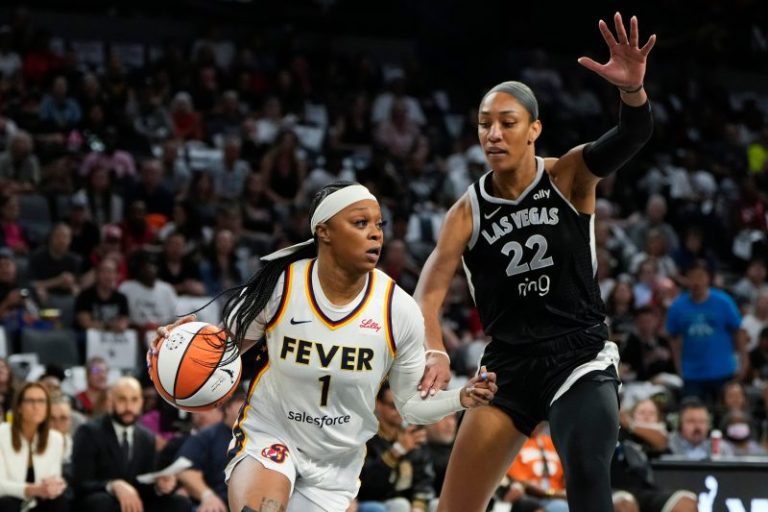
      The No. 2 seed Aces blew out the No. 6 seed Fever 90-68 in Game 2 on Tuesday at Michelob ULTRA Arena in Las Vegas to even the best-of-five semifinal series behind a dominant offensive and defensive performance from Wilson, who finished with 25 points, nine rebounds, five steals (a playoff career high) and two blocks in 33 minutes. 

      The Aces improve to 11-0 in the postseason when Wilson scores 25 or more points. She’s the fourth player in WNBA playoff history with 25 or more points and five or more steals in a game.

      ‘Got it back tonight, but we were angry with ourselves (after Game 1)… for not playing Aces basketball,’ said Chelsea Gray, who had 10 assists and three steals, in addition to six points. ‘Defensively we were just engaged from the start of the game.’

      Hammon challenged the rest of her team to ‘give (Wilson) support’ and the Aces responded. Coming off a four-point performance in Game 1, forward NaLyssa Smith turned up the aggression and scored 18 points, a career playoff high, and grabbed seven rebounds. Jackie Young added 10 points, four assists and three rebounds and the Aces bench contributed 24 points, led by 10 from Jewell Loyd and Dana Evans. The Aces shot 53.8% from the field and 41.7% from 3.

      Kelsey Mitchell had an off night and was held to 13 points, shooting 4-of-13 from the field and 1-of-6 from 3. Odyssey Sims had a team-high 16 points, while Aliyah Boston finished with a 10-point, 13-rebound double-double. Lexie Hull finished with 15 points and the bench contributed six points.

      The semifinal series shifts to Indianapolis for Game 3 on Friday. Here’s everything you need to know about Game 2 of the WNBA semifinals between the Indiana Fever and Las Vegas Aces:

      End of Q3: Aces 70, Fever 52

      Have yourself a night, NaLyssa Smith.

      The Las Vegas forward is up to 16 points (a playoff career high), six rebounds, one steal and one assist on Tuesday against the Indiana Fever, the team that drafted Smith second overall in the 2022.

      ‘It’s playoffs. It’s the will to win. It’s not the first to win one game, it’s the first to win a series. We campout here with different energy,’ said Smith, who played through four fouls. ‘They tell me I need me so I do what I got to do to help this team out.’

      The Aces outscored the Fever 24-17 in the third quarter and led by as many as 22 points.

      A’ja Wilson has a game-high 21 points and is one rebound short of a double-double with nine rebounds, four steals and two blocks, while Jackie Young is up to 10 points, four assists and three rebounds.

      Kelsey Mitchell scored a playoff career high 34 points in the Fever’s Game 1 win, but the All-Star guard has been held in check Tuesday and has been limited to 13 points, shooting 4-of-13 from the field and 1-of-6 from 3. The Fever struggled to get going offensively in the third quarter as a whole, missing nine straight shots in the frame.

      The Fever only have three bench points, while the Aces have 17.

      Halftime: Aces 46, Fever 35

      The Aces led by as many as 18 points in the first half, but the Fever went on a 11-0 run in the second quarter to cut the deficit to 11 points at halftime.

      Aces center A’ja Wilson has a team-high 13 points, four rebounds and two steals. NaLyssa Smith added 10 points, shooting 5-of-6 from the field after being held to four points in Game 1. Jackie Young recorded 10 points, three assists and two rebounds.

      Kelsey Mitchell (3-of-8 FG, 1-of-5 3PT) and Lexie Hull (3-of-10 FG, 3-of-6 3PT) each have nine points for the Fever.

      The Aces shot 55.9% from the field and 3-of-5 from the 3-point line, while the Fever shot 40% from the field and 5-of-13 from 3. The Aces were 5-of-5 from the free throw line, while the Fever were 2-of-2.

      The Fever have an advantage on the boards with 18 rebounds (eight offensive), compared to 14 for the Aces, while Las Vegas is dominating the paint 26-16.

      What time is Fever vs. Aces Game 2?

      Game 2 of the WNBA semifinals series between the No. 2 seed Las Vegas Aces and No. 6 seed Indiana Fever is scheduled to tip off at 9:30 p.m. ET (6:30 p.m. local) on Tuesday, Sept. 23 at Michelob ULTRA Arena in Las Vegas.

      How to watch Fever vs. Aces WNBA playoffs: TV, stream for Game 2

      • Date: Tuesday, Sept. 23
      • Time: 9:30 p.m. ET (6:30 p.m. PT)
      • Location: Michelob ULTRA Arena (Las Vegas)
      • TV: ESPN
      • Stream: Fubo, ESPN Unlimited

      Stream Fever-Aces series on Fubo (free trial)

      Aces sharing the ball

      After having 12 assists and 12 turnovers in Game 1, the Las Vegas Aces already have nine assists in Game 2 with a little more than seven minutes to go in the half.

      First quarter: Aces 26, Fever 17

      For the first time in the 2025 WNBA playoffs, the Fever are trailing after the first quarter.

      The Aces have picked up their defensive intensity, forcing six Fever turnovers that have lead to eight points.

      ‘We can still play up-tempo, but we have to be under control a little more,’ Kelsey Mitchell, who had four points for the Fever in the first quarter, said. ‘We just have to take what they give us.’

      A’ja Wilson has 11 points and three rebounds to lead Las Vegas. Jewell Loyd has five points off the bench.

      Fever-Aces off to a fast start

      It was a track meet in the first five minutes, as the Indiana Fever tried to set a fast pace. Lexie Hull, who was listed as questionable, started the scoring with a 3-pointer for the Fever. Teammate Aliyah Boston has four rebounds.

      NaLyssa Smith has four points for the Las Vegas Aces.

      Indiana Fever starting lineup

      Head coach: Stephanie White

      • 0 Kelsey Mitchell | G 5′ 8′ – Ohio State
      • 1 Odyssey Sims | G 5′ 8′ – Baylor
      • 6 Natasha Howard | F 6′ 3′ – Florida State
      • 7 Aliyah Boston | C 6′ 5′ – South Carolina
      • 10 Lexie Hull | G 6′ 1′ – Stanford

      Lexie Hull will play in Game 2

      Hull popped up on the Fever’s injury report on Tuesday due to back soreness, but is good to go for Game 2. She was listed among Indiana’s starting five ahead of tipoff.

      Fever injury report: Lexie Hull questionable

      Fever guard Lexie Hull (back) was listed as questionable on Tuesday’s injury report. Earlier Tuesday, Hull admitted after shoot-around that she’s ‘a little sore. I’m not going to lie.’ Hull added, ‘It’s catching up to me. We’re just going to keep getting warm and keep going out there and try to forget about the pain … but that’s everyone. Every one is playing with bumps and bruises.’ Hull is averaging 7.2 points, 4.3 rebounds and 1.2 steals per game this season. 

      Chloe Bibby (left knee), Caitlin Clark (right groin), Sydney Colson (left knee), Sophie Cunningham (right knee), Damiris Dantas (concussion protocol) and Aari McDonald (right foot) have all been ruled out for Game 2.

      Las Vegas Aces starting lineup

      Head coach: Becky Hammon

      • 0 Jackie Young | G 6′ 0′ – Notre Dame
      • 1 Kierstan Bell | F 6′ 1′ – Florida Gulf Coast
      • 3 NaLyssa Smith | F 6′ 4′ – Baylor
      • 12 Chelsea Gray | G 5′ 11′ – Duke
      • 22 A’ja Wilson | C 6′ 5′ – South Carolina

      Kelsey Mitchell has been carrying the Indiana Fever — it’s time everyone noticed

      In a tumultuous season defined by injuries and resilience, Indiana Fever guard Kelsey Mitchell has remained a constant.

      Mitchell has, in fact, been a constant for the Fever organization ever since she was drafted No. 2 overall out of Ohio State in 2018. She’s endured ups and downs during her eight-year career in Indiana, including six losing seasons and five different head coaches, enough turmoil to send any top pick packing.

      But Mitchell never bailed and the 29-year-old is now leading the Fever’s improbable postseason charge.

      ‘There have been multiple times this season where (Mitchell) has put us on her back and she’s carried us,’ Indiana head coach Stephanie White said on Sunday after the Fever upset the Las Vegas Aces 89-73 to steal Game 1 of the WNBA playoff semifinals behind Mitchell’s 34-point performance. Full story here.

      Are Caitlin Clark’s Air Force 1s the key to Indiana Fever’s playoff success?

      Caitlin Clark may not be able to play for the Indiana Fever, but she’s clearly trying to influence her teammates with her shoe game. The All-Star guard, who is out with a right groin injury, has worn black Nike Air Force 1 sneakers for the last three games of the playoffs. The Fever’s record in those three games: 3-0.

      It started when the Fever were down 1-0 in their best-of-3 first-round series to the Atlanta Dream. She walked out on the court with the shoes, which exude toughness, and got a big reaction from teammates.

      ‘I fear you, you mean business,’ Fever All-Star center Aliyah Boston joked before Game 2. ‘Black Forces?! Them (refs) better watch out.’ Read full story here.

      A’ja Wilson named 2025 WNBA MVP for record fourth time

      A’ja Wilson was named the WNBA’s Most Valuable Player for the 2025 season. She is the first four-time MVP, besting three-time winners Sheryl Swoopes, Lisa Leslie and Lauren Jackson. 

      WNBA MVP voting results

      A’ja Wilson received 51 of 72 first-place votes and 21 second-place votes (657 points) from a national panel of sportswriters and broadcasters. The Las Vegas Aces center won the award over finalists Minnesota Lynx forward Napheesa Collier (534),  Phoenix Mercury forward Alyssa Thomas (391), Atlanta Dream guard Allisha Gray (180) and Indiana Fever guard Kelsey Mitchell (93).

      Las Vegas Aces forward A’ja Wilson stats

      Wilson averaged a league-leading 23.4 points, 10.2 rebounds, 3.1 assists (ties her career-high), a league-leading 2.3 blocks and 1.6 steals in 40 games this season. Wilson averaged 29.3 points, 8.7 rebounds and 3.3 assists in the Aces’ first-round playoff series against the Seattle Storm, including a 38-point performance in Game 3, tying her playoff career high. However, she was held to 16 points in the Aces’ Game 1 loss to the Fever, shooting a dismal 27.2% from the field. 

      A’ja Wilson named Co-Defensive Player of the Year

      For the third time in four seasons, Las Vegas Aces center A’ja Wilson was named the WNBA Defensive Player of the Year. But this time there is a twist. Wilson will share the award with Minnesota Lynx forward Alanna Smith, the WNBA announced Thursday.

      WNBA playoffs 2025: Aces vs. Fever scores, results and schedule

      All times Eastern; *-if necessary

      Fever lead series 1-0

      • Game 1: Fever 89, Aces 73
      • Game 2, Tuesday: Fever at Aces, 9:30 p.m. (ESPN)
      • Game 3, Friday: Aces at Fever, 7:30 p.m. (ESPN2)
      • Game 4, Sunday: Aces at Fever, 3 p.m. ET on Sunday (ABC)
      • Game 5, Tuesday, Sept. 30: Fever at Aces, TBD*

      Indiana Fever roster

      Las Vegas Aces roster

      2025 WNBA Finals schedule

      *if necessary

      WNBA champions by year

      The USA TODAY app gets you to the heart of the news — fastDownload for award-winning coverage, crosswords, audio storytelling, the eNewspaper and more.

      This post appeared first on USA TODAY

      By Week 3, the league’s weakest defenses have been established. The Dallas Cowboys, Cincinnati Bengals and Miami Dolphins have all had trouble stopping their opponents, so fantasy managers can use that knowledge when assessing their matchup-based streamers.

      Fantasy managers have also learned some key surprising lessons during the early stages of the 2025 NFL season. The Indianapolis Colts have one of the league’s most efficient offenses, the Cleveland Browns defense has actually been effective at stopping the run and the Carolina Panthers have been tougher than expected against quarterbacks.

      Will those trends hold up? It’s hard to say for sure, but as long as they do, fantasy managers will want to pay close attention to fantasy contributors in trickier-than-expected matchups.

      What should fantasy football afficionados do at each lineup position heading into Week 4? USA TODAY Sports outlines 16 players to start or sit in your fantasy matchups this week.

      Fantasy football players to start in Week 4

      Quarterbacks

      • Jordan Love, Green Bay Packers (at Dallas Cowboys)

      The Cowboys have allowed the most fantasy points per game (FPPG) to opposing quarterbacks through three weeks. Love should be able to pass well on a team that has allowed a league-worst 900 passing yards to quarterbacks, so expect him to bounce back after a disappointing Week 3 showing against the Browns.

      • Geno Smith, Las Vegas Raiders (vs. Chicago Bears)

      The Bears are another leaky pass defense – they have surrendered a league-high eight passing touchdowns to quarterbacks – and Chicago remains without its top cornerback, Jaylon Johnson, because of a groin injury. That should create an opportunity for Smith to build upon the 289 passing yards and three touchdowns he logged in Week 3 against the Commanders.

      Running backs

      • J.K. Dobbins, Denver Broncos (vs. Cincinnati Bengals)

      Dobbins has entrenched himself as the Broncos’ starter in front of RJ Harvey and has out-touched the rookie 45-18 through Week 3. That should position Dobbins to take advantage of a Bengals defense that Jordan Mason just gashed for 116 yards and two touchdowns on 16 carries.

      • Nick Chubb, Houston Texans (vs. Tennessee Titans)

      Chubb hasn’t found a lot of running room behind Houston’s shaky offensive line, but he should have a good chance to score in Week 4 against Tennessee. The Titans have allowed a league-high five rushing touchdowns to running backs while allowing the third-most points per game league-wide (31.3).

      Wide receivers

      • Tre Tucker, Las Vegas Raiders (vs. Chicago Bears)

      Tucker is fresh off an eight-catch, 145-yard, three-touchdown outing against the Commanders. Now, he gets to face a Bears defense that has allowed the second-most FPPG to wide receivers this season. Tucker has been targeted 17 times by Smith over the last two weeks, so he should see the volume needed to emerge as a quality flex play.

      • Keenan Allen, Los Angeles Chargers (at New York Giants)

      Allen has been as steady as they come in his return to the Chargers, logging at least 61 yards and a touchdown in each of his three games thus far. Justin Herbert should continue to look his way often against a Giants defense that has surrendered the second-most passing yards to wide receivers (587) in 2025.

      Tight end

      • Kyle Pitts, Atlanta Falcons (vs. Washington Commanders)

      Pitts has been a steady target for Michael Penix Jr. to open the season. He is averaging 6.3 targets per game and has posted at least four catches and 37 yards in each of Atlanta’s first three games. The Commanders have allowed the fourth-most yards to tight ends this season (213) so Pitts should be in for another solid showing.

      Defense/special teams:

      • Denver Broncos (vs. Cincinnati Bengals)

      We all saw what the Minnesota Vikings did to the Joe Burrow-less Bengals in Week 3. The Broncos – who sport a pressure rate of 50.4%, good for second in the NFL – figure to get after Jake Browning frequently and force him into negative plays. That could allow them to rise to the ranks of a top-five defensive unit in Week 4.

      Fantasy football players to sit in Week 4

      Quarterbacks

      • Drake Maye, New England Patriots (vs. Carolina Panthers)

      The Panthers may seem like a good matchup, but they have allowed a league-low two total touchdowns to quarterbacks through three weeks. Maye might still be able to rack up some passing yards, but if any of New England’s running backs get going, they may eat into the quarterback’s overall production.

      • Kyler Murray, Arizona Cardinals (vs. Seattle Seahawks)

      The Seahawks have allowed the sixth-fewest FPPG to fantasy quarterbacks through three weeks. Murray has run for at least 32 yards in all three of his games, but he has only logged a single touchdown in back-to-back weeks. He remains a high-floor, low-ceiling option at quarterback, so it’s hard to trust him against a defense allowing just 15.7 points per game, second fewest in the NFL.

      Running backs

      • David Montgomery, Detroit Lions (vs. Cleveland Browns)

      The Browns have been excellent against the run so far in 2025. They have allowed a league-low 127 rushing yards to running backs this season on an impressive 2.2 yards per carry average. That may prevent Montgomery, who is splitting carries with Jahmyr Gibbs and isn’t as elusive as his younger counterpart, from getting the yardage necessary to be anything more than a touchdown-dependent flex.

      • Cam Skattebo, New York Giants (vs. Los Angeles Chargers)

      The good news? Skattebo broke out on ‘Sunday Night Football’ in Week 3, racking up 121 total yards and a touchdown on 16 carries. The bad news? The talented rookie is set to play a Chargers defense that has allowed the third-fewest FPPG to running backs in Week 4.

      Could Skattebo get the volume needed to emerge as a quality flex play or low-end RB2? Sure, especially with Tyrone Tracy Jr. out because of a separated shoulder. Still, it’s hard to trust the Giants’ shaky offense, so Skattebo comes with more risk than some of the week’s other flex-level talents.

      Wide receivers

      • Travis Hunter, Jacksonville Jaguars (at San Francisco 49ers)

      Hunter has seen his target share decrease each week and was limited to just one catch for 21 yards last week. He hasn’t yet topped 33 receiving yards in a game this season, so it’s hard to recommend trusting him against a 49ers defense that has allowed the fifth-fewest FPPG to receivers this season.

      • Stefon Diggs, New England Patriots (vs. Carolina Panthers)

      Diggs had six catches for 57 yards in his Patriots debut but has racked up just seven catches for 55 yards in two games since. The Panthers have performed well against receivers this year while having more issues against tight ends and running backs. Maye might look more in the direction of Hunter Henry and TreVeyon Henderson as a result, making Diggs a questionable flex play at best.

      Tight end

      • Juwan Johnson, New Orleans Saints (at Buffalo Bills)

      Johnson has been a revelation to start the season, but it’s hard to trust him against a Bills team that has allowed just five receptions to tight ends through three weeks. Add in that Spencer Rattler is making another tough road start and this may be a spot in which to fade Johnson, though he could be in line for some garbage-time opportunities.

      Defense/special teams:

      • Los Angeles Rams (vs. Indianapolis Colts)

      The Colts are one of three NFL teams to not commit a turnover during the first three weeks of the season, along with the Tampa Bay Buccaneers and Buffalo Bills. That – plus Daniel Jones’ 2.69-second time to throw, eighth fastest among NFL quarterbacks – will prevent the Rams from making the big plays needed to be anything more than a middling stream.

      All the NFL news on and off the field. Sign up for USA TODAY’s 4th and Monday newsletter.

      This post appeared first on USA TODAY