Author

admin

Browsing

Silverco Mining (TSXV:SICO) is a production-stage silver company targeting opportunities in Mexico’s Sierra Madre Occidental belt. Its primary technical focus is optimizing the wholly owned Cusi Mining Complex in Chihuahua, an 11,665-hectare district-scale property. The site benefits from established, institutional-quality infrastructure—such as direct access to the national power grid and paved roads—significantly lowering the capital requirements for restarting operations.

The company is undertaking a definitive transition toward mid-tier producer status through a binding agreement to acquire Nuevo Silver. This deal gives Silverco control of the La Negra mine in Querétaro, a currently producing asset that delivers immediate top-line revenue. By pairing the near-term restart of the Cusi 1,200 tpd mill with ongoing production at La Negra, Silverco is effectively bypassing the multi-year development cycle typically faced by junior miners.

This “buy-and-build” strategy is driven by a technical team with specialized expertise in Mexican epithermal vein systems and complex underground mine engineering, positioning the company to accelerate growth while maintaining operational discipline.

Company Highlights

  • The $62.5 million upsized bought deal financing (closing Q1 2026) and Eric Sprott’s $10 million lead order provide cornerstone validation from a legendary mining investor and the necessary liquidity to fast-track production restarts.
  • The updated Mineral Resource Estimate of 41.2 million ounces of silver equivalent (AgEq) in the Measured and Indicated category establishes a high-confidence geological foundation at Cusi, supporting long-term mine planning.
  • The dual-track growth strategy involving the Cusi restart and the Nuevo Silver/La Negra acquisition provides immediate production scale and a diversified cash-flow profile across two distinct Mexican mining jurisdictions.
  • Pure-play silver exposure with significant de-risking is achieved via the 1,200 tonne-per-day (tpd) Cusi mill, which was producing as recently as 2023, ensuring that surface infrastructure is ‘warm’ and capable of a rapid return to service.
  • Imminent exploration catalysts exist following the completion of a 15,000-metre drill program at Cusi; results are currently pending and are expected to define high-grade extensions at the San Miguel vein.

This Silverco Mining profile is part of a paid investor education campaign.*

Click here to connect with Silverco Mining (TSXV:SICO) to receive an Investor Presentation

This post appeared first on investingnews.com

Global central banks own about 17 percent of all the gold ever mined, with reserves topping 36,520.7 metric tons (MT) at the end of November 2025. They acquired the vast majority after becoming net buyers of the metal in 2010.

Central banks purchase gold for a number of reasons: to mitigate risk, to hedge against inflation and to promote economic stability. Increased concerns over another global financial crisis have as expected led central banks once again to build up their gold reserves.

In a mid-2025 survey, the World Gold Council (WGC) said that 95 percent of the central bankers it polled expect global gold reserves to increase over the next 12 months. The precious metal’s ‘performance during times of crisis’ was cited by 85 percent of respondents as highly or somewhat relevant to their decision, while 80 percent cited its long-term store of value.

Central banks added 863.3 metric tons of gold to their vaults in 2025. While this was lower than the previous three years, which all topped 1,000 MT each, the reserve gains were still well above the 2010 to 2021 annual average of 473 MT.

Yearly central bank gold purchases since 2019.

Chart via the WGC.

A record 95 percent of respondents to the WGC survey stated their belief that central banks will continue to grow their holdings, with 5 percent suggesting they would hold at current levels. For the second year in a row, no respondents expected reserves to decrease.

The Council found that sentiment was consistent across advanced and emerging economies and reflected the strategic role of gold amid dynamic economic and geopolitical uncertainty.

Which central banks hold the most gold?

Read on to find out the 10 top countries by central bank gold holdings, as per data from the WGC, including recent Q4 2024 and full-year 2024 reports.

1. United States

Gold reserves: 8,133.46 metric tons

When it comes to the largest gold depository in the world, the American central bank is number one with 8,133.46 metric tons of gold.

A large percentage of US gold is held in “deep storage” in Denver, Fort Knox and West Point. As the US Treasury explains, deep storage is “that portion of the US Government-owned gold bullion reserve which the Mint secures in sealed vaults that are examined annually by the Treasury Department’s Office of the Inspector General and consists primarily of gold bars.”

The rest of US-owned reserves are held as working stock, which the country’s mint uses as raw material to mint congressionally authorized coins.

2. Germany

Gold reserves: 3,350.3 metric tons

The Bundesbank, Germany’s central bank, currently owns 3,351.53 metric tons of gold. Like many of the central banks on this list, the German national bank stores a significant portion of its gold in foreign central banks.

Today, just over half of Germany’s gold holdings are stored within Frankfurt, while internationally 1,236 MT of gold is stored in the vaults of the New York Federal Reserve, and 12 percent of its holdings are in London.

The Bundesbank’s foreign gold reserves came into question in 2012, when the German Federal Court of Auditors, the Bundesrechnungshof, was openly critical of the Bundesbank’s gold auditing. The German bank issued a public statement defending the security of foreign banks. Privately, the Bundesbank then began the arduous process of repatriating some of its gold stock back to German soil. By 2016, more than 583 MT of gold had been transferred back to Germany.

The economic upheaval and geopolitical volatility brought about by US President Donald Trump’s tariff wars and adversarial posturing toward Europe has led to calls for Germany to consider further repatriating its gold, reported The Guardian in January 2026.

3. Italy

Gold reserves: 2,451.9 metric tons

Banca d’Italia, the national bank of Italy, holds 2,451.84 metric tons of gold. The central bank began amassing its gold in 1893, when three separate financial institutions merged into one. From there, its 78 MT of holdings slowly grew into the large gold reserves it holds today.

Like Germany, Italy stores parts of its reserves offshore. In total, 141.2 MT are located in the UK, 149.3 MT are in Switzerland and 1,061 MT are kept in the US Federal Reserve. Italy houses 1,100 MT of gold domestically.

4. France

Gold reserves: 2,437 metric tons

The Banque de France has 2,437 metric tons of gold reserves, all of which it keeps on hand. The precious metal is stored in the bank’s secure underground vault, dubbed La Souterraine, which is located 27 meters below street level.

La Souterraine’s gold vaults are one of the four designated gold depositories of the International Monetary Fund.

According to Investopedia, the collapse of the Bretton Woods gold standard system was in part due to former French President Charles de Gaulle, who “called the U.S. bluff and began actually trading dollars in for gold from the Fort Knox reserves.” At the time, US President Richard Nixon “was forced to take the U.S. off the gold standard, ending the dollar’s automatic convertibility into gold.”

5. Russia

Gold reserves: 2,326.5 metric tons

The Bank of Russia is the official central bank of the Russian Federation and owns 2,332.74 metric tons of gold. Like France, Russia’s central bank has opted to store all its physical gold domestically. The Bank of Russia stores two-thirds of its gold reserves in a bank building in Moscow, and the remaining one-third in Saint Petersburg.

The majority of the yellow metal is in the form of large, variable-weight standard gold bars weighing between 10 and 14 kilograms. There are also smaller bars on site weighing as much as 1 kilogram each.

Russia, which is the second largest gold producer by country, has been a steady purchaser of the precious metal since roughly 2007, with sales ramping up significantly between 2015 and 2020. However, Russia’s refineries were banned from selling gold bullion into the London market following the country’s invasion of Ukraine. Sanctions by the west also include a freeze on about half of Russia’s gold reserves.

In early 2022, Russia tied its currency, the ruble, to the yellow metal. ‘The plan was to shift the currency away from a pegged value and into the gold standard itself so the ruble would become a credible gold substitute at a fixed rate,’ according to Robert Huish, an Associate Professor in International Development Studies at Dalhousie University.

6. China

Gold reserves: 2,306.3 metric tons

The central bank for Mainland China is the People’s Bank of China (PBoC), located in Beijing. According to the WGC, the national financial institute stores 2,279.56 metric tons of gold, most which has been purchased since 2000. In 2001, the PBoC had 400 MT of gold in reserve, but in just a little more than two decades that total has climbed by 459 percent.

The PBoC issues the Panda gold coin, which was first created in 1982. The Panda coin is now one of the top five bullion coins issued by a central bank. It is among the ranks of the American Eagle, Canadian Maple Leaf, South African Krugerrand and Australian Gold Nugget.

The PBoC was one of the top gold buyers of the world’s central banks for 2024 and 2025, purchasing 44 MT and 27 MT of gold during the years respectively. April 2024 marked the 18th consecutive month of gold buying for China’s central bank, which paused its purchases afterward until picking them up again in November. As of January 2026, it has purchased gold for a further 15 consecutive months.

7. Switzerland

Gold reserves: 1,039.9 metric tons

The Swiss National Bank (SNB) holds the seventh largest central bank gold reserves. Its 1,039.94 metric tons of gold are owned by the state of Switzerland, but the central bank manages and maintains the reserve. The Swiss constitution allows the SNB to buy and sell gold with market trends, but it is not required to report the sales.

After years of opaqueness regarding the country’s golden treasure trove and increased selling in 2011 as prices rose, the Swiss Gold Initiative was launched in 2011.

The initiative called for an amendment to the constitution to add three new points to it. The first was a mandate for all reserve gold to be held physically in Switzerland. The other two dealt with the central bank’s ability to sell its gold reserves, along with a decree that 20 percent of the Swiss bank’s assets be held in gold.

This culminated in a national referendum in 2014 that failed to reach a majority of votes. However, the public conversation did prompt the bank to be more transparent.

According to a 2013 release, the central bank reported that 70 percent of its gold reserve was held domestically, 20 percent was located at the Bank of England and 10 percent was stored with the Bank of Canada.

8. India

Gold reserves: 880.2 metric tons

The Reserve Bank of India is another central bank that has fervently acted to increase its holdings in recent years. It began adding to its gold assets in 2017; however, the majority of its purchases have taken place in the past four years.

Strikingly, after India’s central bank purchased 16 MT of gold in 2023, the institution scooped up another 72 MT of the precious metal in 2024. However, its 2025 purchases totaled just 4 MT, its lowest in eight years.

While more than half of its gold is held overseas in safe custody with the Bank of England and the Bank of International Settlements, about a third of its gold is held domestically. In June 2024, India repatriated 100 MT of gold from the United Kingdom. This was the first time since 1991 that the Reserve Bank of India moved its overseas gold holdings back home.

9. Japan

Gold reserves: 846 metric tons

The Bank of Japan currently holds 846 metric tons of gold. Public information about the Bank of Japan’s gold reserves is hard to come by.

In 2000, the island nation was holding approximately 753 MT of the yellow metal, and by 2004, the Bank of Japan’s gold store had grown to 765.2 MT. Its gold reserves remained at that level until March 2021, when the country purchased 80.76 MT of gold, bringing it to its current total.

10. Turkey

Gold reserves: 613.7 metric tons

The Central Bank of Turkey holds 613.7 metric tons of gold. Turkey has been a consistent gold buyer over the past several years, with its central bank adding 75 MT to its holdings in 2024. While the pace of the country’s buying slowed in 2025, the country accumulated another 27 metric tons through the end of November, making it the year’s fifth-largest gold buyer.

*11. International Monetary Fund

Gold reserves: 2,814 metric tons

The gold reserve held by the International Monetary Fund is the third largest in terms of size at 2,814 metric tons. The large gold reserve was amassed primarily during the founding of the international organization in 1944.

In that inaugural year, it was decided that “25 percent of initial quota subscriptions and subsequent quota increases were to be paid in gold.”

Since 1944, the International Monetary Fund has added gold through the repayment of debts owed by member countries. Nations can also exchange gold for another member country’s currency.

Securities Disclosure: I, Melissa Pistilli, hold no direct investment interest in any company mentioned in this article.

Securities Disclosure: I, Dean Belder, hold no direct investment interest in any company mentioned in this article.

This post appeared first on investingnews.com

  • Canadian Megan Oldham won a gold medal in the women’s free ski big air event in Livigno, Italy.
  • Oldham’s victory came after recovering from a concussion in November and a crash during the slopestyle event a week prior.
  • This is Oldham’s second medal of the games, adding to a bronze she won in slopestyle.
  • China’s Eileen Gu secured her fifth Olympic medal by winning silver in the same event.

LIVIGNO, Italy — Megan Oldham wanted to bring one medal back to Canada. Any color would do.

She certainly won’t complain then with two in her suitcase – one being gold that the 24-year-old won Monday night in the women’s free ski big air event that was delayed 75 minutes as sidewinding snow blanketed the Valtellina Valley.

“Honestly, this has been an Olympics that has totally surpassed my dreams … and to come home with gold is something I never thought was possible,” Oldham said. “I’m so proud of myself.”

Watch Winter Olympics on Peacock

And she should be. Her performance over the past week-plus at Livigno Snow Park – and really the last few months – has been rooted in perseverance.

In November, she suffered a concussion that put her on the shelf for four weeks. Oldham had never dealt with one before and faced uncertainty regarding the recovery, she said. Her coach, JF Cusson, was on the road with other athletes and couldn’t oversee that process. When she returned, Cusson said, they had to scrap the original bag of tricks they planned on bringing to Italy since she’d injured herself trying to up her moves.

A week ago, she suffered a “heavy” crash on the final jump of her fist slopestyle run. She shook it off and made the podium with bronze. Of course, she’d be determined and do everything she could to display her skiing, Oldham said. That didn’t make the hematoma on her quad that would seize up any more comfortable.

By the big air finals, she wasn’t limping anymore — just some leftover bruising and soreness.

“I don’t what it is,” said Oldham, who finished fourth in big air in Beijing four years ago, which was tough to process for her. “But just something about it, I want to be up there and prove mostly to myself that I’m capable of it.”

Maybe that explains why she did not take a customary victory jump even though she’d secured gold by the last run of the night. She’d trained hard, after all, and wanted to show everyone the switch 1400 mute. She didn’t land it. It didn’t matter.

Growing up with two brothers – one older, one younger, both in town to watch their sister – who are adrenaline junkies, she tried to keep up with them. They bring out the best in her, she said.  

“Now I can hold this one over them, for sure,” she joked.

Skiing off the roof of family home’s garage was the example Oldham cited of how she and her brothers would get up to no good. One time, their dad came home as they were embarking on a “run.” He was livid – not necessarily concerned for their well-being. He feared them damaging the roof.  

“That was all my brother’s idea,” Oldham said. “I was just tagging along. That shows where it comes from, for sure. The no fear comes from him.”

Oldham’s win was Canada’s second gold of these Olympics – and second in as many days after Mikael Kingsbury won men’s dual moguls Sunday.

China’s Eileen Gu won her fifth Olympic medal in five events and will go for a sixth in the women’s halfpipe later this week. That would make her the most-decorated free skier – male or female – ever.

“Five-time Olympic medalist has a nice ring to it,” Gu said.

This post appeared first on USA TODAY

CORTINA D’AMPEZZO, Italy — Maybe we’ve gotten the Canadians all wrong.

They seem to have the market cornered on niceness, the type of folks who always say hello and never have a bad word to say about anyone or anything. Certainly not the type to cause a ruckus or, gasp, cheat.

And yet …

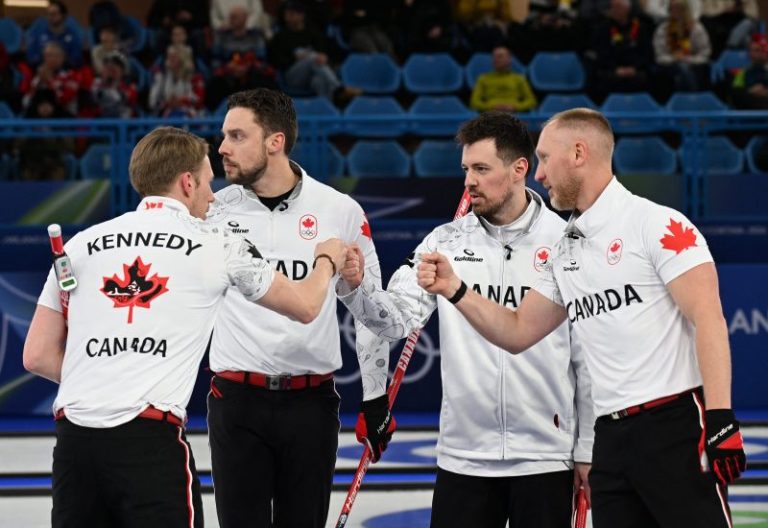
For the second Olympics in a row, Canada is facing accusations that it’s playing fast and loose with the rules to get an edge. Last time it was soccer, when the Canadian women’s team was caught using drones to spy on opponents at the 2024 Paris Olympics. At the 2026 Milano Cortina Olympics, it’s curling. Curling!

Canada’s men’s team was called out not once but twice over the weekend for “double touching,” which can be either touching the stone after its release or touching the granite at any point. Then Canada’s women were accused of a similar offense.

“Obviously it’s frustrating to have that happen,” said Canada skip Rachel Homan, who had a stone removed from the ice for a double-touch violation during a match against Sweden on Saturday, Feb. 14.

“But we’re trying to stick together as a team, and we’re supporting the guys and they’re doing the same for us,” Homan said. “There’s zero intention. It kind of got blown up for no reason.”

That is probably true.

The Canadian curlers are accused of trying to manipulate their stones’ trajectory, not carrying them down the ice and depositing them in the house (the bullseye that is the curlers’ goal).

Plus, a curling stone weighs between 38 and 44 pounds and there is 21 feet of ice between the hogline and the house. Giving the handle an extra tap, or even touching the granite, isn’t going to be what gets Canada on the podium.

But it’s the combination of a cheating scandal in curling – which is always going to be fodder for the “sport, not a sport” debate – and the nicest people on earth being at the center of it that has turned it into the cause celebre at these Games.

“There’s always something blowing up at the Olympics, right? This year it’s this,” sweeper Emma Miskew said after Canada beat China on Monday, Feb. 16, to get to 2-3 in the tournament at the Milano Cortina Olympics.

“It’s all good. We’ll get through it,” Miskew said. “I think it’ll die down eventually.”

Yes, but what about the damage done to Canada’s image as the country nobody can hate?

Canadians are the human equivalent of Disneyland. The next time they’re accused of being obnoxious or braggarts it will be the first. They’re easy-going and fun. Being around them is an immediate mood boost.

They’re like Australians, only with moose and maple syrup instead of koalas and kangaroos.

Now the world, especially people not paying close attention, are going to think Canada is just as corrupt as everybody else. That they’ll cut corners and throw people under the bus if it benefits them.

The Canadians don’t see it that way, of course. They believe they’re the wronged party.  

“We’ve played the game at a high level long enough where we weren’t looking for infractions. … We just trust that the people around us aren’t trying to cheat,” said Canada’s Marc Kennedy, who was called out for double touching by Sweden’s Oskar Eriksson to start this whole mess.

“There might be small infractions here and there, but most of the time you shrug it off. You’ve got so much respect for the players that you’re playing against,” Kennedy said Monday. “So this whole trying to catch people in the act of an infraction and anything to win a medal, it sucks. It’s unfortunate, but it is what it is.”

Except there’s video of the infractions. And while the Canadians might say they’re inadvertent, it was a similar story initially in Paris.

The women’s coaching staff initially denied involvement or knowledge of the drone scheme, only for an investigation to reveal that it was a long-standing operation and the coaches had full knowledge and involvement in it.

Maybe this time is different. Maybe the double touch accusations are nothing but a misunderstanding. But when a country has cheating scandals in back-to-back Olympics, it starts to look like a pattern. And once trust is broke, the cloud of suspicion is almost impossible to clear.

Even if you’re Canadian.

Follow USA TODAY Sports columnist Nancy Armour on social media @nrarmour.

This post appeared first on USA TODAY

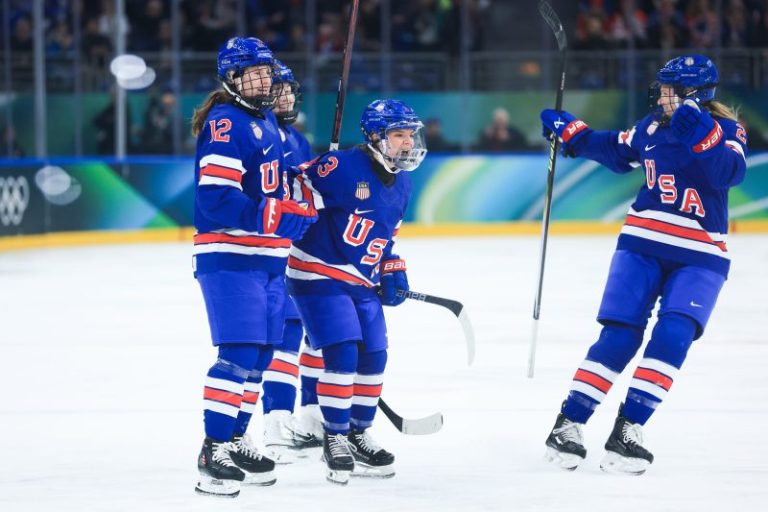
MILAN — Captain Hilary Knight stood on the ice as her USA women’s hockey teammates filed off, one by one, following another resounding performance at the 2026 Winter Olympics.

The five-time Olympian, chasing her second Olympic gold medal, fist bumped each of her teammates, the last to go through the gap in the boards and head to the locker room.

There was Cayla Barnes, who scored about 5 minutes into the American’s 5-0 semifinal win over Sweden, her first goal of the tournament. There was Taylor Heise, Abbey Murphy, Kendall Coyne Schofield and Hayley Scamurra, who all scored in the second period, the latter three of whom scored within less than 3 minutes of each other.

Watch Winter Olympics on Peacock

“I think this is one of the best groups I’ve ever been part of,’ Edwards said. ‘I think our depth and being from top, down being that everyone plays a really good 200-foot game and we just play well together.”

The players, who have combined to score 31 goals so far this tournament, lingered briefly before heading into the tunnel, waving to fans and taking in the moment. They had gotten past their second-to-last hurdle, standing between them and that coveted Olympic gold, which the U.S. women have won twice (1998, 2018) and played for six times previously.

‘It’s hard to kind of zoom out while you’re here and look at the big picture because you’re so focused on the day to day,’ goaltender Aerin Frankel said. ‘But I think we look back at this tournament, what we’ve done so far has been amazing.’

The Americans outshot the Swedes 34-23, and Frankel was impenetrable, keeping Sweden off the board with spectacular save after save to preserve a fifth consecutive shutout. Meanwhile, as Knight remains one goal and one point away from setting the new U.S. Olympic all-time record in both categories, the vaunted leader is more than fine with her teammates getting the shine, quickly deflecting all praise to her teammates at every turn.

‘Anytime I put on this jersey, I feel just so lucky to be a part of this group because there’s so much talent in our locker room and it’s just so much fun to play with the best players in the world,’ Frankel said.

The Americans will play Canada in the gold medal match on Thursday at 1:10 p.m. ET.

What USA women’s hockey players said about playing for Olympic gold

  • Joy Dune: ‘I think it speaks for itself what we want him here to do. We’ll just let the score speak for itself. We’re just going to keep pushing, knowing we can be better. There’s always room for improvement. We’re a really good team, but we can always continue to be better.’
  • Aerin Frankel: ‘It’s hard to kind of zoom out while you’re here and look at the big picture because you’re so focused on the day to day. But I think we look back at this tournament, what we’ve done so far has been amazing.’
  • Laila Edwards: ‘I mean, I think, believe it or not, we have been challenged and we just overcome it and succeeded, but we’ll take what we can get and hopefully come out on top.’

USA women’s hockey scores a rout vs. Sweden

Hayley Scamurra netted a goal at 37:59 to continue the Americans’ dominance in this semifinal matchup — and in this Olympic tournament. The goal gave USA a 5-0 lead.

Sweden swapped out goalkeeper Ebba Svensson Träff for Emma Soderberg at the 36:10 mark immediately after Träff conceded the four goal of the match, including two in less than a minute. Soderberg gave up a goal less than two minutes later to Hayley Scamurra.

USA women’s hockey scores 2 goals in less than a minute

Not 6 minutes after Taylor Heise put the Americans up 2-0, Abbey Murphy and Kendall Coyne Schofield scored within a minute of each other to extend the lead to 4-0. Hannah Bilka and Haley Winn were credited with the assist on Murphy’s goal; Megan Keller and Laila Edwards were credited with the assist on Coyne Schofield’s goal.

Taylor Heise scores for USA women’s hockey

Forward Taylor Heise extended USA’s lead over Sweden to 2-0 at the 29:09 mark. Hannah Bilka made a break toward the goal and connected with Heise, who tapped the puck in for her second score of the tournament. Abbey Murphy was also credited with an assist.

Read about her journey from being cut ahead of the 2022 Beijing Games to roaring back and becoming indespensible for this squad.

Jason Kelce stops by USA hockey vs. Sweden

U.S. women’s hockey rising star Laila Edwards isn’t the only Cleveland Heights native in the building. Fellow Ohioan Jason Kelce and his wife Kylie Kelce were in attendance at the Milano Santagiulia Ice Hockey Arena on Monday for Team USA’s semifinal matchup against Sweden.

Kelce was decked out in red, white and blue in a Team USA Kendall Coyne Schofield jersey.

Edwards revealed last month that Kelce and his brother, Travis Kelce, both donated to her GoFundMe campaign to bring her family and friends to Milan to cheer her on in person. Edwards became the first Black woman to score a goal for the U.S. Olympic hockey team.

Edwards, 22, assisted Schofield’s goal at the 36:10 mark.

USA’s Kirsten Simms called for interference

Kirsten Simms was called for an interference penalty, handing Sweden its second power play of the contest. The Americans were able to kill off the first power play and easily kept the Swedes away from their goal during the second.

USA women’s hockey roster

Here is the full U.S. women’s hockey roster for the Milano Cortina Olympics:

  • Forwards: Kirsten Simms; Kelly Pannek; Grace Zumwinkle; Hayley Scamurra; Britta Curl-Salemme; Hilary Knight; Tessa Janecke; Hannah Bilka; Joy Dunne; Alex Carpenter; Kendall Coyne Schofield; Taylor Heise; Abbey Murphy.
  • Goaltenders: Ava McNaughton; Aerin Frankel; Gwyneth Philips.
  • Defenders: Lee Stecklein; Cayla Barnes; Caroline Harvey; Megan Keller; Rory Guilday; Haley Winn; Laila Edwards.

USA women’s hockey coach

John Wroblewski has led the squad since August 2022. Under his leadership, the Americans have two golds and two silvers at IIHR Women’s World Championships.

USA’s Hayley Scamurra hits penalty box

USA forward Hayley Scamurra is heading to the penalty box after being called for tripping. The penalty gave Sweden a one-player advantage and their first power play of the night.

USA women’s hockey leads Sweden after first period

The U.S. women have a 1-0 lead over Sweden after the first period. Cayla Barnes opened scoring at the 5:09 mark for the Americans, who recorded 13 shots on goal in the frame. Sweden registered only two shots on goal in the first period, including a breakaway shot that goalie Aerin Frankel caught to keep the Swedes off the board. Frankel has only one conceded one goal through three games, in addition to two shutouts.

USA gets first power play

The Americans got the first power play of the match after Sara Hjalmarsson was called for a boarding penalty at the 8:21 mark. However, Sweden was able to kill off the power play and is back at full strength.

USA women’s hockey takes 1-0 lead in first

The Americans are on the board just like that. Cayla Barnes hit a laser to give the U.S. a 1-0 lead over Sweden about 5 minutes into the first period. It was Barnes’ first goal of these Games and USA’s 27th of the tournament.

Kelly Pannek and Lee Stecklein were credited with the assist. The U.S. women are already up to 9-1 in shots on goal. The Swedes didn’t notch their first until more than halfway through the opening frame.

Caroline Harvey stats

Caroline Harvey has nine points so far these Games — two goals, seven assists — the most by a U.S. defender in an Olympics tournament.

Hilary Knight stats

The U.S. hockey captain and five-time Olympian is sitting on the doorstep of breaking two records. Most points by an American at the Olympics and most goals by an American at the Olympics. She is tied with Jenny Potter for most points (32), and in a three-way tie with Natalie Darwitz and Katie King for most goals (14).

USA women’s hockey game vs. Sweden underway

And we’re off here at this Olympics semifinal game. About 20 seconds into the first period, chants of ‘U-S-A! U-S-A!’ broke out from the crowd.

USA women’s hockey stats

  • The Americans are 5-1 in the semifinals at the Olympics, the only loss coming to Sweden at the 2006 Games.
  • This is the sixth time these sides have met in the Olympics. The Americans hold a 4-0-1-0 record.

USA women’s hockey lines today

What time does USA hockey play today?

  • Date: Monday, Feb. 16
  • Time: 10:40 a.m. ET
  • Location: Milano Santagiulia Ice Hockey Arena

Puck drop between the U.S. women’s hockey team and Switzerland is set for 10:40 a.m. ET on Monday, Feb. 16 from the Milano Santagiulia Ice Hockey Arena.

USA women’s hockey game today

  • TV channel: USA Network
  • Streaming options: NBCOlympics.com | NBC Olympic App | Peacock

USA Network will broadcast Monday’s U.S. women’s hockey semifinal matchup against Sweden at the 2026 Winter Olympics. Streaming options for the game include NBCOlympics.com and the NBC Olympic App (with a TV login).

You can also stream the game on Peacock, NBC’s subscription streaming service.

The USA TODAY app gets you to the heart of the news — fastDownload for award-winning coverage, crosswords, audio storytelling, the eNewspaper and more.

This post appeared first on USA TODAY

Two national championship contenders from the Big 12 faced off — and lived up to the bill — when Iowa State knocked off Houston, 70-67, at home on Feb. 16.

He lived up to the moment, leading all scorers with 22 points, five rebounds and four assists in 37 minutes played.

Watch Houston vs. Iowa State men’s basketball live with Fubo (free trial)

Iowa State, meanwhile, also has a veteran group. The Cyclones (21-3, 8-3) are led by multi-year starters Milan Momcilovic, Joshua Jefferson and Tamin Lipsey, making them one of the most-experience rosters in college basketball. Momcilovic and Jefferson are averaging 18.4 and 17 points per game this season, respectively.

Lipsey emerged as the hero for Iowa State, tying the game up with a late free throw and later securing a key offensive rebound with just one second on the clock to give the Cyclones one more shot to extend their one-possession lead.

Iowa State vs. Houston highlights

FINAL: Iowa State wins 70-67

An epic final two minutes saw the lead change hands multiple times. Jamarion Bateman hit a 22-footer for three for Iowa State. Kingston Flemings got a pull up jumper for Houston. Nate Heise made another three, and the roof at Hilton Coliseum blew off as the Cyclones went up 69-67 with a minute left to go.

Tamin Lipsey was once again the hero, securing a crucial rebound with one second left after Blake Buchanan missed his free throw. The ball ended up in Joshua Jefferson’s hands at the free throw line. He only made the first one, but the Cougars were forced to take a full-court heave as time expired.

The Cyclones ended the game on a 17-4 run after originally losing the lead three minutes into the second half.

2nd Half: Cyclones cap off 10-0 run to tie it late

Now it’s the Cougars who have gone cold. Dominykas Pleta and Joshua Jefferson each got buckets in the paint to bring Iowa State to within one point. After a double team forced Kingston Flemings into a bad shot from the corner that hit the side of the backboard, Tamin Lipsey got the rebound and drove right back into the lane and was fouled by Joseph Tugler.

Lipsey hit one of two free throws shots to tie things up at 64-64 with 3:40 to go.

2nd Half: Houston, Iowa State battling as Cougs’ depth gets tested, Houston leads 63-58

Houston big man Chris Cenac Jr. drained a three at the 15-minute mark in the second half to give the Cougars their first lead of the night. Kingston Flemings hit another three eight minutes later to extend their lead to double digits for his 20th point of the game, leading all scorers.

Houston took control of the game despite some late foul trouble from Sharp and Isiah Harwell falling awkwardly on his ankle.

Iowa State, meanwhile, had gone cold from three in the second half, shooting 0-9 until Jamarion Bateman hit a huge one to cut their deficit down to five points with five and a half minutes to go.

HALFTIME: Iowa State leads Houston 43-40

This one feels like a March Madness game. Both teams are shooting the ball well — 56% from the floor and 65% from three-point range for Iowa State, while Houston’s shooting 52% and 44% from deep.

The Cougars backcourt has combined for 34 points between Emanuel Sharp, who has a game-leading 16 points, Kingston Flemings and Milos Uzan, who have each scored nine. Uzan also has five assists, three rebounds and a steal.

The Cyclones offense has been more of a team effort. They don’t have any scorers in double figures, but they have a slight edge in rebounds (16-12) while being virtually similar in assists (9-8).

16:33 First Half: Joshua Jefferson sparks early Iowa State run

Senior forward Joshua Jefferson is putting his mark on the game from the tip-off. He’s got seven points with an assist to help the Cyclones get off to a 13-5 lead in the first four minutes.

What TV channel is Houston vs Iowa State on today?

  • TV channel: ESPN
  • Streaming: ESPN app, Fubo (free trial)

Houston-Iowa State will air live on ESPN, with streaming options on the ESPN app or Fubo, which offers a free trial.

Houston vs Iowa State time today

  • Time: 9 p.m. ET
  • Date: Monday, Feb. 16
  • Location: Hilton Coliseum (Ames, Iowa)

Cougars-Cyclones is set for a 9 p.m. ET tipoff on Monday, Feb. 16, from Hilton Coliseum in Ames, Iowa.

Houston vs Iowa State odds

Odds via BetMGM as of Monday, Feb. 16

  • Spread: Iowa State (-2.5)
  • Moneyline: Iowa State -150 | Houston +125
  • Over/Under: 134.5
This post appeared first on USA TODAY

MILAN — Despite a strong showing, the U.S. medal drought in pairs figure skating continues.

Team USA fell short at the 2026 Winter Olympics on Monday, Feb. 16. The teams of Spencer Akira Howe and Emily Chan, and Ellie Kam and Danny O’Shea, were knocked off the podium before the competition ended. Howe and Chan finished in seventh, with Kam and O’Shea at ninth.

Riku Miura and Ryuichi Kihara of Japan won gold in come-from-behind fashion with an excellent free skate for the country’s first pairs medal. Anastasiia Metelkina and Luka Berulava of Georgia won silver, and bronze went to the German team of Minerva Fabienne Hase and Nikita Volodin.

The last time the U.S. won a medal in pairs remains 1988, when Jill Watson and Peter Oppegard won bronze in Calgary. The 38-year drought is the longest between medals for any figure skating discipline in U.S. Olympic history.

Neither pair was expected to be contending for a medal, but they both came out with a bang in the short program, including Kam and O’Shea riding the momentum of their team event gold to earn a season-best score.

That placed them within striking distance going into the free skate. Kam and O’Shea were in seventh place – less than three points out of third – while Chan and Howe were less than five points back in ninth place.

Chan and Howe were the first U.S. pair to go in what was their strongest part of the competition, and the score reflected it. Despite Chan falling early in the program, they powered right through the deduction and executed everything the rest of the way. The pair got a season-best score of 130.25 for a total score of 200.31.

‘We’re so stoked that we could do two strong performances and finish our Olympic Games competition as we did,’ Howe said. ‘We work so hard to get to this stage, and then once you make it, it’s kind of like your brain doesn’t know how to process that.’

Unfortunately for Kam and O’Shea, they weren’t able to replicate the magic from the team event. Kam had back-to-back falls early in program that spoiled the momentum, earning a score of 122.71 for a final tally of 194.58.

The pair won’t be leaving Milano empty-handed with their team event gold medals the highlight of the trip.

‘Definitely did leave it all out there, just not in the way that I had thought that it was gonna go,’ Kam said. ‘But I’m still so proud of everything that we’ve done here. I feel like all the work that we put in at home has carried through to this competition.’

Still, it’s a promising outing that continues the upward trajectory in the U.S. pairs’ division. When Alexa Knierim and Brandon Frazier finished fifth in the 2022 Winter Olympics, it was the first top five finish for Team USA since 2002. Coupled with the eighth-place finish from Ashley Cain-Gribble and Timothy LeDuc, it was the first time the U.S. had two top-10 pairs since 1998.

Now, with both teams finishing in top 10, it’s the first time the U.S. has had it happen in back-to-back Winter Olympics since 1998 and 2002. Instead of regressing, the pairs are trending. That explains why both teams were all smiles afterward, feeling like they each accomplished great things in their own ways in their respective Olympic debuts.

‘What’s not to be positive about, right?’ a smiling O’Shea said.

Team USA has had so-so performances in figure skating ever since it won team gold to kick off the festivities in Milano Cortina, not winning another title since. Madison Chock and Evan Bates controversially settled for silver in the ice dance, and Ilia Malinin’s stunning collapse in the men’s resulted in no medal.

Now the final group to go will be the women, which will feature the ‘Blade Angels’ in Amber Glenn, Alysa Liu and Isabeau Levito. They are all medal contenders, with the chance to win gold, something Team USA needs since it was the favorites in three of the four disciplines.

This post appeared first on USA TODAY

PERTH, AUSTRALIA AND VANCOUVER, BC / ACCESS Newswire / February 16, 2026 / Sarama Resources Ltd. (‘Sarama‘ or the ‘Company‘) (ASX:SRR)(TSXV:SWA) is pleased to announce it has appointed Davidson & Company LLP (‘Davidson & Co’) as Sarama’s audit firm, effective 13 February 2026.

Davidson & Co was appointed following the receipt by Sarama of the resignation of HLB Mann Judd, effective 10 February 2026. The Audit Committee of the Board of Directors accepted the resignation of HLB Mann Judd and recommended the appointment of Davidson & Co. The Board of Directors of Sarama, on the recommendation of the Audit Committee, appointed Davidson & Co as the new auditor until the next Annual General Meeting of Sarama.

Sarama sent a Notice of Change of Auditor (the ‘Notice‘) to HLB Mann Judd and to Davidson & Co and has received a letter from each, addressed to the securities commissions in each jurisdiction where Sarama is reporting, stating that they agree with the information contained in the Notice. The Notice and letters (the ‘Change of Auditor Package‘) have been reviewed and approved by Sarama’s Audit Committee and the Board of Directors.

The Change of Auditor Package is available under Sarama’s SEDAR+ profile at www.sedarplus.ca.

This announcement was authorised for release to the ASX by the Board of Sarama Resources Ltd.

Neither TSX Venture Exchange nor its Regulation Services Provider (as that term is defined in policies of the TSX Venture Exchange) accepts responsibility for the adequacy or accuracy of this release.

For further information, please contact:

Andrew Dinning
Sarama Resources Ltd
e: info@saramaresources.com
t: +61 8 9363 7600

SOURCE: Sarama Resources Ltd.

View the original press release on ACCESS Newswire

News Provided by ACCESS Newswire via QuoteMedia

This post appeared first on investingnews.com

Surface Metals Inc. (CSE: SUR,OTC:SURMF) (OTCQB: SURMF) (the ‘Company’, or ‘Surface Metals’) is pleased to announce it has engaged Danayi Capital Corp. (‘Danayi’), a full service marketing firm based out of Vancouver, BC, to provide digital marketing services for a 6-month term commencing on February 16, 2026. Under the terms of the agreement between Surface Metals and Danayi, the Company has agreed to pay Danayi one hundred and fifty thousand USD. No compensation in securities of the Company will be paid to Danayi. Danayi Capital Corp., an arm’s length party, is owned by Mehran Bagherzadeh. Based at 550 – 800 West Pender Street, Vancouver, BC, V6C 2V6 (e-mail: mehran@danayi.co; tel: 604-767-2983), Danayi specializes in marketing, advertising and public awareness within the mining and metals sector. To the knowledge of the Company, Danayi does not own any securities of the Company.

About Surface Metals Inc.

Surface Metals Inc. (CSE: SUR,OTC:SURMF) (OTCQB: SURMF) is a North American mineral exploration company focused on advancing a diversified portfolio of gold and lithium projects in Nevada, USA. The Company’s Cimarron Gold Project is located in Nye County, Nevada, in a historically productive gold district. Surface’s Clayton Valley Lithium Brine Project hosts an inferred resource of approximately 302,900 tonnes LCE adjacent to Albemarle’s Silver Peak Mine. Surface Metals is also advancing a sedimentary claystone lithium project in Fish Lake Valley, Nevada.

For more information, please visit: www.surfacemetals.com

On behalf of the Board of Directors
Steve Hanson
Chief Executive Officer, President, and Director
Telephone: (604) 564-9045
info@surfacemetals.com

Neither the CSE nor its regulations service providers accept responsibility for the adequacy or accuracy of this news release. This news release contains certain statements which may constitute forward-looking information within the meaning of applicable securities laws (‘forward-looking statements’). These include statements regarding the amount of funds to be raised under the Offering, and the use of such funds. There is no guarantee the Offering will be completed on the terms outlined above, or at all. Use of funds is subject to the discretion of the Company’s board of directors, and as such may be used for purposes other than as set out above. Any forward-looking statement speaks only as of the date it is made and, except as may be required by applicable securities laws, the Company disclaims any intent or obligation to update any forward-looking statement, whether as a result of new information, future events or results or otherwise.

To view the source version of this press release, please visit https://www.newsfilecorp.com/release/283975

News Provided by TMX Newsfile via QuoteMedia

This post appeared first on investingnews.com