Author

admin

Browsing

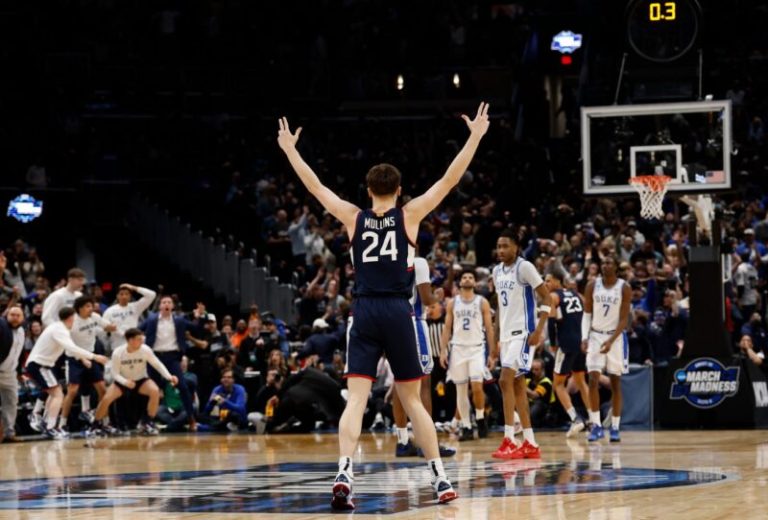
HOUSTON —  Three minutes into Iowa’s Sweet 16 game against Nebraska on Thursday night, a casualty occurred on the Hawkeyes’ sideline.

Iowa coach Ben McCollum, already red-cheeked and furious at his team’s passive start in a game they trailed by 10 points, snapped a dry erase marker into two pieces in the timeout huddle. Ink went everywhere.

“We called them into the huddle and just said very nicely, ‘I’d like you to play harder, guys,’ and that seemed to work,” McCollum quipped, before looking to his left where Hawkeyes guards Tate Sage and Bennett Stirtz sat trying and failing to contain their smiles.

“Am I right? That how that went?” McCollum asked his players.

“Yes,” Sage and Stirtz replied, nodding dutifully.

McCollum’s fiery disposition and ability to extract winning performances from his players have made Iowa’s first-year coach a fast-rising star in his profession. He was coaching in Division II two seasons ago, and on Thursday at Toyota Center helped the Hawkeyes author a thrilling comeback and advance to the Elite Eight for the first time since 1987.

Iowa trailed Nebraska nearly the entire game until Stirtz, the senior guard who followed McCollum from Division II Northwest Missouri State to Drake and then to Iowa, drained a go-ahead 3-pointer with 2:10 remaining.

“Hasn’t changed one bit,” Stirtz said of McCollum. “He’s been the same coach despite all the national attention and that’s why I respect him so much.”

On Saturday in the Elite Eight, Iowa will play an Illinois team coached by Brad Underwood, who started his career coaching at the junior college level.

The last time Iowa was in the Elite Eight, McCollum was a 6-year-old Hawkeyes fan living in Iowa City. He grew up attending Hawkeyes football and basketball games, but his own playing career began in junior college at North Iowa Area Community College. After two seasons, he transferred to play at Northwest Missouri State, where he began his coaching career. In 15 seasons coaching at his alma mater, McCollum won 83% of his games and led the Bearcats to four NCAA Division II national championships.

After McCollum’s one season at mid-major Drake, where he guided the Bulldogs to a program-record 31 wins, Iowa snatched him up. By comparison, coaching at Iowa feels “bougie,” as McCollum put it earlier this week.

“You gain confidence from being in Division II, because you don’t have noise,” McCollum said. “You’re making decisions, winning games and losing games, and there’s not a lot of noise there. And then also with that, when I get on a charter plane now, I certainly appreciate it, or when all these things are done for me, I appreciate it a little bit more, and that comes from that Division II and junior college background.”

McCollum doesn’t tolerate complacency, and he expects his players to behave the same way.

“I don’t like entitled players,” he said. “They just don’t work for me.”

Hawkeyes players are conditioned to expect the same pregame meal (chicken, pork chops, rice and a vegetable) and multiple fiery outbursts from their head coach during the game. Iowa’s student managers know that no inanimate object is safe in McCollum’s hands when he’s upset. McCollum plays bad cop and lets his assistant coaches play good cops.

McCollum relishes playing in front of opposing fans in a hostile road environment, and Thursday’s Sweet 16 matchup in Houston felt like one. Before tip-off, chants of “Go Big Red!” overwhelmed the arena. A clarinet player in Nebraska’s band held up an iPad displaying a graphic that derided Iowa as “off-brand corn.”

What did McCollum actually tell the Hawkeyes in the huddle when he broke his marker?

“He was just telling us we sucked, and we were soft,” Stirtz revealed.

Stirtz has been by his coach’s side through it all, recruited by McCollum to play at Northwest Missouri State when he had no other college offers. The two of them have a fire-and-ice dynamic; whereas McCollum lets his emotions boil over, Stirtz stays cool and collected on the court.

“I think we’re opposites in a lot of ways, but the main thing that we have (in common) is how competitive we are,” Stirtz said. “That’s what brings us so close. We just want to win. Honestly, we also both think it’s more than just a basketball game, too. So that’s why we’re so close: This game’s never going to satisfy us, and we know that.”

Iowa is only the fifth No. 9 seed to advance to the Elite Eight since the tournament field expanded to 64 teams in 1985. Florida Atlantic was the last to do it in 2023, when the Owls made it to the Final Four.

The Hawkeyes went 10-1 in nonconference play this season but fell out of the Top 25 rankings in mid-January after three consecutive Big Ten Conference losses – including two to ranked Illinois and Purdue teams. But the season was an exercise in stacking habits and building consistency, all leading to where they are now.

McCollum is a big fan of the saying, “Everybody arrives when they’re supposed to,” and Iowa’s Sweet 16 victory exemplified that. Junior forward Alvaro Folgueiras, who made the game-winning basket for the Hawkeyes to take down No. 1 seed Florida in the second round, tied the score with five minutes left and scored five of Iowa’s final 12 points against Nebraska. Sage and redshirt freshman Cooper Koch made clutch 3-pointers down the stretch. Stirtz, a national awards candidate and the Hawkeyes’ leading scorer, never wavered.

Stirtz has played every minute of the NCAA Tournament for Iowa so far. Against Nebraska, he led the Hawkeyes with 20 points on 7-of-15 shooting.

“In 20 years it will be an insane story,” McCollum said. “A guy that goes from D-II with his coach and then goes to Drake and then goes to University of Iowa and actually makes it further in the tournament in Division I than he did in Division II. Yeah, I mean, obviously there’s a close relationship there.”

It’s an insane story right now, but McCollum and the Hawkeyes won’t be ready to fully reflect until its conclusion.

“I’s been a hell of a ride,” McCollum said, “but it’s far from over.”

  • The NBA is discussing three new concepts to reform the draft lottery and discourage teams from “tanking.”
  • Commissioner Adam Silver has vowed to fix the tanking issue, stating changes will be made before next season.
  • The proposed concepts involve expanding lottery eligibility to include play-in teams and potentially even first-round playoff losers.

At the NBA Board of Governors session earlier this week, the league presented three NBA Draft lottery reform concepts to ownership in an ongoing attempt to combat tanking.

A person with direct knowledge of the matter told USA TODAY Sports that the session was akin to a brainstorm and that the concepts discussed were not considered formal proposals that would be presented to the Board of Governors for voting — at least not yet. Before it gets to that stage, the NBA’s executives want to hear more feedback from team front office personnel prior to elevating any concept as a formal proposal.

The person also said that the concepts could be tweaked further, or that new concepts could be raised in the future. To that effect, the March 25 discussion with NBA ownership was not the first meeting the group has had on these issues. In essence: the league’s efforts against tanking are fluid and evolving.

The person spoke under the condition of anonymity because the person was not authorized to publicly discuss the matter.

During a March 25 press conference at the end of the Board of Governors meeting, NBA Commissioner Adam Silver characterized discussions with NBA owners about tanking as “lengthy” and vowed that the league is taking the matter seriously.

“We are going to fix it, full stop,” Silver told reporters in the press conference. “I want to say that directly to our fans.”

Given that the 2025-26 NBA season is nearly complete, the NBA does not necessarily need to rush this process, because any potential changes would not impact the bottom of the standings this year. Still, the league is prioritizing the anti-tanking effort and wants to enact changes sooner rather than later.

The NBA will convene a special session of the Board of Governors to vote on any formalized proposals for the 2026-27 season.

“This meeting was not about pointing fingers at any team in particular,” Silver said. “Again, I understand where the incentives are. We understand why it results in certain behavior. I will say it seemed unanimous in the room that we needed to make a change and we needed to make a change for next season. Exactly what that change is, we’re continuing to work on. No votes were taken today.

“I think there’s also unanimous agreement that we need to make this change in advance of the draft and free agency this year so all the teams understand the rules of the road going into next year.”

Here’s a look at the concepts presented:

Concept No. 1: Expand NBA draft lottery eligibility to play-in teams

In this scenario, 18 teams would qualify for the lottery. The 10 teams with the worst records would have the same chance, 8%, to win the lottery. The eight teams that qualify for the Play-In Tournament would then divvy up the remaining 20% of odds, in descending order, from Nos. 11-18.

Concept No. 2: WNBA-style weighted lottery

This concept blends some facets of the way the WNBA operates its lottery. In this scenario, 22 teams would be lottery-eligible. This would include the same 18 teams as the scenario above, while adding the four teams that lose their first-round playoff series.

Then, similar to the way the WNBA ranks teams for its lottery, the NBA would weight teams by their combined records over the most recent two seasons.

Concept No. 3: 18-team lottery most similar to current system

This concept is closest to the way the lottery is set up right now, with some tweaks.

In this version, 18 teams would qualify for the lottery: the teams with the 10 worst records, plus the eight play-in teams. This concept would give the teams with the five worst records — as opposed to the teams with the three worst records in the current setup — the same odds to win the lottery.

Then, odds would go in descending order for the teams ranked sixth through 18th.

Similar to the current lottery system, this concept would have some protections in place to prevent for statistical aberrations: the lowest fall one of the five worst teams could have would be the No. 10 pick.

How does the NBA come up with anti-tanking concepts?

It starts with ongoing discussions and ideas. These can come from team operations or from people within the league office, but the NBA is trying to curate options that appear to have the most traction in a comprehensive list.

The effort to curate and distill these ideas into concepts is being led by NBA executive vice president of basketball strategy and analytics Evan Wasch, NBA president of league operations Byron Spruell and executive vice president, head of basketball operations James Jones. Those three are in constant contact with the NBA’s competition committee so that when the concepts are presented to NBA owners, they’re listed clearly and concisely.

Would any change be permanent?

Almost certainly not. During his press conference, Silver said he believed the league’s previous efforts to combat tanking with lottery reform had worked, but he acknowledged that changes in collective bargaining and changes in analytics and behavior rendered the previous reforms obsolete.

“The world changes, behavior changes,” Silver said. “I don’t necessarily think the changes we made over the last 40 years or so were necessarily wrong. I think in some cases they worked for a period of time. Math is math. When we make those changes and change odds, you know exactly statistically where you’re going to come out.

“What’s changed is behavior around those odds. It may be as the value of franchises has gone up, as the analytics have gotten more sophisticated, as pressure has come from fan bases to engage in behavior that even team ownership or GMs are not proud of, that’s where we find ourselves.”

He also cautioned against the framing of any upcoming lottery reform as a “forever fix” and vowed that the league would continually look at potential changes to the lottery as league economics and league dynamics changed.

“If I’m the one standing at the podium (in five years), I want to make it clear that I recognize things may change also because there also may be changes that we see through collective bargaining or other changes to the system that may impact what we’re doing now,” Silver said. “Certainly going into next season, the incentives will be completely different than they are now.”

Amber Glenn and Isabeau Levito wanted a shot at a world championship medal after missing out at the 2026 Winter Olympics, but the American stars fell just short.

In podium contention at the 2026 world figure skating championships in Prague, Glenn and Levito had errors in their free skate on Friday, March 27, that proved to be too costly, resulting in a fourth place finish for Levito and sixth for Glenn. Fellow U.S. skater Sarah Everhardt ended in 11th.

Decorated Japan skater Kaori Sakamoto, the silver medalist in Milano Cortina, claimed gold, capping off her stellar career with her fourth first-place finish in the past five years after the three-peat from 2022-24. Fellow Japanese skater Mone Chiba took silver and Nina Pinzarrone of Belgium won bronze.

Both Glenn and Levito did well in their short programs, entering the night in third and fourth place, respectively. While Levito has a previous medal at worlds − a silver in 2024 − Glenn was going for her first one at the event, finishing in fifth last year.

Levito went first and had an under-rotated jump early in her program that resulted in a score of 134.83.

Glenn followed, skating a program that was strong in the Olympics and, if replicated, would have assured her a medal. She started strong with a picture perfect triple Axel.

But then the mistakes happened. The triple salchow was under rotated, and a triple loop, which devastated her short program in Milano Cortina, was decisive again when she was unable to complete the jump. Glenn sat on the ice when she was done skating, clearly upset at the mistakes.

Glenn earned a score of 130.47 for the free skate, keeping her off the podium before Sakamoto and Chiba went on the ice. Levito had a chance to medal if Sakamoto and Chiba struggled, but the Japanese skaters looked exceptional on the ice, leaving no doubt of their victories.

Both American athletes were competing roughly a month after the Olympics ended, coming to Prague after battling illnesses as well. The competition notably didn’t have Olympic champion Alysa Liu, who withdrew from worlds as she has been wrapped up in several career opportunities since becoming the breakout star of the Winter Olympics.

The title is the perfect ending for Sakamoto, with this season being the final one of her career. She hoped to add Olympic gold to her resume in February but took silver. She ends her run with four world titles, a Grand Prix Final champion and as a five-time Japanese champion.

One reason Elliot Cadeau was drawn to Michigan as a transfer last spring was the size of the Wolverines’ starting front line, with 7-3 center Aday Mara flanked by 6-9 forwards Morez Johnson Jr. and Yaxel Lendeborg.

Being surrounded by this length and athleticism has given the more diminutive former North Carolina point guard room to dip and duck his way through coach Dusty May’s read-and-react system, where spacing and ball movement are mandatory and players are “encouraged to pass up good shots for great ones,” according to the program’s definition.

“I would say that he does an amazing job dissecting the offense,” said Michigan guard Nimari Burnett. “He makes it so much easier for us all around the court that played with him, just getting us easy shots. I’m just joyful to play with him every single game.”

Along with Mara and Lendeborg — from UCLA and Alabama-Birmingham, respectively — Cadeau has helped transform the No. 1 Wolverines into one of the best teams in the nation and the favorite to advance out of the Midwest Region for the ninth Final Four appearance in program history.

“Elliott runs the show,” Johnson said.

There have been a few hiccups along the way to Friday’s matchup in Chicago against No. 4 Alabama, including a dud in Michigan’s nonconference loss to Duke in February and a run of poor shooting performances late in Big Ten play.

But Cadeau has rebounded to play some of his best basketball in the past few weeks, including a stretch of 26 assists against just five turnovers in his past three games. That he’s done so while dealing with medical issues has made Cadeau one of Michigan’s unquestioned leaders both on the court and off.

“I think he’s really relatable in terms of where he’s from, what he’s been through,” guard Roddy Gayle Jr. said. “He’s always a guy that you can rely on. I feel like most point guards have that trait, but really, he has been someone where if someone isn’t going right, I’m able to lean on him.”

Hearing, vision issues haven’t stopped Elliot Cadeau

That Cadeau has remained unflappable amid his high-profile transfer from Chapel Hill and the stress of running the show for the Wolverines shouldn’t come as a surprise.

As a child growing up in New Jersey, Cadeau was diagnosed as partially deaf in his right ear. He’s had to manage asthma. As a freshman with the Tar Heels, he needed to have surgery to treat a progressive eye disorder called keratoconus, which thins the cornea and can often cause blurred vision and a sensitivity to bright lights and glare.

None of these conditions would seem to be conducive to playing point guard for a team with national championship goals, let alone playing basketball, period.

Yet these same issues have helped define Cadeau, shaping the way he approaches his role as the Wolverines’ facilitator.

“It kind of just made me feel like I just can’t make excuses,” he said after Michigan’s win against No. 9 Saint Louis in the second round.

“I have really close friends when I was growing up who are all at the highest level of the NBA, high-major basketball players, and I wanted to be just as good as them. I was trying to be better than them.

“Even though they didn’t have the same issues as me, I couldn’t just make excuses about it and not be as good as them.”

Handling this adversity helped Cadeau weather a tumultuous two-year run at North Carolina, where he often became the poster child for the Tar Heels’ unrealized expectations after ranking near the bottom of the ACC in turnovers and fouls as a sophomore.

“That’s just kind of a testament to who he is,” said Gayle. “Because of everything that he’s been through, he’s able to kind of separate himself from everything that’s going on and be able to give you advice.”

And despite the challenges he’s faced to reach Friday night, Cadeau insists he’s never been slowed down by the conditions that could have easily derailed a promising career.

“There are no adjustments made,” he said. “Me not being able to hear fully didn’t really make any difference on the court, because you don’t really need hearing unless you’re listening to a play call or you’re listening to your teammates. I feel like basketball-wise, it doesn’t affect me.”

Cadeau a ‘savant’ at the controls of Michigan’s offense

Cadeau’s game has blossomed as the showrunner for one of the top offenses in college basketball. The Wolverines enter the matchup against Alabama ranked ninth nationally in scoring, fourth in field-goal percentage and fifth in assists per game.

The junior is averaging a career-best 10.1 points per game with 57 makes from 3-point range, nearly doubling his total from his final season at North Carolina. Cadeau has 28 fewer turnovers in one fewer game compared to last year while posting 5.7 assists per game, good for fourth in the Big Ten.

Cadeau has been the perfect fit for a system that needs a happy-to-share distributor, especially as Michigan looks to quickly turn defensive stops into transition.

“He’s a savant with what he’s doing,” May said. “He probably doesn’t even realize a lot of the things he’s doing because he’s so intelligent. He’s able to get us into close-out opportunities without really having to run any offense. His ability to read the floor, read the game, manipulate defenses, is incredibly impressive.”

His arrival in Ann Arbor has sparked a clear increase in confidence. Cadeau has been much more willing to chase his own shot, especially given the attention paid to Michigan’s imposing frontcourt. He made three from long range against Saint Louis, helping the Wolverines take control in the first half and cruise to the 95-72 win.

Adding another outside shooter to Burnett and fellow guard Trey McKenney has made the offense even more dangerous, teammates said.

“The difference between him and last year, he was more pass-first,” Lendeborg said. “He’s still pass-first now, but he’s become way more of a scoring threat. You can’t guard him anyway. So having to compete with him and trying to stop him when you think he’s going to pass, it’s good night pretty much honestly.”

Said Gayle, “It wasn’t the fact that he couldn’t, he’s just more confident in doing so. And he works really hard for it.”

This same level of dedication — one needed to fight through his medical conditions and to become a more complete and well-rounded player on both ends — has built Cadeau into an elite college point guard, and in turn made the Wolverines into a team capable of winning the second national championship in program history.

“He’s what we want in a point guard,” May said. “He’s a guy that makes everyone on the team better.”

  • The author argues that college sports are a public trust, not privately owned by schools or conferences.
  • The author calls on Congress to pass legislation to stabilize the system for the benefit of all schools and athletes.
  • Proposed solutions aim to preserve college sports by allowing for collective media rights and new revenue streams.

Cody Campbell is Chairman of the Board of the Texas Tech University Board of Regents and Founder of Saving College Sports, a non-profit organization formed to preserve the institution of intercollegiate athletics.

Until recently, the question of who owns intercollegiate athletics has never been a question our country had to ask. Today, however, largely due to a unanimous U.S. Supreme Court Decision, Congress must step in and decide who controls — and who benefits — from the various untethered parts, pieces, and whole of intercollegiate athletics.

Regulatory anarchy, and athletic departments facing financial insolvency, and a flagrant power grab by the most powerful names and entities in college sports have been well documented by alarming headlines. 

College sports are a unique and undeniable cornerstone of American culture. They’ve provided access to higher education for more kids than any program other than the G.I. Bill. This access demonstrably molds today’s athletes into the leaders of tomorrow with 60%+ of American CEOs having a college sports background. The lessons that are forged on the playing field create a stronger country with stronger leaders.

America’s unparalleled leadership development program of collegiate athletics is now in a heap of a mess. 

Let’s look at the history: From the land-grant colleges of the Morrill Act (1862) to the taxpayer-supported stadiums, scholarships, and tax-exempt status, college sports has never been the private fiefdom of any school, conference or cartel. In truth, public money — direct and indirect — has underwritten athletic facilities, coaching salaries, medical care, and the very education that makes them “student” athletes.  Even the most elite private programs ride on the coattails of federal student aid, charitable deductions, public infrastructure and media regulation that make Saturday afternoons possible. College sports are a Public Trust, built by the American people, largely owned by public institutions, and carried on the backs of taxpayers because we collectively believe in the greater good.  College sports certainly don’t exclusively belong to the Power conferences. Despite posturing that implies ownership, these entities don’t own a damn thing.

Each school, conference, media giant and special interest are now in a feeding frenzy to grant a larger piece of the pie — they all want legislation that gives them more money, more TV time and more prominence — almost always at the expense of smaller college athletics programs, programs that provide the same benefits to our country. They realign conferences to stretch illogically across an entire continent, knowing that it will severely injure individual institutions and communities as expenses skyrocket and age-old rivalries die. They negotiate media deals to crowd out small schools and monopolize revenue. They cause non-revenue sports (women’s and Olympic sports) to be cut, fees to be charged to students, and tuition to be raised.  Cutthroat business tactics may make sense in a corporate boardroom, but they are pushing college sports into something more fragile and much less beneficial to our country.

University and conference leaders rightfully explain that they have no choice but to follow the money, purely out of financial self-preservation. But the outcome of those decisions — taken collectively — creates what is approaching a financial monopoly and threatens the vast majority of college athletic departments and athletes.   

The Constitution’s Preamble is not merely ornamental: “We the People … promote the general Welfare” is its sovereign and sacred charge. Government’s solemn duty is not to just stand by and let the strongest programs crush the weaker ones. Its duty is not to allow the rules to be written by institutions and organizations who can afford to hire the most expensive lobbyists. Government’s responsibility is to stabilize the system, de-fang the misplaced sense of ownership and entitlement, and maximize the commercial value of this asset that “We the People” collectively own — so that every school, every sport, every athlete, and every community that has invested its heart and treasure may continue to thrive.

To this end, President Trump’s 2025 Executive Order, the bipartisan legislation recently released by Democratic Senator Cantwell and Republican Senator Schmitt, and the proposals brought forward by the independent organization, Saving College Sports, are aimed at preservation of the entire system and the immeasurable benefits that it provides us all. Recent momentum behind these proposals demonstrates rare bipartisan willingness to work together to save one of the few remaining institutions that unites people of all political persuasions.  

Measures must be taken to make the system permanently financially stable. Many of these measures are included in the above-mentioned legislative proposals and can provide the colleges long-term optionality to collectively pool media rights, and grant freedom to generate revenue through myriad additional avenues that make common business sense.

Bottom line is this: Simply do what is right for the entire country — all schools, all sports, both big and small. This can all be accomplished while honoring existing media contracts, but through ensuring that future arrangements serve the public trust, not just a privileged few. 

It is incumbent on Congress to promote the general welfare, to work for the common good, and preserve college sports for our children and grandchildren. The American people built it. The American people own it. Now, the American people and our elected representatives must protect it.

U.S. stocks and bonds sold off Thursday and oil continued its weekslong upward trajectory, as optimism faded about possible peace talks or a U.S.-Iran ceasefire.

The price of U.S. crude oil rose near $95 per barrel, up more than 4%. International Brent crude rose 5%, to more than $109 per barrel. Since the war started, the cost of U.S. crude oil is up more than 40%. Since the start of the year, it has risen more than 60%.

The S&P 500 closed down by 1.7%, the Dow tumbled 470 points and the Russell 2000 ended the day down 1.7%. For the S&P 500, Thursday was its worst single day since the war began.

The Nasdaq Composite fared the worst though, and dropped nearly 2.4%, pushing the index into correction territory. A correction is when an index falls 10% or more from its most recent all-time high. As of Thursday’s close, the index is now down 10.9% from its October high.

Heating oil, a proxy for jet fuel prices, also spiked 8% on Thursday afternoon. The nationwide average price of unleaded gas was $3.98 a gallon.

Nonetheless, Trump downplayed the severity of the oil and gas price spikes.

Energy prices “have not gone up as much as I thought,” Trump said at a Cabinet meeting in Washington.

The military campaign is “not over, so maybe it’ll go up a little bit more,” Trump said. “It’s all going to come back down to where it was and probably lower.”

Trump also cast doubt on a deal with Iran. “They are begging to work out a deal,” he said. “I don’t know if we’ll be able to do that. I don’t know if we’re willing to do that.”

But analysts widely believe that oil prices will continue to remain elevated over the long run, factoring in the risk that shippers will now have to assume for oil tankers that transit through the Strait of Hormuz.

Also impacting market sentiment was a report from the Organisation for Economic Co-operation and Development, which predicted that as a result of the war with Iran, the average inflation rate for G20 countries this year would rise to 4%, up from its December prediction of 2.8%. The United States is a member of the OECD.

Bonds also sold off, driving yields higher. The 10-year U.S. Treasury bond yield rose to 4.42%. The yield on 20-year bond hit 4.97% and the 30-year yield hit 4.93%.

Treasury yields, especially for the 10-year bond, heavily influence consumer lending rates. As a result, mortgage rates have risen from around 6% at the start of the war on Feb. 28 to more than 6.5% as of Thursday afternoon.

Stock indexes in Asia had already begun to sell off overnight. China’s Shanghai index and Hong Kong’s Hang Seng index both fell 1%, while Korea’s Kospi slid 3.2%.

These indexes were also weighed down by big drops in shares of tech companies, including Samsung, after Google revealed a new, more efficient use of storage and memory systems for artificial intelligence.

The Stoxx 600 in Europe followed, closing down more than 1%. Flagship stock indexes in Germany, France and the U.K. also ended the trading session down by around 1%.

LOS ANGELES — A jury found Meta and YouTube negligent in the design or operation of their social media platforms, producing a bellwether verdict in the first lawsuit to take tech giants to trial for social media addiction.

The Los Angeles County Superior Court jury said that Meta’s and YouTube’s negligence were a substantial factor in causing harm to the plaintiff, identified in court by her initials, K.G.M., and that the companies failed to adequately warn users of the dangers of Instagram (Meta’s platform) and YouTube (which is owned by Google).

It awarded K.G.M. $3 million in compensatory damages, finding Meta 70% responsible for harm caused to the now 20-year-old plaintiff, and YouTube responsible for 30%.

The trial, which began last month in a Los Angeles County courtroom and included testimony from Mark Zuckerberg and other tech executives, was the first in a consolidated group of cases brought against Meta and other companies by more than 1,600 plaintiffs, including over 350 families and over 250 school districts.

Outside the courtroom, families who say their children were harmed by social media embraced as they celebrated the verdict, telling reporters they feel “vindicated.”

Spokespeople for Meta and Google said the companies disagree with the verdict and plan to appeal.

“Teen mental health is profoundly complex and cannot be linked to a single app,” a Meta spokesperson said. “We will continue to defend ourselves vigorously as every case is different, and we remain confident in our record of protecting teens online.”

José Castañeda, a spokesperson for Google, also said the case “misunderstands YouTube, which is a responsibly built streaming platform, not a social media site.”

In a joint statement, co-lead counsel for K.G.M. said the verdict is “a historic moment” for thousands of children and their families.

“But this verdict is bigger than one case,” the lawyers said. “For years, social media companies have profited from targeting children while concealing their addictive and dangerous design features. Today’s verdict is a referendum — from a jury, to an entire industry — that accountability has arrived.”

The jury decided on $2.1 million in punitive damages for Meta and $900,000 for YouTube, totaling $3 million. It’s a small fraction of the $1 billion in punitive damages the plaintiff’s counsel sought.

Plaintiff K.G.M., center, arrives at Los Angeles County Superior Court on Feb. 26.Mario Tama / Getty Images file

K.G.M.’s lead attorney, Mark Lanier, has said he hopes the proceedings produce transparency and accountability “so that the public can see that these companies have been orchestrating an addiction crisis in our country and, actually, the world.”

The plaintiff was a minor at the time of the incidents outlined in her lawsuit. K.G.M. testified in court that her nearly nonstop use of social media caused or contributed to depression, anxiety and body dysmorphia. It “really affected my self-worth,” she said last month.

Speaking about her social media use, K.G.M. testified that she felt she wanted to constantly be on the platforms and feared missing out if she wasn’t.

Attorneys for Meta and YouTube have disputed claims brought by the plaintiff, arguing their platforms aren’t purposefully harmful and addictive.

A spokesperson for Meta said K.G.M.’s “profound challenges” weren’t caused by social media and pointed to “significant emotional and physical abuse” that she experienced when she was younger.

In his closing argument, an attorney for YouTube said there wasn’t a single mention of addiction to that platform in K.G.M.’s medical records.

The verdict comes after jurors in a separate trial in New Mexico held Meta liable for failing to protect children from online predators and sexual exploitation on Facebook and Instagram.

The New Mexico jury found Tuesday that Meta violated the state’s consumer protection laws and ordered it to pay $375 million in civil penalties. Meta has said it disagrees with the verdict and plans to appeal.

In Los Angeles, deliberations took longer, wrapping up after nearly 44 hours over nine days. The jurors had told Judge Carolyn B. Kuhl that they were having trouble coming to a consensus on one defendant.

Social media companies have historically been shielded by Section 230, a provision added to the Communications Act of 1934 that says internet companies aren’t liable for the content users post.

Meta CEO Mark Zuckerberg leaves Los Angeles County Superior Court on Feb. 18. Kyle Grillot / Bloomberg via Getty Images file

K.G.M.’s lawsuit was the first civil action seeking to hold the platforms accountable for allegedly causing addiction and mental health problems.

TikTok and Snap, who were also named as defendants in K.G.M.’s lawsuit, reached settlements before the trial. They remain defendants in a series of similar lawsuits expected to go to trial this year.

Matt Bergman, founding attorney of the Social Media Victims Law Center — which is representing hundreds of plaintiffs in state and federal proceedings — said the jury’s decision Wednesday “establishes a framework for how similar cases across the country will be evaluated and demonstrates that juries are willing to hold technology companies accountable when the evidence shows foreseeable harm.”

“Families pursuing justice in other jurisdictions can now point to this outcome as proof that these claims deserve to be heard and taken seriously,” Bergman said in a statement.

Lanier told NBC News in an interview that this was the most difficult case he’s tried in his 42 years as a lawyer.

“I think the jury understood that they were the very first case in the history of our country to look at social media addiction, and they wanted to leave no question, but that they seriously considered the evidence,” Lanier said. “So they took forever, then they looked carefully at each of the questions and answered everyone was, yes, guilty.”

California Attorney General Rob Bonta also weighed in on the Los Angeles and New Mexico verdicts, writing in an X statement that California “looks forward to holding Meta accountable in our own upcoming August trial in the Bay Area.”

“TODAY” co-anchor Savannah Guthrie will return to the NBC morning show on April 6, as investigators continue to search for her 84-year-old mother in Arizona.

In her first interview since Nancy Guthrie went missing in February, Savannah Guthrie told Hoda Kotb she believes returning to “TODAY” is “part of my purpose right now” — even if it’s hard to imagine coming back to a workplace “of joy and lightness.”

“I can’t come back and try to be something that I’m not. But I can’t not come back because it’s my family,” Guthrie said in the interview about returning to work. “I don’t know if I can do it. I don’t know if I’ll belong anymore, but I would like to try. I would like to try.”

“I’m not gonna be the same. But maybe it’s like that old poem, ‘More beautiful in the broken places,’” she added.

Tune into “Savannah Speaks: A Dateline Special” at 9 p.m. EST on NBC.

Kotb revealed Guthrie’s return Friday on “TODAY.” Her co-host, Craig Melvin, added that the team “can’t wait to welcome her back with open arms.”

“It’s where she belongs. It’s where we all want her to be,” Melvin said.

A spokesperson for “TODAY” did not have additional comment.

Nancy Guthrie was reported missing Feb. 1 after she did not show up at a friend’s house for virtual church services, authorities said. She was last seen the previous night around 9:45 p.m. after having dinner at her daughter Annie Guthrie’s home.

Authorities have described the case as a possible kidnapping or abduction, but clues have been scarce. The Pima County Sheriff’s Office has not publicly specified a motive.

Guthrie told Kotb that her religious faith is “how I will stay connected to my mom.” She alluded to her mother’s experience with loss after her husband, Charles Guthrie, died at the age of 49 in 1988.

“I saw her belief. I saw her faith. She taught me, she taught all of us,” said Guthrie, who was 16 at the time of her father’s death. “I may not do it as well as her, but I will do it. I will do it for my kids. I will. I will not fall apart. I will not let whoever did this take my children’s mother from them.”

Guthrie repeated her pleas for information about her mother’s possible abduction, saying in part: “We need someone to tell the truth. I have no anger in my heart. I have hope in my heart. I have love. But this family needs peace.”

“We need an answer, and someone has it in their power to help,” she added.

Guthrie also opened up about her visit earlier this month to the New York City set of the “TODAY” show, describing her NBC colleagues as her “greater family.”

“I really wanted to come and see everybody. I just love this beautiful place that we call home, where we get to come and be every day,” she said, adding, “When times are hard, you want to be with your family.”

U.S. stocks rose Wednesday and global oil prices fell in yet another volatile trading session as traders and investors were buffeted by constant headlines about the war in Iran.

News of a 15-point U.S. peace plan proposal sparked hopes early in the day that the Trump administration was moving to end its monthlong war against Iran. Initially, the S&P 500 and the Nasdaq 100 futures rose more than 1%.

But reports that Iran had responded negatively to the proposal briefly knocked index futures off their pre-market highs and lifted oil prices off their morning lows.

Despite the early setback, stocks closed the trading day higher. At 4 p.m. ET, the S&P 500 index was up about 0.4%, the Nasdaq Composite closed 0.7% higher, and the Dow jumped 305 points. The Russell 2000 index of smaller companies rose 1.1%.

The price of U.S. crude oil also traded off its lowest levels of the day and was down only 1.4% to about $90 per barrel by late afternoon. West Texas Intermediate crude oil has soared more than 30% since the start of the war on Feb. 28. The cost per barrel is up 50% since the beginning of the year.

International Brent crude prices traded near breakeven, at around $102 per barrel. The price of heating oil, a proxy for jet fuel, dropped 6%.

The global price of oil directly affects what Americans pay at the gas pump and what it costs them to heat and cool their homes. The average nationwide price of unleaded gas Wednesday was $3.98 per gallon, according to AAA data.

“Markets desperately want to believe in the positive,” UBS Global Wealth Management chief economist Paul Donovan wrote. “Focus on the apparent 15-point US plan to end the war has received more attention than Iranian dismissals of this, or the fact that passage through the Strait of Hormuz is minimal.”

Iran’s response to the U.S. proposal included a list of five conditions for ending the war, according to Iranian state TV, which cited a senior political-security official with knowledge of the details of the proposal.

Pakistan has also offered to mediate talks to end the hostilities, four sources told NBC News. A Persian Gulf official said Pakistan had been passing messages between the two countries for the past two days.

An in-person meeting between the U.S. and Iran could be held in the coming days, two sources added.

But President Donald Trump has continued to give conflicting signals.

On March 16, Trump said he was delaying his scheduled visit to China “by a month or so” to monitor the war. On Monday, he said the Strait of Hormuz would be “open very soon.”

And on Tuesday, Trump told reporters in the Oval Office, “This war has been won.” At the same time, the U.S. is sending more than 1,000 additional troops to the Middle East, sources said.

A motorist drives past a sign displaying prices at a gas station in Oakland, Calif., on Tuesday.Godofredo A. Vásquez / AP

Since the war started, the market has experienced several days like this, when markets are whipsawed by constant back-and-forth comments.

“There’s really no way to know at this point what the facts are regarding the state of negotiations, as neither side has any real incentive to conduct talks via the press, so expect more whipsaw action as things continue to progress,” analysts at Bespoke Investment Group wrote in a client note.

They added that the “ongoing tensions continue to support higher prices [and] stoke inflation concerns” and are likely to cause central banks to remain on hold, rather than cut rates.

On the contrary, traders believe the European Central Bank and the Bank of England will both raise interest rates.

“Uncertainty remains high,” analysts at ING wrote in a note Wednesday morning. “Overall, volatility remains elevated and a geopolitical risk premium persists.”

In the 18 trading sessions since the war began, U.S. oil prices have closed down only five times. Likewise, over the same period, the S&P 500 has closed higher only seven times. Three of those higher closes were only fractional.

After Wednesday’s close, the Nasdaq was down nearly 6% for the year, while the S&P 500 was on track for a 3.5% loss so far. The majority of those losses were concentrated in the weeks since the war began.

Meanwhile, the Strait of Hormuz, through which 20% of the world’s oil supply typically passes, has remained at a near standstill since the war began.

On Monday, just five ships passed through the strait, according to data compiled by S&P Global Market Intelligence. On Tuesday, the total was six. On many days since the war started, not a single ship has passed through.

However, some of the ships passing through the strait have taken an unusual course that put them close to the Iranian coastline, potentially signaling that Tehran was keeping a tight grip on traffic flows. Two Indian ships were granted passage Tuesday after a deal with Iran, Bloomberg News reported. The Iranian navy also guided the ships.

Otherwise, hundreds of other ships loaded up with cargo, oil and liquefied natural gas remain stuck.

  • Texas coach Vic Schaefer is chasing his first national championship after leading two different programs to the Final Four.
  • Schaefer’s defensive adjustments, prompted by a past loss to Oregon, helped Texas dominate the Ducks in the second round of the NCAA Tournament.
  • Schaefer has guided Texas to its fifth Sweet 16 appearance in his sixth season with the program.

AUSTIN, TX —  Vic Schaefer was worried. So two hours before his Texas team was set to tip off its second-round NCAA Tournament game against Oregon on March 22, he pulled the Longhorns into the practice gym and ran through a new defensive strategy.

“My Bible study today was run toward things that you’re worried about or you’re concerned about. And I was concerned about pick-and-roll defense today,” Schaefer said. “But I thought we ran to it today.”

Texas crushed Oregon, 100-58. The Longhorns snatched 13 steals and scored 23 points off turnovers. After the Ducks shot 9-of-11 from the field in the first quarter, the Longhorns held them to a combined 12 field goals on 30% shooting over the next three quarters.  

The reason Schaefer was so concerned about pick-and-roll defense, he later told USA TODAY, was because of a 2019 game against the Ducks when he was the head coach at Mississippi State.

Schaefer’s Bulldogs were coming off consecutive national runner-up finishes in 2017 and 2018 and seemed primed to return to the championship game in 2019 when they earned a No. 1 seed in NCAA Tournament. But Mississippi State lost by four points in an Elite Eight game, played in Portland, to second-seeded Oregon and point guard Sabrina Ionescu.

“That was my best team,” Schaefer said. “That team was better than the two previous teams that played in the national championship game. If we’d have beat them, we’d have won the national championship, no question. But we got unlucky, we got sent to Oregon, we had to play in front of 13,000 Ducks and we got beat 88-84 because we couldn’t guard the pick-and-roll. Ionescu crushed me with pick-and-roll.”

Schaefer chasing elusive national title with fifth Sweet 16 with Longhorns

Schaefer frequently talks about coaching against “ghosts,” referring to hypothetical situations that could incapacitate his teams. But the past is also a stubborn poltergeist with disturbances that can be harder to shake.

In his sixth season at Texas, Schaefer is a semifinalist for Naismith Coach of the Year after he guided the Longhorns to the Southeastern Conference Tournament championship title in their debut season in the conference and a No. 1 seed in the NCAA Tournament for the third straight season. Texas went to the Final Four in 2025 and on Sunday booked its ticket to the Sweet 16 for the fifth time under Schaefer.

At Texas and Mississippi State, Schaefer has a combined career record of 398-101. He is one of two active coaches to take two different programs to the Final Four, the other being Kim Mulkey (LSU and Baylor).

Through Schaefer’s illustrious 21-season career as a head coach, which also includes seven seasons at Sam Houston State, one accomplishment has eluded him: Winning a national championship.  

“You get evaluated more on this time of year as a coach than any other time during the season,” Schaefer said. “You can win the championship, the conference championship, the tournament championship, but this is the time of year when you got to earn your keep. With this team, how special they are, they’re good enough. I keep telling ’em, they’re good enough.”

Schaefer has the requisite experience to say that. He was an assistant on legendary coach Gary Blair’s Texas A&M staff when the Aggies won the national title in 2011. That’s where Schaefer learned many tricks of the trade that he still employs and are part of what makes him, him.

Consistency, evolution and ‘generational talent’ spur Texas basketball

Schaefer is a fan of consistency. When he finds something that works, he sticks with it. His teams all deploy the same suffocating style of pressure defense. His season-long practice plans rarely deviate year to year; practices in February 2026 look very similar to practices in February 2025 and February 2024, and so on.  

That doesn’t mean it’s all cut-and-paste, said Texas associate head coach Elena Lovato, who spent four seasons on Schaefer’s staff at Mississippi State.

“I think he’s evolved a lot as an offensive coach,” Lovato said. “At Mississippi State, we were primarily dribble drive. We’d have a few sets here and there to get us into some high-low stuff. I think here, we’ve really evolved and grown our playbook. And we have better players, you know, like we have five stars, so we’re utilizing their skill sets and I think (Schaefer) has done a really good job of making it really hard for people to guard us.”

Schaefer is also a fan of backup plans and being overprepared. He’ll install a secondary defense hours before a game, just in case. During games he keeps two play cards in his pocket; the smaller of the two has 50 different plays on it.

Many of the plays are for Texas junior sensation Madison Booker, whom Schaefer called a “generational talent” after she dropped 40 points on Oregon in the Longhorns’ second-round victory.

“I think Coach Schaefer has really just pushed me into taking just a bigger role, just being aggressive on the offensive end, finding my shot, hunting my shot,” Booker said after the game. “That’s all he says in practice is hunting my shot. I think my coach did a great job just drawing up plays and putting me in the right position just to score the ball easily.”

In her five seasons at Texas, senior point guard Rori Harmon has become increasingly convinced that she and Schaefer are cut from the same cloth. They’re so connected on the court that Lovato calls Harmon “a mini Vic.”

“I think when it comes to the game of basketball, it’s one of those things where you hate losing more than you love winning, and I think that’s what we share a lot,” Harmon said. “A lot of some phrases or words he would say while he recruited me or throughout my whole career here, it matches what I think when it comes to being competitive, being passionate, honoring the game, being disciplined, all that stuff. It truly does match me, and I think that’s why it works so well.”

Not just generational talent: generations of Schaefers fixed on a title

Harmon, Booker and their Longhorns teammates are well-versed in Schaefer’s history. Blair Schaefer, Vic’s daughter and former point guard on his 2014-2018 Mississippi State teams, is now a Texas assistant coach. Another Texas assistant coach, Sydney Carter, was a standout player for Schaefer at Texas A&M.

The Longhorns are used to watching clips of plays that Schaefer ran at his previous stops and hearing tales about his former teams – whatever he thinks can help them improve.

“I just feel like the lesson that we kind of got from his stories and his words were just basically like it’s one game at a time, that preparation is key right now,” Booker said. “That’s why our practices right now are very crucial to how we play in this tournament and how we play throughout really the whole season, and how crucial it is just for this moment because it’s basically like a win-or-go-home game. Just kind of be present where your feet are, don’t get too far ahead.”

Staying in the present is sometimes easier said than done.

Every team is different, Schaefer contends. And winning a national title takes luck, not just talent. But standing outside the Longhorns’ locker room after his team throttled Oregon and with another Sweet 16 on the horizon, Schaefer couldn’t help but think that this year could be the year.

With Sunday’s win, Texas improved its record to 33-3 in a season that began by inserting three new players into the starting lineup, two of them sophomores. Three players – Booker, sophomore guard Jordan Lee and senior center Kyla Oldacre – average double-figure scoring. The Longhorns’ center duo of Breya Cunningham and Oldacre dominate the interior, Booker is virtually unstoppable from anywhere on the court, and Harmon sets the tone on defense.

“This team, offensively, when they go out there and make shots, when you’ve got a difference-maker player like Madison Booker and they create their own shot, and then we’ve got the two-headed monster inside – they may not score a lot, but man they take up a lot of room down there,” Schaefer said. “It just makes for a really special team.”

Lovato has that same feeling.

“I won’t be surprised if it happens because I know how much work goes in behind the scenes from a player perspective, from a staff perspective, from Coach Schaefer losing sleep, sleeping in the office,” she said. “I think all of those things, we’d just kind of finally be rewarded for all the fruits of our labor.”

Texas’ lone women’s basketball national championship was in 1986. Forty years later, Schaefer is attempting to deliver a second. The Longhorns know how much a championship would mean for the program and for their head coach.

“I think he wants it, too,” Harmon said. “To get one while we’re both here would mean a lot, because I have been here for a really long time and I’ve witnessed the growth of every team, every year that he’s been here from the start. So I think doing it for him is another reason why we go so hard.”