Author

admin

Browsing

A flurry of bets made prior to major announcements about the Iran war has ramped up speculation that individuals or groups with advance knowledge of U.S. military plans are cashing in on insider information.

And while prediction market platforms Polymarket and Kalshi now say they are taking more proactive measures designed to prevent such illicit activity, experts say there have been few signs so far that Trump administration regulators are cracking down.

“You need the deterrent factor that exists on the government side,” said Chris Ehrman, an attorney who previously served as head of the Commodity Futures Trading Commission’s whistleblower office. Without it, he said, simply allowing the platforms to self-regulate often amounts to “whipping them with a wet noddle.”

So far, the suspect bets have been largely concentrated on Polymarket, a platform that allows users to wager on the likelihood of certain events taking place. But in at least one case, speculation about a possible insider trade has migrated to a more traditional market.

The CFTC did not respond to a request for comment. In an interview this week with the Washington Reporter, an online conservative publication, CFTC Chairman Michael Selig pushed back on the idea that his office was not taking on the issue.

“There’s this false media narrative that CFTC-regulated markets are the Wild West and have no regulation and that’s blatantly false,” he said. “The CFTC uses complex surveillance tools and has seasoned career staff that pro-actively monitor these markets for insider trading and fraud.”

The CFTC recently issued guidance that reminded prediction market platforms of their responsibilities to limit insider trading.

Noah Solowiejczyk, a partner at law firm Fenwick & West and a former federal prosecutor, said the agency has recently shown signs it wants to take insider trading cases more seriously.

“I think you’ll see an enforcement action or prosecution happen” in an events-driven insider trading case, Solowiejczyk predicted.

Once relegated to the world of finance, insider has become a major topic in recent years as concerns about everything from politicians’ stock trades to professional athletes’ performances are now widely scrutinized for evidence of manipulation — fueled in part by the ongoing creep of investing and gambling onto smartphones and into everyday life.

Data suggests traders with advanced knowledge of geopolitical events may have collectively pocketed millions from recent bets on Polymarket. Last month, in the run-up to the latest round of American and Israeli attacks on Iran, some $529 million was traded on the platform tied to the timing of the strikes, Bloomberg News reported.

Earlier this week, analytics firm Bubblemaps said a series of connected Polymarket accounts had earned $1 million over the past two years predicting U.S. and Israeli strikes in the Middle East.

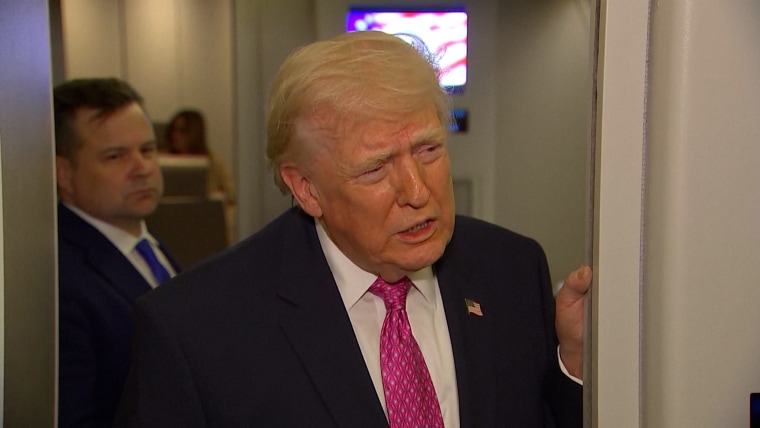
On Monday, approximately 15 minutes before President Donald Trump posted that there had been “productive” talks with Iran, stocks and oil futures trades on the main exchange run by longtime markets firm CME Group saw an unusual burst of volume compared to the relatively subdued backdrop seen the rest of that morning.

The bets predicted stocks would rise and oil prices would fall that day — precisely what happened once Trump made his announcement.

Depending on when they closed, the trades could have yielded millions — though shortly after Trump’s post, Iran denied there had been direct talks, and the market moves reversed somewhat.

Polymarket did not respond to a request for comment. A CME spokespersn declined to comment.

Solowiejczyk said the CFTC has likely been hampered by staffing shortages, which may be impacting its ability to take on new cases. Barron’s magazine recently reported that the CFTC has made significant cuts in its enforcement division, including the loss of all enforcement attorneys in its Chicago office.

It is not clear to what extent the anonymity that’s available to traders on Polymarket and Kalshi would hinder a federal investigation into illicit trading.

While part of Polymarket is registered in the U.S., making it subject to federal know-your-customer requirements, another part is registered in Panama — something that could make it harder to trace individuals making insider bets. Experts also say traders can circumvent geographic restrictions by using virtual private networks, or VPNs, that mask which country they are operating in.

So far, no American has faced federal charges in connection with insider trading on event-driven news. In February, Israel charged two of its military service members with using classified information to place bets on Polymarket related to unspecified combat operations.

Polymarket only recently began accepting trades from U.S.-based users, following an effort by the Trump administration to end a Biden-era push to restrict its use here.

Kalshi is fully registered in the U.S., and recently suspended an editor for influencer MrBeast in connection with alleged insider trading.

Many of the suspect bets on Polymarket are placed by accounts that are either new or solely focused on one specific outcome, further suggesting insiders could be behind them.

Even prior to the recent military operations and the accompanying suspicious bets, accusations of insider trading on Polymarket had begun to surface.

In January, a Polymarket user earned some $400,000 betting that then-Venezuelan President Nicolás Maduro would soon be out of office. One trader appeared to make approximately $1.2 million forecasting whom Google would announce as the most-searched people of 2025.

In response to a question about insider trading in November, Polymarket CEO Shayne Coplan told “60 Minutes” that “having an edge” is “a good thing.”

Coplan said that while he was focused on the ethics of insider transactions, it was “sort of an inevitability that this will happen, and there’s a lot of benefits from it.”

This week, Polymarket and Kalshi both unveiled measures designed to further crack down on insider trading.

Polymarket announced new rules explicitly stating users cannot act on insider information or trade on events whose outcome they could influence.

Kalshi said it was deploying technology that would “preemptively block politicians, athletes, and other relevant people” from trading in politics and sports markets. It also said it was adding a whistleblower function to its markets homepage that would allow users to flag potential violations.

A representative for Kalshi said the company has not been involved in the recent suspect trades. “We ban insider trading and enforce it,” a spokeswoman said in an email.

Polymarket, recently valued at $9 billion, counts Donald Trump Jr. as an investor. The president’s eldest son is also a strategic adviser to Kalshi, its top competitor.

White House representatives denied any wrongdoing originated from the administration and blasted insinuations that they were.

“All federal employees are subject to government ethics guidelines that prohibit the use of nonpublic information for financial benefit,” White House spokesman Kush Desai said in a statement.

“However, any implication that Administration officials are engaged in such activity without evidence is baseless and irresponsible reporting.”

“The President has no involvement in business deals that would implicate his constitutional responsibilities,” David Warrington, White House counsel, said in a statement. “President Trump performs his constitutional duties in an ethically sound manner and to suggest otherwise is either ill-informed or malicious.”

“Don does not interface with the federal government as part of his role with any company that he invests in or advises and has no influence or involvement with administration policies relating to prediction markets,” a representative for Donald Trump Jr. said in a statement.

Members of Congress have taken a more circumspect view of event-market platforms, putting forward legislation that would ban elected officials and government employees from using them and restricting the types of events, such as war or deaths, users can wager on.

The most recent bill, introduced by Sen. Chris Murphy, D-Conn., and Rep. Greg Casar, D-Texas, would ban trades on government actions, terrorism, war, assassination and events “where an individual knows or controls the outcome.”

“There’s no getting around the fact that any prediction market where somebody knows or controls the outcome of a bet is ripe for corruption,” Murphy said in a statement.

“Even worse, prediction markets are also an avenue by which government decisions get influenced by who’s making money off them, and that should be unforgivable to the American public,” he said.

President Donald Trump is used to bending financial markets to his will.

But with the war in Iran, he may have reached the limit of his ability to do so.

On Friday, the S&P 500 closed down 1.7% and notched its fifth-straight weekly decline, its worst stretch since 2022 and a sign of rapidly faltering confidence in a swift resolution to the Iran war.

Since the U.S. attacked Iran on Feb. 28, the S&P 500 has declined about 7%.

The Dow Jones Industrial Average fell 1.7% Friday and has lost nearly 4,000 points since the start of the war. It is now down more than 10% from its most recent high, a correction in technical terms.

The tech-heavy Nasdaq fell further into correction territory Friday, closing down 2% and off 13% since its record close in October.

Oil prices also rose sharply, with U.S. crude topping $100 a barrel and global Brent crude at approximately $114 at around 4 p.m. ET. The yield on the 10-year Treasury note surged to 4.4%, the highest since last summer. Some energy stocks, like Exxon, traded near all-time highs.

Shortly after stock markets had closed Thursday, Trump announced he was pausing attacks on Iranian energy sites for 10 days. But stocks barely budged.

Just days earlier, they had rocketed higher Monday when the president announced there had been “productive” talks with Iranian representatives, so he would pause strikes on Iranian power facilities for five days.

“The market is looking beyond commentary from the administration,” said Adam Turnquist, chief strategist at LPL Financial investment group, which manages nearly $2 trillion in assets. “They actually want concrete details and a resolution. And actions speak louder than words, that’s really present in [current] price action.”

This new reality stands in contrast to Trump’s ability to move markets throughout his first term and into the outset of his second.

Trump spent the better part of 2025 whipsawing traders via frequent changes regarding tariff levels. Eventually, a pattern emerged: The president would announce a new import duty, markets would fall, and Trump would usually end up reversing himself in some way.

The trend even got a nickname, coined by a columnist for the Financial Times: “TACO” — for “Trump Always Chickens Out.” (Last month, the Supreme Court struck down many of the tariffs.)

This time, the chain of events unleashed by Trump’s decision to attack Iran are such that a return to prewar conditions — and market levels — is virtually impossible in the short or even medium term, experts say.

The disruption to flows of oil and gas has been so substantial that transport costs, and ultimately the price paid per barrel, are likely to stay elevated indefinitely. Even when the Strait of Hormuz, which Iran has used as a chokepoint to drive concessions from the West, eventually reopens, the cost of transiting through it has likely gone up for the foreseeable future.

And the broader fallout on the economy and consumer purchases is already being felt.

That, in turn, has made interest rate cuts by the Federal Reserve less likely, because the higher oil costs are set to contribute to already sticky inflation. The odds of a rate hike before the end of the year have now outpaced the odds of a cut.

“Let’s say hostilities end tomorrow — the market will rally, but it’s not necessarily ripping back to where it was before because of the disruptions that have occurred,” said Steve Sosnick, chief strategist at Interactive Brokers financial group. “You’re not going to see oil go back to where it was immediately. You’re not going to see markets price in rate cuts the way they were before.”

White House spokesman Kush Desai said Friday that Trump “continues to be a powerful force driving the market’s confidence in the United States as the most dynamic, pro-business economy in the world.”

“Once the military objectives of Operation Epic Fury have been achieved and the market’s short-term disruptions are behind us, everyday investors are set to reap a windfall in a booming American economy,” Desai said.

A day earlier, the president said he was not concerned about the market’s recent performance.

Oil prices “have not gone up as much as I thought, Scott, to be honest with you,” he said during a Cabinet meeting, addressing Treasury Secretary Scott Bessent. “It’s all going to come back down to where it was and probably lower.”

Markets have not fallen further because the outlook for earnings growth remains bullish, Turnquist said — though that could change the longer the conflict drags on and further impinges on consumer spending and business investment.

And compared to prior oil shocks, the U.S. economy is less oil-intensive, as it has transitioned to one that is largely service-oriented. Global oil markets have also been supported by America’s oil production boom over the past decade — with more supplies online, overall prices are less likely to rise as much.

Yet by some metrics, stocks were already considered expensive prior to the hostilities. Having already contended with stretched valuations, traders may find it much harder to power stock prices back to the record levels seen just prior to the start of the latest conflict.

“The risk-reward is still very heavily weighted toward [the] risk” of further stock-price declines,” said Matt Maley, chief market strategist at Miller Tabak financial group.

Should hostilities persist, Trump’s ability to influence markets will only further erode, Sosnick predicted.

“He now realizes he’d like to jawbone his way out of it, but it’s not that easy at this point because the situation encompasses so many moving parts and difficult variables,” Sosnick said. “It doesn’t lend itself to a quick set of comments mollifying investors.”

CHICAGO – Dusty May’s youngest son wanted to keep playing basketball. Just like his dad once did.

Eli May had it all planned out. He was going to walk-on at South Florida, just like his eldest brother, Jack, did at Florida, and middle brother, Charlie, at UCF.

But then Michigan called two years ago. That’s when dad came up with another idea, similar to the one he plotted for himself 30 years earlier. Eli May could join his father’s new program as a student manager, just like Dusty May had given up his uniform at Division II Oakland City University to become a student manager under former coach Bob Knight at Indiana after one semester. 

“I didn’t necessarily want to take this path,” Eli May admitted earlier this week, and yet it now offers a fascinating glimpse into the mindset and demeanor his father employed to course-correct No. 1 seed Michigan so rapidly, with a chance to make the Final Four in his second season on the job with a win over No. 6 seed Tennessee in the Elite Eight on Sunday, March 29 at United Center. 

The student managers traveling with Michigan are among the only holdovers in the program from the previous regime. There are five of them in Chicago this week for the Midwest Region of the 2026 NCAA Tournament in addition to Eli May, each of whom started under former Michigan coach Juwan Howard. Most of them hope this leads to a career in basketball just as it did for Dusty May.

They arrive at practice and workouts before all the players, and rebound for them at whatever hour of the day they want to get shots up. They cut up game film for coaches and jump in with the scout team during practice. They keep stats and track opponents’ play calls during games. They also pick up towels and trash, drive coaches to the airport, make lunch runs and photocopies, and perform any other odd task that needs to be done around the program. 

None of them get paid, and yet no Division-I basketball team can run without them. This is what Dusty May had in mind when he suggested Eli think about joining the family in Ann Arbor rather than go to USF. 

“It’s obviously tough to give up playing the game and being on a team wearing a jersey,” Dusty May told USA TODAY Sports. “But I just thought as far as his long-term development, all the things our managers learn, problem-solving, they learn people skills. They learn to function. We try to give them a lot of responsibility because we know if they’re ever going to make it in coaching … they have to have the experience of doing meaningful work. Our managers have helped him become much more responsible.”

Those managers were also a little skeptical at first, still reeling from a tumultuous final season under Howard in which Michigan stumbled to one of the worst records in program history (8-24).

They are used to the coach’s son being around. Howard’s sons played for Michigan. Charlie May, meanwhile, became a walk-on at Michigan when his father was hired. The son of Michigan women’s basketball coach Kim Barnes Arico is also a graduate assistant for the men’s team this year.

Eli May, now a sophomore, arrived on campus the summer before the 2024-25 season when there weren’t many student managers around to help the players. He had no idea what he was doing and none of the other student managers talked to him much at first, unsure how to approach the coach’s son who wasn’t a player. He eventually won them over, partly because he had no choice. 

“Once you commit to something in our family,” Charlie May explained, “it’s go deal with it.”

“I’m technically in charge of him and he never complains,” student manager Sam Saraceno said. “Eli is doing grunt work a lot of people wouldn’t do. That’s how you could tell it was different.”

The student managers weren’t treated poorly before Dusty May came to Michigan, they all emphasized. They just feel seen more because May used to be one of them. 

They notice how he still picks up trash from the floor around the practice facility, and lugs water jugs back to the supply closet after practice. They relish when the 5-10 May spots student manager Ryan Levine six points in 1-on-1 games and proceeds to take him into the post for bucket after bucket. They value being included.

“If you were to ask any of us why we do this, the main answer that would come through is the love for the game and the want to be part of something bigger than ourselves,” student manager Cameron Gordon said. “You don’t become a student manager if you don’t have those developments, so while (May) is not a student manager anymore, that’s very authentically who he is and you see it in little things he’s said to us.”

But for the longest time, May didn’t want his youngest son to pursue coaching. He’d always be pitching ideas, Eli said. Become an athletic director, or a front office type, or even a ref. Anything but the grind May put his family through rising up the coaching ladder.

So when May first approached Eli about being a student manager two years ago, he also mentioned perhaps there would be an opportunity to join the program as a walk-on once Charlie moved on. It was the carrot that convinced Eli to give it a try.

But just like dad, he might never put on another jersey again.

“I’d seen the managers from the outside, but I’d never been inside a program and seen it. What they’ve learned, how they go about their business, it made me want to be a manager more than anything,” Eli May said. “I feel like it’s a much better path to becoming a coach eventually.”

SACARMENTO, CA — The Oklahoma women’s basketball team upset South Carolina in the regular season, but the Gamecocks got the last laugh in the Sweet 16. 

No. 1-seeded South Carolina defeated No. 4 Oklahoma 94-68 in a wire-to-wire victory in the 2026 Women’s NCAA Tournament on Saturday, punching the Gamecocks’ ticket to their sixth consecutive Elite Eight appearance. 

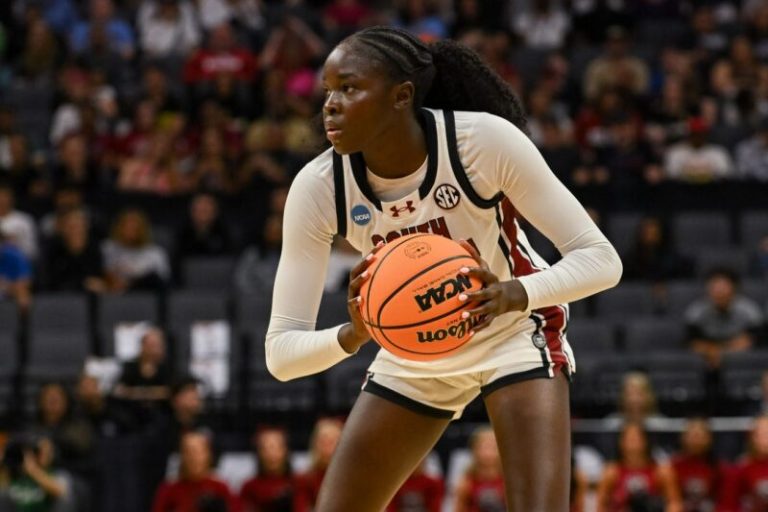
The win was a total team effort for South Carolina, who had three players finish in double digits. Ta’Niya Latson led the way with a game-high 28 points in the first Sweet 16 appearance of her career, going a perfect 4-of-4 from the 3-point line. Raven Johnson finished with 18 points, Tessa Johnson added 14 points and Agot Makeer had 10 points off the bench.

The Gamecocks shot 51% from the field and 10-of-14 (71%) from the 3-point line, marking the team’s best performance from beyond the arc all season. 

Oklahoma freshman guard Aaliyah Chavez had 21 points in the losing effort.

USA TODAY Sports is providing live updates and highlights from Saturday’s matchup. Here’s all the highlights and score updates from South Carolina vs. Oklahoma’s Sweet 16 battle:

Madina Okot hits rebound milestone

South Carolina center Madina Okot has passed A’ja Wilson for second all-time on South Carolina’s single-season total rebounds list. Her 12 rebounds so far bring her total to 394, three more than Wilson. Okot’s inside presence has been a key factor in the Gamecocks’ dominant performance over Oklahoma and its star center Raegan Beers, who has eight rebounds. 

Indiana Fever center Aliyah Boston holds the South Carolina women’s basketball single-season rebounding record of 447, set during the 2021-22 season. − Dylan Clearfield 

End of Q3: South Carolina 68, Oklahoma 49

South Carolina led by as many as 25 points and the Gamecocks carry a 19-point lead into the fourth quarter. Three South Carolina players are in double digits, led by 18 points each from Raven Johnson and Ta’Niya Latson. Tessa Johnson scored 11 of her 14 points in the third quarter.

Oklahoma started to find its offensive rhythm in the frame, but couldn’t put together stops to slow down South Carolina. Aaliyah Chavez has a team-high 14 points for the Sooners.

Tessa Johnson heats up in third quarter

The first half belonged to South Carolina guards Ta’Niya Latson and Raven Johnson, but the third quarter has belonged to Tessa Johnson, who scored nine of her 12 points in the first five minutes of the frame. Tessa Johnson is shooting 5-of-6 from the field including 2-of-2 from the 3-point line. South Carolina has a 62-38 lead over Oklahoma with 5:07 remaining.

Halftime: South Carolina 47, Oklahoma 28

South Carolina has a 19-point lead over Oklahoma heading into halftime. It may the first Sweet 16 appearance of Ta’Niya Latson’s career, but you would never be able to tell. Latson has a game-high 18 points.

Raven Johnson is on pace for a career night with 16 points on 7-of-9 shooting from the field including 2-of-3 from 3. Her career-high is 22 points against Louisiana State earlier this month on March 7.

South Carolina has held Oklahoma to 33% from the field and 2-of-9 from the 3-point line. No Oklahoma player has reached double digits in scoring.

Chloe Kitts wears Tessa Johnson hoodie

Gamecocks senior Chloe Kitts, who is out with an injury, made a subtle but meaningful statement on the sideline during South Carolina’s warmups, wearing a hoodie that reads “Who can guard Tessa?” What started as a viral line from LSU coach Kim Mulkey has quickly turned into a full-blown movement centered around Tessa Johnson. First appearing on a T-shirt, and now a cream hoodie, the outfit is small gesture that speaks volumes, turning an inside joke into a symbol of team unity. 

The Gamecocks, though, might need a new shirt after this game: “Who Can Guard Raven?” Raven Johnson already has 16 points on 7-of-9 shooting. − Erin Kirby

South Carolina winning rebound battle vs. Oklahoma

Oklahoma entered the game at second in the nation in rebounds per game (48.7). But midway through the second quarter, South Carolina is winning the rebound battle 18-12. Senior center Madina Okot leads the charge with seven boards. The Gamecocks rank 10th nationally in rebounds per game (42.3). − Dylan Clearfield

South Carolina goes on 5-0 run

South Carolina opened the second quarter against Oklahoma on a 5-0 run to extend its lead to a game-high 15 points.

End of Q1: South Carolina 23, Oklahoma 13

South Carolina got off to a hot start and led by as many 12 points in the first quarter. They have a double-digit lead heading into the second quarter. 

Raven Johnson (9) and Ta’Niya Latson (8) combined for 17 of South Carolina’s 23 first-quarter points. South Carolina is outrebounding Oklahoma 17-7. Madina Okot is already up to seven rebounds. 

Aaliyah Chavez leads Oklahoma with seven points. The Sooners struggled to find their rhythm in the first quarter. They shot 32% from the field and 1-of-5 from the 3-point line. 

South Carolina goes on 10-0 run

The Sweet 16 battle between South Carolina and Oklahoma is underway at Golden 1 Center in Sacramento, California. Ta’Niya Latson got South Carolina on the board with a fading jumper and knocked down a 3-pointer to give the Gamecocks a 5-0 lead. A Raven Johnson layup and three made free throws from Latson stretched South Carolina’s lead to 10-0 with 7:22 left in the first quarter.

Oklahoma missed their first five field goals to open the game.

What time is South Carolina vs. Oklahoma Sweet 16 game?

The No. 1 South Carolina Gamecocks will face off against the No. 4 Oklahoma Sooners in the Sweet 16 round of the 2026 Women’s NCAA Tournament at 5:00 p.m. ET on Saturday, March 28 in Sacramento, California. 

  • Date: Saturday, March 28
  • Time: 5:00 p.m. ET (2:00 p.m. PT)
  • Location: Golden 1 Center (Sacramento, CA)

South Carolina vs. Oklahoma: TV, streaming

  • Stream: ESPN Unlimited

South Carolina starting lineup

Head coach: Dawn Staley

  •  00 Ta’Niya Latson | G 5-8 –  Senior
  •  5  Tessa Johnson | G 6-0 – Junior
  •  8  Joyce Edwards | F 6-3 – Sophomore
  • 11 Madina Okot | C 6-6 –  Senior
  • 25 Raven Johnson | G 5-9 –  Senior

Oklahoma Sooners starting lineup

Head coach: Jennie Baranczyk

  • 2 Aaliyah Chavez | G 5-10 – Freshman
  • 3 Zya Vann | G 5-9 – Sophomore
  • 6 Sahara Williams | F 5-11 – Junior
  • 12 Payton Verhulst | G 6-1 –  Senior
  • 15 Raegan Beers | C 6-4 – Senior

A’ja Wilson compliments Raven Johnson

South Carolina alum A’ja Wilson said senior guard Raven Johnson “doesn’t get talked about enough” during a recent interview with ESPN’s Sean Hurd.

“We’re talking about somebody that can count on her hand how many times she’s lost,” Wilson said. “To see her just weather storms – like when people would talk about her – she’s showing up the next season, like, heard you. That type of stuff is what really is amazing to me when it comes to Ray. I’m so grateful to watch her grow. I’m grateful to see her thrive.”

South Carolina takes the court

It’s almost showtime at Golden 1 Center in Sacramento, California.

Who won South Carolina-Oklahoma regular season matchup?

South Carolina women’s basketball is out for revenge.

Oklahoma handed South Carolina its second loss of the season on Jan. 22, when freshman Aaliyah Chavez led the Sooners to a 94-82 overtime victory in Norman, Oklahoma. Chavez scored 15 of her game-high 26 points in overtime, including four 3-pointers to seal the Sooners third-ever win against an AP top 2 opponent.

South Carolina can get the last laugh on Saturday in the Sweet 16 round of the 2026 Women’s NCAA Tournament. The Gamecocks has surpassed the 100-point mark in the first two games of the tournament against No. 16 Southern and No. 9 USC. Joyce Edwards is averaging a near double-double, averaging 25 points and nine rebounds through two games. 

Meanwhile, Oklahoma blew out No. 13 Idaho 89-69 and survived a close 77-71 win over No. 5 Michigan State in the second round. Raegan Beers had 18 points and 14 rebounds in Oklahoma’s second-round win.

South Carolina Gamecocks roster

Oklahoma Sooners roster

Reach USA TODAY National Women’s Sports Reporter Cydney Henderson at chenderson@gannett.com and follow her on X at@CydHenderson.

The USA TODAY app gets you to the heart of the news — fast. Download for award-winning coverage, crosswords, audio storytelling, the eNewspaper and more.

Following Texas women’s basketball’s uninspired 86-70 loss to Vanderbilt in February, head coach Vic Schaefer publicly called out his squad. The challenge led to some hard conversations between the Longhorns. 

“We had to come back to drawing board. What’s our goals for the season? What do we want out of this season too? What are we doing?” junior forward Madison Booker recalled to USA TODAY Sports. “Our veteran leader, Rori (Harmon) stepped up and said, ‘The center’s the center here, so we need to do better.’”

Booker said the reset “got us clicking at the right moment.” That’s not an understatement. Texas has responded with ten consecutive wins, including an SEC championship victory over South Carolina, and two wins in the 2026 Women’s NCAA Tournament. Texas is now one win away from their third consecutive Elite Eight appearance. 

No. 5 Kentucky stands in their way. 

40 POINTS, 0 MISTAKES: Madison Booker dominates as Texas women advance to Sweet 16

Booker, however, enters the Sweet 16 round of the Women’s NCAA Tournament March Madness round extra motivated. Booker reached the Elite Eight her freshman year and advanced to the Final Four her sophomore season, before falling short of the ultimate goal of winning Texas’ first national title since 1986 each time.

“Just keep pushing,” said Booker, who dropped a career-high 40 points in Texas’ second-round win over No. 8 Oregon. “It definitely pushes you a lot just because you know how far you can get, the work you put in and you know what you could have did better those last two years… we learned from it.”

Booker finished with eight rebounds and five assists in Texas’ second-round win, but the biggest assist has come from TurboTax. Booker spoke to USA TODAY Sports ahead of March Madness through her partnership with the company, which helps student-athletes navigate the tax side of NIL earnings to allow the All-American to “just focus on the court, more than I focus on my taxes,” Booker joked.

Questions and answers have been lightly edited for length and clarity.

Q: Texas will be able to stay in the state for the Sweet 16 and the Elite Eight (in the Fort Worth regional 3 bracket). How big of an advantage is that for you guys to stay so close to home?

Booker: “It’s a big advantage. I mean, our fans are amazing and I’m happy that we can reward them with staying in Texas too. So they won’t have to travel far to come see us play… I mean we play hard. I guess we get the No. 3 seed to stay in Texas, so that’s all kind our hard work.”

Q: Texas has been through a gauntlet this season and the SEC, especially with your schedule, how has that prepared you for the tournament?

Booker: “The SEC I think is one of the best conferences in the world for basketball, for sure. But I feel like other conferences are so different from the SEC. SEC is much more physical and a little quicker… I feel like if we’ve been through the war already. When we play teams outside of SEC, we can definitely use the physicality and the speed to our advantage, pressure the ball more. We’ve had games where we had to play some good defense and we’ve done it before. So we have the film, we have the losses. We’ve learned from that of course. And I think we just can use that to our advantage.”

Q: During the SEC Tournament semifinal game against Ole Miss game, there was a clip of you in the huddle, speaking to your teammates. Do you feel like your leadership has evolved over the course of the season?

Booker: “I think it has. I watched Rori (Harmon) a lot, just being a leader and I just kind of stood there. So I kind of just found myself coming to conferences, be more vocal with my team. They already told me that they would listen to me. So yeah, I definitely just used it for positive vibes, just like an extra push. So the Ole Miss game (on March 7), I just felt like Ole Miss had a great… fourth quarter. And my whole message to him was just, ‘Hey, we’re good. We’re still by two. Let’s settle down. Let’s think about what happened and let’s reset and move forward.’ And I think that’s just my whole mentality with being a leader. It is just a game right now. Let’s just keep playing. Let’s not turn into many mistakes.”

Q: How has it been stepping into that role of being a more vocal leader if it hasn’t always come natural. How have you felt comfortable doing that?

Booker: “It hurts my vocal chords, honestly. I’m not a big talker at all, but I can tell when I do talk, it definitely spreads throughout the team. It is higher energy, it’s much more talking. I think we started having fun with then everybody started talking. Practice is fun, games are fun. I mean, we’re winning. I think we’re clicking the right times, we’re making shots, we’re playing great defense. But yeah, it kind of just changes when it’s just not one person talking with more than one person talking.”

Q: You and Rori (Harmon) have formed a one-two punch this season and she’s playing in her final March Madness tournament. What has she meant to this team and what do you think she’ll bring to a WNBA team?

Booker: “Oh my gosh. She has meant so much to this program and university. I think Rori (Harmon’s) standard, the standard she has for herself on defense especially, I don’t think anybody else in the country has that standard. She wants to guard the best player… If you’re the best player on the team, if you say you’re best friend in the country, she wants to guard you. And when I came here, I looked up to her because her mentality, the standard here, her work ethic is off the charts. And I think that’s something that people really don’t see. They just see her playing defense and her getting steals and breaking records, but she’s literally the energy of this team. When she goes, we go. When her defense is on point, I think we’re one of the best teams in the country.

But for a WNBA team, I think people would love to have her. I mean, she’s literally a point guard. Point God, I would say. She could do anything on the court. She can get your team going. She can play defense and she just don’t get herself going, but she has a team going. That’s the impact she has as a player. But I think any W team would love to have her.”

Q: What has Coach Vic Schaefer meant to you guys during this time?

Booker: “He’s teaching you life. Life is sometimes not fair. He teaches about hard work, hard get you anything you want in life with basketball, but you’re always in the gym. The game will reward you some type of way. But yeah, he is those things. He works hard. He has a passion for the game. He never takes a day off and it’s rewarding him. I think he might be a Hall of Fame coach one day, honestly, for college basketball. But yeah, he’s meant a lot. He’s taught a lot of lessons. My favorite phrase from him is that’s how life is y’all and that is how life is. But no, he’s meant a lot. He’s a great coach. I don’t regret coming here at all. And hopefully I can win him a national championship.”

Q: What would it mean to bring a national championship to Texas for the first time? And like you said, 40 years, what would that mean to you?

Booker: “A lot. I would love to see 2026 up there on the practice wall or in the Moody Center. It would just speed a cherry on top. I feel like we worked so hard this season. I feel like y’all watch us play and y’all like, gosh, you didn’t even get tired. I was pressing 40 minutes. But I don’t think y’all see how hard we work out. Our conditioning days are before the season. How many times we’re in the gym, how many hours we’re in the gym. We are working so hard just for that end goal. And I think it would just be a sign or a pat on the back, like, “We did it, y’all.”

Q: You became the first athlete to sign with Kevin Durant as collaboration with Nike and Texas. What was it like working with Durant as someone who’s literally been in your shoes?

Booker: “It is still surreal. I can’t believe that really happened… Signing with my favorite player, his shoe deal and stuff like that, that means a lot. I love wearing KDs. I wear ’em all the time. But yeah, just for him to also take notice and pick me before his starter, it means a lot. I have no words honestly. It is a lot.”

Q: Has Kevin Durant given you any tips or advice for the tournament or anything that you want to use?

Booker: “His words is just go take it. They go give it to you. Go take it. That’s literally what he just said the other day to me.”

Reach USA TODAY National Women’s Sports Reporter Cydney Henderson at chenderson@gannett.com and follow her on X at@CydHenderson.

The USA TODAY app gets you to the heart of the news — fast. Download for award-winning coverage, crosswords, audio storytelling, the eNewspaper and more.

HOUSTON — The Illinois men’s basketball team was in the airport in Champaign, Illinois, preparing to board a flight to Houston for the NCAA Tournament regional, when Illini freshman forward David Mirkovic made a prescient purchase.

Mirkovic’s teammate, Keaton Wagler, sent him a link to an artificially generated photo of Mirkovic wearing a black cowboy hat. It was meant as a joke, but Mirkovic found a similar looking hat on Amazon and ordered it for $34. It was delivered to the Illini’s hotel in Houston on Friday, the day before Illinois played Iowa in the Elite Eight.

Mirkovic only intended to wear the hat if the Illini won. They did, 71-59, and after the team celebrated in the locker room by spraying each other with water guns – a program tradition that began two years ago in the NCAA Tournament – Mirkovic proudly donned his new headwear.

Asked if he felt like a cowboy, the Montenegro native paused and replied, “I don’t know. What does it mean, being a cowboy?”

He paused and reconsidered: “Yeah, why not. We’re in Texas.”

Mirkovic scored nine points and had a team-high 12 rebounds in Illinois’ Elite Eight win, coming just one point shy of his second consecutive double-double. He was still named to the South Regional All-Tournament team and his performance helped Illinois advance to the Final Four, where it will play either Duke or Connecticut.

None of Mirkovic’s Illini teammates joined him in buying cowboy hats, but he retained hope that he could start a new NCAA Tournament tradition.

“Maybe for next season,” he said, smiling.

The Milwaukee Bucks have officially been eliminated from NBA playoff contention for the 2025-26 season.

The franchise had not missed the playoffs since the 2015-16 season but will now instead land in the NBA draft lottery.

Center Myles Turner and the Bucks fell to 29-44 on the season after losing 127-95 to Victor Wembanyama and the San Antonio Spurs on Saturday. Milwaukee is 11th in the Eastern Conference standings as of Saturday afternoon.

“It’s been disappointing, obviously,” Bucks coach Doc Rivers told reporters. “Since I’ve been here, I haven’t had a healthy stretch and it’s been your key guys. It’s been (Giannis Antetokounmpo). It’s been (former Bucks guard Damian Lillard). And you hope you can play through that, but we just haven’t had the ability.”

The Bucks waived Lillard before the season, and the team has been playing chunks of this season without Antetokounmpo.

Antetokounmpo has not played since March 15, and the team has won just one of its last six games in the absence of its star player.

Rivers added that he believes his team is playing at a deficit with “only one quote-unquote star” while “every other team has two and three.”

The team made additions to the roster, acquiring Turner in the offseason, in an attempt to produce a winner, but the team continued to be plagued by injuries this season.

“We needed health,” Rivers said. “We were thin. We knew that before the season started, and it just didn’t go our way. All the talk and all that stuff probably didn’t help, either.”

“The talk” was presumably alluding to Antetokounmpo’s future with the franchise. The team officially out of the playoff picture will only fuel more speculation about Antetokounmpo’s future with the team.

Bucks co-owner and governor Wes Edens told ESPN that the Bucks will likely pursue one of just two outcomes regarding Antetokounmpo this offseason: either the team will sign the star to another extension, or he will be traded. Antetokounmpo is eligible for a contract extension on Oct. 1.

Rivers has tried to see the silver linings this season, starting with some of the younger players on the roster, including Ryan Rollins, Pete Nance and Ousmane Dieng.

Rivers also credited Bobby Portis for his effort in a leadership role this season.

“He’s been a pro throughout this year,” Rivers said. “We had a great talk today about it before the game. I’m just so proud of him as a leader. He tries to do the right stuff.”

A federal judge in California has blocked the Trump administration from designating Anthropic as a supply chain risk to national security and cutting off the AI company’s work with federal agencies.

Anthropic sued the Defense Department and other federal agencies this month after the Pentagon labeled it a “supply-chain risk to national security.” President Donald Trump said he would also ban the use of Anthropic’s products across other federal agencies.

“Defendants’ designation of Anthropic as a ‘supply chain risk’ is likely both contrary to law and arbitrary and capricious,” U.S. District Judge Rita Lin of Northern California wrote in her order Thursday night. “The Department of War provides no legitimate basis to infer from Anthropic’s forthright insistence on usage restrictions that it might become a saboteur.”

Lin paused her order for a week to allow the administration time to appeal.

The Defense Department and the White House did not immediately respond to a request for comment Thursday evening.

“We’re grateful to the court for moving swiftly, and pleased they agree Anthropic is likely to succeed on the merits,” an Anthropic spokesperson said in a statement Thursday. “While this case was necessary to protect Anthropic, our customers, and our partners, our focus remains on working productively with the government to ensure all Americans benefit from safe, reliable AI.”

The supply chain risk designation requires the Pentagon and its contractors to stop using Anthropic’s commercial AI services for all defense business.

Defense Secretary Pete Hegseth said on X in late February that he was issuing a directive to give the company the “supply chain risk” label. Trump also said he was ordering all federal agencies, including the Treasury and State departments, to cease using Anthropic’s AI technology.

“The record reflects that the Challenged Actions were taken without any meaningful notice or pre-deprivation process (and, in the case of the Presidential Directive and the Hegseth Directive, without any post-deprivation process either),” Lin wrote in her order.

The order Thursday also bars other agencies from cutting off their work with Anthropic. Lin wrote that the order restores the status quo.

“This Order does not require the Department of War to use Anthropic’s products or services and does not prevent the Department of War from transitioning to other artificial intelligence providers, so long as those actions are consistent with applicable regulations, statutes, and constitutional provisions,” the order said.

Anthropic filed two lawsuits against the Defense Department — one in U.S. District Court for Northern California and the other in U.S. Circuit Court of Appeals for Washington, D.C. — alleging that the federal government’s moves go beyond a normal contract dispute and instead are an “unlawful campaign of retaliation” that followed months of heated negotiations about how the military should be able to use Anthropic’s AI systems.

Anthropic had sought stronger guarantees that the Pentagon would not use its AI systems for autonomous weapons or mass domestic surveillance.

Anthropic is the creator of the Claude chatbot system and the only AI company whose services were cleared for use on the Defense Department’s classified networks.

Hours after Hegseth’s announcement last month, OpenAI CEO Sam Altman said his company had reached an agreement with the Pentagon to use its services in classified settings.

Lin wrote: “Although Anthropic was on notice that the government objected to its contracting terms, it had no notice or opportunity to object before Defendants publicly barred it from all federal government work and blacklisted it with private companies working with the U.S. military. It also had no notice or opportunity to object to the factual basis for its designation as a supply chain risk, which it learned of in this litigation.”

Federal authorities are investigating a close call this week involving a military helicopter and a United Airlines plane approaching John Wayne Airport in Santa Ana.

United Airlines Flight 589 was approaching the airport in Orange County around 8:40 p.m. Tuesday when a Sikorsky Black Hawk helicopter crossed its path, according to the Federal Aviation Administration.

Pilots on the United Airlines plane were advised by air traffic control to watch for the military helicopter flying near the airport, United Airlines said.

“They saw the helicopter, and also received a traffic alert, which they responded to by leveling the aircraft,” United said.

The United flight with 162 passengers and six crew members landed safely.

The new investigation comes a week after the FAA issued a new airport safety order designed to improve safety near airports where helicopters cross both arrival and departure paths. The order suspends use of visual separation between airplanes and helicopters and requires air traffic controllers to use radar to manage lateral and vertical separation between aircraft.

A close call earlier this month between a twin-engine Beechcraft 99 and helicopter at Hollywood Burbank Airport was cited by federal authorities as a key factor behind a new airport safety measure.

In another example, the agency said American Airlines Flight 1657 was cleared to land at San Antonio International Airport when a police helicopter was on its final approach path. The helicopter turned to avoid the American Airlines plane, the FAA said.

The new requirement applies to more than 150 of the nation’s busiest airports and extends a restriction already in place at Ronald Reagan Washington National Airport.

The upgraded safety measure was rolled out after a year-long FAA safety team review. In a news release, the FAA also referenced the Jan. 29 American Airlines jet and Army Black Hawk crash that killed 67 people. A key factor in the crash was the placement of a helicopter route in the approach path of Reagan National Airport’s secondary runway, the NTSB board said, also identifying air traffic controllers’ over reliance on asking helicopter pilots to avoid other aircraft as a factor.

WASHINGTON — The Senate agreed unanimously early Friday to fund the Department of Homeland Security, but without funding for immigration enforcement and deportation operations.

Senators approved the package at 2:20 a.m. by voice vote following a marathon session.

The 42-day funding lapse has seen them go without pay, leading many to call out of work and causing long lines at airports. While the measure still needs to pass the House, the Senate vote paves the way to allow airports to fully function again.

The legislation would fund all of DHS except Immigration and Customs Enforcement and Customs and Border Protection, which Democrats have refused to vote for without significant reforms to immigration raids and deportation practices.

The deal followed arduous bipartisan negotiations that occurred in fits and starts over the last six weeks, succumbing to the impasse around policy changes to immigration enforcement. Under the new plan, Democrats get their weeks-long demand to fund the department with the exceptions of ICE or CBP, but also without the restrictions they sought on how immigration officers may conduct operations.

“This could have been done three weeks ago,” Senate Minority Leader Chuck Schumer, D-N.Y., said. “This is exactly what we wanted.”

Long wait lines at a TSA checkpoint at New York’s LaGuardia airport Friday.Gabrielle Korein / NBC News

The bill faces an uncertain future in the Republican-controlled House. It is expected to have President Donald Trump’s support, which could help corral conservatives who have been skeptical about splitting off ICE funding from the underlying bill.

“Hopefully they’ll be around, and we can get at least a lot of the government opened up again, and then we’ll go from there,” Senate Majority Leader John Thune, R-S.D., said of the House and a potential vote on Friday. He said he texted with Speaker Mike Johnson, R-La., on Thursday night.

The Senate adjourned for a two-week recess, leaving the House with few options other than to accept their bill as written.

Thune separately blamed Democrats. “President Trump should never have had to step in to rescue TSA workers and U.S. air travel. We are here because, thanks to Democrats’ determined refusal to reach an agreement, there will be no Homeland Security funding bill this year.”

Speaking after the vote, Schumer said: “In the wake of the murders of Renee Good and Alex Pretti, Senate Democrats were clear. No blank check for a lawless ICE and Border Patrol.”

He added that the “long overdue agreement” funds TSA, the Coast Guard, the Federal Emergency Management Agency and the Cybersecurity and Infrastructure Security Agency, and “strengthens security at the border and the ports of entry, and keeps Americans safe.”

He added that the deal “could have been accomplished weeks ago if Republicans hadn’t stood in the way.”

The White House and Republicans declined to grant Democrats’ demands to restrict Trump’s immigration practices. They now plan to pursue the remainder for funding for ICE and CBP in a separate party-line bill, which they could also use to pass Iran war funding and elements of the Trump-backed SAVE America Act.

Senate Republicans held a vote open for hours Thursday as the two sides continued to negotiate, having traded offers for days.

Trump, meanwhile, announced earlier Thursday that he would instruct newly sworn-in Homeland Security Secretary Markwayne Mullin to “immediately pay our TSA Agents in order to address this Emergency Situation.”

That move may not be needed if the House passes the Senate legislation, according to a senior administration official, who said the White House is waiting to see what will happen.

This official also said the funds to pay TSA agents would come from the so-called One Big Beautiful Bill, the tax-cut and spending legislation Trump signed into law in July. It’s not clear exactly how that would work, but the administration has dipped into those unspent funds before to cover pay gaps during funding lapses.

The House can either debate and vote out the Senate-passed measures in the Rules Committee before bringing them to the floor under a simple majority vote, or Johnson can seek to fast-track it to the floor.

The House was set to hold an unrelated vote at 10 a.m. before leaving for recess.

We’d like to hear from you about how you’re experiencing the partial government shutdown, whether you’re a TSA agent who can’t work right now or a federal employee who is feeling the effects at your agency. Please contact us at tips@nbcuni.com or reach out to us here.

TSA officers missed their first full paychecks in mid-March, leading many to call out of work. Call-out rates for TSA officers have exceeded 11% nationally, with rates at some airports passing 40%.

Trump sent ICE agents to airports to help TSA earlier this week. Unlike TSA officers, ICE agents continue to receive paychecks during the partial shutdown as a result of funding from the so-called One Big Beautiful Bill, a sweeping GOP domestic policy package, that Trump signed into law last year.